
On this page
Two identical products sit on two identical pages. One shows a 4.4-star average from 40 buyers. The other shows nothing. The reviewed page will out-sell the blank one by a wide margin, and it will do it without a cent of extra ad spend, a redesign, or a discount code.
Reviews are the closest thing ecommerce has to a free conversion lever, and most stores under-use it. They sit on thin review counts, bury the star rating below the fold, delete every complaint, and never ask a happy customer to write a word. The research on what reviews do to buying behavior is unusually clear, so it pays to know the numbers before you decide how much effort to put in.
This post covers how much product reviews lift conversion, how they influence a buyer's decision, how many reviews it takes to build trust, which star rating converts best, how to collect more reviews, and how to handle the negative ones.
How much do product reviews lift conversion rate?
Product reviews can lift conversion rate by anywhere from roughly 50 percent to more than 250 percent, depending on how many reviews a page carries and whether shoppers actually engage with them. The range is wide because the size of the effect scales with review count, product price, and shopper behavior, not with any single fixed multiplier.
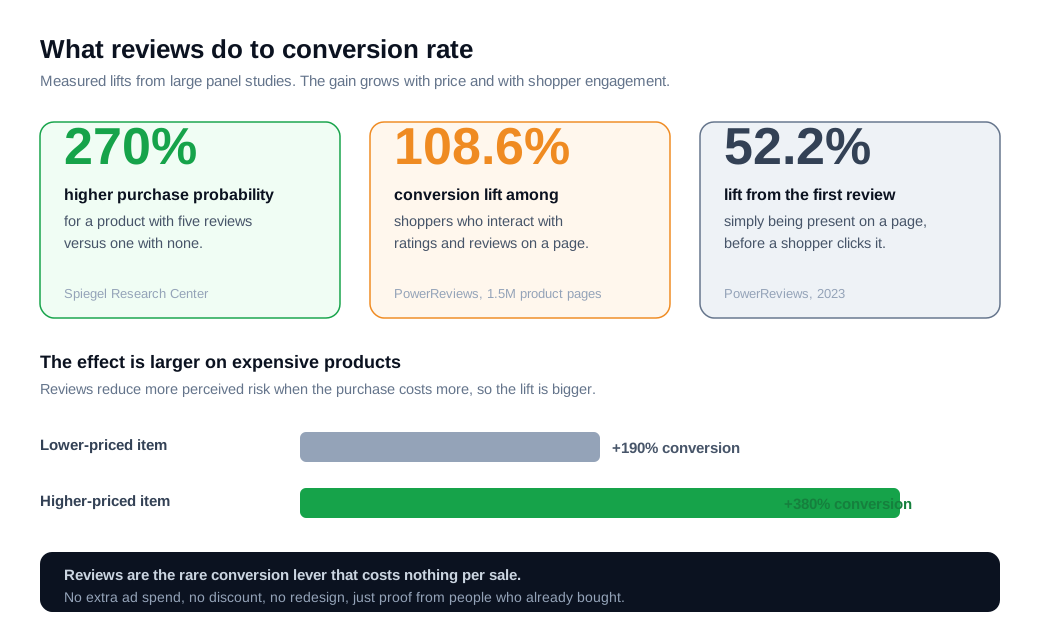
PowerReviews analyzed 1.5 million product pages across more than 1,200 brand and retailer sites and found a 108.6 percent lift in conversion among shoppers who interact with ratings and reviews on a page. The mere presence of reviews moves the number too. That same analysis found conversion rises 52.2 percent once a page has at least one review, before a shopper even clicks into the review content.
Northwestern University's Spiegel Research Center put a sharper figure on the volume effect. Its study of a housewares retailer found the purchase probability of a product with five reviews is 270 percent higher than the same product with none. Price changes the math further. When reviews were displayed, conversion rose 190 percent for a lower-priced product and 380 percent for a higher-priced one, because a review removes more perceived risk when the purchase costs more.
Here is a worked example. A product page draws 8,000 visits a month and converts at 1.5 percent with no reviews, which is 120 orders of a $60 item, or $7,200. Suppose collecting reviews on that page lifts its blended conversion by a conservative 40 percent, well below the headline figures above because not every visitor reads reviews. The rate moves to 2.1 percent, which is 168 orders, or $10,080. That is $2,880 a month from the same traffic, with no change to your ad budget. The lift compounds across every product page you review, which is why reviews reward being treated as a program rather than an afterthought.
How do reviews influence buying decisions?
Reviews influence buying decisions by supplying the social proof a shopper uses to lower the risk of a purchase they cannot touch, try on, or return without friction. Online, the buyer is guessing about fit, quality, and whether the photos are honest. Other customers' words are the evidence that closes that gap, and shoppers weight them heavily.
Half of consumers now trust online reviews as much as a personal recommendation from friends or family, according to BrightLocal's Local Consumer Review Survey. That is the mechanism at work. A stranger who bought the product and reported back carries nearly the same authority as a friend who did, because both have used the thing you are still deciding about.
Credibility inside the review matters as much as the star. The Spiegel study found that flagging a reviewer with a verified buyer badge, a small label confirming the person actually purchased, raised the odds of a sale by 15 percent. Shoppers discount reviews they suspect are planted, so proof of a real transaction does real work.
The influence peaks at moments of high intent, which is when a shopper is on the product page weighing the decision. That is also the moment a store can help directly. When a buyer is stuck on a question that reviews do not answer, a fast reply through something like live chat resolves the doubt before they leave, and reaching people at that peak of interest is the core of an inbound sales motion. Reviews and a live answer solve the same problem, which is a buyer who wants reassurance right now.
How many reviews build trust?
The first five reviews build most of the trust, and the returns shrink quickly after that. Getting a product from zero to a handful of reviews delivers a far larger conversion gain than getting it from fifty reviews to a hundred, which changes where a store should spend its collection effort.
The Spiegel data shows the marginal value of each new review dropping sharply once a product passes about five. That is why the jump from no reviews to five produces the 270 percent lift, while later reviews add little to purchase probability. PowerReviews found a related pattern on volume: pages with 11 to 30 reviews convert more than twice as well as pages with none, and the curve keeps flattening from there.
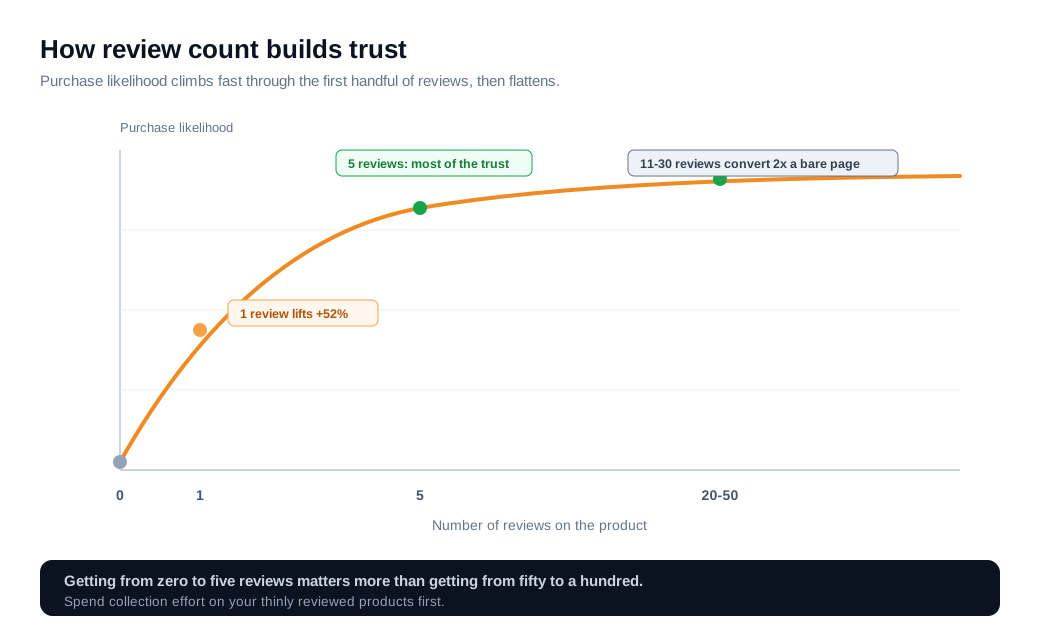
The practical read is to chase breadth before depth. A catalog where every product has five to twenty reviews will out-convert a catalog where a few hero products have five hundred reviews and the long tail has zero. Recency counts as well, because a shopper trusts a review from last month more than one from three years ago, so a steady trickle of fresh reviews beats a one-time burst that ages out.
For a store, that means prioritizing your thinly reviewed products. Pull a list of pages with fewer than five reviews and aim your collection at those first. The conversion gain from moving one product from zero to five reviews is the same regardless of whether the product is a bestseller, so the fastest wins usually sit in the neglected middle of the catalog.
What star rating converts best?
The star rating that converts best sits between roughly 4.2 and 4.5, comfortably short of a perfect 5.0. Both the Spiegel study and PowerReviews found that purchase likelihood peaks in that band and then dips as the average approaches a flawless five stars.
The reason is skepticism. A wall of nothing but five-star reviews reads as too good to be true, and shoppers start to suspect the store curated or planted them. As Spiegel research director Edward Malthouse put it, when consumers see all five-star reviews they become skeptical that there is some manipulation happening. A rating that includes a few threes and fours looks like what real customer opinion actually is, which is mostly happy with some honest gripes.
This flips a common instinct. A store chasing a 5.0 average by suppressing anything critical is trading a believable page for a suspicious one. A 4.4 with visible imperfections converts better than a 4.9 that looks staged, so the goal is an authentic average rather than a pristine one. That principle carries straight into how you deal with the reviews you would rather not show.
How do you collect more reviews?
You collect more reviews by asking every buyer at the right moment, making the task a single click, and automating the request so it fires on every order. Left to chance, only a small slice of customers write anything, so the volume you get is mostly a function of how deliberately you ask.
Timing is the biggest lever. For most physical goods, a request sent 7 to 14 days after confirmed delivery works best, because the customer has had time to use the product and form a real opinion. Ask before the box arrives and you get frustration; ask months later and you get silence. Slow-result products like skincare or supplements need a longer wait, often 21 to 30 days, before the customer has anything to report.
A few practices raise the response rate on top of good timing. Keep the request short enough to read in ten seconds and answer in one click, and send it to a mobile-friendly form. Prioritize repeat and higher-spend customers, who tend to have stronger opinions and reply more often. Yotpo's guidance on asking for reviews in ecommerce stresses that a single, well-timed, low-effort ask beats a long survey, and that automating the send so it happens after every purchase is what turns a trickle into a steady stream.
Here is a worked example. A store ships 2,000 orders a month and sends an automated review request 10 days after delivery. At a 6 percent response rate, a realistic figure for a clean one-click flow, that is 120 new reviews a month. Spread across a 50-product catalog, most products clear the critical first-five-reviews threshold within a quarter, which is exactly where the conversion lift is steepest. The same store relying on unprompted reviews might see well under 1 percent of buyers write anything, leaving most pages bare.
How do you handle negative reviews?
You handle negative reviews by responding fast and in public, fixing the underlying problem, and leaving the review up rather than deleting it. A visible complaint with a good reply builds more trust than a page scrubbed clean, because shoppers do not believe the clean page.
The response is where the trust is won. BrightLocal found that 88 percent of consumers will choose a business that responds to all its reviews over one that ignores them, which just 47 percent would pick, and 89 percent of consumers read the businesses' replies. A calm, specific, non-defensive answer that names the issue and offers a real remedy tells the next shopper how you treat problems, which is often more persuasive than the complaint is damaging.
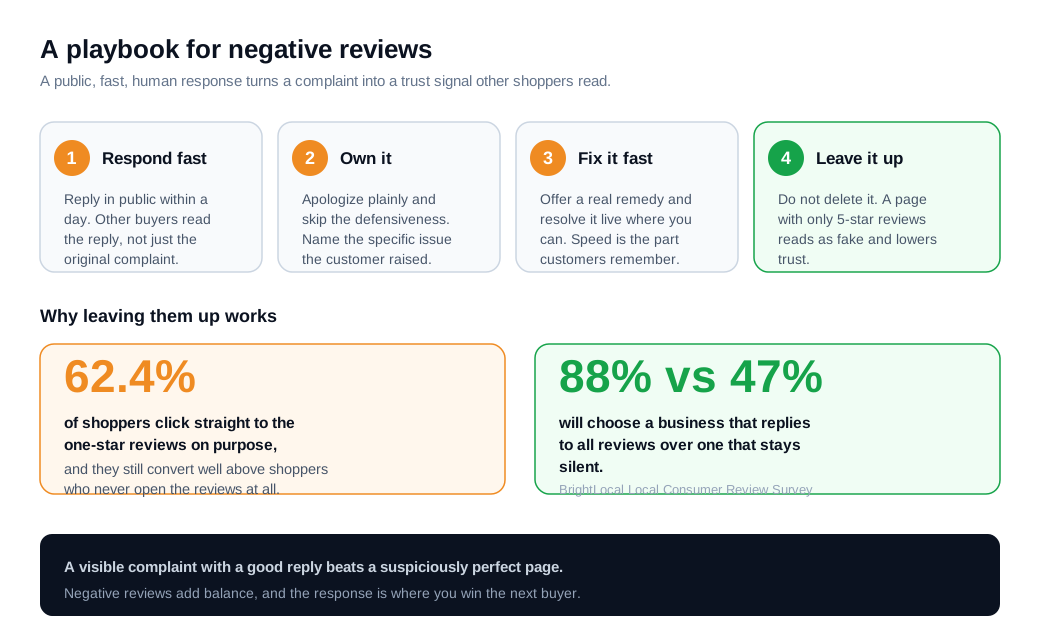
Deleting negative reviews backfires, because shoppers actively hunt for them. PowerReviews found 62.4 percent of shoppers seek out the one-star reviews on purpose, and those shoppers still convert at a higher rate than visitors who never open the reviews at all. A negative review adds the balance that makes the positive ones believable, and a product with zero criticism reads as filtered. The buyer who reads a fair complaint and your thoughtful fix is often closer to purchasing than the one who saw only praise.
Speed matters as much as tone. Answering a complaint in public within a day, and resolving the customer's issue directly through a channel like live chat when they are still engaged, tends to turn the reviewer around and shows every future reader that a problem here gets solved. The complaint you answer well becomes a selling point rather than a liability.
Key takeaways
- Reviews are a high-value, near-free conversion lever. Presence alone lifts conversion around 52 percent, engaged shoppers convert about 109 percent higher, and a product with five reviews is 270 percent more likely to sell than one with none.
- The lift is bigger on expensive products. Reviews raised conversion 190 percent on a lower-priced item and 380 percent on a higher-priced one, because they remove more perceived risk when more money is at stake.
- The first five reviews do most of the work. Returns shrink fast after that, so chase breadth across your catalog before depth on a few hero products, and prioritize pages with fewer than five reviews.
- Aim for an honest 4.2 to 4.5, not a perfect 5.0. Purchase likelihood peaks in that band, because an all-five-star page reads as manipulated and quietly lowers trust.
- Collect reviews on purpose. Automate a one-click request 7 to 14 days after delivery, prioritize repeat and higher-spend buyers, and a modest 6 percent response rate can clear a whole catalog's first-five threshold in a quarter.
- Answer negative reviews, do not delete them. Most shoppers seek out the one-star reviews and still convert, and 88 percent prefer a business that replies to every review, so a fast, public, human response turns a complaint into a trust signal.

Written by
Nilas MylerCo-founder & CTO, Glimpze
Nilas is the co-founder and CTO of Glimpze, an inbound sales tool that turns high-intent website visitors into live conversations. A former SEO consultant for some of the largest companies in Denmark, he writes about speed-to-lead, inbound sales, and conversion rate optimization — the technical and operational mechanics of turning traffic into pipeline.


