
On this page
A sales team can look busy and still be heading for a miss. Reps are logging calls, deals sit in the CRM, the forecast says the quarter is fine, and then three of the five deals everyone counted on slip a quarter or vanish. The activity was real. The read on it was wrong.
Closing that gap between motion and outcome is the whole job of a sales pipeline. Managed well, it tells you which deals are real, where they stall, and how much revenue you can actually bank. Managed loosely, it turns into a wish list with dollar signs attached. This post covers what a pipeline is, how it differs from a funnel, the stages most teams use, and the two habits that keep it healthy: keeping the math honest and running a disciplined review.
What is a sales pipeline?
A sales pipeline is a structured, visual snapshot of every active deal and the stage it occupies on the way from first contact to a signed contract. It lays out your sales process as a series of stages, then sorts each open opportunity into the stage that matches where the buyer actually is.
That single view does three jobs at once. A rep sees their own workload and what to do next on each deal. A manager sees where deals bunch up or go quiet. Leadership gets a revenue projection grounded in real opportunities rather than optimism. Both Salesforce and Zendesk describe the pipeline as the operating layer for a sales team, the place where deal status, dollar value, and next steps live in one frame instead of scattered across notebooks and inboxes.
The payoff for treating it as a process rather than a list is large. Research published in Harvard Business Review found that companies with a formal, well-run sales process grew revenue roughly 28 percent faster than companies without one, a gap the authors tied to disciplined pipeline management rather than headcount or luck (hbr.org). The reverse is just as real. When the pipeline is a loose collection of hopeful guesses, the forecast built on it swings wildly, capacity gets spent on deals that were never going to close, and the first sign of trouble arrives too late to fix.
What is the difference between a sales pipeline and a sales funnel?
A pipeline tracks individual deals and the actions a rep takes to move each one forward, while a funnel tracks conversion rates as a whole population of leads narrows from stage to stage. Same deals, two lenses.
The pipeline is the seller's operating view. It answers a practical question: which deals close this quarter, and what does each one need from me right now? It is measured in dollars and deal counts per stage, and reps and managers work inside it every day.
The funnel is the analyst's view. It answers a different question: where do leads drop off? It is measured in percentages, such as what share of leads becomes an opportunity and what share of opportunities becomes a proposal. RevOps and marketing use the funnel to find the leak, then fix the process that feeds the pipeline.
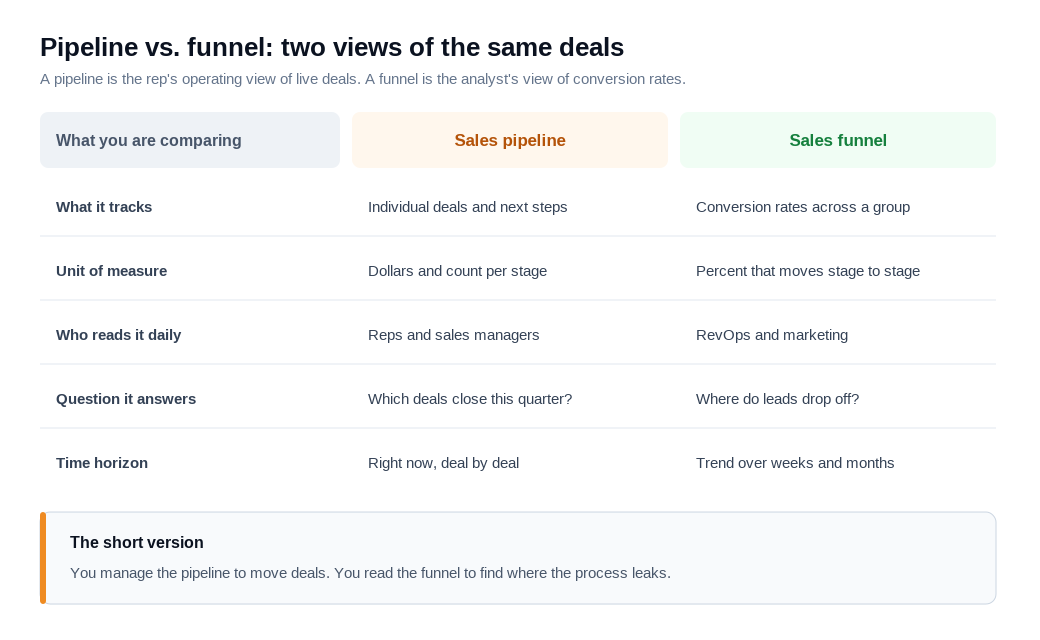
You need both. The funnel might tell you the process loses half its leads at qualification, a pattern no single deal would reveal. The pipeline tells you the specific opportunities in front of you and whether Thursday's proposal is going to land. Manage the pipeline to move deals; read the funnel to find where the process leaks.
What are the stages of a sales pipeline?
Most B2B pipelines run five to seven stages that mirror the buyer's journey, commonly prospecting, qualification, discovery, proposal, negotiation, and closing. The labels vary by company and the count depends on how complex your sale is, but the shape holds steady: wide at the top where leads enter, narrow at the bottom where deals close (Pipedrive).
Here is what each stage usually means:
- Prospecting. Identify potential buyers who fit your profile, through inbound interest or outbound outreach. The stage ends when a real lead exists to work.
- Qualification. Confirm the lead is worth a rep's time by checking budget, authority, need, and timeline. Weak-fit deals get disqualified here, which protects the rest of the pipeline from clutter.
- Discovery or meeting. Run a working session to map the buyer's problem and the people who will weigh in on the decision. The stage ends when both sides agree on the need.
- Proposal. Present pricing and scope tied to the value the buyer named, not a generic quote.
- Negotiation. Work through terms, objections, and any procurement or legal review that stands between agreement and signature.
- Closing. Sign the deal, or mark it lost and record why for later analysis.
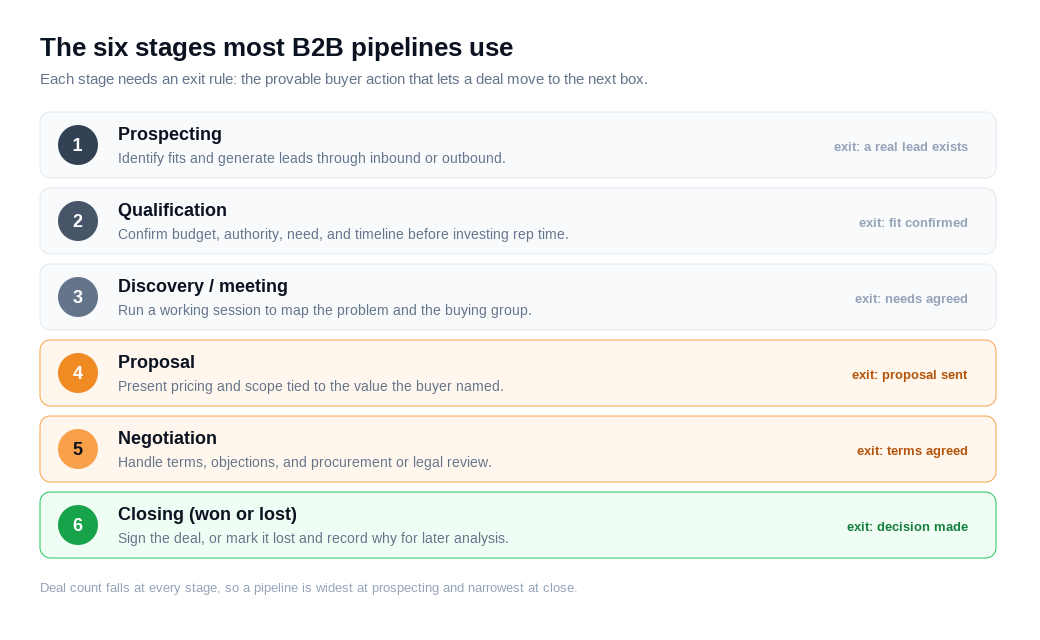
The part teams skip is the exit criterion for each stage: the specific, provable buyer action that lets a deal advance. "The buyer agreed to a paid pilot" is an exit criterion. "The rep feels good about it" is not. Without written criteria, two reps stage the same deal differently, the same opportunity reads as "proposal" for one and "negotiation" for another, and the forecast built on top becomes fiction. Define the action that moves a deal forward, write it down, and hold every deal to the same rule.
How do you keep a sales pipeline healthy?
You keep a pipeline healthy by watching a few numbers, coverage, velocity, and deal age, and acting on them before the quarter closes rather than explaining them after. A pipeline that looks full on Monday can still miss if the deals inside it are too few, too slow, or too stale.
Coverage asks whether you have enough pipeline to hit the number. Divide your open qualified pipeline by the quota for the period. Most B2B teams treat 3x to 4x as the healthy band, meaning three to four dollars of qualified pipeline for every dollar of quota, which leaves room for the deals that stall or fall out along the way (HubSpot, Salesmotion). If a rep carries a $250,000 quarterly quota and you target 3.5x coverage, they need about $875,000 of qualified pipeline open. Catching them at $400,000 in week two is an early warning you can still act on. Discovering the same gap in week eleven is a miss you get to report.
Velocity asks whether the pipeline is moving fast enough to land. The formula multiplies the number of qualified deals by average deal value and win rate, then divides by the average sales cycle in days: (deals times value times win rate) divided by cycle length (Dock).
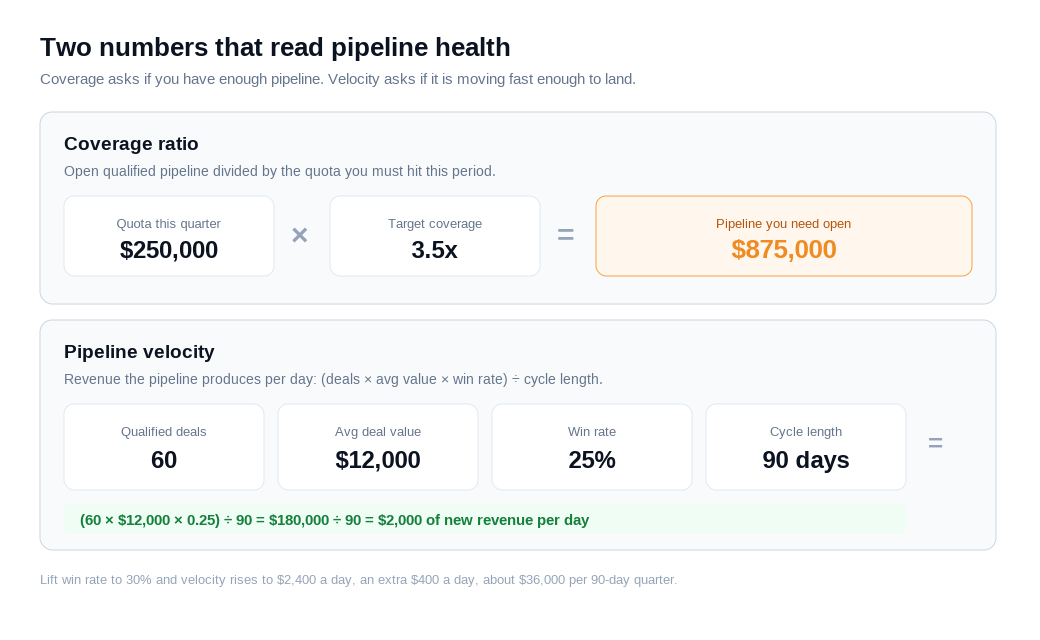
Work an example. A rep with 60 qualified deals, a $12,000 average value, a 25 percent win rate, and a 90-day cycle is generating (60 times $12,000 times 0.25) divided by 90, which is $180,000 over 90 days, or about $2,000 of new revenue per day. Velocity earns its keep by showing which lever pays. Lift the win rate from 25 to 30 percent and daily velocity climbs to $2,400, an extra $400 a day and roughly $36,000 across a 90-day quarter from the exact same set of deals. Shorten the cycle or raise average deal size and the same math rewards you again.
Deal age catches the stall that coverage and velocity can hide. A deal with no logged call, email, or meeting for about two weeks is effectively inactive, whatever stage the CRM still shows (Outreach). Track stage age, the days a deal has sat in its current stage, not just total age, because a deal parked in "proposal" for 40 days is a sharper distress signal than one that has simply been open a while. Set a threshold per stage, flag anything past it, and force a decision: advance it, or close it lost.
That last move matters more than it sounds. Part of a healthy pipeline is the discipline to end deals that are not progressing. Closing them lost is basic hygiene that frees rep capacity, cleans the forecast, and feeds your loss analysis with data you can learn from.
Speed at the top of the pipeline protects everything below it. Reaching an inbound lead while intent is still high is one of the few moves that lifts both velocity and win rate without adding a single deal, which is why a real inbound sales motion leans on fast follow-up. Letting a high-intent visitor start a conversation on the page through live chat instead of a form-and-wait sequence, and getting that conversation to an available rep through lead routing and instant notifications, keeps deals entering the pipeline on day zero rather than day three, when the buyer has often already talked to someone else.
How do you review a sales pipeline effectively?
You review a pipeline effectively by meeting on a fixed cadence, inspecting deals against evidence rather than optimism, and leaving every review with a concrete next step on each deal that matters. The review is where pipeline health gets enforced, so a loose review quietly produces a loose pipeline.
Cadence comes first. Weekly is the standard for most B2B teams, held in a 30 to 60 minute session on the same day, focused on the deals expected to close this month and next (Sybill). A predictable weekly slot beats an end-of-quarter scramble, because problems surface while there is still time to act on them rather than after the number is already set.
Inspect deals with questions that demand proof. A short list of prompts separates real deals from happy talk:
- What has the buyer done since we last talked?
- Who on their side is actively championing this, and who could kill it?
- What specific evidence supports the close date?
- What is the next step, and is it on the calendar?
Each question points at buyer behavior instead of rep confidence (Outreach). A close date backed by "they seemed positive on the call" is a guess dressed as a forecast. A close date backed by "legal has the redlined contract and signature is booked for Friday" is something you can commit to the board. The review exists to tell those two apart before they both count as pipeline.
Run the meeting as deal inspection plus hygiene. Before or during the review, scan for missing next steps, stale owners, and deals past their stage-age threshold, and clear each one out. The goal is a pipeline where every remaining deal is real, current, and owned by someone with a next action. That is the only pipeline a forecast can stand on.
Sales pipeline management FAQs
How much pipeline coverage do you need to hit quota?
Most teams aim for 3x to 4x coverage, meaning three to four dollars of qualified pipeline for every dollar of quota. The right multiple depends on your win rate, since a team that wins 30 percent of deals needs less coverage than one winning 15 percent, because more of its pipeline converts. Back into your own figure by dividing 1 by your realistic win rate, then add a buffer for slippage and late-quarter fallout.
How many stages should a sales pipeline have?
Five to seven stages fits most B2B sales, enough to reflect the real buying steps without creating busywork. With fewer than four stages, the pipeline hides where deals stall. With more than seven, reps spend more time updating stages than selling. Match the stage count to the actual decisions a buyer makes, and give each stage a clear exit criterion so a deal only advances on a provable action.
How often should you clean your pipeline?
Clean the pipeline weekly, alongside the standard review, rather than saving it for quarter-end. A weekly pass to flag stalled deals, fix missing next steps, and close out dead opportunities keeps the data trustworthy enough to forecast from. Pipelines decay quietly, and a full quarter of neglect takes far longer to untangle than fifteen minutes a week.
Key takeaways
- A pipeline is a staged, visual view of live deals, and companies that manage it as a real process rather than a list grow revenue meaningfully faster, roughly 28 percent by HBR's research.
- Pipeline and funnel are two lenses on the same deals, with the pipeline tracking individual deals in dollars and the funnel tracking conversion rates in percentages.
- Five to seven stages with written exit criteria keep reps consistent, because the stage a deal sits in should depend on a provable buyer action, not a rep's mood.
- Coverage, velocity, and deal age read pipeline health, so aim for 3x to 4x coverage, watch revenue per day, and treat two weeks of silence as a stalled deal.
- A weekly review built on evidence enforces the rest, where every deal earns a proof-backed close date and carries a next step already on the calendar.
- Speed into the pipeline compounds downstream, because reaching high-intent buyers fast lifts velocity and win rate without adding a single new deal.
TAGS

Written by
Daniel SemeckyCo-founder & CEO
Daniel is the co-founder and CEO of Glimpze. He spends his days talking to revenue teams about how to catch high-intent visitors before they bounce, and writes about inbound sales, lead conversion, and building a motion where marketing and sales actually share a number.


