
On this page
A SaaS company closes a $2,000 deal to acquire a customer who pays $200 a month. On the day that customer signs, the company is $2,000 in the hole on that account. The question that decides how fast the business can grow is short: how long until that hole is filled back in?
CAC payback period answers it. Two companies can post the same revenue growth for a year and look identical on a board deck, while one refills its acquisition hole in eight months and the other takes twenty-two. The slow one needs far more cash to reach the same milestones, and it can run out before its customers ever pay it back.
This post covers what CAC payback period is, how to calculate it without flattering the number, what a good payback looks like across company sizes, why it gates how fast you can grow, how it differs from the LTV to CAC ratio, and the specific levers that shorten it.
What is CAC payback period?
CAC payback period is the number of months of gross profit a customer generates before that profit covers what you spent to acquire them. It collapses one question into a single figure: how long your acquisition spend stays underwater on each new account.
The metric sits at the center of SaaS unit economics because subscription revenue arrives in small monthly slices while acquisition cost lands all at once, up front. You pay the ad bill, the sales salary, and the commission in the month you close the deal, then wait for $150 or $200 of margin to come back each month afterward. Payback period measures the length of that wait. Stripe describes it as the time it takes a new customer to generate enough gross profit to cover the cost of acquiring them.
A shorter period means the cash you sink into growth comes back quickly and can be spent again. A longer one means each customer ties up capital for a year or more before turning a profit, which is workable if you have deep reserves and dangerous if you do not.
How do you calculate CAC payback period?
You calculate CAC payback period by dividing customer acquisition cost by the monthly gross profit each customer produces, which is average revenue per account times gross margin. The formula is short, and the inputs are where companies quietly cheat themselves.
CAC payback = CAC / (ARPA x gross margin)
Start with CAC. Add up everything you spent on sales and marketing over a period, then divide by the number of customers you won in that period. The spend is fully loaded: ad budget, the salaries of the sales and marketing team, commissions, agency fees, and the tools the team runs on. Wall Street Prep frames the denominator of the ratio as monthly recurring revenue adjusted by gross margin, which is the part most people leave out.
The margin term is the piece that gets skipped, and skipping it understates the payback. The SaaS CFO points out that dividing CAC by raw revenue treats every subscription dollar as pure profit and ignores the hosting, support, and delivery costs that eat into it. A version built on revenue instead of gross-margin revenue always returns a shorter, prettier number than the business actually earns.
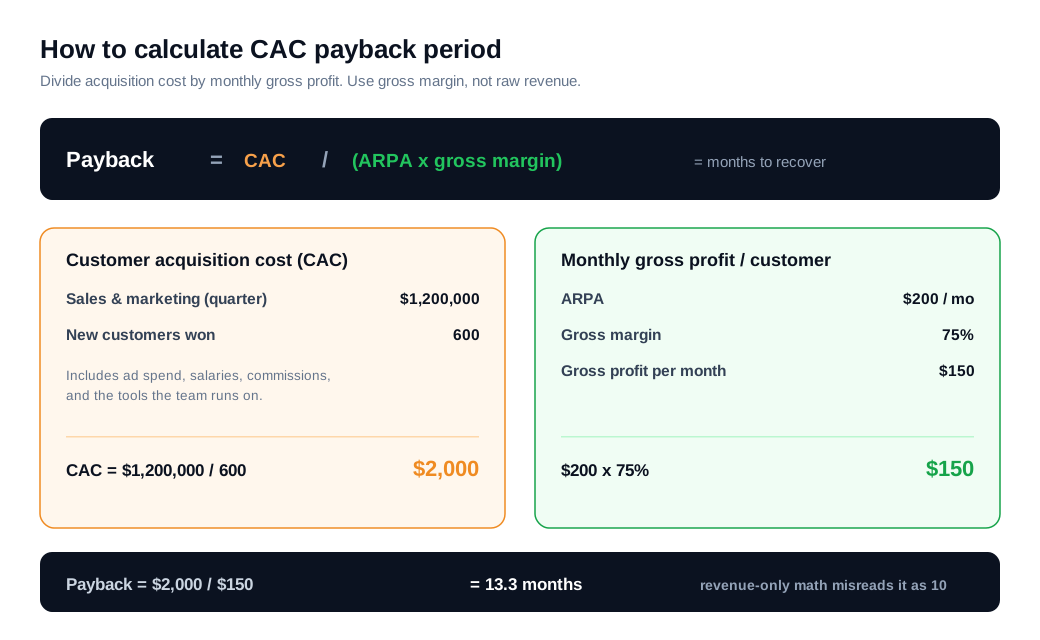
Here is a worked example. A SaaS company spent $1.2 million on sales and marketing last quarter and closed 600 new customers, so CAC is $1,200,000 divided by 600, or $2,000. Each account pays $200 a month (ARPA) and the company runs at 75 percent gross margin, which means every customer throws off $150 of gross profit a month. Payback is $2,000 divided by $150, or about 13.3 months.
Notice what happens if you drop the margin term. Dividing $2,000 by the full $200 of revenue gives 10 months, which looks healthier and is wrong by more than three months. On a large customer base, that gap is the difference between a plan that funds itself and one that runs short.
One timing detail separates a rough estimate from a real one. The SaaS CFO recommends matching the spend to the customers it produced. If your average sales cycle runs two months, the customers who signed this quarter were worked by spend from the prior period, so shift the sales and marketing figure back by the length of the cycle before dividing. Skip that step in a fast-growing company and rising spend gets divided by customers it has not created yet, which inflates CAC and the payback that follows.
What is a good CAC payback period?
A CAC payback period under 12 months is the widely used rule of thumb for healthy SaaS, though the median company runs longer than that and the right target depends heavily on deal size. Twelve months is the line most operators quote, and most viable subscription businesses aim to land at or below it.
The reported medians sit higher than the rule of thumb. First Page Sage's 2025 benchmarks put the median B2B SaaS company at about 16 months to recover CAC, with top-quartile companies doing it in 6 months or fewer and the bottom quartile taking 24 months or more. Benchmarkit's 2025 report shows the median improving from 18 months to 16 months year over year, one of the largest single-year gains in its data, as SaaS teams pulled back on go-to-market spend rather than chasing growth at any cost.
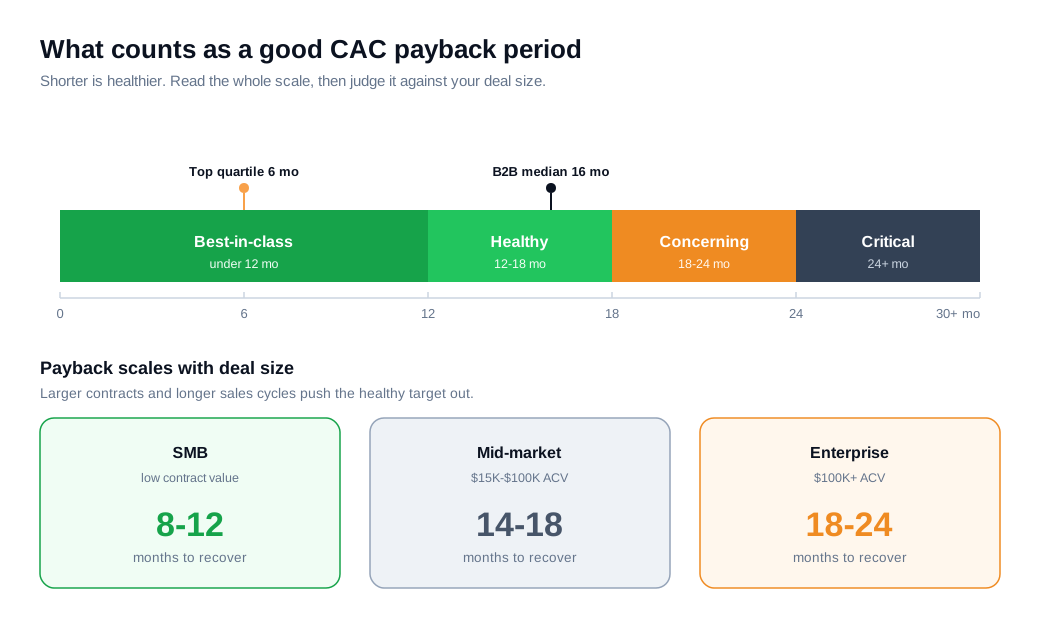
Read the whole scale rather than a single line. Under 12 months is best-in-class, with the top quartile clearing CAC in under 6. The 12 to 18 month band is healthy for most companies. From 18 to 24 months the picture turns concerning, because each customer ties up cash for two years before paying off, and beyond 24 months the model usually needs fixing before you spend more on growth.
Segment matters as much as the overall median. Payback is closely tied to average contract value, so the benchmark you should hold yourself to shifts with the size of your customers. Companies selling to small businesses with low contract values often recover CAC in 8 to 12 months, mid-market vendors in the $15,000 to $100,000 range tend to land at 14 to 18 months, and enterprise sellers with six-figure contracts and long sales cycles commonly stretch to 18 to 24 months. A 20-month payback is a warning for a self-serve tool and roughly par for an enterprise platform. Judge the number against your own segment and cash runway, not against a single industry line.
Why does CAC payback period matter?
CAC payback period matters because it sets the speed limit on how fast you can grow without raising more cash. Every dollar you recover from an existing customer is a dollar you can spend acquiring the next one, so the length of the payback controls how quickly your acquisition budget recycles.
The math is a loop. A company with a 6-month payback recovers its acquisition spend and can redeploy it twice as often as a company with a 12-month payback, which means it adds customers faster on the same starting capital. Stretch payback to 24 months and every dollar you spend stays out of the reinvestment loop for two full years. The longer the payback, the more outside capital you need to fund the same growth curve, and the harder each acquisition dollar pushes on your burn rate.
Runway is where this gets sharp. When your payback period is longer than the cash runway you have, you are funding growth with money you do not have on hand yet, betting that customers will pay off before the account empties. That bet works when churn stays low and the payback estimate holds. It ends companies when either assumption slips. In the worked example, cutting payback from 13.3 months to 8.9 recovers the same $2,000 nearly a third faster, and that recovered cash is what lets the business acquire the next cohort without a new funding round.
How is CAC payback period different from the LTV to CAC ratio?
CAC payback period measures how fast acquisition cost comes back, while the LTV to CAC ratio measures how much total value a customer creates over their entire lifetime, so the two answer different questions and healthy companies watch both. Payback is a cash-flow clock in months. The ratio is a lifetime-value verdict expressed as a multiple like 3:1.
They can point in opposite directions, which is exactly why one is not a substitute for the other. A company with a strong 5:1 LTV to CAC ratio and a 30-month payback has excellent lifetime economics and a cash-flow problem at the same time, because it fronts a large cost and waits years to see it returned. That gap is dangerous if the churn assumption behind the lifetime value turns out to be optimistic, since the value that justifies the spend never fully arrives. Payback keeps the ratio honest by grounding it in months you can actually observe, while the ratio keeps payback in perspective by confirming the customer is worth far more than the cost even after the money comes back.
How do you shorten your CAC payback period?
You shorten CAC payback period by raising the monthly gross profit per customer or lowering the cost to acquire them, and the fastest wins usually come from expansion revenue, annual prepayment, and converting more of the traffic you already pay for. Both halves of the formula are in play, and they move at different speeds.
Start with the revenue side. Upsells, added seats, and plan upgrades raise ARPA at almost no extra acquisition cost, so every dollar of expansion flows into the monthly gross profit that pays CAC back faster. Drivetrain's guide to the metric lists premium tiers and usage-based pricing among the most direct ways to lift the revenue that shortens payback.
Annual prepayment is the bluntest lever of all. A customer who pays a year up front hands you twelve months of revenue on day one, which can collapse the payback on collected cash to almost nothing even when the headline monthly math is unchanged. That is why so many SaaS pricing pages steer buyers toward annual plans with a discount, since the discount often costs less than the capital the upfront cash frees up.
Gross margin does quiet work from the cost side. Trimming what it takes to host, deliver, and support each account leaves more of every revenue dollar counted as gross profit, which lifts the denominator in the formula and pulls payback in without changing price or spend.
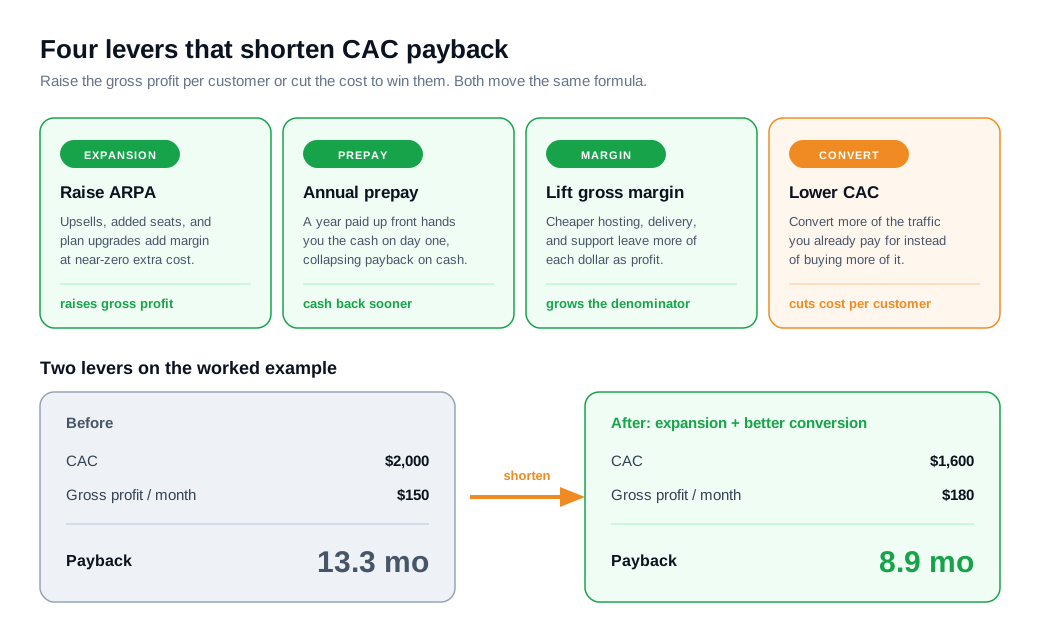
CAC is the other half, and the fastest wins there usually come from converting more of the traffic you already buy rather than buying more of it. A large share of acquisition budget pays for visitors who reach a pricing or product page, hesitate, and leave without ever raising a hand. Reaching those high-intent visitors while they are still on the page, with live chat or a quick live video call when a question is faster to show than to type, turns more of that existing traffic into customers and lowers CAC without touching the ad budget. Speed to the buyer is the core of an inbound sales motion, and it works directly on the denominator, new customers won, that sets CAC.
Put two levers together on the worked example. Push ARPA to $240 through expansion, which lifts monthly gross profit to $180, then sharpen the funnel so the same $1.2 million acquires 750 customers instead of 600, dropping CAC to $1,600. Payback falls from 13.3 months to $1,600 divided by $180, or about 8.9 months. No new budget was added. The same spend simply bought more expansion and better conversion, and both showed up in the payback number.
Key takeaways
- Payback is your acquisition spend measured in months underwater. CAC payback period is how many months of gross profit a customer produces before that profit covers what you spent to win them.
- Use gross margin, or the number lies to you. Divide CAC by ARPA times gross margin, not by raw revenue, because skipping margin returned a 10-month payback in the example that was really 13.3.
- Under 12 months is the healthy rule of thumb, but medians run to 16. Top-quartile SaaS clears CAC in under 6 months while the bottom quartile takes 24 or more, and the right target shifts with your contract size.
- Payback sets your growth speed limit. A shorter period recycles acquisition cash faster and needs less outside capital, so when payback runs longer than your runway you are funding growth with money you do not have.
- Track it alongside LTV to CAC, not instead of it. Payback measures how fast the money returns and the ratio measures how much a customer is worth, and a strong ratio with a long payback still ties up cash.
- Shorten it from both sides. Raise gross profit per customer through expansion and annual prepayment, and lower CAC by converting more of the traffic you already pay for.
TAGS

Written by
Nilas MylerCo-founder & CTO, Glimpze
Nilas is the co-founder and CTO of Glimpze, an inbound sales tool that turns high-intent website visitors into live conversations. A former SEO consultant for some of the largest companies in Denmark, he writes about speed-to-lead, inbound sales, and conversion rate optimization — the technical and operational mechanics of turning traffic into pipeline.


