On this page
- What is conversion rate optimization?
- How do you calculate your conversion rate?
- What is a good conversion rate?
- How does the CRO process actually work?
- What are the core building blocks of a CRO strategy?
- Why CRO compounds across every channel
- Common CRO mistakes
- Conversion rate optimization: FAQs
- Key takeaways
- Sources
Most companies solve a traffic problem by buying more traffic. They raise the ad budget, publish more content, chase another channel, and watch the visitor count climb while the number of customers barely moves. The uncomfortable fact hiding underneath that graph is that the average website converts somewhere between 2% and 5% of its visitors. The other 95 to 98 out of every 100 people showed up, looked around, and left without doing the thing you needed them to do.
Conversion rate optimization is the discipline of fixing that ratio instead of ignoring it. This post covers what CRO actually is, how to calculate and benchmark your own conversion rate, how the optimization process works in practice, the core building blocks of a CRO strategy, and the mistakes that quietly waste most teams' testing budget.
What is conversion rate optimization?
Conversion rate optimization (CRO) is the structured process of increasing the percentage of website or app visitors who complete a desired action, such as making a purchase, starting a trial, booking a demo, or submitting a form, without needing to increase traffic. Instead of spending more to bring in new visitors, CRO focuses on getting more value out of the visitors you already have.
A "conversion" is simply whatever action matters most to your business at a given stage. For an ecommerce store, that's usually a completed purchase. For a SaaS company, it might be a trial signup, a demo request, or an upgrade from free to paid. For a media site, it could be a newsletter subscription. The specific action changes by business; the underlying practice of measuring it, testing changes against it, and keeping what works stays the same.
CRO sits downstream of acquisition and upstream of retention. Marketing and SEO get people to your site. Product and customer success keep them around after they buy. CRO owns the middle: turning an anonymous visit into a committed action.
How do you calculate your conversion rate?
The formula is simple:
(Number of conversions ÷ Total number of visitors) × 100 = Conversion rate
If 2,000 people visit your pricing page in a month and 60 of them start a trial, your conversion rate for that page is 3%. If 100 people fill out a demo request form out of 5,000 visitors to your homepage, that's a 2% conversion rate for that specific path.
Two distinctions matter once you start measuring seriously. First, a macro conversion is the primary action you actually care about (a purchase, a signed contract, a completed signup). A micro conversion is a smaller step along the way that signals progress toward it (adding an item to a cart, starting a form, watching a demo video). Tracking only the macro conversion hides where visitors are actually dropping off; tracking micro conversions too lets you see which step in the funnel is losing the most people.
Second, decide what "visitor" means before you calculate anything. Conversion rate by unique visitors, by sessions, and by traffic source can tell three different stories from the same raw numbers. Pick a consistent definition and stick with it, or your month-over-month comparisons won't mean anything.
What is a good conversion rate?
There isn't a single number that applies to every business, but there are real benchmarks worth knowing so you can tell whether you're actually behind or just assuming you are.
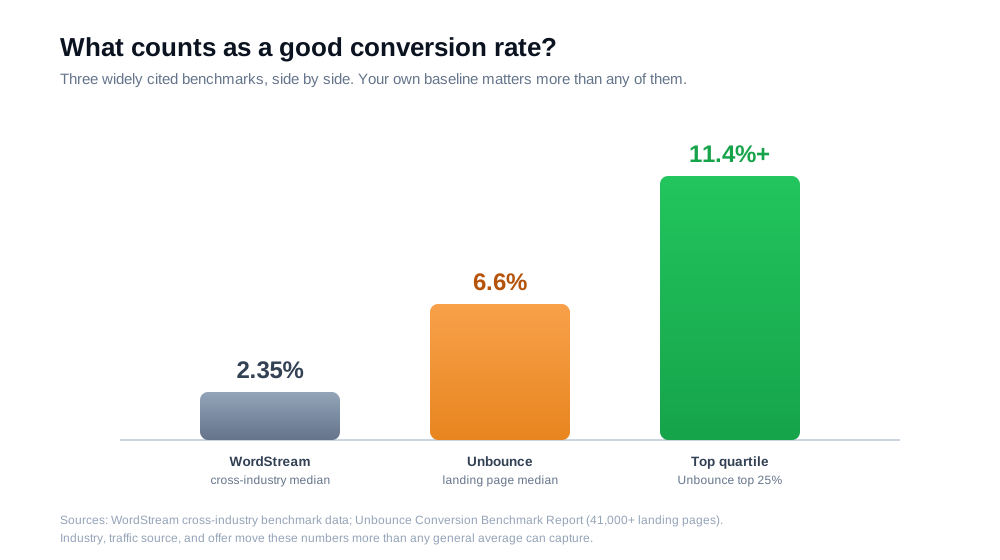
WordStream's cross-industry data puts the median conversion rate around 2.35%, with the top 25% of advertisers converting at 5.31% or better and the top 10% above 11.45%. Unbounce's Conversion Benchmark Report, built from more than 41,000 landing pages and 57 million tracked conversions, found a higher median of 6.6% for dedicated landing pages specifically, with the top quartile starting around 11.4%. The gap between those two figures is itself a useful lesson: a purpose-built landing page with one goal will almost always outconvert a general website page trying to do five things at once.
Industry, traffic source, and offer all move these numbers substantially. A niche B2B tool with a $50,000 contract value can be thriving at a 1% conversion rate if the leads are qualified and the deal size is large. A free mobile game needs a completely different benchmark. Branded search traffic converts multiples higher than cold display ads on the exact same page, because intent, not design, is doing most of the work.
What should worry you more than any external benchmark is this: in Econsultancy's Conversion Rate Optimization Report, none of the companies surveyed described themselves as "very satisfied" with their conversion rates, and only 22% said they were even "quite satisfied." Most teams running a website today believe, correctly, that they're leaving conversions on the table. Chasing an industry average matters less than measuring your own baseline honestly and improving against it, month over month.
How does the CRO process actually work?
Good CRO runs as a continuous loop, not a redesign you do once a year.
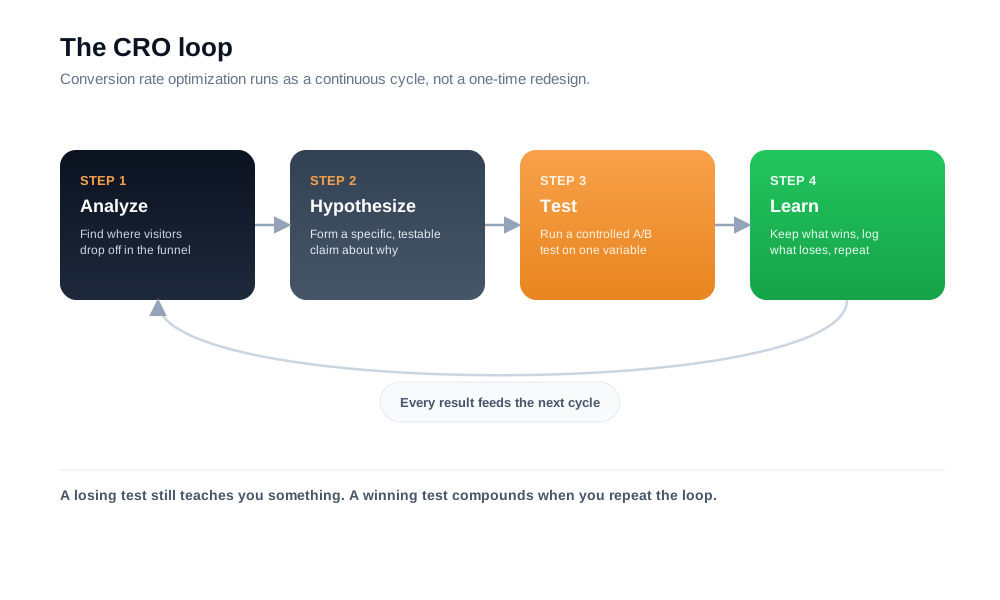
Analyze. Start with your funnel, not your opinions. Where do visitors actually drop off? Analytics tools tell you the "where": which page, which step, which device. Session recordings and heatmaps tell you more of the "why": where people hesitate, what they scroll past, where they rage-click on something that doesn't work.
Hypothesize. Turn the observation into a specific, testable claim. Not "the pricing page needs work" but "visitors are bouncing on the pricing page because they can't find the answer to a specific objection before leaving, so adding an answer to that objection near the CTA will increase signups." A hypothesis you can be proven wrong about is the whole point; a vague one just gives you permission to redesign things you personally dislike.
Test. Run a controlled experiment, usually an A/B test, that isolates the one change your hypothesis is about. Split traffic evenly, let it run until you reach statistical significance (not just until you see a number you like), and resist the urge to call a winner after two days and forty conversions.
Learn. Whether the test wins, loses, or comes back inconclusive, you now know something you didn't before. A losing test that disproves a popular internal assumption is often more valuable than a winning one, because it stops you from shipping the same bad idea everywhere else on the site. Feed the result back into the next round of analysis and start again.
Teams that treat CRO as a one-time project usually see one round of gains and then plateau. Teams that treat it as a permanent loop keep compounding small wins long after the "obvious" fixes are done.
What are the core building blocks of a CRO strategy?
Most CRO work falls into four overlapping areas.
Funnel analysis. Before you can fix a leak, you need to know exactly where it is. Mapping the full path from first visit to conversion, and measuring the conversion rate between each step rather than just the overall rate, tells you which specific stage is losing the most valuable traffic. A funnel with a healthy 40% visitor-to-lead rate but a terrible 5% lead-to-customer rate needs a completely different fix than the reverse.
Landing page and copy optimization. The message has to match the visitor's intent the moment they arrive. That means a clear, specific headline, a value proposition that's obvious within a few seconds, and copy that answers "what is this, why should I care, and what do I do next" without making the visitor hunt for it.
A/B testing and experimentation. This is the mechanism that turns opinions into evidence. Good experimentation means testing one variable at a time, running tests long enough to reach real statistical significance, and being honest when a test is inconclusive instead of squinting at the data until it agrees with you.
Reducing friction and answering objections. This is where the biggest, least glamorous wins usually live. Unclear pricing, a form that asks for too much, a question the page never answers, a moment of "wait, can I trust this?" right before the CTA: these quietly kill more conversions than a weak button color ever will. One tactic that most CRO guides skip entirely is giving hesitant, high-intent visitors a way to get their actual question answered in the moment, rather than hoping your FAQ page happens to cover it. We built Glimpze around exactly that idea: a visitor reading your pricing page with one unresolved objection can start a live chat or video conversation right there instead of bouncing to compare you against a competitor who answers faster.
Why CRO compounds across every channel
Here's the part that makes CRO different from most other growth work: it multiplies, rather than adds to, everything else you're already doing.
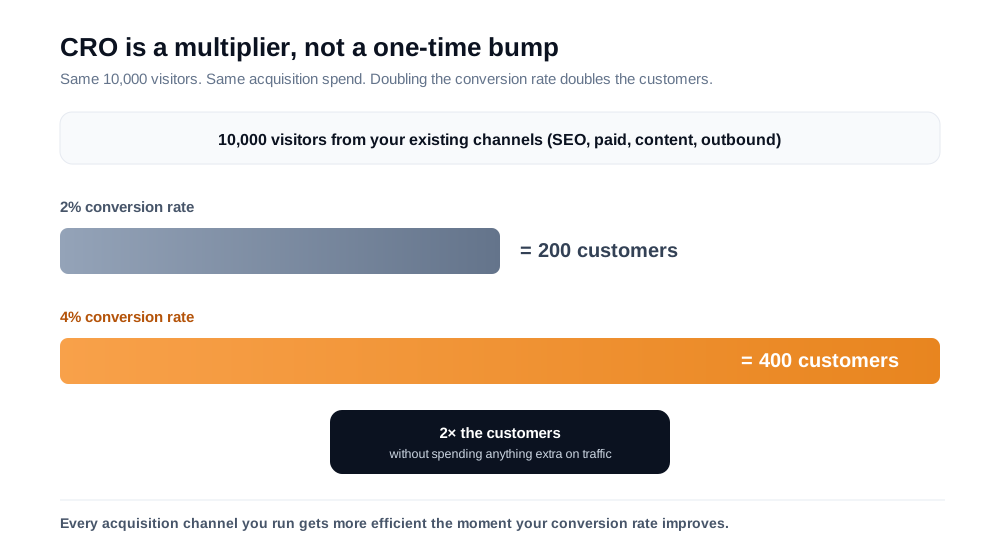
If you improve your conversion rate from 2% to 4%, you don't just get a one-time bump. You get double the return on every dollar you already spend on SEO, paid search, content, and outbound, permanently, until the next change to your funnel. That's a structurally different kind of growth than most acquisition work, where doubling results usually means doubling spend.
This is also the cleanest way to answer a question people conflate constantly: how is CRO different from SEO or paid acquisition? SEO and paid acquisition are about getting more visitors to the top of the funnel. CRO is about converting more of the visitors you already got. They aren't competitors for budget; they're multipliers of each other. A 20% CRO improvement makes every acquisition channel you run 20% more efficient overnight, with no additional ad spend and no new content required.
Common CRO mistakes
A few patterns show up again and again in teams that struggle to get traction with CRO.
Copying "best practices" without testing them locally. A tactic that lifted conversions 30% on someone else's ecommerce checkout might do nothing, or actively hurt, on your B2B demo request form. Best-practice lists are a starting point for hypotheses, not a substitute for testing on your own audience.
Changing too many things in one test. If you redesign the headline, the CTA, and the hero image at the same time, a winning test tells you the combination worked but nothing about which element actually mattered. That makes every future decision a guess dressed up as data.
Calling tests early. Stopping a test the moment it looks like it's winning, rather than waiting for statistical significance, is one of the most common ways teams fool themselves. A lot of "winning" tests would have reverted to no difference at all with another week of traffic.
Ignoring qualitative signals. Analytics tells you what happened. Session recordings, on-page surveys, and actual conversations with hesitant visitors tell you why. Teams that only look at dashboards end up testing surface-level tweaks while missing the real objection that's costing them conversions.
Treating CRO as a project instead of a system. A redesign sprint produces a burst of improvement and then, without a standing process to keep testing, conversion rates quietly drift back down as the market, the competition, and visitor expectations change.
Conversion rate optimization: FAQs
What counts as a good conversion rate for a SaaS company?
SaaS conversion rates vary by what you're measuring. Visitor-to-trial signup commonly lands in the low single digits to around 5% for self-serve products, while a well-run demo request page for a higher-touch B2B product can run higher because the traffic is more qualified. Trial-to-paid conversion is a separate number entirely and usually the more important one to optimize, since it's closer to actual revenue.
How is CRO different from SEO or paid acquisition?
SEO and paid acquisition are about generating more visitors. CRO is about converting a higher share of the visitors you already have. They complement rather than compete with each other: every improvement in conversion rate makes your existing SEO and paid spend more efficient, without adding traffic or cost.
How long does it take to see results from CRO?
It depends on your traffic volume and the size of the change. A page with enough traffic to reach statistical significance quickly can validate a test in a couple of weeks; a lower-traffic page might take a month or more for a single test to reach a reliable result. The bigger time investment is building the habit of continuous testing, since the compounding value comes from running the loop repeatedly, not from any single test.
Do you need a dedicated CRO tool to get started?
No. You can start with what you likely already have: an analytics platform to see where visitors drop off, and a way to talk to your users, whether that's surveys, session recordings, or live conversations with visitors on high-intent pages. Dedicated A/B testing and heatmap tools help you scale the process once you know what to test, but the first useful CRO work is usually just careful measurement and a clear hypothesis.
Where should you start with CRO?
Start by instrumenting your funnel so you can see stage-by-stage conversion rates, not just the overall number. Find the step losing the most high-intent traffic, form one specific hypothesis about why, and run a single controlled test before you touch anything else. The step with the biggest drop-off, not the page you personally think looks outdated, is almost always where the highest-impact fix is hiding.
Key takeaways
- CRO grows revenue from the traffic you already have. Instead of paying for more visitors, you increase the share of existing visitors who convert, and that gain compounds across every acquisition channel you run.
- Benchmarks vary widely, so measure your own baseline. Cross-industry medians run from roughly 2.35% (WordStream) to 6.6% for dedicated landing pages (Unbounce), but industry, traffic source, and offer move these numbers more than any general average can capture.
- CRO is a loop, not a project. Analyze the funnel, form a specific hypothesis, run a controlled test, and learn from the result, whether it wins or loses, then start again.
- Friction and unanswered objections cause more lost conversions than weak design. Unclear pricing, long forms, and unresolved questions quietly cost more than button colors ever will.
- The biggest mistakes are process failures, not creative ones: copying unvalidated best practices, testing too many variables at once, and calling tests before reaching statistical significance.
TAGS

Written by
Nilas MylerCo-founder & CTO, Glimpze
Nilas is the co-founder and CTO of Glimpze, an inbound sales tool that turns high-intent website visitors into live conversations. A former SEO consultant for some of the largest companies in Denmark, he writes about speed-to-lead, inbound sales, and conversion rate optimization — the technical and operational mechanics of turning traffic into pipeline.


