
On this page
On the first of the month, a sales team signs a three-year deal worth $36,000 and marks it as a win. On the last day of that same month, finance records $1,000 of revenue from it. Neither number is wrong, and both describe the same signature on the same page.
Bookings, billings, and revenue are three ways of counting the same money at three points in a contract's life. Treating one as another is how a company overstates its profit, misreads its cash position, and walks into diligence with figures an auditor unwinds in an afternoon. The relationship between them turns mechanical once you can see where each number sits on the timeline.
This post covers what bookings, billings, and revenue each measure, how a single deal moves through all three, how to calculate billings from revenue and deferred revenue, why the three get mixed up so often, and which number to reach for depending on the question in front of you.
What are bookings?
Bookings are the total value of the contracts customers commit to in a period, recorded on the day the deal is signed, before any invoice is sent or any service is delivered. They measure demand: how much business your sales team closed, counted at full contract value across the entire term.
A multi-year commitment lands in bookings all at once. Sign a customer to a three-year plan at $1,000 a month and you have booked $36,000 today, even though you have not billed a cent of it and have earned none of it yet. Wall Street Prep describes a booking as the value of a customer's contractual spending commitment, recorded on the date the agreement is formalized, which is why the figure reflects sales momentum rather than accounting reality.
Bookings never appear on your income statement. It is a management metric, useful for tracking quota, pipeline, and growth, and teams usually split it into new bookings from fresh logos, renewal bookings from existing customers re-signing, and expansion bookings from upsells. NetSuite treats the booking as the starting point of the whole revenue model, the promise that everything downstream depends on.
New bookings are the output of everything upstream in your funnel. A visitor reading your pricing page is a future booking, and a contact form that promises a reply within a business day quietly lets some of them cool off. Answering in the moment with live chat, or hopping on a short call when a question is easier to show than to type, is how a fair amount of that pipeline gets signed. That speed is the core of an inbound sales motion, and it lands squarely in the new-bookings line.
What are billings?
Billings are the amount you invoice customers during a period, set by your billing schedule rather than by the signing date or the delivery timeline. This is the money you are asking customers to pay right now, so billings track closely with the cash you expect to collect soon.
The same $36,000 contract can produce very different billings depending on how you structure the invoices. Bill the customer annually in advance and year-one billings from that deal are $12,000, one third of the booking. Bill monthly and the figure is $1,000 for the first month. Bill the whole three years upfront and you invoice all $36,000 at once. Corporate Finance Institute notes that billings depend on the invoicing frequency the contract specifies, which can be monthly, annual, or anything the two parties agree to.
Billings sit in the middle of the timeline, after the booking and before the revenue is fully earned. Because they represent invoices going out the door, finance teams watch billings as a near-term cash flow signal, a read on working capital that recognized revenue alone can hide.
What is revenue?
Revenue is the portion of a contract you have earned by actually delivering the service, recognized under GAAP across the period you deliver it, rather than on the day you sign or invoice. For SaaS, that means recognizing the contract ratably as the customer gets access to the software month after month.
The rule that governs this is ASC 606, which lays out a five-step model: identify the contract, identify the performance obligations, determine the transaction price, allocate that price to the obligations, and recognize revenue as each obligation is satisfied. Orb points out that a subscription is almost always satisfied over time, because the customer consumes the benefit of software access continuously rather than at a single moment.
Back to the deal. That $36,000 three-year contract earns $1,000 of revenue each month, the value of one month of access delivered. On the day you sign it, recognized revenue from the contract is zero. After the first month, it is $1,000. Maxio frames the same point with a round example: a customer who pays $12,000 for an annual plan produces $1,000 in recognized revenue each month, rather than $12,000 up front.
Revenue is the only one of the three that lands on your income statement, which is exactly why the distinction matters. It is the number auditors, tax authorities, and serious investors treat as real.
How do bookings, billings, and revenue relate?
They are the same contract counted at three points on a timeline: bookings the instant it is signed, billings when each invoice goes out, and revenue as the service is delivered month by month. Follow one deal and the relationship stops being abstract.
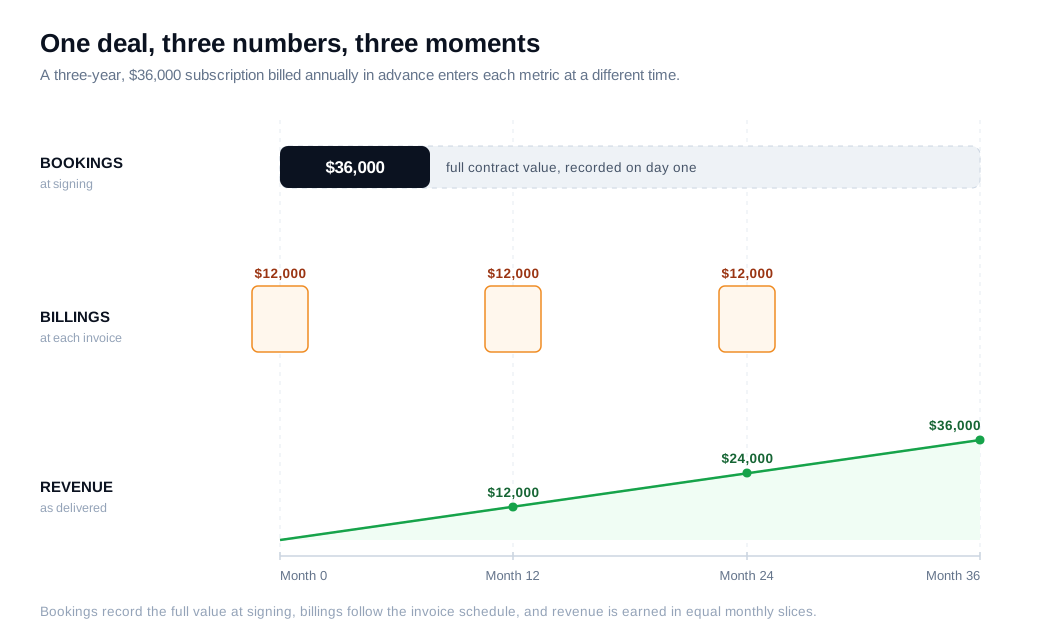
Take the three-year, $36,000 subscription, billed annually in advance. On signing day, bookings jump by the full $36,000, billings are $0, and revenue is $0. When the first annual invoice goes out, billings for the year become $12,000 while recognized revenue is still climbing $1,000 at a time. Twelve months in, you have recognized $12,000 of revenue, sent $12,000 in billings for year one, and the original $36,000 booking is a third earned with two years still to run.
Bookings lead the sequence, billings track in the middle, and recognized revenue follows behind. Lago sums up the pattern cleanly: the gap between what you have billed and what you have recognized is your deferred revenue balance at any point in time. That balance is the bridge between the three numbers, and it is worth calculating directly.
How do you calculate billings from revenue and deferred revenue?
Billings equals recognized revenue plus the change in deferred revenue over the period, because every dollar you invoice either gets earned in the period (revenue) or waits on the balance sheet as an obligation you still owe the customer (deferred revenue). The formula is short: Billings = Revenue + Change in Deferred Revenue.
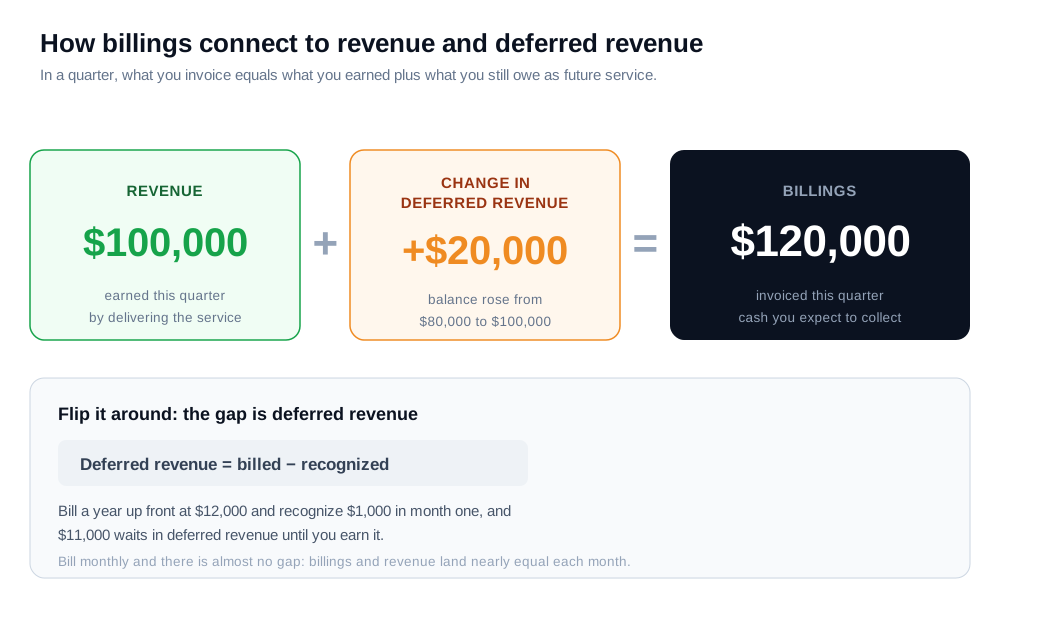
Here it is with numbers. In a quarter, your company recognizes $100,000 of revenue. Over the same quarter, deferred revenue on the balance sheet rises from $80,000 to $100,000, an increase of $20,000. Billings for the quarter are $100,000 plus $20,000, or $120,000. You invoiced $120,000 of work, earned $100,000 of it, and parked the remaining $20,000 as future service you still have to deliver.
The relationship runs the other way too. Maxio gives the mirror formula: deferred revenue equals the amount billed minus the amount recognized as revenue. Bill a customer $12,000 for a year upfront and recognize $1,000 in month one, and $11,000 sits in deferred revenue waiting to be earned.
One caveat keeps this from being a universal shortcut. If you bill customers monthly, you never build a meaningful deferred revenue balance, because you invoice roughly the same amount you earn each month. The formula still holds, and billings and revenue simply end up nearly equal. The interesting gap only opens up when you bill annually or multi-year in advance.
Why do the three often get confused?
They get confused because all three count the same dollars and can look almost identical in a steady, monthly-billed business, so the differences only surface once contracts get long, get billed upfront, or start growing fast. In a calm month the three numbers drift close together, which lulls teams into using them interchangeably.
The costly version of the mistake is reporting bookings as revenue. BooksTime makes the point with a clean case: sign a $24,000 annual agreement today and your bookings are $24,000, but the revenue you can recognize this month is $2,000. Tell your board you did $24,000 in revenue when the income statement shows $2,000, and you have created a gap that surfaces in the worst possible room, an audit or a diligence process.
The distortion spreads into other metrics. Plug bookings or billings into a formula that expects GAAP revenue, like the SaaS magic number or a payback calculation, and you overstate sales efficiency, which tempts you to spend more on acquisition than the earned revenue can support. The three numbers sit close enough to substitute by accident and differ enough that the substitution quietly breaks whatever you calculate next.
The practical damage shows up as a founder who reads bookings as cash, hires against revenue that has not been earned, and forecasts from a number that describes commitments rather than collections.
When should you use bookings, billings, or revenue?
Use bookings to gauge sales momentum, billings to forecast near-term cash, and revenue to measure what you have actually earned and to report to the outside world. Each answers a different question, and the trouble starts only when you ask one number to do another's job.
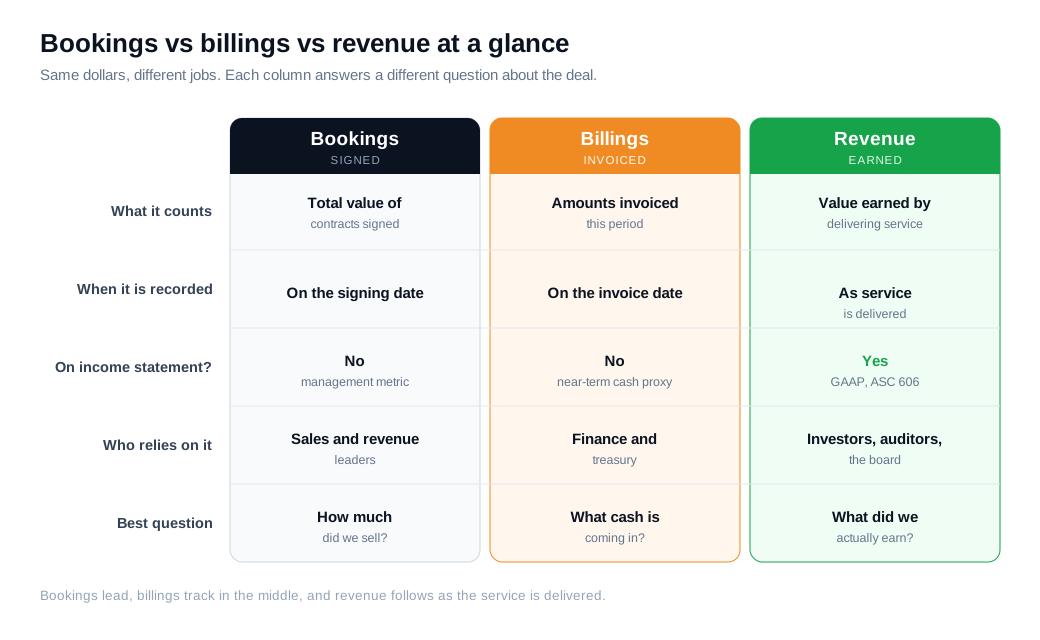
Reach for bookings when you want to know how sales performed: whether the team is closing, how large new commitments are, and how fast the pipeline is converting. It is the earliest signal you have, and it leads the other two, which makes it a forward read on demand.
Reach for billings when the question is about cash and working capital. Billings track what you are invoicing, so they point at what is likely to land in the bank over the coming weeks, and a rising billings line often signals cash strength before recognized revenue catches up.
Reach for revenue when you report results, calculate efficiency metrics, or set a valuation. It is the GAAP figure on your income statement and the only one an auditor or a serious investor will treat as earned. Pair it with the deferred revenue balance, which many investors read as a leading indicator, since a swelling or shrinking deferred balance often moves before GAAP revenue does. Most companies track all three: bookings for momentum, billings for cash, and revenue for the record.
Key takeaways
- Bookings, billings, and revenue count the same contract at three moments. Bookings land on the signing date, billings land when you invoice, and revenue is earned as you deliver the service.
- Only revenue is a GAAP figure on the income statement. Bookings and billings are management metrics, so reporting either as revenue inflates profit and fails under audit or diligence.
- Billings equals revenue plus the change in deferred revenue. A quarter with $100,000 of revenue and a $20,000 rise in deferred revenue means you billed $120,000.
- Deferred revenue is the bridge between the three. It holds the money you have billed but not yet earned, and it only builds up when you bill annually or multi-year in advance.
- Match the metric to the question. Bookings answer how much you sold, billings answer what cash is coming, and revenue answers what you actually earned.
- Long, upfront-billed, fast-growing contracts pull the three apart. In a steady monthly-billed business they nearly overlap, which is exactly why teams stop telling them apart until it matters.
TAGS

Written by
Daniel SemeckyCo-founder & CEO
Daniel is the co-founder and CEO of Glimpze. He spends his days talking to revenue teams about how to catch high-intent visitors before they bounce, and writes about inbound sales, lead conversion, and building a motion where marketing and sales actually share a number.


