
On this page
A user signs up for your free plan on a Tuesday. By Friday she has connected her company's data, invited three teammates, run the same report twice, and opened your pricing page. She has not downloaded an ebook, sat through a webinar, or filled in a single marketing form, so most lead-scoring systems still file her under unqualified.
That is backwards. In three days she has shown more buying intent than any form fill could carry, and she showed it by using the exact thing you are trying to sell. A product-qualified lead is how you catch users like her before they quietly stall, forget to upgrade, or drift to a competitor.
This post covers what a PQL is, how it differs from a marketing-qualified lead, the signals that define one, how a PQL relates to product activation, why PQLs convert at higher rates, and the specific way to act on them once you can see them.
What is a product-qualified lead?
A product-qualified lead (PQL) is a user who has experienced real value inside your product and, through that usage, has shown they are likely to become a paying customer. The qualification comes from behavior, not from a claim the user makes about themselves on a form.
Most lead models wait for a person to raise their hand: book a demo, request a quote, download a guide. A PQL flips the order. The user tries the product first, usually through a free trial or a freemium plan, hits the point where it clicks, and keeps going. By the time anyone from your team looks at the account, the hard part of the sale, convincing someone the product works, is already done.
TechTarget defines a PQL as a lead who has used the product and taken actions that indicate genuine buying interest, which sets them apart from a contact who has only researched, been referred, or responded to a promotion. The distinction matters because the evidence is firsthand. The account has lived with your product and chosen to keep using it.
The idea belongs to product-led growth, where the product itself is the main engine for acquiring, activating, and converting users. As OpenView explains in its guide to PQLs, the model works because the product generates a stream of usage data that tells you which accounts are getting value and which are drifting, long before a rep makes contact. Your job is to read that stream and pull out the accounts worth a conversation.
How does a PQL differ from an MQL?
A PQL is qualified by what a user does inside your product, while a marketing-qualified lead (MQL) is qualified by how someone engages with your marketing. The two labels sit at different points in the buyer's journey and rest on very different evidence.
An MQL earns its status through interest. Someone downloads a whitepaper, attends a webinar, or hits a lead-score threshold built from email opens and page visits. That tells you a person is curious about the category. It does not tell you whether your product solves their problem, because they have not touched it yet.
A PQL earns its status through intent backed by value. The account has reached its aha moment, used a core feature, maybe invited a colleague. When sales engages an MQL, the first job is to convince a curious contact that the product is worth their time. When sales engages a PQL, the product has already made that case, and the rep starts from a user who has felt it work.
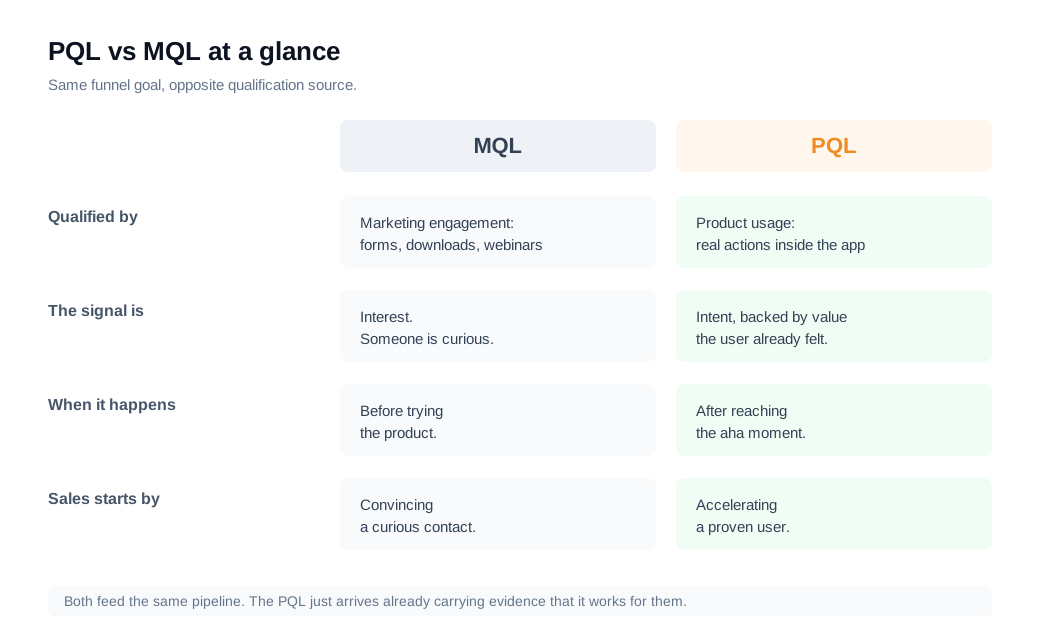
The two are not rivals, and plenty of companies use both. An MQL model still helps you fill the top of the funnel and reach buyers who have not signed up yet. As ProductLed lays out, the PQL simply adds a far stronger signal for the accounts that have already entered your product, so your sales time flows to the users most likely to pay.
What signals define a PQL?
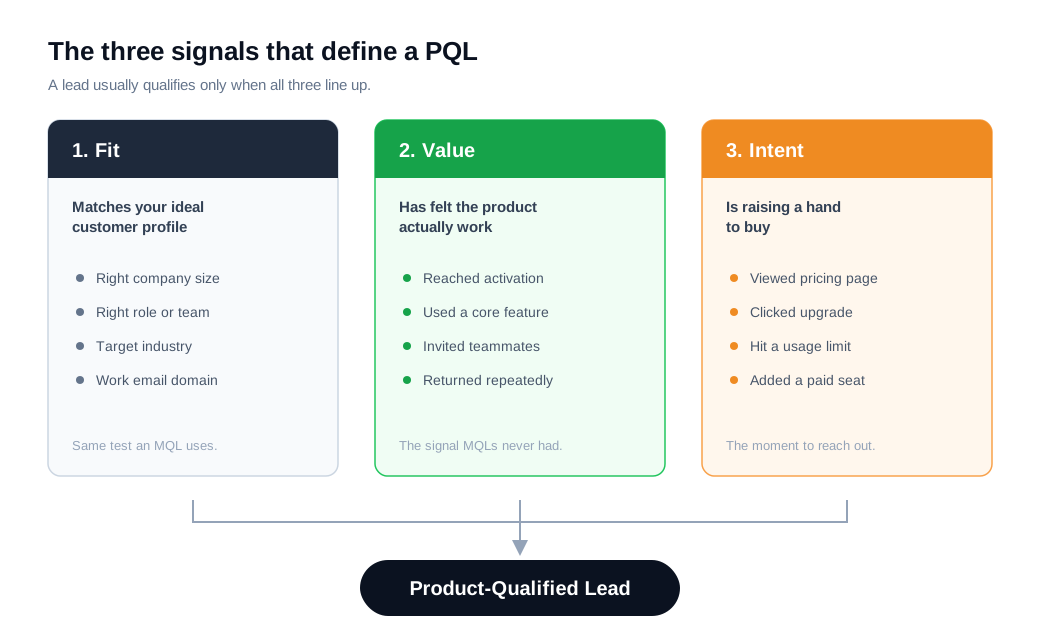
The strongest PQL definitions combine three kinds of signal: fit (does the user match your ideal customer), value (have they felt the product work), and intent (are they showing they want to buy). A lead usually qualifies only when all three line up, which keeps the definition tight enough to be useful.
ProductLed's cheat sheet for defining PQLs frames these three signals as the core of any model. Fit is the same test an MQL uses: company size, role, industry, a work email domain that matches your target market. Value is the signal MQLs never had, and it has to be grounded in a real activation event and the milestones that follow it, ideally within a time window. Intent is the hand-raise: viewing the pricing page, clicking an upgrade button, hitting a usage limit, or adding a paid seat.
The value signal is where most of the work sits, because you have to define what "felt the product work" means for your specific product. The classic example is Slack, which treats a workspace that crosses a heavy message threshold as a strong buying signal, since a team sending that many messages has replaced email with Slack and will not go back. Decibel's breakdown of lessons from Slack, Atlassian, and Zendesk shows the pattern repeats across products: the PQL trigger is the usage level where the product has clearly become part of how the team works.
Your own trigger will look different. For a project tool it might be creating a second project. For an analytics platform it might be connecting a data source and viewing a dashboard. For a support tool it might be resolving the first ticket. ProductLed notes that PQL qualification tends to work best as a binary outcome, PQL or not, rather than a rolling point score, because a binary answer gives sales a clear next step instead of a fuzzy number.
Is a PQL the same as product activation?
No, activation and a PQL are related but measure different things: activation is the moment a user first reaches value, while a PQL is a user whose fuller pattern of usage says they are ready to buy. Treating them as the same thing is a common way to build a PQL model that fires too early.
OpenView draws the line clearly: activation tells you a user solved the problem that brought them to your product and reached their aha moment, which is a prerequisite for buying. A PQL sits further along. It takes that activated user and layers on fit and intent, so you are looking at someone who has both felt the value and shown signs of wanting more of it. Every PQL has activated, but not every activated user is a PQL.
The same source flags a related distinction worth knowing. A PQL is tied to one person and their individual actions, while a product-qualified account (PQA) is a group of connected users inside one company whose combined behavior signals purchasing potential. For team products, the account view usually matters more than any single user, because the buying decision is made by the group, not the one person who signed up.
Why do PQLs convert better than MQLs?
PQLs convert at higher rates than MQLs because the product has already done the persuading: the user felt the value before a rep ever reached out. You are no longer selling a promise. You are helping someone formalize a decision they are partway to making on their own.
ProductLed and other product-led growth benchmarks report PQL-to-paid conversion rates that run well above typical MQL conversion, often several times higher, precisely because product usage is a stronger predictor of purchase than marketing engagement. The exact figures vary by product and how strictly each team defines a PQL, so treat any single number as directional rather than a guarantee.
The underlying funnel math is where public benchmarks help. OpenView's 2022 Product Benchmarks report found median activation rates of roughly 20 percent for freemium products and around 40 percent for free-trial products, and free-to-paid conversion for free-trial products running roughly double that of freemium. Those numbers set the pool you are working from: activation gets a user to value, and a PQL model decides which of the activated users deserve a rep's time.
Here is a worked example. A freemium tool gets 2,000 free signups a month. It defines a PQL as any workspace that, within 14 days, connects a data source, invites at least two teammates, and views the pricing page, while also matching the target company size. Suppose 8 percent of signups clear that bar, which is 160 PQLs. Say those PQLs convert to paid at 25 percent, while the other 1,840 signups convert at 3 percent.
Run the numbers. The 160 PQLs produce 40 new customers. The remaining 1,840 signups produce about 55. That is 95 new customers in total, and 40 of them, roughly 42 percent, came from the 8 percent of signups the PQL model flagged.
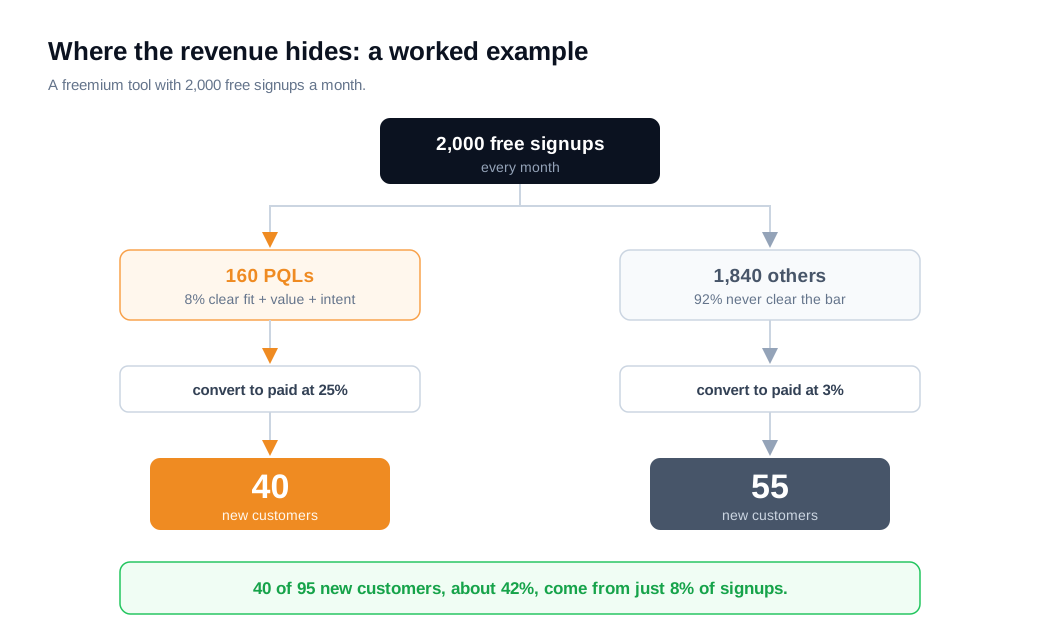
That concentration is the whole point. It tells a small sales or growth team exactly where to spend the hours it has. The caveat runs the other way too. A loose definition that flags a third of your signups as PQLs floods reps with weak accounts and buries the strong ones, so the discipline of the definition is what makes the conversion advantage real.
How do you act on PQLs?
You act on a PQL by routing it to the right motion the moment it qualifies, then reaching the user while the intent is still fresh, with context on why they qualified. Speed and relevance are what turn the signal into revenue, and both fade fast once the moment passes.
Start with routing. Not every PQL needs a human. ProductLed's guide to layering sales onto product-led growth recommends segmenting qualified users into a self-serve path and a sales-assisted path, usually by account size or expansion potential. A solo user on a small team can be nudged to upgrade inside the product. A PQL inside a 500-person company that just added five seats is worth a rep reaching out directly.
Speed decides the rest. A user who viewed pricing today is a different prospect from the same user a week later, so the alert has to reach the right person in real time rather than surfacing in a weekly report. Piping PQL triggers into the channel your team already lives in helps here, which is why routing rules and Slack-style notifications that fire the instant an account qualifies, wired up through your integrations, tend to beat any dashboard someone has to remember to check.
Context makes the outreach land. A rep who knows the account connected two data sources, invited four teammates, and viewed pricing twice can open with something specific instead of a generic check-in. That is the difference between an inbound sales conversation that continues a story the user started and a cold call that ignores it.
Channel matters too. The highest-intent moment is often while the user is still in the product or sitting on the pricing page, which is exactly when a quick answer moves the deal. Reaching them there with live chat, or a short live video call or screen share when a question is easier to show than to type, catches the intent at its peak rather than routing them to a form and a next-day reply. For self-serve PQLs who do not warrant a rep, an in-product prompt at the moment they hit a usage limit does the same job at scale.
Key takeaways
- A PQL is qualified by product behavior, not by a form. It is a user who has experienced real value in your product and, through usage, shown they are likely to buy.
- The core difference from an MQL is the evidence. An MQL signals interest from marketing engagement, while a PQL signals intent backed by value the user has already felt firsthand.
- Strong PQL models combine fit, value, and intent. The user matches your ideal customer, has reached activation and used the product, and is showing hand-raising behavior like viewing pricing.
- Activation is not the same as a PQL. Activation is the first taste of value and a prerequisite, while a PQL layers fit and buying intent on top of an activated user.
- The conversion advantage is real but depends on discipline. PQLs convert well above MQLs because the product did the persuading, though a loose definition floods reps with weak accounts and erases the edge.
- Act fast and with context. Route each PQL to self-serve or sales, alert the right person in real time, and reach the user while intent is high with a message tied to what they actually did.
TAGS

Written by
Daniel SemeckyCo-founder & CEO
Daniel is the co-founder and CEO of Glimpze. He spends his days talking to revenue teams about how to catch high-intent visitors before they bounce, and writes about inbound sales, lead conversion, and building a motion where marketing and sales actually share a number.


