
On this page
- What should a demo follow-up email include?
- How soon should you send a demo follow-up email?
- How long should a demo follow-up email be, and what subject line works?
- What next steps drive replies?
- How many demo follow-up emails should you send?
- How do you handle a non-response after a demo?
- Key takeaways
- Sources
You just ran a strong demo. The buyer nodded at the right moments, asked about pricing, and said the words every rep wants to hear: this looks like what we need. Then you sent a follow-up, and the thread went silent.
That silence is normal, and it is fixable. Most deals are decided in the days after the demo, not during it, and the note you send next is the one lever you fully control. A rambling recap with three questions and a bare calendar link gets skimmed and buried. A tight message that reminds the buyer why they leaned in and asks for one clear next step gets a reply.
This post covers what a demo follow-up email should include, how fast to send it, how long it should run, which next step actually earns a reply, how many times to follow up before you stop, and how to handle a prospect who goes quiet.
What should a demo follow-up email include?
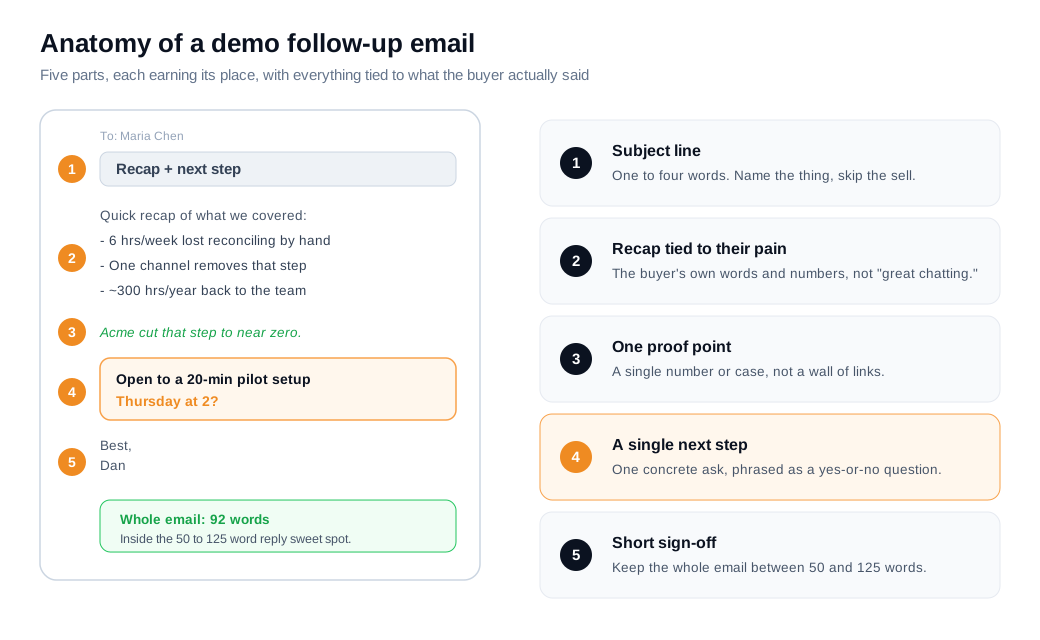
A demo follow-up email should include a short recap tied to the buyer's own words, one piece of proof or value, and a single clear next step, with nothing in it that you did not actually discuss on the call. Everything else is filler that pushes the reply further down the screen.
Start with the recap, and make it specific. Gong's analysis of sales emails found that the notes which reply best open with a value summary anchored to the prospect's stated pain, then move to one clear next step and one link. "Great chatting today" is not a recap. "Here is the three-step reconciliation you said eats six hours a week, and where the product removes two of those steps" is.
Add one proof point, not five. A single number, a short case reference, or the exact result the buyer asked about does more work than a wall of links. If you promised to send pricing, a security doc, or the recording, attach that one thing and leave the rest for later.
Close with a single next step phrased as a question. The whole email should point at one action. When you stack three asks (book time, loop in your CFO, review the deck), you hand the buyer a decision instead of an easy yes, and a busy buyer resolves that decision by not replying at all.
Here is a worked example that runs under 100 words:
Subject: Recap + the 3-user pilot
Hi Maria,
Thanks for the time today. Quick recap of what we covered:
- Your team loses about six hours a week reconciling two dashboards by hand.
- Routing those alerts into one Slack channel removes that manual step.
- On the numbers you shared, that is roughly 300 hours a year back to the team.
You mentioned a three-user pilot as the next step. Are you open to a 20-minute setup session Thursday with your two analysts? If Thursday is tight, name a day that works and I will send an invite.
Best, Dan
How soon should you send a demo follow-up email?
Send the first demo follow-up the same day, ideally within a few hours of the call and no later than the next morning, while the details are still fresh for both sides. Speed is the cheapest edge you have, and almost no one uses it.
Buyer expectations have moved. In Salesforce's State of the Connected Customer research, most customers say they expect an immediate response when they reach out to a company, and a demo is the strongest reach-out a prospect makes. A recap that lands within hours matches that expectation. One that shows up three days later competes with everything else that happened that week.
There is a memory reason too. The buyer forgets the specifics of your call fast, and they forget yours faster if they saw two other vendors the same week. A same-day recap freezes your version of the story while it is still accurate in their head. It also signals how you will operate as a vendor, organized and responsive, before they have signed anything.
Speed matters most when the buyer is already on your site and interested. If a demo happens over live video chat straight from the page, the recap can go out before the buyer closes the tab, and tight lead routing and notifications make sure the right rep is the one who sends it. For a broader inbound sales motion the same rule holds: the faster the raised hand reaches a person, the more of those hands turn into pipeline.
How long should a demo follow-up email be, and what subject line works?
Keep the body between roughly 50 and 125 words and the subject line to one to four words, because short and scannable wins on replies at every stage. The post-demo recap can sit at the longer end of that band, since a genuine summary earns a little length, but past about 125 words the reply rate slides.
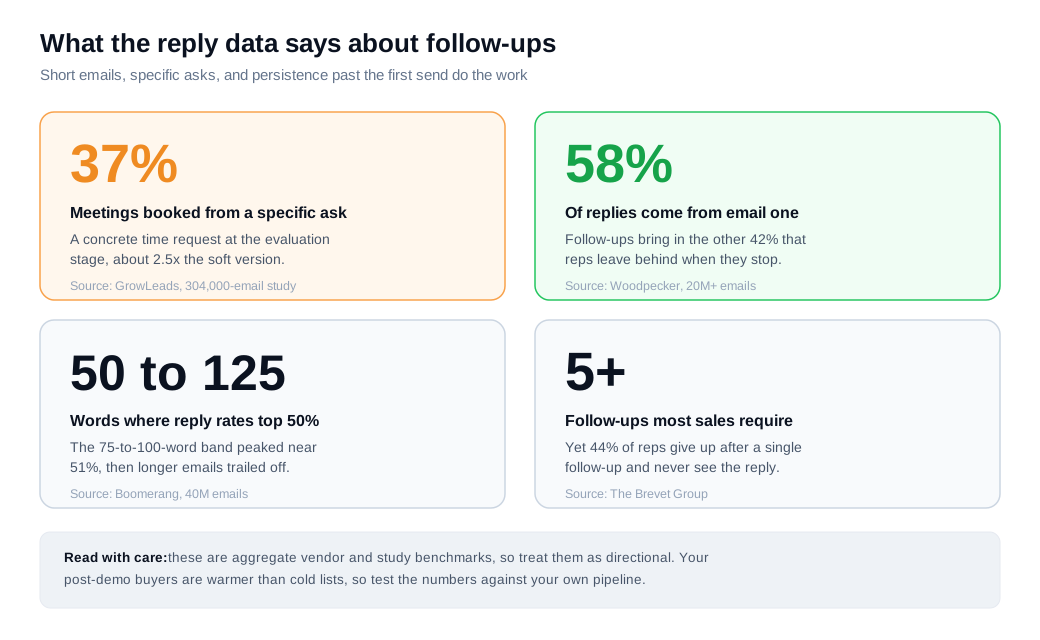
The length data is consistent. Boomerang's study of 40 million emails found that messages between 50 and 125 words returned response rates above 50%, with the 75-to-100-word range peaking near 51% and longer emails trailing off. Gong's sales-email research lands in the same place: reply rates drop once an email runs past about 100 words, and the strongest notes are three to four sentences.
Subject lines follow the same logic. Gong found that open rates fall as subject lines get longer, and one-to-four-word lines perform best. Skip the sell and name the thing: "Recap + next step," "Your pilot," "The security doc." Save the pitch for the body, where the buyer already chose to look.
A quick gut check before you hit send: read the email on your phone. If it fills more than a screen, or asks you to scroll to find the one question, cut it down.
What next steps drive replies?
The next step that drives replies is a single, specific ask tied to what you already agreed on, delivered as a plain question a busy person can answer in one line. Vague closers like "let me know your thoughts" or a menu of three options both underperform a clear request.
The stage you are in decides the shape of that ask. A study of more than 304,000 outreach emails found that interest-based CTAs, which ask about a problem or offer to share something useful, beat time requests early on, pulling a 12% reply rate against 7%, with far more of those replies being positive. Once a prospect enters active evaluation, which is exactly where a post-demo buyer sits, the pattern flips: specific asks with a concrete time request converted at a 37% meeting-booking rate, roughly two and a half times the soft version. After a demo, name the day.
So make the ask concrete and singular. "Are you free Thursday at 2 for a 20-minute pilot setup?" gives the buyer a yes or no they can send from their phone. "Would love to find time that works for everyone" gives them homework. Gong's data shows the same effect on the CTA itself, with interest-and-agreement-based asks lifting meeting bookings over generic time-drains.
Tie the step to the buyer's own next move whenever you can. If they said the CFO signs off on spend, the next step is a short call with the CFO, not a nudge to "review internally." Meeting the buyer at their stated next action is what turns a recap into a booked meeting.
How many demo follow-up emails should you send?
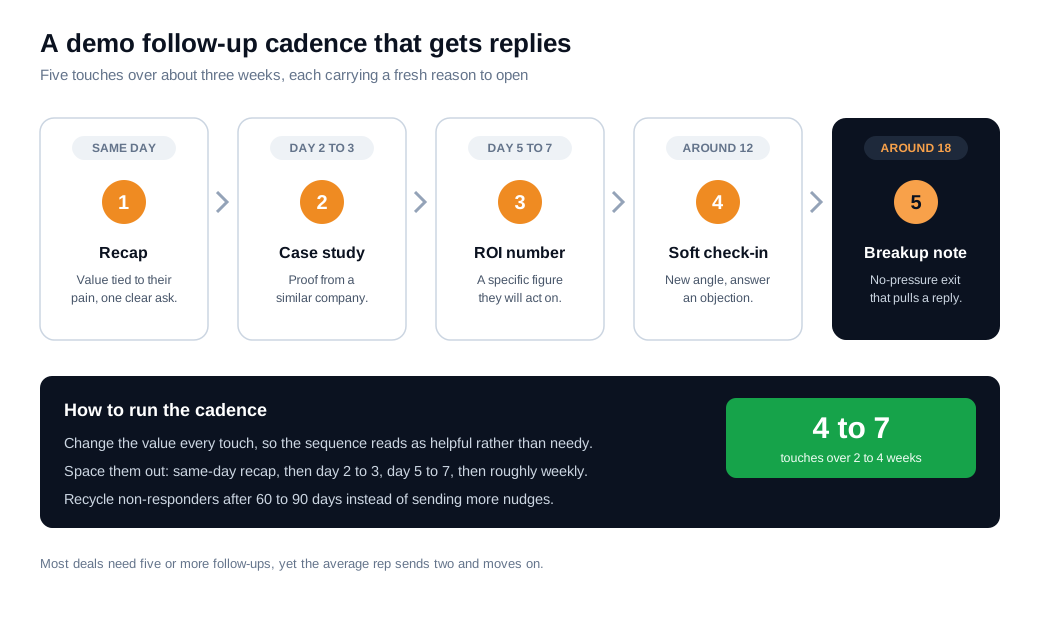
Plan for four to seven touches spread across two to four weeks, because most deals need five or more follow-ups and the average rep quits far too early. The gap between what works and what reps do is the easiest pipeline you will ever find.
The persistence numbers are stark. The Brevet Group reports that 80% of sales require an average of five follow-ups after the first meeting, while 44% of salespeople give up after a single follow-up. Woodpecker's analysis of more than 20 million cold emails shows why the extra touches pay off: the first email captures roughly 58% of all replies, and the follow-ups bring in the other 42% that most reps leave on the table by stopping.
More is not always better, though. The same body of data shows diminishing returns past the mid-single digits, and deliverability and goodwill both suffer if you keep hammering the same inbox. Four to seven well-spaced, genuinely useful touches is the sweet spot. Ten near-identical nudges is noise.
Here is a worked cadence. Say you demo 20 buyers in a month and stop after one recap. At a typical 15% reply you hear from 3. Now run the same 20 through a five-touch sequence over three weeks, each touch carrying a new angle: a recap, a case study, an ROI number, a soft check-in, a breakup note. If those added touches lift you to a 30% reply, you now hear from 6 of the 20. Same demos, double the conversations, and the only added cost is four short emails per buyer.
Space the touches so each one has room to land: same-day recap, then day two or three, then day five to seven, then roughly weekly. Change the value every time so the sequence reads as helpful rather than needy.
How do you handle a non-response after a demo?
When a prospect goes quiet, change the angle in each follow-up, try a second contact at the account, and then close the loop with a short breakup email that makes it easy to say the deal is dead. Repeating "just checking in" three times trains the buyer to ignore you.
Give every touch a fresh reason to open. One email carries a case study from a similar company, the next a specific ROI figure, the next a short answer to the objection they raised on the call. Each should stand on its own, so a buyer who ignored the last one still finds a reason to reply to this one. Silence often means a stalled internal process rather than a hard no, so a useful nudge can restart it.
When you have given value several times and still hear nothing, send the breakup. HubSpot's guidance on following up after no response is to send a brief, no-pressure note that signals you are closing their file. The move works because it removes the pressure and leans on loss aversion: a buyer who was quietly interested will reply rather than let the thread close for good.
A short breakup example:
Subject: Closing the loop
Hi Maria,
I have not heard back, so I will assume the pilot is not a priority right now and stop reaching out. If that is off base, reply with a day next week and I will set it up. Either way, thanks for the time, and I am here if things change.
Best, Dan
Two more moves save deals a breakup cannot. Multi-thread by looping in a second contact at the account, since your champion may have gone on leave or lost the internal argument. And recycle non-responders after 60 to 90 days rather than burning them out, because timing, not interest, is usually what killed the thread. A quiet lead in December is often a live one in March.
Key takeaways
- Anchor the recap to the buyer's own words. A demo follow up email that opens with the specific pain they described, adds one proof point, and asks for a single next step reads as helpful, while a generic "great chatting" note gets buried.
- Send it the same day. Most buyers expect a near-immediate response, and a recap that lands within hours freezes your version of the demo before competitors and plain forgetting take over.
- Keep it short. Boomerang's 40-million-email study puts the reply sweet spot at 50 to 125 words, and Gong finds three to four sentences with a one-to-four-word subject line work best.
- Make the next step one concrete ask. After a demo the buyer is in active evaluation, where specific time requests booked meetings at 37% in a 304,000-email study, so name the day instead of saying "let me know your thoughts."
- Follow up four to seven times. The Brevet Group finds 80% of sales need five or more follow-ups while 44% of reps quit after one, and Woodpecker's data shows follow-ups drive 42% of all replies.
- Break up, then recycle. When a prospect ghosts, a short no-pressure breakup email often pulls the reply nothing else could, and re-approaching after 60 to 90 days revives leads that stalled on timing, not interest.
TAGS

Written by
Daniel SemeckyCo-founder & CEO
Daniel is the co-founder and CEO of Glimpze. He spends his days talking to revenue teams about how to catch high-intent visitors before they bounce, and writes about inbound sales, lead conversion, and building a motion where marketing and sales actually share a number.


