
On this page
- Does free shipping or a discount drive more sales?
- How does free shipping affect conversions?
- Why does free shipping beat a discount of equal value?
- How do discounts compare?
- How do free shipping thresholds raise average order value?
- Which offer should you use, and when?
- How do you test free shipping against discounts?
- Key takeaways
- Sources
Free shipping worth $8 and $6 off a $60 order cost a store almost the same money. Shoppers treat them very differently. Run both as a split test and the free shipping side usually takes more orders, even when it is the cheaper gift.
The reason is not in a spreadsheet. It sits in how people read a price, why an extra charge at checkout stings more than a slightly higher sticker, and how a shipping bar can nudge a cart from $60 to $75 without a single new visitor.
Get the mechanics right and the same promo budget returns more revenue.
This post covers whether free shipping or a discount drives more sales, how each affects conversion, why free shipping feels better than an equal discount, how thresholds raise average order value, which offer fits which store, and how to test the two against each other on your own traffic.
Does free shipping or a discount drive more sales?
Free shipping usually drives more sales than an equal discount. It erases the single biggest reason shoppers abandon a cart, and it carries a psychological pull that a price cut does not match.
The Baymard Institute finds that extra costs like shipping, taxes, and fees are the top reason people with real buying intent leave checkout, cited by 48 percent of them. An offer that removes that specific objection tends to beat one that shaves a few dollars off a price the shopper had already accepted.
The word "usually" is doing real work, though. Free shipping wins most often on low and mid-priced orders, where a shipping charge is a large share of the total. On a $400 order, $8 of shipping is background noise, and a 10 percent discount worth $40 speaks louder.
Margin matters too. Free shipping is a fixed cost you absorb on every qualifying order, while a percentage discount scales with basket size.
The honest answer is that free shipping is the stronger default for most stores. The rest of this post is about when that default flips, and how to prove it on your own numbers.
How does free shipping affect conversions?
Free shipping lifts conversion by removing the number one checkout objection, unexpected cost, before the shopper ever hits it. Shipping fees that appear late in checkout trigger the exact abandonment Baymard measures, so folding that cost into the price or the store's margin closes the gap between intent and purchase.
Consumer expectation has hardened around it. Capital One Shopping's research reports that a majority of shoppers will not complete a purchase once they learn shipping is not free.
Figures compiled by Redstag Fulfillment show most American shoppers now expect free shipping once an order clears a minimum, with a large share rating free delivery as more important than fast delivery.
When an offer meets an expectation shoppers already hold, its absence reads as a penalty. That is why the presence of free shipping moves the conversion needle more than most discounts of the same value.
The catch is that free shipping is never actually free. Someone pays to move the box, and if that someone is you, the conversion gain can arrive with a margin loss attached. That trade is why you test rather than assume, which the last section covers.
Why does free shipping beat a discount of equal value?
Free shipping beats a discount of equal value because a price of zero is processed differently, a bias behavioral economists call the zero price effect.
In the classic demonstration from Dan Ariely and colleagues, shoppers chose between a Lindt truffle at 15 cents and a Hershey's Kiss at 1 cent, and 76 percent took the higher-quality truffle. When both prices dropped by a cent, making the Kiss free, preferences flipped and about 69 percent grabbed the free candy — even though the price gap between the two options was identical.
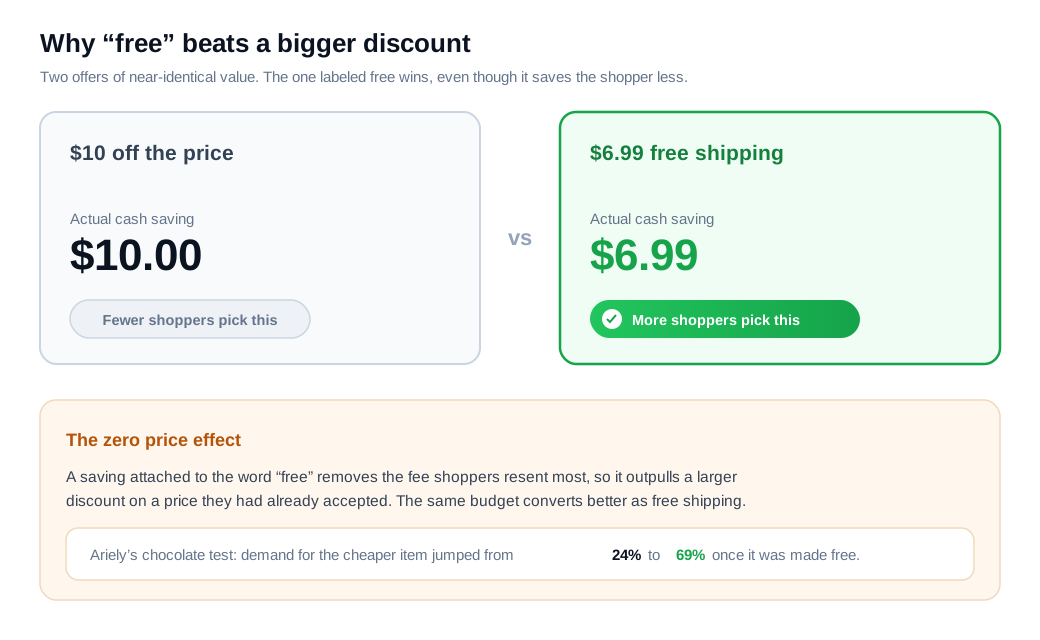
The same asymmetry shows up in shipping. Former Wharton professor David Bell found that shoppers preferred an offer that saved them $6.99 in shipping over one that took a larger $10 off the product price, as recounted in The Hustle's write-up of the research.
People struggle to see why moving a box should cost anything, so a shipping charge feels like a penalty rather than a fair price, and removing it feels better than a discount worth more. The St. Louis Fed's primer on the psychology of free frames it the same way: zero is a special price that lowers the perceived risk of a decision.
For the seller, the lesson is framing. The same cash saving lands harder attached to the word "free" and to the fee shoppers resent most, so a store choosing between two offers of equal cost should usually put the money toward shipping.
How do discounts compare?
Percentage and dollar discounts win when the order is large, the margin is generous, or the goal is to clear specific inventory — situations where free shipping does little.
A discount scales with the basket. On a $300 order a 15 percent cut returns $45 of perceived value, far more than any realistic shipping charge, and that scale is what makes discounts the better tool for high-ticket and considered purchases.
Discounts also flex in ways free shipping cannot. You can target them by product to move slow stock, by customer to win back a lapsed buyer, or by cart size to protect margin. A code like "15 percent off orders over $150" behaves like a threshold and a discount at once.
The trade-off is that a visible price cut can train shoppers to wait for the next sale and can cheapen a premium brand — effects that a free shipping offer mostly avoids because it reads as a service rather than a markdown.
The two also hit your books differently. A 10 percent discount on a $60 order costs you $6 and scales with what people buy, while free shipping costs a flat $8 (or whatever the label runs) whether the basket is $40 or $90.
On small orders free shipping is the more expensive gift, and on large orders the discount is. That crossover point, where the two offers cost the same, is worth finding for your own catalog, because it tells you which lever is cheaper at each basket size.
ReferralCandy's comparison reaches the same split: free shipping for broad conversion on everyday baskets, discounts for high-value orders and precise targeting.
How do free shipping thresholds raise average order value?
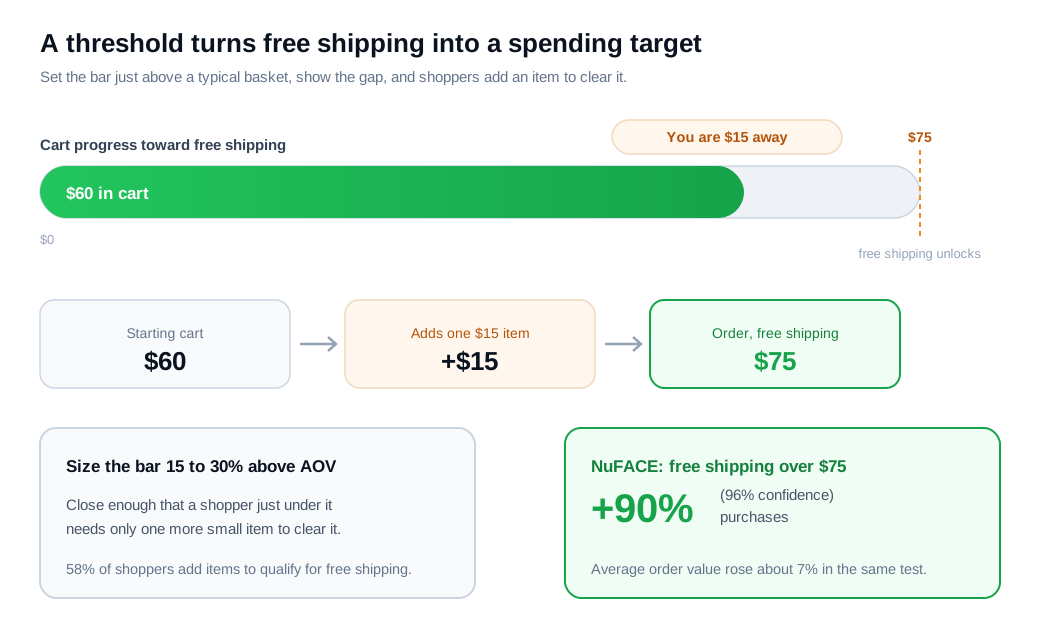
A free shipping threshold raises average order value by setting the bar just above a typical basket, so shoppers add an item to avoid paying for delivery. It turns the psychology of free into a spending target.
It is also the mechanism that lets a store offer free shipping without absorbing the cost on every small order. Around 58 percent of shoppers say they add items to a cart to qualify for free shipping, according to SellersCommerce's data, which is why the tactic is so dependable.
The size of the bar decides the result:
- Set it 15 to 30 percent above your average order value, close enough that a shopper sitting just under it needs only one more small item to clear it.
- Show the gap in plain language. A message like "You are $15 away from free shipping" only works if the shopper can see how close they are.
- Set the bar too high and it feels unreachable, so orders stay put.
- Set it below your average and you hand free shipping to baskets that would have cleared it anyway.
Here is what it looks like in the wild. Skincare brand NuFACE tested placing a "Free shipping over $75" message above its main call to action. VWO's case study reports the variation lifted the number of purchases by about 90 percent at a 96 percent confidence level, while raising average order value by roughly 7 percent.
The threshold did two jobs at once: it removed the shipping objection for qualifying orders, and it pushed shoppers with smaller carts to add one more item.
Which offer should you use, and when?
Use free shipping, usually as a threshold, as the default for everyday and mid-priced baskets. Reach for a discount when orders are large, margins are thin, or you need to target a specific product or customer.
The decision comes down to three things:
- Your price point, or how much of the order total a shipping charge represents.
- Your margin per order, or how much a flat absorb or a percentage cut leaves behind.
- Your goal, whether that is broad conversion or moving specific stock to specific people.
Work a concrete example. Suppose a store gets 5,000 checkout sessions in a promo month, its average order value is $60, gross margin is 50 percent (so $30 of margin per order before any offer), and fulfillment costs $8 a shipment. At a baseline 4 percent conversion the store books 200 orders and $6,000 of contribution.
Now run three offers against that baseline.
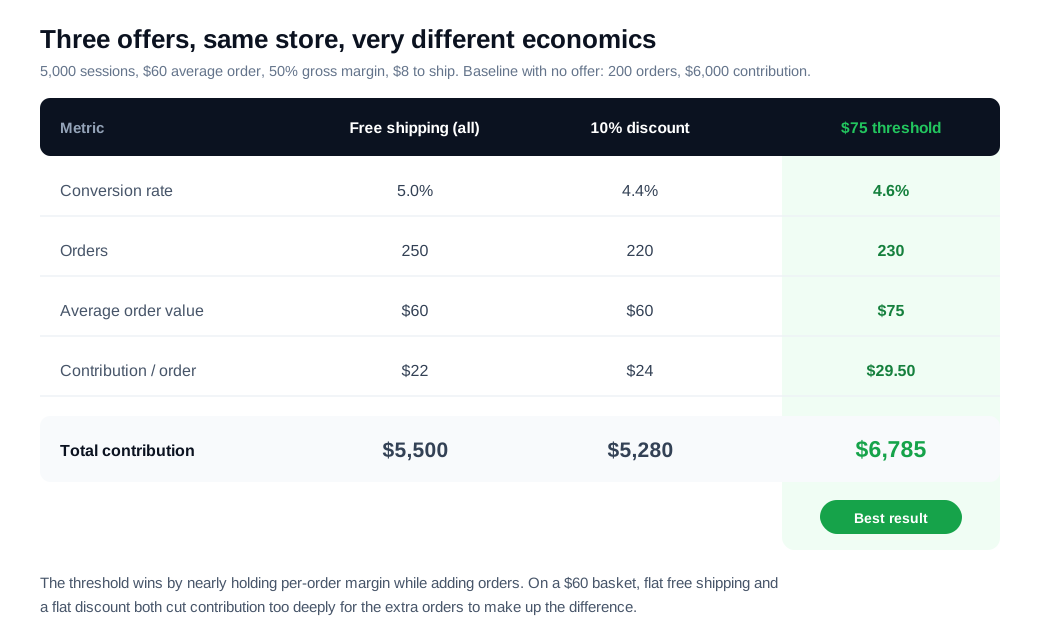
Universal free shipping lifts conversion, but the store swallows $8 on every order. Say conversion rises to 5 percent, giving 250 orders at $22 of contribution each, which is $5,500. More orders, less money, because the flat cost is heavy against a $30 margin.
A flat 10 percent discount ($6 off) lifts conversion less, say to 4.4 percent, giving 220 orders at $24 each, or $5,280.
The free shipping threshold at $75 changes the shape of the order. Conversion rises to about 4.6 percent and, more importantly, shoppers add items to clear the bar, pushing average order value to $75. That is 230 orders carrying $37.50 of margin minus $8 of shipping, or $29.50 each, for $6,785 of contribution.
The threshold wins because it nearly holds per-order contribution while adding orders, where the two flat offers cut margin too deeply to catch up.
The example also shows where a discount would take the lead. Raise the price point to a $400 average order and that $8 shipping absorb becomes trivial, while a percentage discount scales into real perceived value and still leaves plenty of margin.
For higher-ticket, considered purchases, a conversation often recovers more margin. A shopper weighing a $600 order will frequently respond to a person answering the one question holding them back, which is why offering live chat on product and cart pages, handled like an inbound sales touch rather than a hard sell, tends to beat reflexively discounting. Save the price cut for when the shopper genuinely needs it.
How do you test free shipping against discounts?
You test the two offers by running them as parallel variants on live traffic, judging the winner on contribution per session, not conversion rate alone.
Conversion tells you which offer more people accepted. Contribution, meaning revenue after the cost of the offer and the goods, tells you which one actually made more money. Those two answers often disagree.
Set it up as a clean split. BDOW's testing guide suggests creating variants with unique codes (a percentage discount, a dollar discount, and free shipping or a threshold), then splitting traffic evenly and letting each run untouched.
Keep the cash value roughly matched so you are testing the mechanism rather than the size of the giveaway, for example free shipping worth about $8 against $8 off. Pick one primary metric before you start, and make it revenue or contribution per visitor, so a cheap but popular offer cannot win on volume while quietly losing money.
Give it enough traffic and time to reach statistical significance, run it across full weeks to absorb day-of-week swings, and watch a few guardrail metrics beside the headline: average order value, margin per order, and return rate.
Segment the results too. Free shipping may win on mobile and small baskets while a discount wins on your highest-value orders, and the right call for the store can be to run both, each matched to the segment where it pays off.
A tool like live chat on the checkout page can also surface why one variant underperforms, since the questions shoppers ask when an offer confuses them are the fastest read on what to fix next.
Key takeaways
- Free shipping is the stronger default, because it removes the top cause of cart abandonment, the 48 percent who quit over extra costs, and meets an expectation most shoppers now hold.
- Free beats a bigger discount on small and mid orders, thanks to the zero price effect: shoppers preferred saving $6.99 on shipping over $10 off a price they had already accepted.
- Discounts win on high-ticket and targeting, since a percentage cut scales with basket size and can be aimed at a product, a customer, or a cart threshold in ways free shipping cannot.
- A threshold turns free shipping into an AOV lever, set 15 to 30 percent above your average order value and shown as a live progress gap, as NuFACE's "over $75" test that lifted purchases about 90 percent shows.
- Judge the test on contribution per session, because the more popular offer can still lose money once you subtract the shipping you absorb or the margin you discount away.
- The best answer is often both, free shipping or a threshold for everyday baskets and a targeted discount for high-value orders, proven with a live split test rather than assumed.

Written by
Nilas MylerCo-founder & CTO, Glimpze
Nilas is the co-founder and CTO of Glimpze, an inbound sales tool that turns high-intent website visitors into live conversations. A former SEO consultant for some of the largest companies in Denmark, he writes about speed-to-lead, inbound sales, and conversion rate optimization — the technical and operational mechanics of turning traffic into pipeline.


