
On this page
A shopper orders the same jacket in two sizes, keeps one, and ships the other back a week later. At checkout the sale looked whole. Seven days on, half of it reverses, and the store still pays for the return label, the warehouse labor to inspect and restock, and the markdown on a coat that may not sell again at full price.
That pattern is now ordinary. In 2024, US shoppers returned about $890 billion in merchandise, roughly 16.9% of everything retailers sold, according to the National Retail Federation and Happy Returns. Online the rate runs higher, near 19.3% of online sales in the NRF's 2025 estimate. Some of that is the cost of selling to people who cannot touch the product first. A large share of it traces to a short list of causes you can actually fix.
This post covers why customers return products, what a normal return rate looks like, how accurate descriptions and pre-purchase support cut returns, what bracketing is and how to limit it, and how to measure your return rate so you know whether any of it is working.
Why do customers return products?
Most product returns trace to a short list of causes led by wrong fit or size, an item that does not match its description or photos, damage or defects, and shoppers who changed their mind. Sort your returns into those buckets and you learn which ones a better product page can prevent and which ones sit in the warehouse or the courier van.
Fit is the dominant cause in apparel and footwear, the two categories that drive most ecommerce returns. Fit and sizing account for roughly 53% to 70% of clothing returns, per Fabrikator's breakdown, because a size label alone cannot tell a buyer how a garment will actually sit on their body. The next cluster is expectation mismatch. About 22% of returns happen because the product looked different in person than it did online, and roughly 14% because the description was inaccurate, according to figures compiled by Ringly. Those are failures of the page rather than the product.
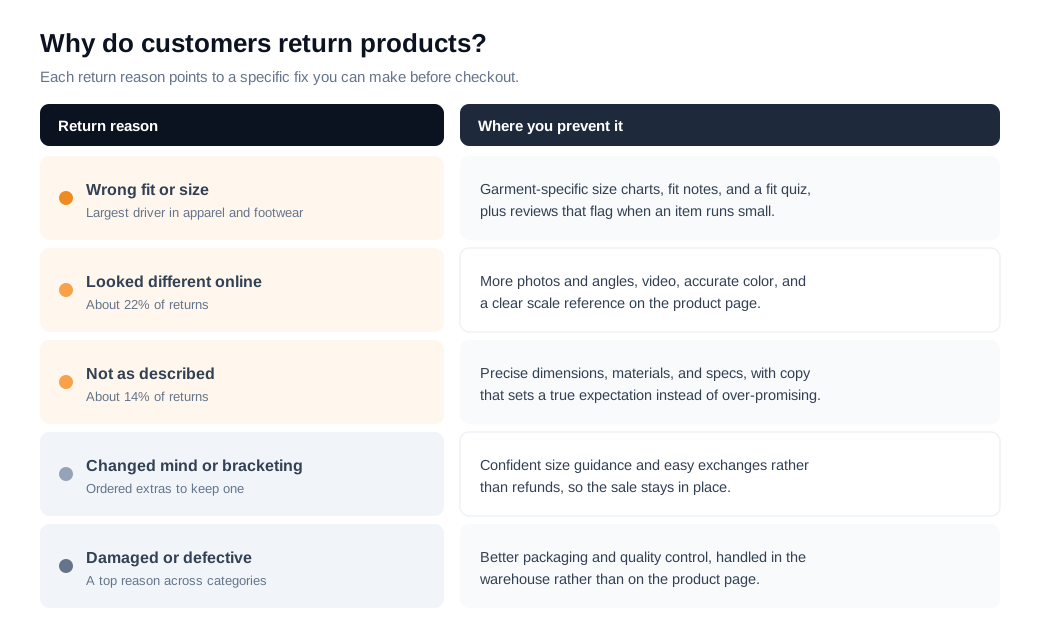
The rest split between fulfillment and intent. Damaged or defective arrivals are a leading reason across every category and point at packaging and quality control rather than copy. Outside apparel, unclear specs cause the same trouble in a different form: an electronics buyer who cannot tell whether a cable fits their model, or a shopper who receives the wrong variant, returns for a reason a clearer page would have removed. And a steady share of shoppers simply change their mind, order more than they intend to keep, or buy for an occasion and send it back after. Each bucket needs a different fix, which is why the first useful step is tagging every return with a reason before you touch anything else.
What is a normal product return rate?
A normal product return rate depends on what you sell, but online stores commonly land between 15% and 30% overall, with the NRF putting 2025 ecommerce returns near 19.3% of online sales. Judging your own number against a single benchmark hides more than it shows, because category sets the expected range before you change a thing.
Apparel sits at the top. Clothing return rates commonly run 20% to 40%, footwear a little lower, while categories where fit is not a factor stay far below that. Electronics typically fall in the high single digits to the mid teens, and beauty lower still, as category benchmarks compiled by Richpanel show. A 25% return rate is a warning sign for a housewares store and an ordinary week for a fashion brand.
Online also runs consistently higher than in-store, since shoppers cannot inspect the item first, and rates spike after the holidays when gift returns land. The practical move is to benchmark against your own history and your own category, then segment. A blended sitewide rate tells you a problem exists somewhere. Return rate by product, by category, and by reason tells you where, which is the number you can act on.
How do accurate descriptions reduce returns?
Accurate descriptions reduce returns by closing the gap between what a shopper pictures at checkout and what shows up at the door, which removes the "not as described" and "looked different online" returns that make up a meaningful slice of the total. When the page sets a true expectation, fewer orders disappoint on arrival.
Start with the details that decide fit and suitability. Precise dimensions and weight, materials and care, true-to-size guidance, and a garment-specific size chart answer the questions that otherwise get answered by ordering and returning. Multiple photos from several angles, an accurate color, a clear scale reference, and a short video reduce the surprise that drives the 22% "looked different" bucket. Optimizing product content along these lines is one of the more reliable ways to move returns, since detailed, accurate product data is tied to both lower return rates and higher conversion, per Envive's roundup of description studies.
There is a discipline to it that teams often skip. Copy that oversells raises returns, because every claim the product cannot live up to becomes a disappointed unboxing and a shipping label. Describe the item as it is, name the trade-offs, and let the specs carry the weight. Customer reviews then do work the copywriter cannot: a review that says "runs small, order up" or "the blue is closer to teal" corrects expectations in the buyer's own words, so surfacing fit and accuracy feedback near the buy box is one of the cheapest return-reducers available.
Here is a worked example. Suppose a store sells 4,000 units a month at an 18% return rate, which is 720 returns, and its own return tags show 30% of those are "not as described" or "looked different." That is 216 returns a month tied to the page itself. Cut that group by a third through better copy, sharper photos, and surfaced reviews, and you save about 72 returns a month. At a $60 order value that is roughly $4,300 of reversed revenue you stop losing every month, before counting the return shipping and restocking labor each one would have cost.
How does pre-purchase support help?
Pre-purchase support helps by answering the exact question holding a shopper back before they commit, so they buy the right item once instead of buying, returning, and reordering. A return that begins as an unanswered sizing or compatibility question never has to happen if the question gets answered at the moment it comes up.
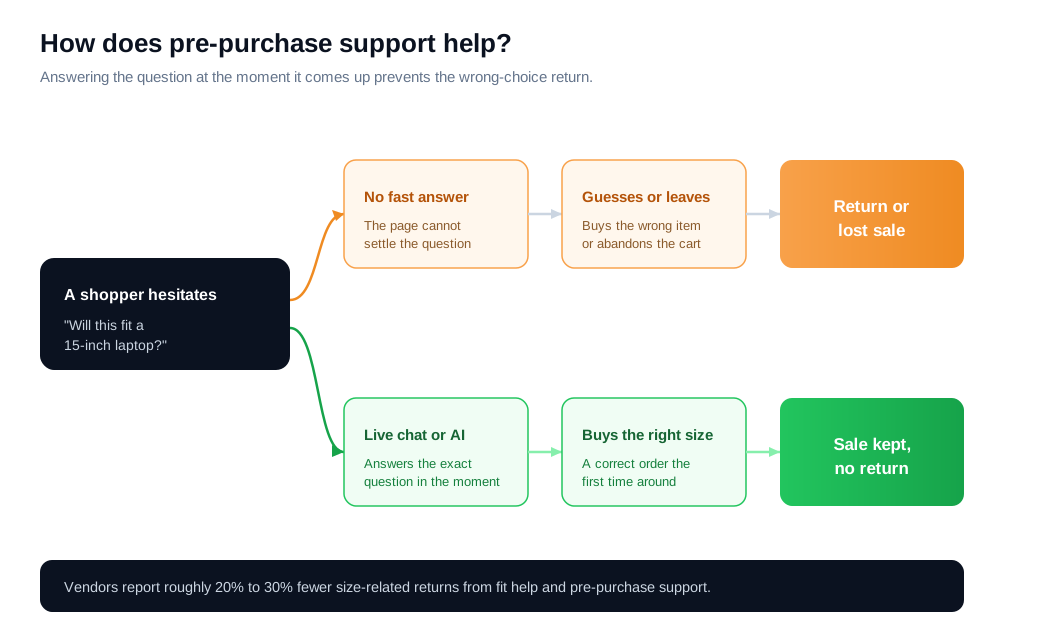
The mechanism maps onto the reasons. A shopper unsure whether a coat runs small, whether a part fits their model, or whether a fabric suits their need has three options: guess, leave, or ask. Guessing produces the wrong-choice return, and leaving produces a lost sale. A fast answer produces a correct purchase. That is why fit tools and guided pre-purchase support keep showing up in return-reduction results, with vendors reporting reductions in the 20% to 30% range from sizing help and virtual try-on, per Vntana's rundown of tactics. Treat those as vendor figures, but the direction is consistent and the logic holds, because a right-sized order does not come back.
Put the help where the hesitation is. A live chat window on the product and cart pages lets a shopper ask "will this fit a 15-inch laptop?" and buy with confidence, and for higher-consideration products a rep who can jump on video or screen share can walk a buyer through the exact concern, the same inbound sales motion that lifts conversion also trimming returns. Outside staffed hours, an AI chat assistant grounded in your specs and sizing can field the common questions, and keeping that assistant's knowledge base accurate matters as much as the product copy, since a confident wrong answer creates the return a right one would have prevented.
Targeting matters more than volume here. A generic popup on every page gets ignored, so trigger the offer on real hesitation, such as a shopper who has lingered on a sizing tab or bounced between two variants, and route them to whoever can actually answer. Help that arrives at the deciding moment prevents a return; help that fires too early just adds noise.
What is bracketing, and how do you reduce it?
Bracketing is when a shopper deliberately buys the same item in several sizes or colors, plans to keep one, and returns the rest, and you reduce it by removing the sizing uncertainty that makes bracketing feel like the safe choice. It is a rational response to a page that cannot tell the buyer which size is right.
The behavior is widespread and growing, especially among younger shoppers. Fabrikator reports that 51% of Gen Z have bracketed an order, and every one of those orders books multiple units of revenue that were never meant to stay. Banning it punishes good customers, so the lever is the uncertainty behind it, not the shopper.
Give people a reason not to hedge. A precise, garment-specific size chart, a fit quiz that recommends one size, and reviews that flag whether an item runs large or small all shrink the case for ordering two. When a buyer still guesses wrong, steer the outcome toward an exchange rather than a refund, since an exchange for the right size keeps the sale while a refund loses it. Some stores also flag orders that contain the same item in multiple sizes and route them for a quick fit follow-up, which catches the pattern before it ships and turns a planned double return into one confident order.
How do you measure return rate?
You measure return rate by dividing the number of items returned by the number of items sold over the same period and multiplying by 100: (items returned ÷ items sold) × 100. Keep the numerator and denominator on the same basis, either units or orders, so the ratio actually means something, a point Loop Returns and Narvar both stress.
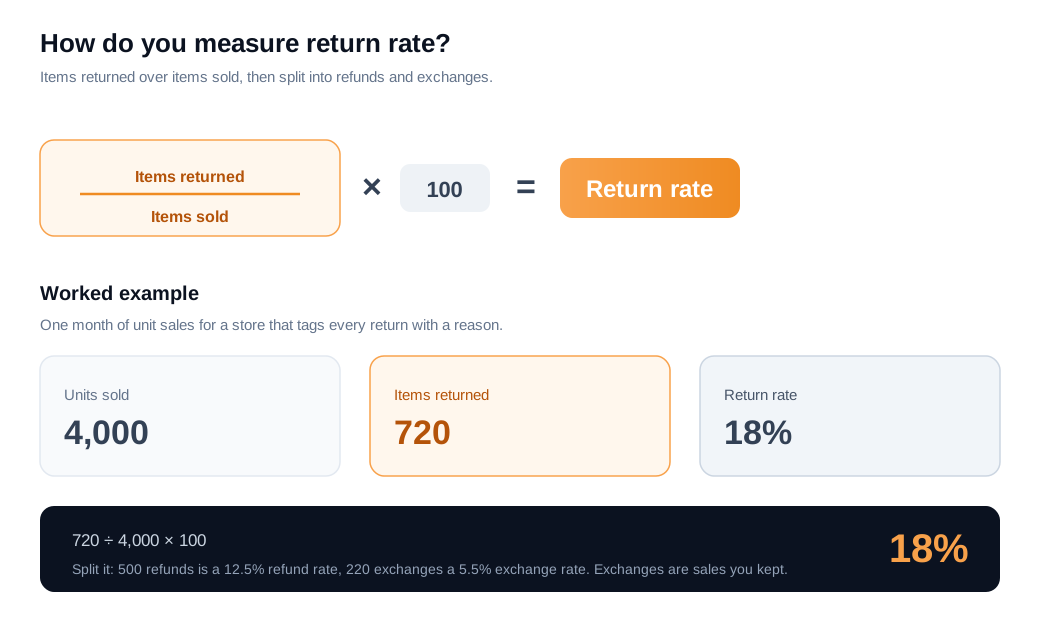
Here is a worked example. A store sells 4,000 units in a month and 720 come back. Divide 720 by 4,000 to get 0.18, then multiply by 100 for an 18% return rate. Split that further to make it useful: if 500 of the 720 were refunded and 220 were exchanged, your refund rate is 12.5% and your exchange rate is 5.5%, and the exchanges are sales you kept. Tracking those apart, as Narvar recommends, tells you whether a change turned lost sales into saved ones or just shuffled returns around.
Two habits keep the number honest. Match the return window to your policy, so a purchase in one month and its return the next get credited to the same cohort rather than flattering the current period. And always pair the rate with a reason code. A return rate that falls tells you something worked. A return rate that falls while "not as described" drops fastest tells you it was the product page, which is the difference between guessing and knowing what to do next.
Key takeaways
- Sort returns by reason first. Fit and size, "not as described," damage, and changed-mind returns each need a different fix, and tagging every return is what tells you which lever to pull.
- Judge your rate by category. Online returns commonly run 15% to 30%, apparel far higher than electronics or beauty, so benchmark against your own history and segment rather than a single sitewide number.
- Make the page tell the truth. Precise dimensions, size charts, multiple photos, accurate color, and surfaced fit reviews remove the "looked different" and "not as described" returns, and honest copy beats overselling.
- Answer the question before checkout. Live chat, a grounded AI assistant, and fit guidance turn a would-be wrong-choice return into a correct purchase, with vendors reporting 20% to 30% fewer size-related returns.
- Attack bracketing with certainty, not penalties. Better size guidance and easy exchanges shrink the reason shoppers order two sizes to keep one.
- Break the rate down by reason. Return rate is items returned over items sold times 100, and the reason breakdown is what tells you whether a fix actually worked.

Written by
Nilas MylerCo-founder & CTO, Glimpze
Nilas is the co-founder and CTO of Glimpze, an inbound sales tool that turns high-intent website visitors into live conversations. A former SEO consultant for some of the largest companies in Denmark, he writes about speed-to-lead, inbound sales, and conversion rate optimization — the technical and operational mechanics of turning traffic into pipeline.


