
On this page
- What is upselling?
- What is cross-selling?
- What is the difference between upselling and cross-selling?
- Why do upselling and cross-selling matter for revenue?
- Where do you place upselling and cross-selling on the store?
- How do you avoid overdoing it?
- How do you measure whether upselling and cross-selling are working?
- Key takeaways
- Sources
A shopper drops a $130 pair of running shoes into the cart. Two small suggestions appear next to it. One points to a $165 model with more cushioning and a smoother ride. The other adds a $14 three-pack of moisture-wicking socks that pairs with the shoe. The first offer raises the value of the thing they already want. The second adds something that goes with it.
Those are the two oldest moves in retail, and online they run on the same recommendation widgets. They also explain a large share of ecommerce revenue. McKinsey estimated that about 35% of what people buy on Amazon comes from algorithmic recommendations, and Salesforce found that shoppers who click a recommendation make up roughly 7% of visits yet drive about 26% of revenue. Small nudges, outsized results, when they land right.
This post covers what upselling and cross-selling each mean, how they differ, why they move revenue, where to place each on the store, how to avoid overdoing it, and how to measure whether either is actually working.
What is upselling?
Upselling is persuading a shopper to buy a higher-value version of the item they are already considering, so the same purchase carries a larger price and, usually, a better margin. The product category stays the same. The tier goes up.
The classic form is a good-better-best ladder. A customer looking at the $130 running shoe sees a $165 model with more cushioning and a lighter upper, or a $200 model with a carbon plate. A laptop buyer configuring 256GB of storage is shown the 512GB option for another $150. A software plan page nudges a Starter user toward Pro for the extra seats. In each case the shopper wanted one thing, and the store offered a stronger version of that same thing.
Upselling works because the shopper has already decided to buy the category. The hard part of the sale, convincing someone they need running shoes at all, is done. Comparing two shoes is a much smaller leap than deciding to shop for shoes, so a well-framed upgrade converts often. The catch is that the upgrade has to earn its price. A shopper who cannot see what the extra $35 buys reads the higher number as a tax, and either drops to the cheaper option or leaves to think about it.
What is cross-selling?
Cross-selling is recommending a complementary product that goes with what the shopper is already buying, so the order gains an extra item rather than a pricier one. The original product stays in the cart. Something related joins it.
Amazon's "Frequently bought together" and "Customers who bought this item also bought" rows are the reference examples. Buy a camera, and the store suggests a memory card, a case, and a spare battery. Buy a dress, and it shows shoes and a clutch that match. Buy a mattress, and it offers a protector and a set of sheets. None of these replaces the original purchase. Each one attaches to it.
Cross-selling leans on relevance more than price. A phone case next to a new phone feels helpful, because the shopper will need one anyway, so the suggestion reads as a reminder rather than a pitch. An unrelated suggestion, a kitchen gadget next to a phone, reads as noise and teaches people to ignore the widget. The best cross-sells answer a question the buyer had not gotten to yet, usually some version of "what do I need to actually use this?"
What is the difference between upselling and cross-selling?
The difference is direction: upselling moves a shopper up to a more expensive version of one product, while cross-selling moves them across to an additional, complementary product. Upselling grows the value of a single line item. Cross-selling grows the number of line items.
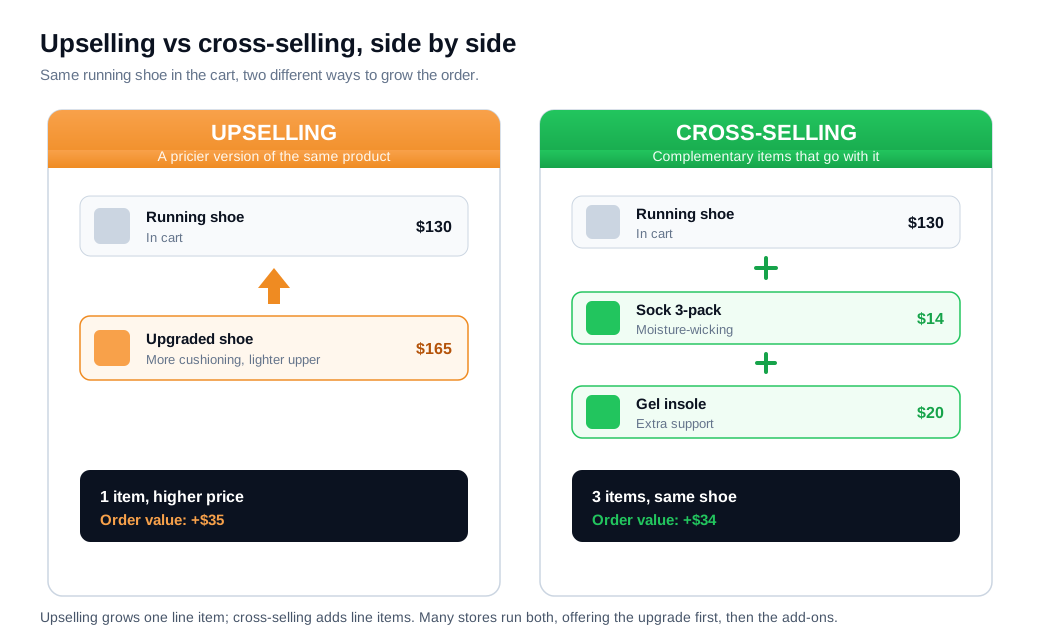
A single scenario shows both at once. A customer adds the $130 running shoe to the cart. The upsell is the $165 shoe with better cushioning: one item, higher price. The cross-sell is the $14 sock three-pack and a $20 gel insole: extra items, same shoe. You can run them together, offering the upgraded shoe first, then, once a shoe is chosen, suggesting the socks that go with it. Sequence matters, because pushing both in the same breath tends to overwhelm the decision.
There is a third cousin worth naming, the down-sell, where a store offers a cheaper option to a shopper about to abandon over price. It is the mirror image of upselling and useful for rescuing a sale that would otherwise be lost, though it sits outside the scope here.
Why do upselling and cross-selling matter for revenue?
Upselling and cross-selling matter because they raise average order value from traffic you have already paid to acquire, which is the cheapest revenue in ecommerce. Every extra dollar from a shopper already in the cart skips the cost of winning a new visitor.
The economics favor selling to people already in motion. The marketing textbook Marketing Metrics puts the probability of selling to an existing customer at 60% to 70%, against 5% to 20% for a new prospect, a gap that explains why expansion revenue tends to be more profitable than acquisition. Recommendation data points the same way. Salesforce reported that visits where a shopper clicked a product recommendation were about 7% of all visits but drove roughly 24% of orders and 26% of revenue, and those clickers were 4.5 times more likely to complete a purchase.
Work the numbers on an ordinary store. Say it takes 10,000 orders a month at a $60 average order value, or $600,000 in monthly revenue. Add an upsell that lifts 8% of orders by $25, and a cross-sell that adds $12 to 15% of orders. The upsell contributes 800 x $25, or $20,000. The cross-sell contributes 1,500 x $12, or $18,000. Together that is $38,000 more a month, a 6.3% lift in average order value, on exactly the same traffic and ad spend. Over a year it clears $450,000, which is why the recommendation rows earn their place on the page.
Where do you place upselling and cross-selling on the store?
Place each offer where the shopper is most ready for it: upsells early, near the product decision, and cross-sells later, once the main item is locked in. The rule of thumb is to upgrade the choice before it is made and to add to it after.
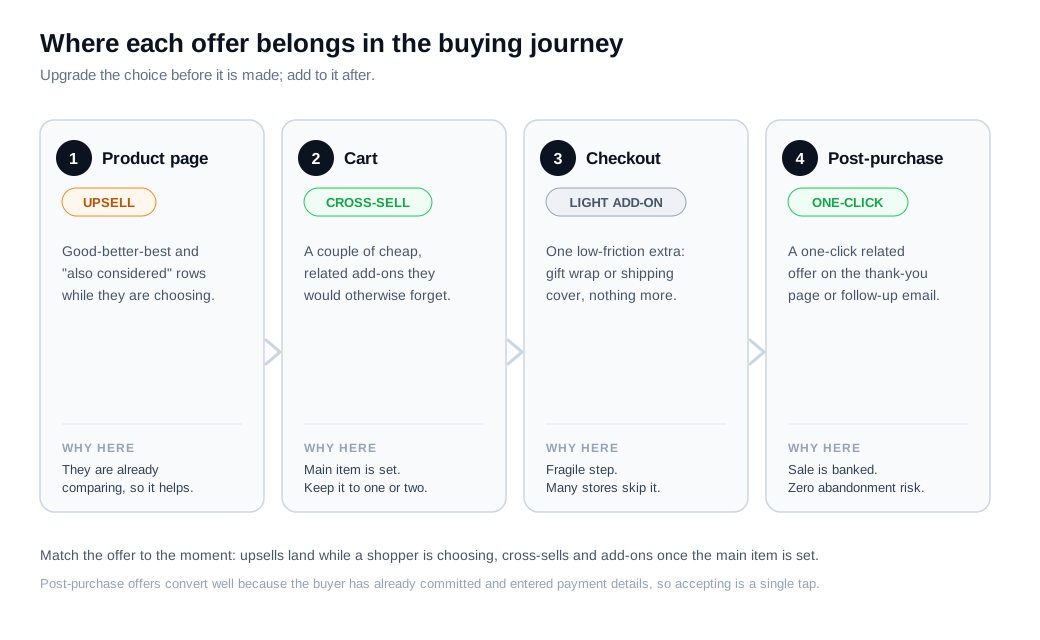
The product page is the home of the upsell. A shopper reading the $130 shoe is still choosing, so a compact good-better-best comparison, or an "also considered" row featuring the upgraded model, lands while the decision is open. Alternatives shown here help rather than distract, because the shopper is already comparing.
The cart is where cross-sells work best. The main item is chosen, so a short list of genuinely related add-ons, the socks, the insole, the memory card, catches things the buyer would have forgotten. Keep it to a couple of options, and keep them cheap relative to the cart, so the add feels trivial.
The checkout is the most fragile slot, so use it lightly. A single low-friction add-on, gift wrap, shipping protection, or a small consumable, is about as far as you should push, because anything that reopens the decision here risks the whole order. Many stores skip offers at checkout to protect the conversion.
Post-purchase, on the confirmation page or in the follow-up email, is underrated. The sale is already banked, so a one-click offer to add a related item carries no cart-abandonment risk. Yotpo notes that post-purchase upsells tend to convert well precisely because the buyer has already committed and entered their payment details, so accepting is a single tap.
For higher-consideration purchases, the best placement is sometimes a person. A shopper weighing the $130 shoe against the $165 one often has a specific question, about fit, durability, or whether the upgrade is worth it, and a real-time answer through live chat resolves it in the moment instead of leaving them to guess or leave. Stores that treat the storefront as an inbound sales channel let a rep suggest the right tier in context, which converts better than a popup and avoids pushing something the shopper does not need.
How do you avoid overdoing it?
You avoid overdoing it by keeping offers few, relevant, and well-timed, because past a certain point each extra suggestion lowers the odds of any sale at all. Adding more offers stops helping quickly. Past a handful, each new suggestion drags the whole page down.
The clearest evidence comes from a classic experiment. Psychologists Sheena Iyengar and Mark Lepper set up a jam-tasting booth in a grocery store, alternating between 24 varieties and 6. The larger display drew more foot traffic, but only 3% of the people who stopped bought a jar. The smaller display converted 30% of its visitors, roughly ten times as many. Too many options created paralysis, and shoppers walked away rather than choose.
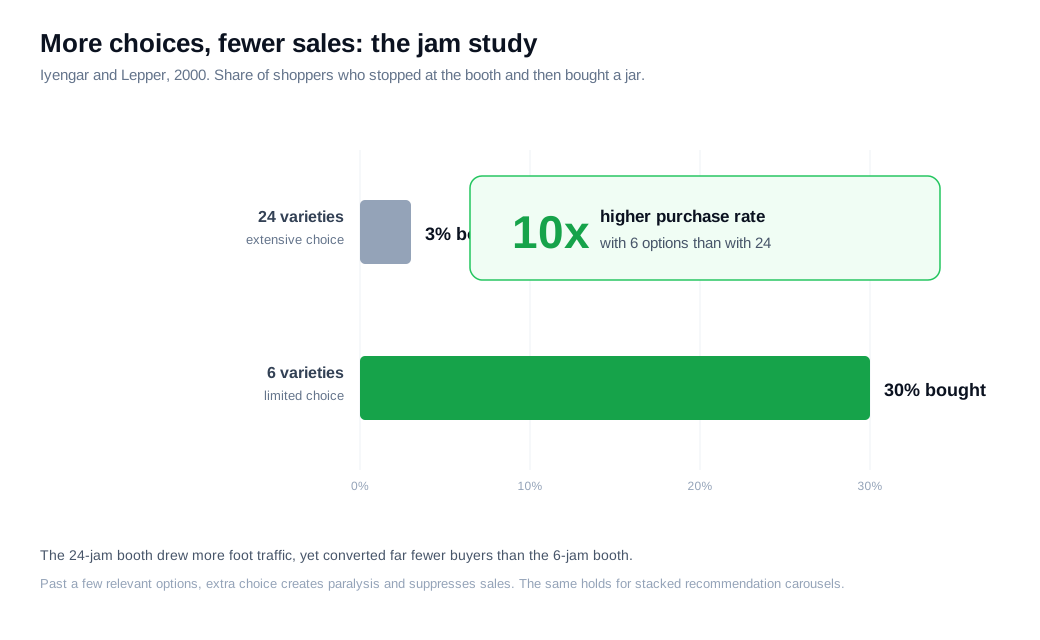
The same paralysis shows up in a cart stuffed with recommendation carousels. Three practical limits keep the effect on your side. Cap each placement at one or two options, not a wall of them, so the shopper can actually weigh the suggestion. Make every suggestion relevant to what is in the cart, since an unrelated offer trains people to tune out the widget entirely. And time the offer to the moment, an upgrade while choosing, an add-on after choosing, rather than interrupting checkout with a pitch.
Tone matters as much as count. An upsell should give the shopper a clear reason the pricier option is better for them, and it should be easy to decline. Pressure and dark patterns win a single order and cost the repeat business that makes a store profitable. If you run proactive nudges, the same discipline applies: a well-timed, relevant prompt, set up along the lines of the proactive outreach guide, helps, while a barrage of popups just annoys.
How do you measure whether upselling and cross-selling are working?
Measure upselling and cross-selling by tracking average order value, attach rate, and the acceptance rate of each offer, then watch a guardrail metric so the extra revenue is not quietly costing you conversions or returns. The headline you care about is more revenue per order without fewer orders.
Three numbers tell most of the story. Average order value shows whether the total is rising. Attach rate, the share of orders that include a recommended add-on, shows how often cross-sells land. Offer acceptance rate, taken per placement, shows which specific widgets earn their space and which just add clutter. Track them per placement, because a product-page upsell and a post-purchase cross-sell behave nothing alike.
The guardrail is the important part. An offer that lifts average order value but drops the overall conversion rate, or that inflates returns because people were nudged into the wrong tier, is a net loss dressed up as a win. Test changes the way you would test any product-page change, splitting traffic and keeping the offer only if the order-value gain survives without denting conversion. A cross-sell that adds $12 to average order value while shaving a point off checkout completion may be costing you money on balance.
Key takeaways
- Upselling raises the tier; cross-selling adds an item. An upsell swaps one product for a pricier version of the same thing, while a cross-sell keeps the product and attaches a complementary one, so one grows order value and the other grows item count.
- The revenue is cheap because the traffic is already paid for. Marketing Metrics puts the odds of selling to an existing customer at 60% to 70% versus 5% to 20% for a new one, and Salesforce found recommendation clicks drive about 26% of revenue from just 7% of visits.
- Placement follows readiness. Upsell on the product page while the shopper is choosing, cross-sell in the cart once the main item is set, keep checkout offers light, and save one-click add-ons for the post-purchase page.
- Fewer, relevant offers sell more. The jam study converted 30% of shoppers with 6 options against 3% with 24, so cap each placement at one or two suggestions and keep them tied to what is in the cart.
- Relevance and timing beat pressure. An upgrade needs a clear reason it is worth the money and an easy way to decline, since dark patterns win one order and lose the repeat business that makes a store profitable.
- Measure order value, attach rate, and a conversion guardrail. Track acceptance per placement and hold any change only if the order-value gain survives without denting checkout completion or raising returns.

Written by
Nilas MylerCo-founder & CTO, Glimpze
Nilas is the co-founder and CTO of Glimpze, an inbound sales tool that turns high-intent website visitors into live conversations. A former SEO consultant for some of the largest companies in Denmark, he writes about speed-to-lead, inbound sales, and conversion rate optimization — the technical and operational mechanics of turning traffic into pipeline.


