
On this page
A product page shows "Only 2 left" and a timer counting down from ten minutes. You add the item to your cart. Then you notice the same timer on every product, the stock counter has not moved since yesterday, and the "sale ends tonight" banner said the exact same thing last week. The urge to buy drains out of you, and now you distrust the whole store.
That is the tension at the center of urgency and scarcity. Used honestly, they nudge a ready buyer to stop dithering and act. Used as a bluff, they win a few orders today and cost you the trust that would have won far more over a year. The line between the two is narrower than most stores assume, and since 2022 US regulators have been watching it closely.
This post covers what separates urgency from scarcity, why they move people, what ethical use looks like, which tactics cross into dark patterns, why fake scarcity backfires, and how to test your messaging without deceiving anyone.
What is the difference between urgency and scarcity?
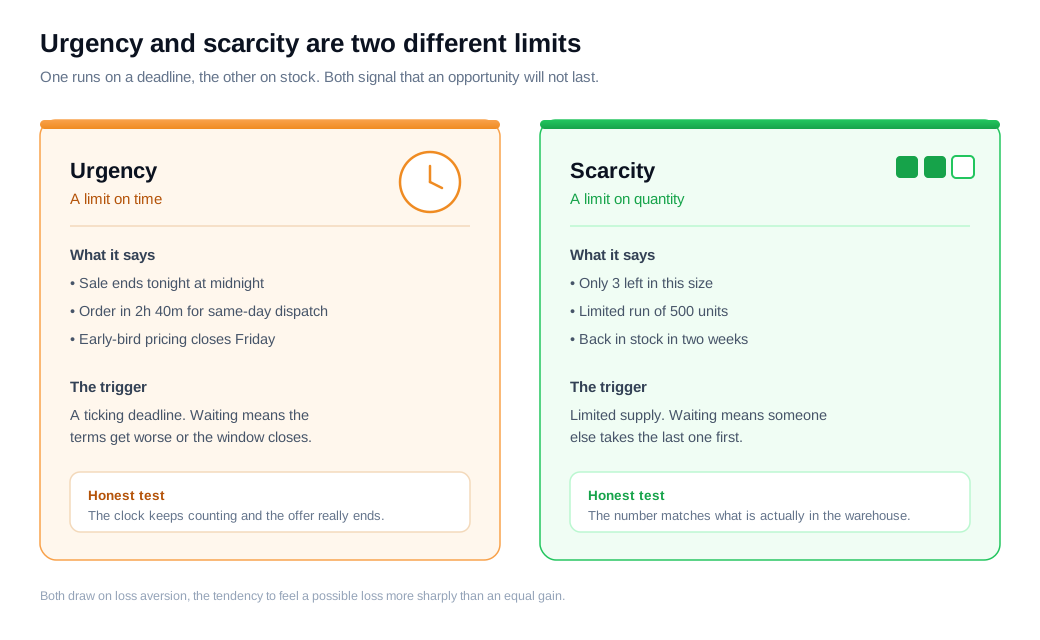
Urgency is a limit on time and scarcity is a limit on quantity; both tell a shopper that an opportunity will not last, but one runs on a deadline and the other on stock. A "sale ends at midnight" banner is urgency. A "3 left in your size" counter is scarcity. The two often appear together, and that pairing is deliberate, because a deadline plus a dwindling supply pushes harder than either alone.
The distinction matters for honesty as much as for classification. A time claim is verifiable against a clock, and a quantity claim is verifiable against your inventory system. Each has its own honest test, and each fails in its own way when the claim is invented. Keeping them separate in your head makes it easier to see when a message has drifted from a real constraint into a manufactured one.
How do urgency and scarcity drive action?
Urgency and scarcity drive action by triggering loss aversion, the well-documented tendency to feel a potential loss more sharply than an equivalent gain, so a limited offer quietly reframes a purchase as something you might miss rather than something you might get. A shopper weighing a jacket is comparing the price against the pleasure of owning it. Add "3 left" and the frame shifts: now inaction carries a cost of its own, the risk of walking away empty-handed.
This sits inside Robert Cialdini's scarcity principle, one of the six persuasion levers he documented in his 1984 book Influence. Scarcity does two things at once. It raises perceived value, because things that are hard to get read as more desirable, and it activates reactance, the urge to protect a freedom that feels threatened. When an option might vanish, people want it more precisely because they might not be allowed to have it.
The tactics are everywhere because they work often enough to be worth deploying. A Princeton crawl of roughly 11,000 shopping sites by Mathur and colleagues found scarcity messages such as low-stock and high-demand claims on 609 sites, and urgency messages such as countdown timers and limited-time banners on 437 sites. The mechanism is real. What decides whether it helps or hurts you is whether the limit behind the message is real too.
What do ethical urgency and scarcity look like?
Ethical urgency and scarcity rest on a single rule: every claim is true and would still hold up if the shopper could see behind the curtain. If your sale ends at midnight, set the timer to midnight and end the sale at midnight. If four units are in the warehouse, show four. The Nielsen Norman Group frames it plainly in its review of the scarcity principle, that scarcity used with true information can move users toward converting, while false scarcity risks the trust that makes the whole tactic function.
A few patterns clear that bar reliably. A low-stock counter wired to your real inventory, so the number falls as units sell and disappears when you restock. A genuine shipping deadline, such as "order within 2 hours 40 minutes for same-day dispatch," which is a fact about your fulfillment cutoff rather than a pressure tactic. A limited edition or seasonal run that is actually limited. A flash sale with a real end time. In each case the shopper could audit the claim and find it accurate.
Setting an honest threshold is mostly arithmetic. If you sell about ten units of an item a day, showing a low-stock warning at thirty units is defensible, because thirty units is roughly three days of supply and the message is true. Showing it at three hundred units is not. Tie the trigger to sales velocity and the warning stays truthful without any judgment call in the moment.
There is a worked case for this. The CRO agency Speero (with CXL) tested adding urgency to product pages for a pet-food retailer whose customers, surveyed beforehand, worried most about how fast they could get more food before running out. The variant added a real, time-sensitive delivery message. Across 1,877 visitors it produced a 27.1% revenue lift and a 9.5% conversion uplift, without a single invented claim, because the urgency answered a real fear about a real deadline.
Often the most honest move is to replace pressure with an answer. A shopper who hesitates usually has a specific question, about sizing, shipping cost, or a return window, and a manufactured timer does nothing for that. A live chat prompt on the product or cart page lets a rep resolve the actual objection in the moment, which is a large part of why an inbound sales approach converts hesitant buyers that a countdown clock would only annoy.
What tactics cross into dark patterns?
A tactic crosses into a dark pattern the moment the pressure it creates rests on something false, or on something the shopper cannot verify and would object to if they could. The Federal Trade Commission put names to the common ones in its 2022 staff report, Bringing Dark Patterns to Light, and four of them are urgency and scarcity gone wrong.
False Low Stock says supply is short when it is not, the "Only 1 left" that shows on every visit while the warehouse is full. False High Demand invents interest, such as "20 other shoppers have this in their cart," with no measurement behind it. A Baseless Countdown Timer shows a clock that simply resets or vanishes when it hits zero, so the deadline is theater. False Limited Time claims an offer ends soon with no real deadline, or a meaningless one that returns the next day. Each borrows the mechanics of honest scarcity and detaches them from any fact.
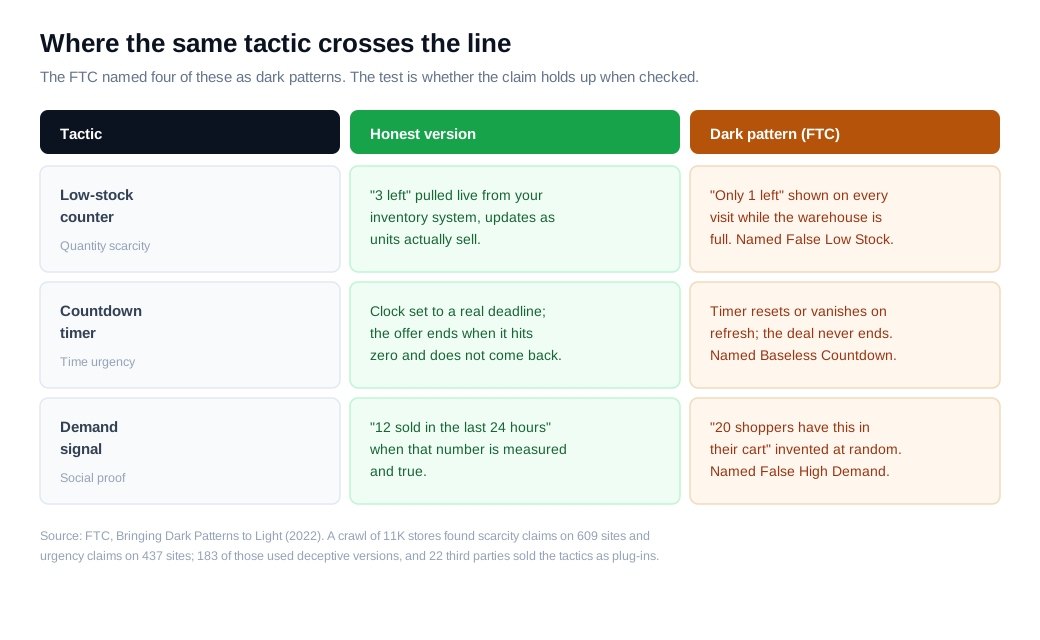
The scale is not trivial. Of the sites carrying scarcity and urgency messages in the Mathur crawl, 183 were using outright deceptive versions, and the researchers identified 22 third-party companies selling these tactics as turnkey plug-ins, timers and fake counters you install in minutes. That last detail is the trap for a well-meaning store: many dark patterns arrive as a convenient app, not a deliberate scheme, so the tactic slips in without anyone deciding to deceive.
Why does fake scarcity backfire?
Fake scarcity backfires because the effect depends entirely on belief, and the moment a shopper suspects a bluff the same signal that raised perceived value now reads as dishonesty. Nielsen Norman Group names decreased trust as the single biggest risk of scarcity in interface design: if users think the pressure is fabricated, they leave, and they carry the impression to the next visit and the next store. A signal meant to say "act now" ends up saying "do not believe this page."
The academic picture points the same way. Reviews of scarcity research describe how artificial or excessive scarcity can trigger consumer skepticism and reactance, which lowers purchase intention rather than raising it, and how a shopper who has been burned once becomes primed to read the next scarcity claim as a manipulation attempt. Once that suspicion sets in, honest scarcity you use later stops working too, because the shopper no longer takes any of your limits at face value.
Then there is the legal exposure. The FTC's report is guidance the agency uses to bring enforcement actions, and its position is direct: if a marketer represents that a deal is scarce, limited-time, or about to expire, that representation must be true. A fake countdown or an invented stock count is not a growth hack with a downside in brand perception alone. It is a claim a regulator can treat as deceptive, which turns a conversion tactic into a liability.
How do you test urgency messaging?
Test urgency messaging with a controlled A/B test that pits a page carrying the honest urgency element against an identical page without it, and judge the winner on revenue per visitor rather than clicks alone. Split traffic randomly, change only the one element, and let the test run until you have enough orders to trust the result. Anything less and you are reading noise.
Here is a worked example. Suppose you send 10,000 visitors to each variant over a few weeks. The control, with no urgency, converts at 3.10%, or 310 orders. The variant, with a genuine "order by 3pm for same-day dispatch" message, converts at 3.50%, or 350 orders. That is 40 extra orders per 10,000 visitors, a 12.9% relative lift. Before you ship it, confirm the gap clears statistical significance, generally 95% confidence, so you are not celebrating a fluke that evaporates next month. A common rule of thumb is to gather at least 100 conversions per variant before calling a winner.
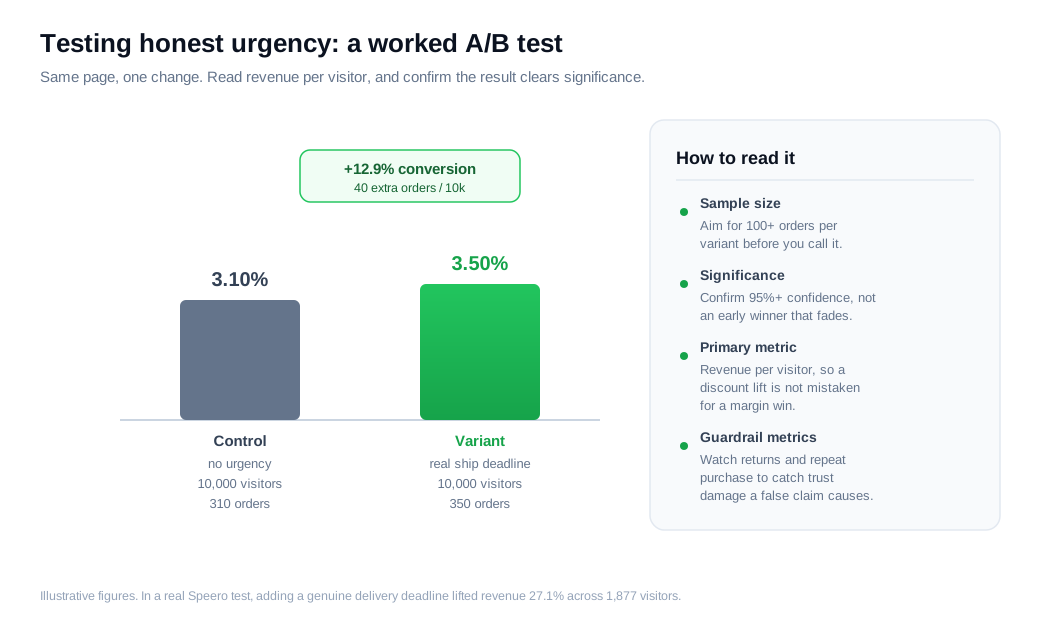
Pick the right primary metric. Revenue per visitor keeps you honest when the urgency is attached to a discount, because a higher conversion rate that comes from giving away margin is not a real win. Watch guardrail metrics too. Return rate and repeat-purchase rate are where a deceptive claim shows its cost, since a shopper pressured into a purchase they regret is more likely to send it back and less likely to come back. Segment new versus returning visitors as well, because returning customers who have seen your timers before may react differently.
Two habits keep the program clean over time. First, keep the claim true for the entire test, so you are measuring the effect of honest urgency and not quietly running a dark pattern in the name of research. Second, retest periodically, because a tactic that lifts conversion this quarter can fatigue as shoppers grow used to it, and a well-timed proactive nudge that answers a real question often ages better than a countdown that shoppers eventually tune out.
Key takeaways
- Urgency limits time and scarcity limits quantity. Both work by triggering loss aversion, and each has its own honest test, a real clock or a real stock count.
- Honesty is the whole tactic, not a constraint on it. A claim that would survive the shopper checking behind the curtain is the definition of ethical urgency and scarcity.
- Tie thresholds to real data. Wire low-stock counters to inventory and countdowns to real deadlines, and set warning levels by actual sales velocity so the message stays true on its own.
- Know the four named dark patterns. False Low Stock, False High Demand, Baseless Countdown Timers, and False Limited Time all borrow honest mechanics and detach them from fact, and the FTC treats them as deceptive.
- Fake scarcity reverses the effect. Once a shopper suspects a bluff, the signal reads as dishonesty, it poisons trust in your honest claims, and it exposes you to enforcement.
- Test on revenue per visitor with guardrails. Run a real A/B test to significance, and watch returns and repeat purchases to catch the trust damage a raw conversion number hides.

Written by
Nilas MylerCo-founder & CTO, Glimpze
Nilas is the co-founder and CTO of Glimpze, an inbound sales tool that turns high-intent website visitors into live conversations. A former SEO consultant for some of the largest companies in Denmark, he writes about speed-to-lead, inbound sales, and conversion rate optimization — the technical and operational mechanics of turning traffic into pipeline.


