
On this page
- What makes an inbound sales follow-up email effective?
- How soon should you follow up after inbound interest?
- What subject lines get inbound follow-up emails opened?
- How long should an inbound follow-up email be, and what goes in it?
- How many inbound follow-ups are too many?
- What does a full inbound follow-up sequence look like?
- How do you measure whether your follow-up emails convert?
- Key takeaways
- Sources
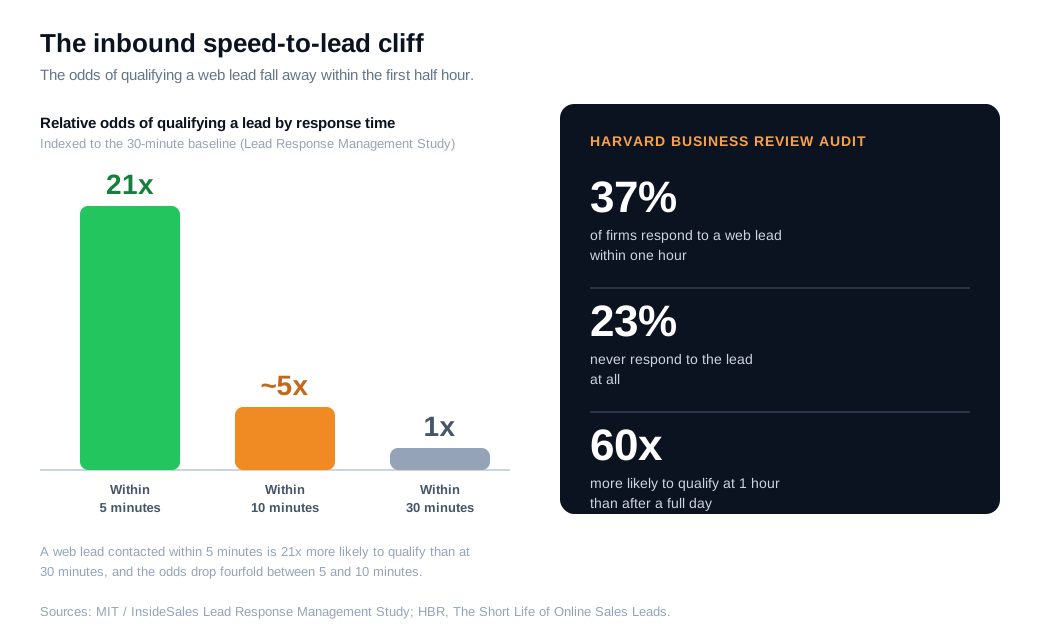
A form fill or demo request is the highest-intent signal a buyer will ever hand you, and it decays by the minute. The MIT and InsideSales.com Lead Response Management Study, built on more than 100,000 call attempts, found that reaching a web lead within five minutes makes you 21 times more likely to qualify it than waiting 30 minutes. Most companies answer in hours or days, if at all.
The follow-up email is where that intent gets won or wasted. Written well, it continues a conversation the buyer already opened. Written like a cold pitch, it lands in the same mental trash folder as every other "just circling back" message they got that week.
This guide covers what makes an inbound follow-up email effective, how fast to send the first one, which subject lines get replies, how long the email should be and what goes in it, how many follow-ups are too many, a full worked sequence with sample copy and numbers, and how to measure whether any of it converts.
What makes an inbound sales follow-up email effective?
An effective inbound sales follow-up email does three things: it references the specific action the buyer took, it answers the question that action implied, and it asks for one small next step. Everything else is packaging.
Context is what separates it from cold email. This person raised their hand. They downloaded the pricing guide, started a trial, requested a demo, or opened a chat and left before a rep replied. Your job is to continue that thread, not to reintroduce yourself as if the interaction never happened.
That changes the math on what works. Backlinko's analysis of 12 million outreach emails found that a personalized message body earned a 32.7% higher response rate than a generic one, and inbound gives you the richest personalization there is: the exact thing they just looked at. "You checked out our pricing page twice this week" beats any researched icebreaker.
Effective follow-ups are also short and single-purpose. They lead with the buyer's problem, offer one concrete piece of value (a relevant number, a two-line answer, a link to the exact resource), and close with a single low-friction ask. The more you cram in, the less likely you are to get a reply, which we will get to under length.
One more trait: they sound like a person. A follow-up that reads like a mail-merge field ("Hi [FirstName], I wanted to reach out regarding...") signals automation, and automation signals low priority. Write the way you would if the lead were a warm referral, because functionally they are.
How soon should you follow up after inbound interest?
Send the first follow-up within five minutes of the inbound action, and treat anything past an hour as a missed lead. The window is short because intent is perishable.
The most cited evidence is the MIT and InsideSales.com Lead Response Management Study, which analyzed more than 100,000 call attempts and found that contacting a web lead within five minutes made a rep 21 times more likely to qualify it than waiting 30 minutes, and 100 times more likely to reach the person at all. Harvard Business Review's audit of 2,241 U.S. companies reached the same conclusion from the other side: firms that responded within an hour were roughly seven times more likely to have a meaningful conversation with a decision maker than those that waited just one hour longer, and about 60 times more likely than those that took a full day.
Here is the uncomfortable part. That same HBR audit found only 37% of companies responded within an hour, and 23% never responded at all. Speed is a cheap edge because so few teams actually apply it.
Consider a simple example. Say 100 people request a demo this month. At a five-minute median response you might qualify 40 of them. Push the median to 30 minutes and, using the study's 21x qualification gap as a directional guide, that number falls toward a handful. The leads are identical; only your timing changed.
For a form fill or demo request, an automated confirmation should fire instantly, and a real human reply (ideally with a calendar link or an offer to talk now) should follow within minutes. For the highest-intent signals, email is often the wrong channel entirely. Someone active on your pricing page right now will convert better on a live chat that escalates straight to a call than on an email they will open hours later. Email follow-up is the safety net for the moments you could not catch them live.
What subject lines get inbound follow-up emails opened?
The subject lines that win are short, specific to what the buyer just did, and framed as a question or a plain reference rather than a pitch. Belkins' analysis of B2B cold email subject lines found that two-to-four-word lines earned the highest open rates, that question-style lines outperformed statements, and that all-lowercase lines beat title case across the millions of emails they studied.
For inbound, the strongest subject line is usually the plainest one that names the action. "Your Glimpze demo" or "question about your trial" tells the reader exactly why you are in their inbox and reads like a reply, not a broadcast. Reference beats cleverness.
A few patterns that hold up:
- The direct reference: "following up on your pricing question"
- The question: "still comparing live chat tools?"
- The specific offer: "15 minutes to see your setup live?"
- The re-reply: answer inside the original thread so the line becomes "Re: your demo request," which keeps the context attached.
Avoid anything that smells like mass email: all caps, a fake "Re:" bolted onto a fresh thread, emoji, or vague hype like "an opportunity for you." Those cut open rates and, worse, train the buyer to ignore your next message. Keep the line under about 33 characters so it renders in full on a phone, since close to half of all emails are opened on mobile.
How long should an inbound follow-up email be, and what goes in it?
Keep an inbound follow-up email to about 50 to 125 words with a single call to action. Reply-rate data across large email datasets consistently points to that range, and first-touch messages tend to perform best under roughly 80 words.
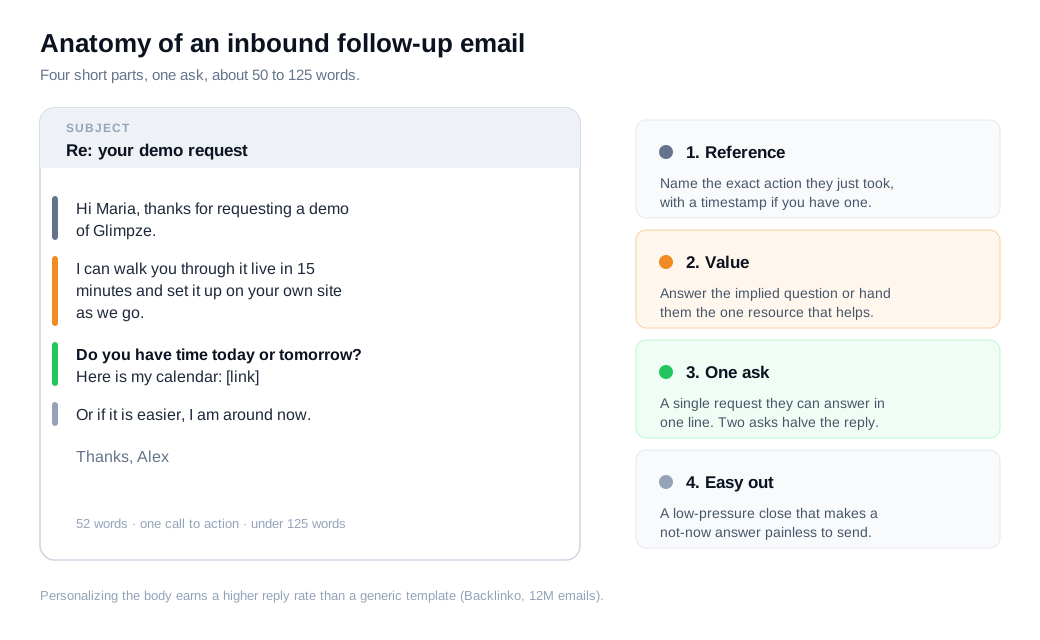
Structure it in four short parts:
- Reference (one line): name the action they took, with a timestamp if you have it.
- Value (one or two lines): answer the implied question or hand them the one resource that moves them forward.
- Ask (one line): a single, answerable request. "Want me to send times?" beats "let me know your availability, budget, and timeline."
- Out (one line): a low-pressure close that makes a not-now answer easy.
The single-ask rule is the one people break most. Two asks in the same email split your reply rate and create hesitation. The reader has to choose, and the easiest choice is to close the tab. Pose one question, make it answerable in a sentence, and let the rest of the conversation follow once they reply.
Write for a skim. Bold one phrase at most, use white space, and put the two lines that carry the email at the top and the bottom. A busy buyer reads the first line and the last line before deciding whether to engage, so those two lines do the real work.
How many inbound follow-ups are too many?
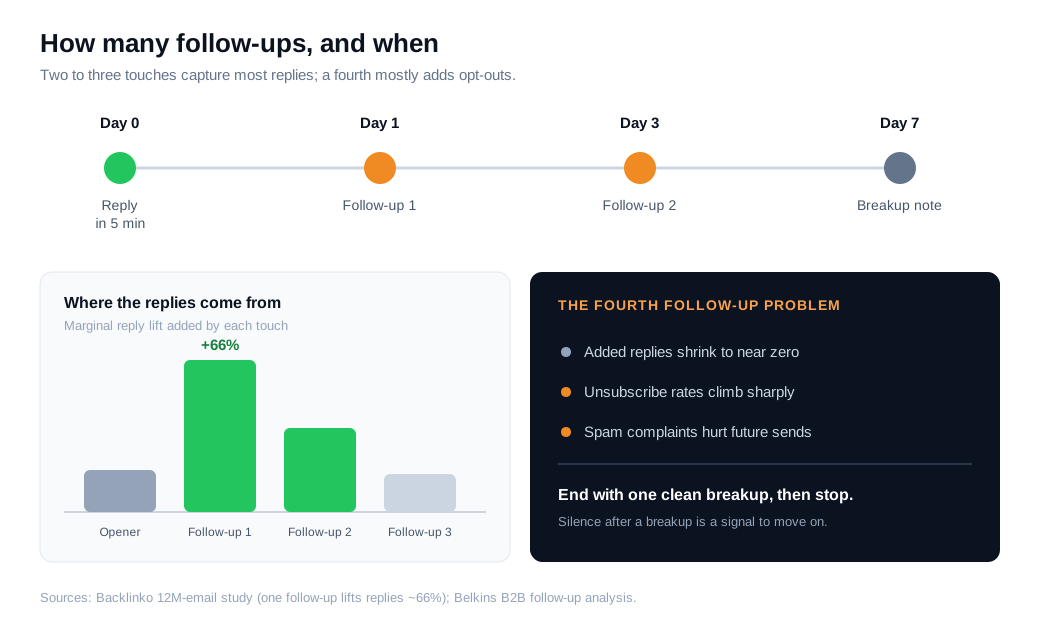
Two to three follow-ups after your first reply is the sweet spot, and a fourth or beyond mostly buys you unsubscribes instead of replies. The value of persistence is real, but it runs out faster on warm inbound leads than on cold prospecting.
The lift from the early touches is large. Backlinko's 12-million-email study found that a single follow-up raised reply rates by 65.8% over the opening message alone. Practitioner analyses of large sending datasets show reply rates continuing to climb through the second and third touch, then flattening. By the fourth follow-up the added replies shrink toward nothing while unsubscribe and spam-complaint rates rise, which damages your ability to reach the next lead.
Spacing matters as much as count. On a warm inbound lead, front-load the sequence: reply immediately, follow up the next day, again two to three days later, then send a final note about a week out. That covers the window where genuine intent lives without dragging a decayed lead through a three-week cold cadence.
End cleanly. A short breakup email ("should I close this out?") pulls a surprising number of replies and lets you move the non-responders into a lighter nurture instead of burning more sends on them. Silence after a good breakup message is your signal to move on, and a fifth email only costs you deliverability.
What does a full inbound follow-up sequence look like?
A complete inbound follow-up sequence pairs an instant first reply with three spaced follow-ups over about a week, each built on a single angle, ending in a clean breakup. Here is a worked example for a lead who requested a demo and then went quiet.
Touch 1, within five minutes. Subject: "Re: your demo request." "Hi Maria, thanks for requesting a demo of Glimpze. I can walk you through it live in 15 minutes and set it up on your own site as we go. Do you have time today or tomorrow? Here is my calendar: [link]. Or if it is easier, I am around right now." (52 words: reference, value, one ask, easy out.)
Touch 2, next day. Subject: "quick question." "Hi Maria, following up on the demo you asked about yesterday. What is the main thing you are hoping live chat solves, faster replies to visitors or catching leads before they leave? Happy to tailor the walkthrough to that." (One question, invites a one-line reply.)
Touch 3, three days later. Subject: "the 5-minute number." "Hi Maria, one stat that made us build Glimpze: leads contacted within five minutes are 21 times more likely to qualify than at 30 minutes. If speed-to-lead is on your radar, a 15-minute demo is the fastest way to see it work. Want a couple of times?" (Value led, single ask.)
Touch 4, about a week out. Subject: "should I close this out?" "Hi Maria, I have not heard back, so I will assume the timing is not right and stop here. If that changes, just reply and I will pick it back up. All the best." (Clean breakup.)
Run the numbers on a batch. Say 100 demo requests enter this sequence in a month. The instant first reply plus a fast qualifying conversation might book 35 to 40 meetings on its own. The next-day and three-day touches recover a share of the leads who missed the first email, adding perhaps 10 to 15 more replies given the 65.8% lift a first follow-up provides. The breakup message pulls a final handful and cleans the list. Same 100 leads, roughly double the booked conversations you would get from a single reply with no follow-up.
To make the instant first touch realistic at volume, the sequence has to be wired to your systems. A new inbound lead should ping the right rep in real time so the five-minute reply is even possible, which is exactly what lead routing and notifications are for, and the whole motion belongs inside your broader inbound sales process rather than a standalone email tool.
How do you measure whether your follow-up emails convert?
Measure follow-up emails with four numbers, tracked per touch: speed-to-first-reply, open rate, reply rate, and meeting-booked rate. Each isolates a different problem, so a weak number tells you exactly what to fix.
- Speed-to-first-reply (median minutes from inbound action to a human response): the single most important metric for inbound. If it is measured in hours, fix it before touching anything else.
- Open rate, per touch: low opens point at subject lines or send timing. Test shorter, more specific lines.
- Reply rate, per touch: this shows which follow-up is doing the work. If most replies land on touch two or three, cutting the sequence short leaves conversations on the table.
- Meeting-booked rate: the share of replies that turn into a real conversation. If people reply but do not book, the ask or the offer is the weak link, not the copy.
Track one more thing beyond reply volume: reply quality. A "no thanks" still counts as a reply, so a high reply rate with few meetings usually points at your targeting or your offer rather than your writing. Review weekly, change one variable at a time, and keep the version that lifts the metric you were aiming at.
Key takeaways
- Inbound follow-up is a speed game first and a copy game second. Reaching a lead within five minutes makes you 21 times more likely to qualify it than waiting 30 minutes, and most companies never come close.
- Reference, value, one ask. An effective inbound email names the action the buyer took, hands them one useful thing, and poses a single answerable question in about 50 to 125 words.
- Short, specific subject lines win. Two-to-four-word, question-style, lowercase lines that name what the buyer did beat clever or hyped lines, and keeping them under about 33 characters helps on mobile.
- Two to three follow-ups, then stop. A single follow-up lifts replies by roughly 66%, but a fourth touch mostly adds opt-outs, so front-load the touches over about a week and end with a clean breakup.
- Wire the first touch to your systems. Instant routing and notifications are what make a five-minute reply possible, and live channels often beat email for the highest-intent moments.
- Measure speed first, then reply and booking rates. Track per touch, change one variable at a time, and watch reply quality rather than reply volume alone.
TAGS

Written by
Daniel SemeckyCo-founder & CEO
Daniel is the co-founder and CEO of Glimpze. He spends his days talking to revenue teams about how to catch high-intent visitors before they bounce, and writes about inbound sales, lead conversion, and building a motion where marketing and sales actually share a number.


