On this page
A visitor pastes a full credit card number into your chat window to "save time." The agent, trying to help, copies it into an internal note. That number now sits in a live transcript, a database, a nightly backup, and whatever third-party service your chat vendor runs on. One convenient exchange just created a compliance problem that can outlive the sale.
Live chat collects sensitive data precisely because it feels casual. People type things into a chat box they would never put on a form: account numbers, health details, passwords, home addresses, even a child's date of birth. The channel that makes buying feel easy also makes it easy to hold data you never meant to keep.
This guide covers live chat security from the ground up: the real data risks the channel carries, how to handle personal information without killing the conversation, what GDPR and CCPA actually require, how to secure and retain transcripts, what to check before you trust a vendor, and what to do in the first hours after a breach.
What data risks does live chat carry?
Live chat carries four data risks that compound each other: it collects more personal data than you plan for, it exposes that data to social engineering in real time, it copies the data into places you do not control, and it keeps the data far longer than you need. Each one is manageable on its own, and together they are how a chat widget becomes the weakest link in a security program.
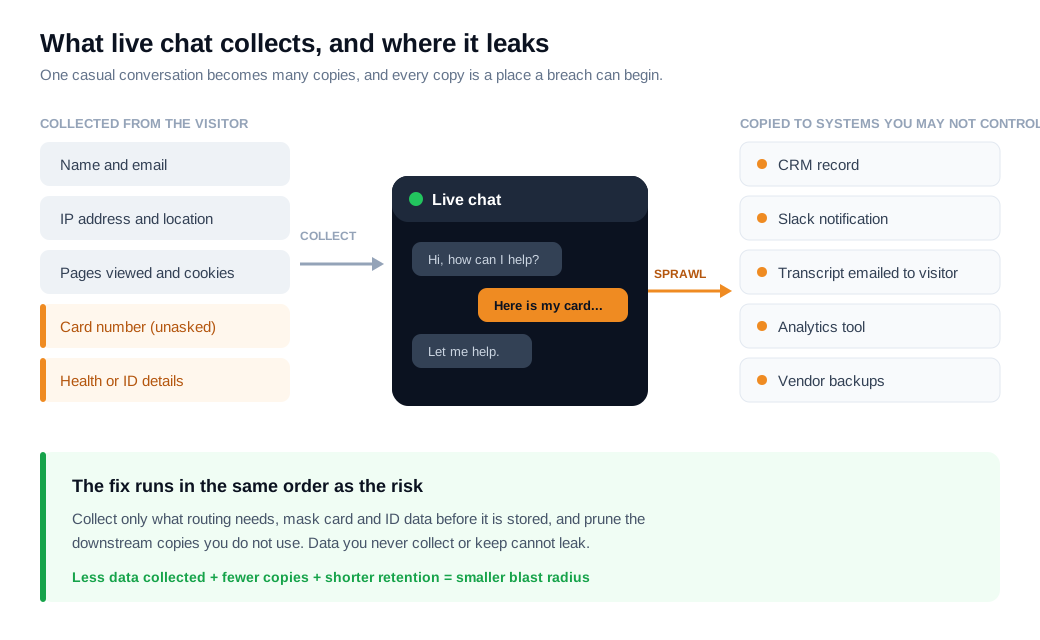
Start with over-collection. A single conversation routinely captures a name, email, IP address, location, browser fingerprint, the pages the visitor viewed, and the free text they typed. LiveAgent's security guidance lists chat logs, cookies, and location among the data a widget gathers by default, and most of it arrives whether or not you asked for it.
Then the human factor. Because a chat feels like a private message, visitors volunteer sensitive details unprompted, and attackers exploit the same trust in reverse. Security researchers have documented campaigns where criminals abused live chat tools to phish credit card and personal data, posing as support to pull information out of users while the conversation was live. A chat window is a social-engineering surface in both directions.
The third risk is data sprawl. Transcripts rarely stay in one place. They sync to a CRM, get emailed to a customer, land in a Slack channel as a notification, feed an analytics tool, and sit in the vendor's backups. Every copy is another place a breach can start, and most teams cannot list all of them.
The stakes are concrete. IBM's 2024 Cost of a Data Breach report put the global average breach at $4.88 million, up 10% in a year, and found that customer PII was both the most commonly breached record type, involved in 46% of breaches, and among the most costly. Compromised credentials, the kind of thing that leaks through a convincing chat, were the most common attack vector and took 292 days on average to contain.
Worked example: say your widget handles 5,000 chats a month, and a conservative 3% contain some piece of regulated personal data a visitor typed without being asked, so about 150 records a month, or 1,800 a year. If any single one of those transcripts is exposed and triggers a notifiable breach, the cost lands on the investigation, notification, and lost trust that IBM measures in the millions, well beyond the value of one record. The cheap fix is to stop collecting and storing those 1,800 records in the first place.
How do you handle PII in chat?
Handle PII in chat by collecting less of it, masking it the moment it appears, and keeping it out of every downstream copy you do not strictly need. The goal is that a sensitive value spends as little time as possible in a form a person or a breach can read.
Start before the conversation. Set a pre-chat form that asks only for what routing and follow-up actually require, usually a name and an email, and drop the fields you added "just in case." Data you never collect cannot leak.
During the conversation, mask sensitive input automatically. Well-built chat tools detect patterns that look like card numbers, national IDs, or similar, and replace them with tokens before the message is stored, so the agent sees enough to help while the raw value never reaches the transcript. This matters most for payment data. The PCI DSS standard is explicit that primary account numbers should never be sent unprotected through end-user messaging like email, instant messaging, or chat, and CrowdStrike's breakdown of the PCI requirements covers how cardholder data must be protected wherever it lands. If a customer starts to type a card number, the right move is to stop them and route the payment to a secure page.
Train agents to treat their side of the keyboard the same way. Copying a Social Security number into a note, pasting an address into a personal message, or screenshotting a chat all defeat the masking that runs on the input. For conversations that genuinely need identity verification, some teams move to live video so a customer can show a document on camera rather than type details that then persist as text.
Watch the AI layer too. If you run an AI chat assistant, remember that anything it ingests can be logged, and in some configurations used to improve a model, so confirm that customer messages are excluded from training and that the assistant redacts sensitive input the same way a human-facing widget does.
How does live chat meet GDPR and CCPA?
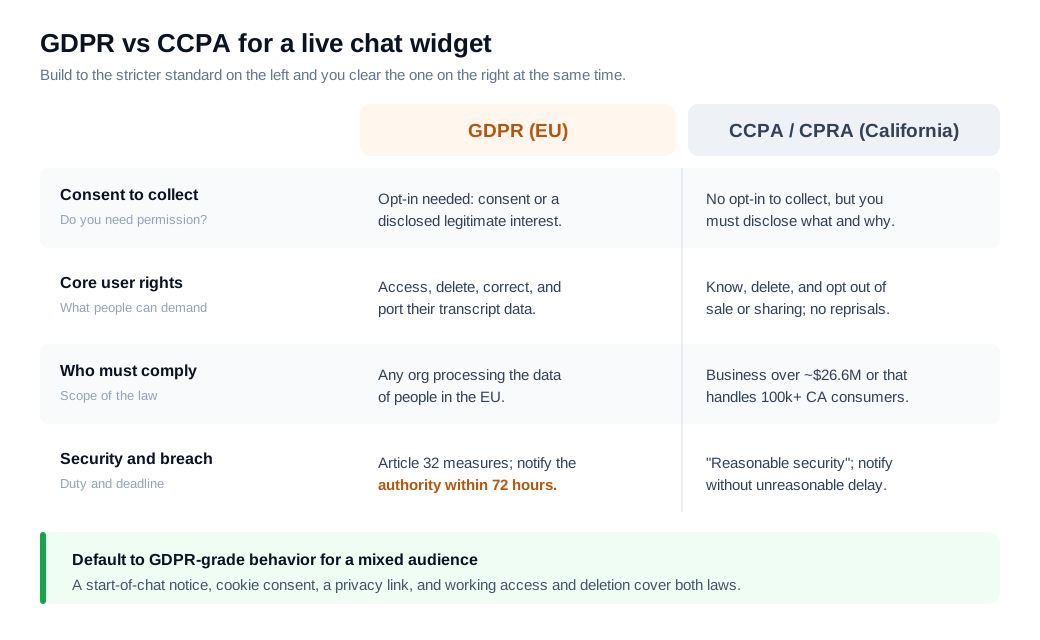
Live chat meets GDPR and CCPA by having a lawful basis to process the data, telling people clearly what you collect, securing it, and being able to honor the access, deletion, and opt-out rights both laws grant. The two regimes differ most on consent, and a compliant widget is built to satisfy the stricter of the two.
Under the GDPR, you need a lawful basis before you process personal data, and for a chat widget that usually means consent or legitimate interest, disclosed up front. Article 32 then requires "appropriate technical and organisational measures" to secure that data, naming pseudonymisation and encryption as examples, along with the ability to restore data after an incident and to test your controls. Article 32 is a standard that scales with the risk of what you hold, rather than a checklist you tick once.
The GDPR also gives individuals rights you have to honor through the chat channel: the right to access a copy of their transcript, the right to have it deleted, and the right to have mistakes corrected. If you cannot pull every message tied to one person and export or erase it on request, the channel is not compliant, however good the encryption is.
CCPA, with its CPRA amendments, works differently on consent. A California business generally does not need opt-in permission to collect personal information, but it must disclose collection, honor a consumer's right to know, right to delete, and right to opt out of sale or sharing, and not discriminate against people who exercise those rights, as the California Attorney General's office lays out. The law reaches businesses above a size threshold that is adjusted for inflation each year, set at $26,625,000 in gross revenue for the 2026 compliance year per Jackson Lewis's CCPA guidance, or businesses that handle the data of 100,000 or more California consumers.
The practical takeaway is that a chat widget aimed at a mixed audience should default to GDPR-grade behavior: a visible notice at the start of the chat explaining what you collect and why, a link to your privacy policy, cookie consent that governs the chat's own trackers, and a documented way to fulfill access and deletion requests. Build to the stricter standard and you clear the lower one automatically.
How do you secure chat transcripts?
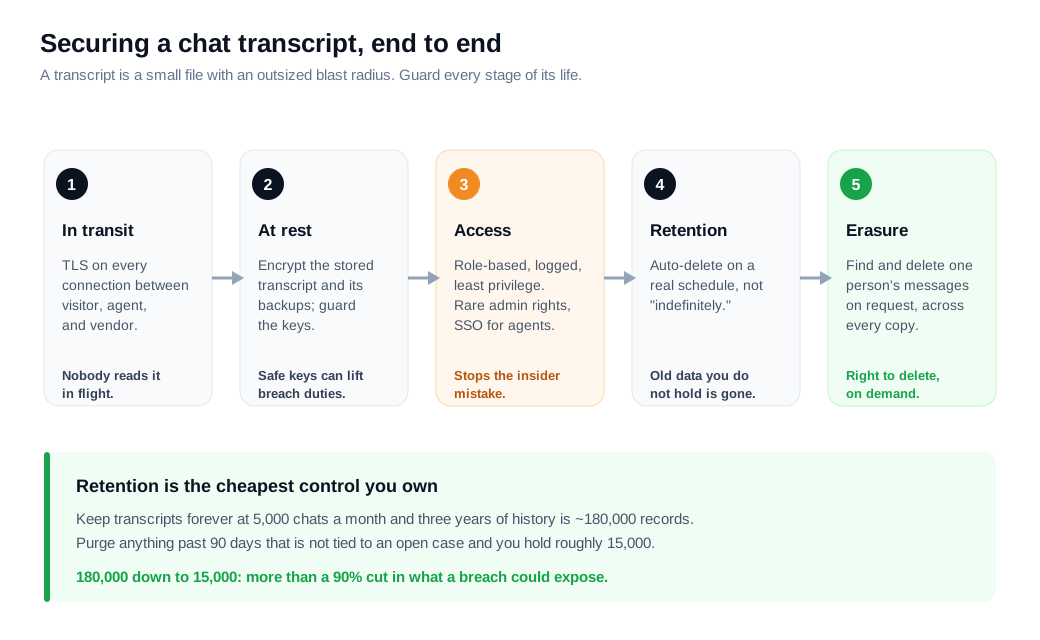
Secure chat transcripts by encrypting them in transit and at rest, restricting who can read them, minimizing how many copies exist, and deleting them on a schedule instead of keeping them forever. A transcript is a small file with an outsized blast radius, so treat it like the sensitive record it is.
Encryption comes first and comes in two forms. Encryption in transit, meaning TLS on every connection between the visitor, your agents, and the vendor, stops anyone from reading messages as they travel. Encryption at rest protects the stored transcript in the database and its backups. Guidance aimed specifically at live chat compliance calls for both, and encryption matters legally as well as technically: under the GDPR, a breach of strongly encrypted data whose keys stay safe is generally judged unlikely to harm individuals, which can change your notification duties.
Access control is the next layer. Every agent should see only the conversations their role requires, admin rights should be rare, and access should be logged so you can answer who read what. The reason is blunt: encryption protects data from outsiders, and role-based access is what protects it from the far more common insider mistake or misuse.
Then minimize copies and retention. Decide which downstream systems truly need transcript data, cut the rest, and set a retention window that matches a real business or legal need rather than "indefinitely." Auto-delete on that schedule.
Worked example: imagine you keep transcripts forever and hold three years of chat, roughly 180,000 conversations at 5,000 a month. Change the policy to purge anything older than 90 days unless it is attached to an open case, and your stored population drops to about 15,000 transcripts. You have cut the data an attacker could steal, and the records you would have to search in a lawsuit or a data subject request, by more than 90%, without losing anything the business actually uses. Less stored data is less risk, full stop.
What should you look for in a secure live chat vendor?
Look for a live chat vendor that can prove its security with independent audits, sign a data processing agreement, encrypt data both ways, and give you real control over retention and access, because your compliance depends on theirs. When you embed a widget, that vendor becomes a processor handling your customers' data, and their weaknesses become yours.
Ask for evidence rather than adjectives. A serious vendor holds a recognized certification such as SOC 2 Type II or ISO 27001 and will share the report or a summary under NDA. LiveAgent's guidance frames encryption, access control, and regular security audits as the baseline, and a vendor who cannot describe theirs in specifics is telling you something.
Run through a short checklist before you commit. Will they sign a data processing agreement, and for EU data, do they offer Standard Contractual Clauses or equivalent transfer safeguards? Where is data hosted, and can you keep it in a specific region? Who are their sub-processors, and how are you told when that list changes? Can you configure retention, mask sensitive fields, restrict agent access by role, and export or delete one person's data on request? Do they support single sign-on and enforce strong authentication for agents?
Comparisons help here, since security posture varies widely between tools that look similar on a feature grid. If you are weighing options, a side-by-side of chat platforms on encryption, certifications, and data controls is more useful than one on chat features alone. Many tools, including ones with a free tier, publish their security and subprocessor documentation openly, and a vendor that hides it is a poor place to send your customers' data.
What do you do in the first hours after a live chat data breach?
In the first hours after a live chat breach, contain the exposure, assess whose data was affected, and start the regulatory clock, because both GDPR and CCPA put you on a deadline the moment you become aware. Preparation before the incident is what makes those hours survivable.
Contain first. Revoke the compromised credentials or access, take the affected integration offline, and stop the bleeding before you do anything else. Then scope it: which transcripts, which fields, how many people, and from which jurisdictions, since that determines who you must tell.
The GDPR sets the tightest timer. Article 33 requires notifying your supervisory authority without undue delay and, where feasible, within 72 hours of becoming aware of a breach that risks people's rights, and if you miss that window you must explain why. This is where the earlier encryption work pays off, because a breach of properly encrypted data with safe keys may not rise to a notifiable risk at all.
Document everything as you go. Regulators expect a written record of what happened, what data was involved, and how you responded, whether or not the breach met the notification bar. A rehearsed plan, a named owner, and a contact list beat improvising while the 72-hour clock runs.
Key takeaways
- Live chat over-collects by default. A casual chat box pulls in names, IPs, locations, and whatever sensitive text a visitor volunteers, so the first control is collecting and storing less.
- Mask PII the moment it appears. Detect and tokenize card numbers and IDs before they hit the transcript, keep payment data out of chat per PCI DSS, and train agents not to paste sensitive values into notes.
- Build to the stricter privacy law. A GDPR-grade widget with clear notice, consent, and working access and deletion rights clears CCPA obligations at the same time.
- Treat transcripts as sensitive records. Encrypt them in transit and at rest, gate them with role-based access, and auto-delete on a real retention schedule instead of keeping them forever.
- Your vendor's security is your security. Require audits like SOC 2, a signed data processing agreement, regional hosting, and configurable retention before you trust a tool with customer data.
- Rehearse the breach response. Contain, scope, and start the GDPR 72-hour clock with a named owner and a written record, since the deadline begins the moment you become aware.

Written by
Nilas MylerCo-founder & CTO, Glimpze
Nilas is the co-founder and CTO of Glimpze, an inbound sales tool that turns high-intent website visitors into live conversations. A former SEO consultant for some of the largest companies in Denmark, he writes about speed-to-lead, inbound sales, and conversion rate optimization — the technical and operational mechanics of turning traffic into pipeline.


