
On this page
A customer hits a snag at checkout on Saturday morning. They open your help widget, type out the problem, and see an automated line promising that a specialist will be in touch. Then they wait. By the time a real reply lands on Monday afternoon, they have already found a workaround, posted a complaint, or bought from a competitor who answered in ninety seconds.
First response time is the number that measures that wait. It is one of the most watched metrics in customer support, because the speed of your first reply shapes how the whole conversation feels before anyone has actually fixed anything. A quick acknowledgment tells a customer they were heard. A slow one tells them the opposite, however good the eventual answer turns out to be.
This guide defines first response time and how to measure it properly, sets realistic benchmarks for live chat, phone, social, and email, separates it from resolution time, explains why speed moves satisfaction so much, names the things that quietly slow teams down, and lays out concrete ways to reply faster without cutting corners.
What is first response time?
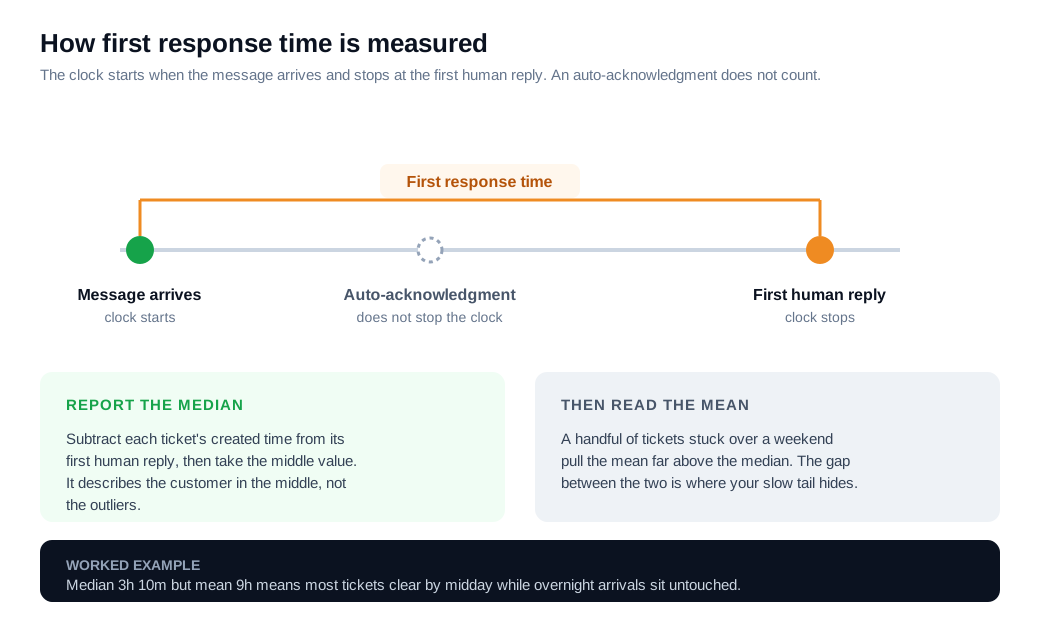
First response time (FRT) is the elapsed time between a customer reaching out and the first genuine reply from your team, measured on whatever channel they used. The clock starts the moment their message arrives, an email, a chat, a social mention, or a call, and it stops when a person actually responds.
The word that matters in that definition is genuine. An automated "we received your ticket" receipt does not stop the clock, because it tells the customer nothing they did not already know. A real first response moves the conversation forward, even if it is only a line that says someone is looking into the problem. That short acknowledgment counts. A canned auto-reply does not.
FRT is a first-touch metric. It measures attention, not the fix. A team can answer within thirty seconds and still take two days to resolve the underlying issue, and a team can solve everything perfectly while leaving customers to stew for hours before the first hello. Those are different problems, so first response time earns its own number on the dashboard and its own target.
How is first response time measured?
You measure first response time by subtracting the moment a ticket was created from the moment of its first human reply, then summarizing those gaps across all the tickets in a period. The per-ticket math is simple. The choices you make about how to summarize it are where most reporting goes wrong.
Report the median rather than the mean. For each ticket, take the difference between the created timestamp and the first-reply timestamp, then find the middle value across all tickets. The median describes the customer in the middle of your queue. The mean gets yanked around by a few tickets that sat untouched over a weekend, so a team with a healthy median can still post an ugly average. Read both, because the distance between them is the size of your slow tail.
Decide up front whether you count calendar hours or business hours. Unless you staff support around the clock, measure in business hours, so a ticket that arrives at 9 p.m. and gets answered at 9 a.m. does not register as a twelve-hour failure when your team was never open. Segment the number too, by channel and by hour, because a chat during the Tuesday rush and an email that lands at midnight live in different worlds.
Here is the measurement in numbers. Say 1,200 email tickets came in last month. You export the created and first-reply timestamps, compute the gap for each, and find the median is 3 hours 10 minutes while the mean is 9 hours. Most customers get a reply by midday, which is respectable. The gap up to the nine-hour mean tells you a batch of tickets, probably overnight arrivals and the Monday backlog, is sitting far longer than the typical case. The median gave you the normal experience. The distance to the mean told you exactly where to go looking.
What are good FRT benchmarks by channel?
A good first response time depends entirely on the channel: seconds for live chat and phone, under an hour for social media, and a few hours at most for email. Judging every channel against one number is the most common benchmarking mistake, because customers arrive at each one with a completely different sense of how long is reasonable.
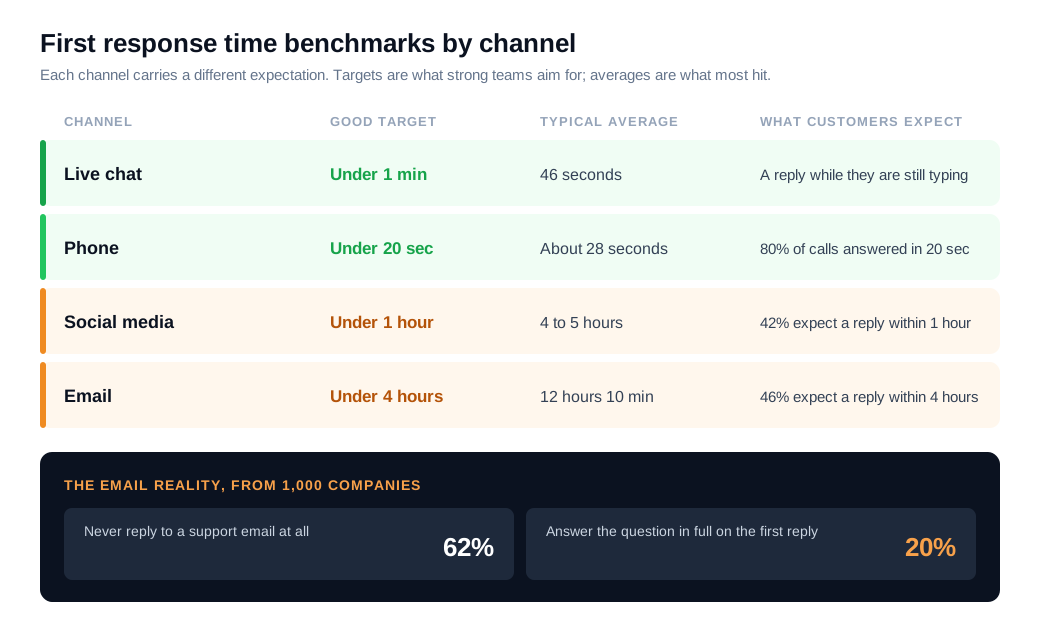
On live chat, aim to reply inside a minute. Comm100's analysis of more than 56 million chats put the average wait for a first agent response at 46 seconds, and strong teams beat that. Chat is a live channel, so the customer is sitting there watching for the reply, which is why the tolerance is so tight.
Phone is tighter still. The long-standing call center standard is the 80/20 rule, answering 80 percent of calls within 20 seconds, with the global average speed of answer landing around 28 seconds. Social media buys you more room, though less than most brands assume: roughly 42 percent of customers expect a reply within an hour, while the average brand takes four to five hours to respond.
Email carries the loosest expectation and the widest reality gap. A commonly cited tier from Zendesk treats under an hour as best-in-class, under four hours as good, and under twelve hours as merely acceptable, and about 46 percent of customers expect an email answer within four hours. Yet when SuperOffice sent a service question to 1,000 companies, the average response ran 12 hours and 10 minutes, 62 percent never replied at all, and only 20 percent answered the question in full on the first try. Two cautions before any of these go on a wall. Definitions vary between vendors, so a benchmark only compares if it measures what you measure, and your own trend line matters more than any cross-industry figure.
Is first response time the same as resolution time?
No. First response time measures how long a customer waits for the first reply, while resolution time measures how long the whole issue takes to close. They answer different questions, and blending them into one average hides both.
A fast first response paired with a slow resolution is a normal, workable pattern, as long as the first reply sets an honest expectation about what happens next. The failure mode is silence, where a customer hears nothing until the problem is fully solved and spends the gap assuming they have been forgotten. Track the two side by side, and read first response time next to a satisfaction score so you can tell whether a quick reply is actually a good one. Speed with no substance shows up later as repeat contacts and low resolution rates.
Why does first response time drive satisfaction?
First response time drives satisfaction because a quick reply signals that the customer was heard, and that reassurance lands before the actual answer does. Waiting is where frustration grows. The customer cannot see your queue, so a quiet inbox reads as being ignored, and every extra minute of silence makes the eventual reply feel more grudging.
The expectation data is blunt about this. HubSpot Research found that 90 percent of customers rate an immediate response as important or very important when they have a service question, and 60 percent define "immediate" as ten minutes or less. In the same vein, 63 percent of customers rank speed of response as the single most important factor in a support experience, ahead of the speed of the resolution itself.
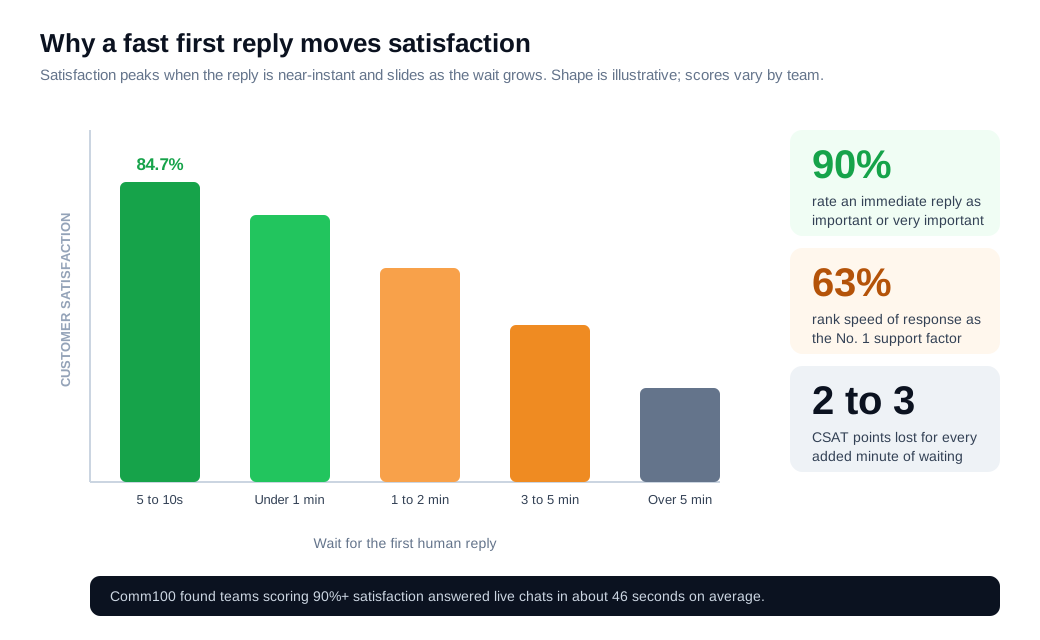
The satisfaction curve follows the clock closely. Live chat CSAT tends to peak near 84.7 percent when the first reply arrives within five to ten seconds, and benchmark analyses estimate that every additional minute of waiting shaves roughly two to three points off the score. Comm100's data points the same way from the other side: teams that scored 90 percent or higher on satisfaction answered chats in about 46 seconds on average. Speed does not guarantee a happy customer, yet almost nothing else you do can rescue an experience that opened with a long, unexplained wait.
What slows first response time down?
Most teams are slow because a message has to pass through triage, assignment, and a crowded queue before a human ever sees it, and each step adds delay. The customer almost never lands in front of the right agent the instant they hit send.
The classic bottleneck is manual triage with no clear ownership. A ticket drops into a shared inbox, waits to be read, waits to be categorized, and waits again to be assigned to whoever has capacity. Nobody owns it, so everybody assumes someone else will pick it up. Notifications are the quiet failure point on top of that. If a new message does not ping an agent somewhere they actually look, it depends on someone remembering to refresh a list, and most agents work their queue in a couple of batches a day rather than in real time.
Two structural gaps make it worse. The first is coverage: tickets that arrive in the evening, overnight, or across a weekend pile up with nobody watching, which is exactly the tail that dragged the mean up in the earlier example. The second is channel sprawl. When email, chat, social, and phone each live in a separate tool, some channels get watched closely and others get checked when someone remembers, so a customer who reaches out on the neglected one waits the longest. Add complex tickets that get escalated before anyone even acknowledges them, and the first-response clock runs well past target before real work begins.
How do you improve first response time?
Improve first response time by shortening the path from message to human: set a target per channel, route and notify automatically, arm agents with ready answers, and cover the gaps with real-time channels and AI. Each lever attacks a different source of delay, and they compound.
Start by setting a first-response SLA for each channel and putting it on a dashboard next to your median, measured in business hours. A target nobody measures is a wish, and once the number is visible the slow tail becomes obvious and fixable. Then remove the assignment lag. Automatic routing and notifications that send each ticket to an owner and ping them in Slack or on their phone mean a message never waits for someone to notice it, which is usually the single change with the biggest payoff.
Shorten the reply itself. Saved replies and a solid knowledge base let agents answer common questions in seconds, as long as they personalize the opener instead of pasting boilerplate. For repetitive questions and after-hours coverage, an AI chat assistant can give an instant first response, resolve the simple cases, and capture context so a human picks up warm the next morning, which keeps your effective FRT low even when the office is dark.
The biggest leap is meeting customers on a live channel before the wait ever starts. Offering live chat on your high-traffic and high-intent pages lets an agent reply in the moment the question comes up, pushing first response time toward zero for the conversations that matter most. Consolidate your channels into one queue so nothing sits unwatched, and staff against your real peaks rather than spreading people evenly across a flat schedule. Most tools, Glimpze included, offer a free tier, so you can baseline your current median before spending anything on changing it. Whatever stack you choose, the order holds: make the number visible, cut the handoffs, and reply where the customer already is.
Key takeaways
- First response time is the gap between a customer reaching out and your first genuine reply. An automated receipt does not stop the clock, because attention, not the resolution, is what this metric measures.
- Report the median in business hours, then watch the mean. The median describes the typical customer, and the distance to the mean shows the size of the slow tail you need to fix.
- Benchmarks live per channel, not across one line. Aim for under a minute on live chat, under 20 seconds on phone, under an hour on social, and under four hours on email, against averages that run far slower.
- Speed drives satisfaction before the answer arrives. Ninety percent of customers call an immediate response important, and live chat satisfaction peaks near 84.7 percent when the first reply lands within ten seconds.
- Delay comes from handoffs, not from the work. Manual triage, missing notifications, after-hours gaps, and scattered channels stack up the minutes before an agent ever sees the message.
- Fixes shorten the path from message to human. A per-channel SLA, automatic routing and notifications, saved replies, AI coverage, and live chat on key pages each cut a different slice of the wait.

Written by
Nilas MylerCo-founder & CTO, Glimpze
Nilas is the co-founder and CTO of Glimpze, an inbound sales tool that turns high-intent website visitors into live conversations. A former SEO consultant for some of the largest companies in Denmark, he writes about speed-to-lead, inbound sales, and conversion rate optimization — the technical and operational mechanics of turning traffic into pipeline.


