
On this page
Every startup runs on a clock, and the clock is the cash in the bank. Each month of spending moves the balance closer to zero, and the founder's job is to reach profitability or the next funding round before it gets there.
Burn rate is how fast that clock ticks. Runway is how much time is left on it. Founders who track both can name the month they need to hit a milestone or close a round. Founders who ignore them tend to find out the hard way, usually with a payroll they cannot cover and a fundraise that takes longer than they hoped.
This post covers what burn rate is, the difference between gross and net burn, what runway means, how to calculate both with a worked example, what a healthy runway looks like, why the two numbers decide whether a company survives, and the levers that stretch runway without a new round.
What is burn rate?
Burn rate is the amount of cash a company spends each month to keep operating. It is stated as a single monthly figure, and for a startup that is not yet profitable, it measures how quickly the bank balance is shrinking.
The spending is the ordinary cost of running the business: salaries and payroll taxes, office rent, software subscriptions, cloud hosting, contractor invoices, and marketing spend. Most early-stage companies pay out more than they take in, so the balance falls a little further every month. Carta describes burn rate as the rate at which a company uses up its cash reserves, and it is the single number that tells you how long those reserves will hold.
Burn rate is usually quoted as an average over a few months rather than a single month, because one large annual invoice or a delayed payment can make any single month look unusual. First Round Review frames it as a core measure of how a company is managing the money it has raised.
What is the difference between gross burn and net burn?
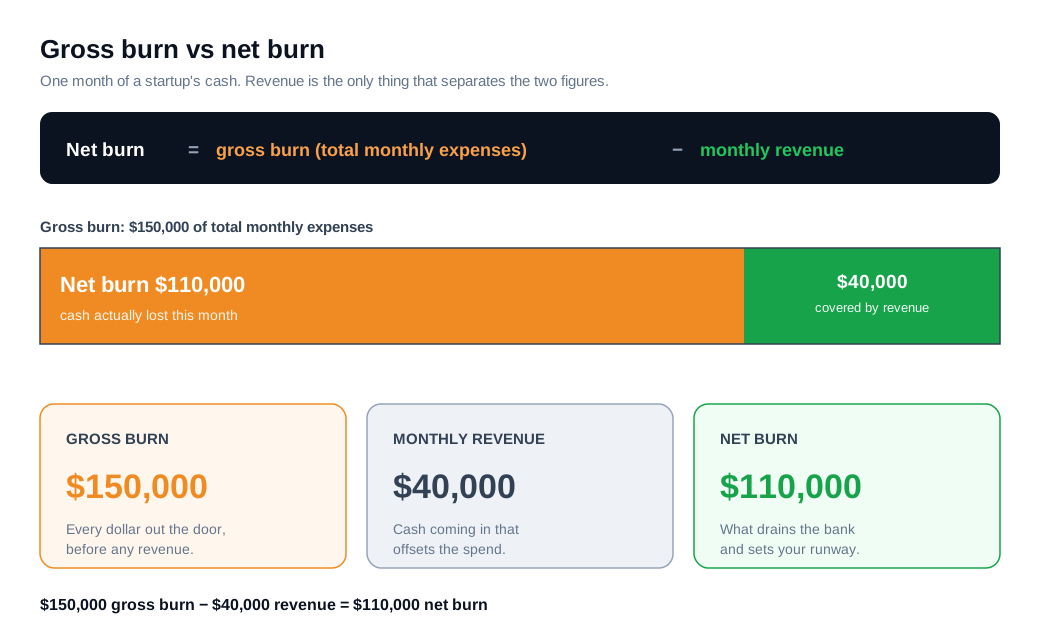
Gross burn is every dollar that leaves the company in a month, while net burn is that figure after you subtract the revenue coming in. The two answer different questions, and a careful founder watches both.
Gross burn is the total of all operating expenses, with revenue ignored. It shows the raw size of your spending and makes cost spikes easy to spot, such as a new lease or a wave of hires. Net burn subtracts monthly revenue from that total, so it shows the actual cash lost each month and the real speed at which reserves drain. Carta and Wall Street Prep both define net burn as gross burn minus revenue.
The gap between them matters. A company can hold gross burn steady while net burn falls quickly as revenue grows, which is the shape of a business heading toward profitability. Watch gross burn to keep spending disciplined, and watch net burn because it is the number that sets your runway.
What is runway?
Runway is the number of months a company can keep operating at its current net burn before the cash runs out. It converts your bank balance and your burn rate into the one figure that matters most to a founder: how much time is left.
The name comes from aviation. A plane needs enough runway to get airborne before it reaches the end, and a startup needs enough months to reach profitability or a new round before the account empties. When runway hits zero and no new cash has arrived, the company cannot make payroll and stops. Pilot describes runway as the amount of time a startup has before it runs out of money at its current spending level.
Runway is a forecast, not a fact, because it assumes burn stays where it is. If you hire, sign a bigger lease, or lose a large customer, the number moves, which is why founders recheck it every month rather than once a quarter.
How do you calculate burn rate and runway?
You calculate net burn by subtracting monthly revenue from monthly operating expenses, then divide the cash you have on hand by that net burn to get runway in months. Two short formulas do the work.
Net burn = monthly operating expenses minus monthly revenue
Runway = cash on hand / net burn
There is a second way to find burn that acts as a useful check. Visible lays it out: take your cash balance at the start of a period, subtract the balance at the end, and divide by the number of months in between. That gives your average net burn straight from the bank statement, with no expense categorizing required.
Here is a worked example. A seed-stage SaaS company holds $1,200,000 in the bank. It spends $150,000 a month on salaries, rent, tools, and ads, and it brings in $40,000 a month in revenue. Gross burn is $150,000. Net burn is $150,000 minus $40,000, or $110,000. Runway is $1,200,000 divided by $110,000, which is about 10.9 months, so call it eleven months of cash at the current pace.
The bank-statement check lines up. If the company started the quarter with $1,200,000 and ended it with $870,000, it burned $330,000 over three months, or $110,000 a month on average, the same net burn the expense math produced.
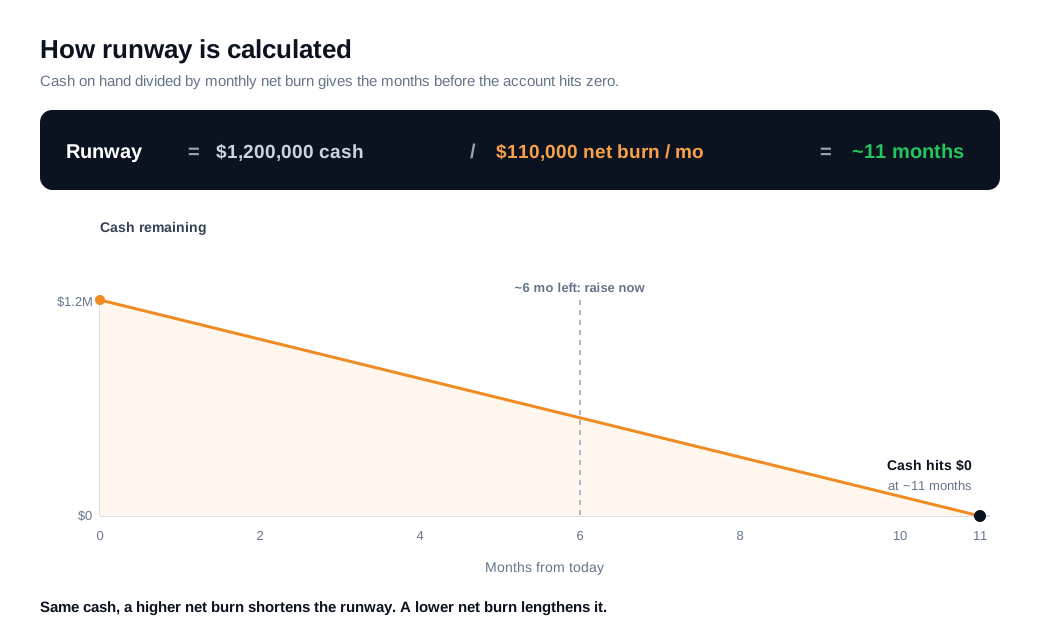
One more figure is worth knowing: gross-burn runway, the worst case if revenue vanished. Divide $1,200,000 by the full $150,000 of expenses and you get eight months. The gap between eleven months and eight is the cushion your revenue currently buys you, and it shrinks the moment sales slow.
What is a good runway for a startup?
Most investors and operators treat 12 to 18 months of runway as the healthy target, because that is roughly the time it takes to hit the milestones a strong next round depends on. A company with less than a year of cash is usually already in fundraising mode, whether or not the founders admit it.
The low end has a name. Paul Graham calls the danger zone the fatal pinch, defined in his essay as being default dead, growing slowly, and running low on time all at once, with roughly six months of runway left. At that point the options narrow fast, because raising a round or turning cash-flow positive both take longer than six months for most teams.
The practical rule most operators follow is to start raising while you still have six to nine months of runway, not when you are down to the last few weeks. Fundraising can take three to six months from first meeting to money in the bank, and a founder negotiating with a full account is in a far stronger position than one who has to accept the first term sheet offered. Aim to close a round with a year or more still in reserve.
Benchmarks are a starting point, not a verdict. A capital-light team with growing revenue can operate comfortably on less than a business that just hired twenty people ahead of a product launch. Read your runway against your own growth rate and spending plans, not a single industry line.
Why do burn rate and runway matter?
Burn rate and runway matter because running out of cash is one of the most common ways startups die, and these two numbers are the earliest warning a founder gets. They turn a vague worry about money into a specific date on the calendar.
The failure data is blunt. In a widely cited analysis of startup post-mortems, CB Insights found the top reasons companies fold were no market need at 42 percent, running out of cash at 29 percent, and not having the right team at 23 percent. Running out of cash is often the final event that follows a deeper problem, but it is still the moment the doors close.
Burn and runway are also the inputs to the single question Paul Graham argues every founder should be able to answer: are you default alive or default dead. Default alive means that on your current trajectory, with no new funding, revenue growth will carry you to profitability before the cash runs out. Default dead means it will not. You cannot answer that without knowing your burn rate, your runway, and how fast revenue is climbing against them.
Graham also names the most common cause of a burn rate that gets out of hand, which is hiring too fast. Payroll is usually the largest line in a startup budget, and each early hire raises burn for as long as they stay, so a hiring plan built for the revenue you hope to have rather than the revenue you do have is the quickest way to shorten runway.
How do you extend your runway?
You extend runway by lowering net burn, which means cutting non-essential costs, growing revenue, or both, and by raising capital before you are forced to. Brex groups the levers into three: spend less, earn more, or bring in outside money.
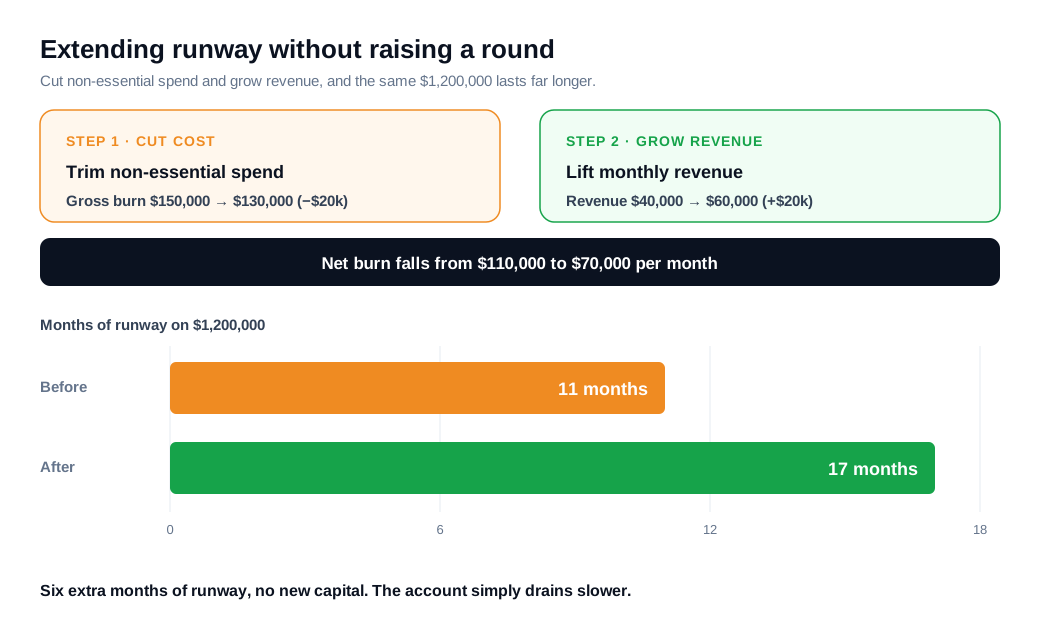
Start with cost, because it moves fastest. Payroll and rent are the two largest line items for most startups, so a hiring freeze or a delay on a non-essential role adds months of runway on its own, and trimming unused software and renegotiating vendor contracts helps at the margin. Every dollar of gross burn you remove drops straight into net burn.
Revenue is the other half, and it compounds. Annual prepayment deals hand you a year of cash on day one, upsells raise revenue with no new acquisition cost, and converting more of the traffic you already pay for lifts revenue without lifting the marketing budget. A large share of that traffic reaches a pricing or product page, hesitates, and leaves without ever talking to anyone. Reaching those high-intent visitors while they are still on the page, with live chat or a quick call when a question is faster to answer live, turns more of them into paying customers, and a faster inbound sales motion works directly on the revenue that offsets your burn.
Put both halves on the worked example. Trim $20,000 of non-essential spend, so gross burn falls to $130,000, and grow revenue from $40,000 to $60,000. Net burn drops from $110,000 to $70,000. Runway on the same $1,200,000 stretches from about eleven months to about seventeen, six extra months bought without raising a dollar.
Outside capital is the third lever, and it buys time rather than fixing economics. A bridge round, venture debt, or revenue-based financing can add a few months of runway between equity rounds, which is useful when it lets you reach a milestone that makes the next raise stronger. Used to paper over a burn rate that is simply too high, it only pushes the same problem a quarter down the road.
Key takeaways
- Burn rate is monthly cash out, runway is months left. Burn rate is what you spend each month, and runway is how long your cash lasts at that pace.
- Net burn is the number that sets runway. Gross burn is total expenses, net burn subtracts revenue, and dividing cash by net burn gives runway in months.
- Run the worked example both ways. $1,200,000 in the bank at $110,000 net burn is about eleven months, and the bank-statement method should return the same figure.
- Twelve to eighteen months is the healthy target. Below six months is Paul Graham's fatal pinch, so start raising while you still have six to nine months in reserve.
- Cash is a top killer, so watch the trend. Running out of cash ranks among the most common reasons startups fail, and burn and runway are the earliest warning you get.
- Extend runway from both sides. Cut non-essential spend and grow revenue to lower net burn, and raise outside money before you are forced to, not after.
TAGS

Written by
Daniel SemeckyCo-founder & CEO
Daniel is the co-founder and CEO of Glimpze. He spends his days talking to revenue teams about how to catch high-intent visitors before they bounce, and writes about inbound sales, lead conversion, and building a motion where marketing and sales actually share a number.


