
On this page
A shopper who bought running shoes last month lands on your homepage. Another arrives cold from a paid ad, having never seen your brand. A third left a pair of hiking boots in a cart on Tuesday. Show all three the same storefront and you are wasting the visit for at least two of them.
Ecommerce personalization is the practice of not doing that. It reshapes what each visitor sees based on who they are and how they behave, so the store meets a returning buyer, a first-time prospect, and a cart abandoner where each one actually stands.
This guide covers what ecommerce personalization means, what you can actually personalize, how it moves conversion rate and average order value, what data it runs on, how to implement it without a nine-month project, and the mistakes that quietly cost you a shopper's trust.
What is ecommerce personalization?
Ecommerce personalization is the practice of tailoring an online store's content, product recommendations, offers, and messaging to individual shoppers or tightly defined segments, using data about their behavior, purchase history, and stated preferences. Instead of a single fixed storefront, each visitor sees a version shaped to their context.
The goal is relevance, and relevance shortens the path to a purchase. A returning customer sees the brands and sizes they favor near the top. A cold visitor from a discount ad sees a first-order code and best sellers rather than a niche collection. The store does the sorting work that a shopper would otherwise have to do themselves, which is why Salesforce frames personalization as meeting rising expectations for experiences that feel built for the individual.
Those expectations are real and measurable. McKinsey's research on personalization found that 71 percent of consumers expect companies to deliver personalized interactions, and 76 percent get frustrated when they do not find them, a pattern documented in the firm's analysis of why the value of getting personalization right is multiplying. A generic experience is no longer a neutral default. For a growing share of shoppers, it reads as a store that does not know them.
Personalization comes in two flavors, and most stores use both. Rules-based personalization is hand-written if-then logic: a new visitor from a paid search ad sees a welcome offer, a shopper in Germany sees prices in euros. Algorithmic personalization uses a model that learns from behavior across many shoppers and predicts the next best item to show, which is what powers the recommendation feeds you see on large marketplaces.
What can you personalize?
You can personalize almost any surface a shopper touches: the homepage, product pages, on-site search and category ordering, the cart and checkout, email and SMS, and the offers each segment sees. The catalog stays the same. What changes is which parts of it each visitor meets first.
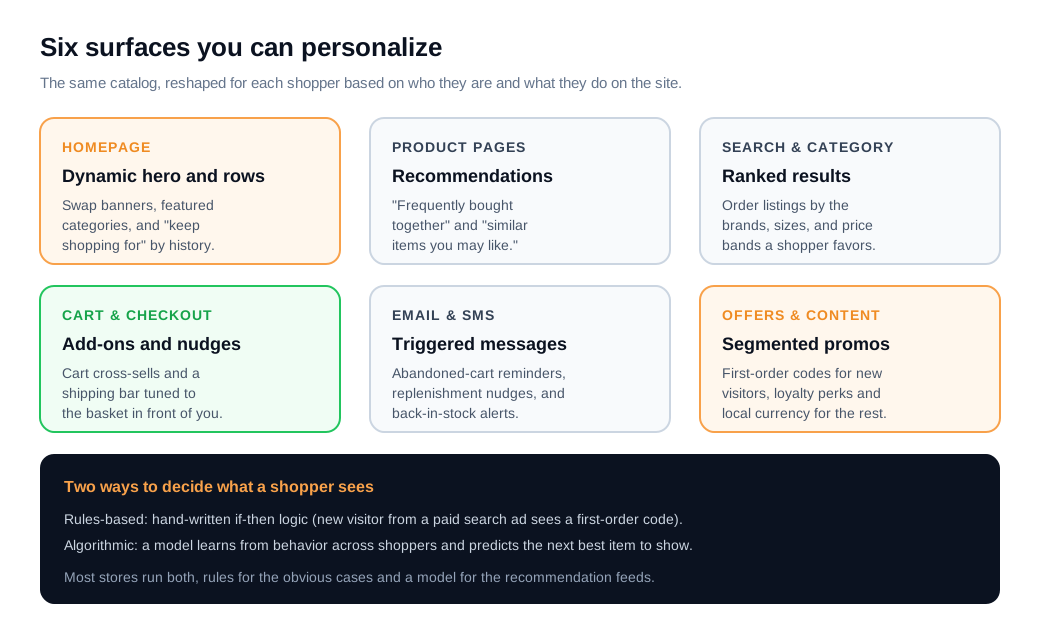
Product recommendations are the highest-impact surface, which is why nearly every large retailer relies on them. Amazon's recommendation engine is often credited with generating around 35 percent of the company's revenue, a figure cited in BigCommerce's guide to recommendation engines. The familiar modules do the work: "frequently bought together" on a product page, "similar items you may like" below the fold, and "keep shopping for" rows on the homepage that pick up where a shopper left off.
Beyond recommendations, on-site search can rank results by the brands and price bands a shopper has favored, so the listing that matters shows up first. The cart can surface a cross-sell tuned to what is already in the basket, and a free shipping bar can adjust to how close the order sits to the threshold. Email and SMS carry triggered messages: an abandoned-cart reminder, a replenishment nudge when a consumable is due, a back-in-stock alert on a watched item.
Live conversation belongs on this list too. When a shopper is stuck on a high-consideration purchase, a person on live chat can tailor a recommendation in real time in a way no static widget can, reading the exact question and pointing to the right product. An AI chat assistant can do a lighter version at scale, answering with the shopper's context in view rather than a canned script.
How does it lift conversions and AOV?
Personalization lifts conversions and average order value because relevance shortens the distance between a shopper's intent and the product that satisfies it, and because recommendations put complementary and higher-tier items in front of people already in a buying frame of mind. The first effect wins more orders. The second grows the size of each one.
McKinsey's analysis puts the aggregate impact in a clear band: personalization most often drives revenue lifts of 10 to 15 percent, with company-specific results ranging from 5 to 25 percent depending on sector and execution. Companies that grow faster than their peers pull a disproportionate share of that growth from personalization. On the demand side, the 2021 State of Personalization report from Twilio Segment found that 60 percent of consumers say they will become repeat buyers after a personalized shopping experience, which is where the long-term value compounds.
The reason the numbers matter so much is that conversion rate and average order value multiply. A small gain on each stacks into a larger total than either one alone.
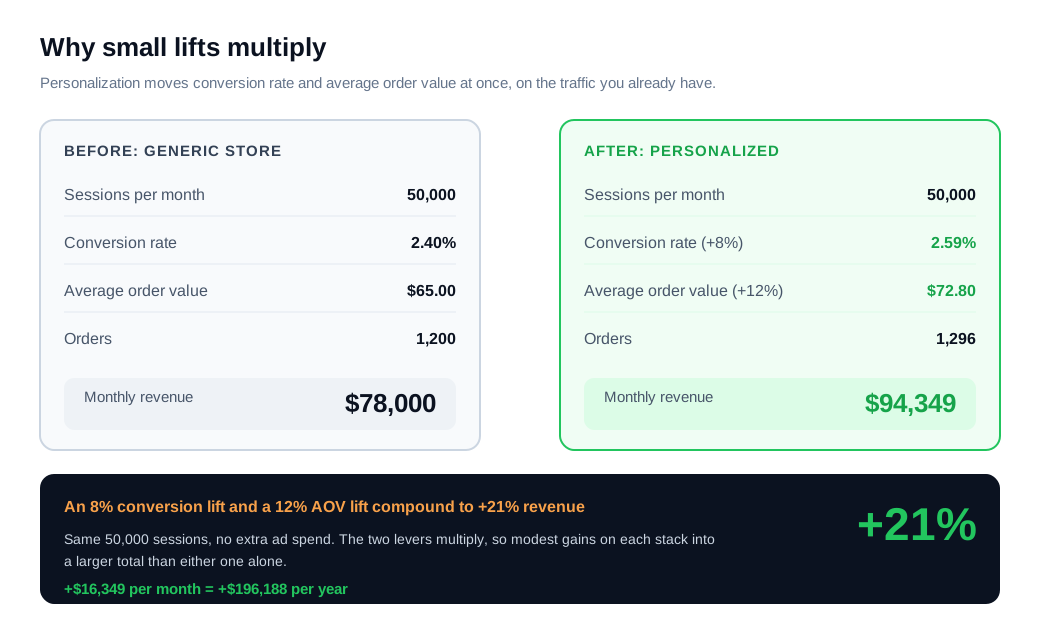
Here is a worked example. Say a store gets 50,000 sessions a month, converts at 2.4 percent, and runs a $65 average order value. That is 1,200 orders and $78,000 in monthly revenue. Now add personalized recommendations on product and cart pages. Suppose they lift conversion by a modest 8 percent, to 2.59 percent, and raise average order value by 12 percent through cross-sells, to $72.80. The store now books 1,296 orders at $72.80, or about $94,349 a month.
That is a 21 percent revenue gain, roughly $16,300 a month or nearly $196,000 a year, on the exact same traffic and ad spend. Neither lift is heroic on its own. They stack because you are converting slightly more of the same visitors and earning slightly more from each, and the two effects reinforce each other rather than compete.
What data do you need to personalize?
Personalization runs on three kinds of data: behavioral data (what shoppers click, view, search, and buy), transactional data (order history and value), and zero-party data (preferences a shopper hands you directly, like a quiz answer or a size). The richer and cleaner these three are, the sharper the personalization, and the more it looks helpful rather than random.
Behavioral and transactional data usually already exist in your platform and analytics, waiting to be put to work. The pages a visitor lingers on, the categories they browse, the items they abandon, and what they have bought before all feed the segmentation and the recommendation model. Zero-party data is the piece many stores skip. A short onboarding quiz, a preference center, or a simple "what are you shopping for" prompt gives you signal a shopper has volunteered, which sidesteps the guesswork entirely.
The critical requirement is that this data be first-party, meaning collected directly from your own site and customers rather than bought from a broker or borrowed through third-party cookies. As browsers restrict cross-site tracking, first-party data is the foundation that keeps working. It is also the foundation shoppers are most comfortable with, because they gave it to you in the course of using your store. Own that data cleanly and the rest of the program has fuel. Rely on signals you cannot control and the personalization degrades the moment a cookie disappears.
How do you implement it?
You implement ecommerce personalization by collecting first-party data, segmenting shoppers, shipping one high-value surface first, testing it against a control group, and expanding only once that first surface proves its lift. The trap is trying to personalize everything at once. The teams that see returns start narrow and let results earn the next step.
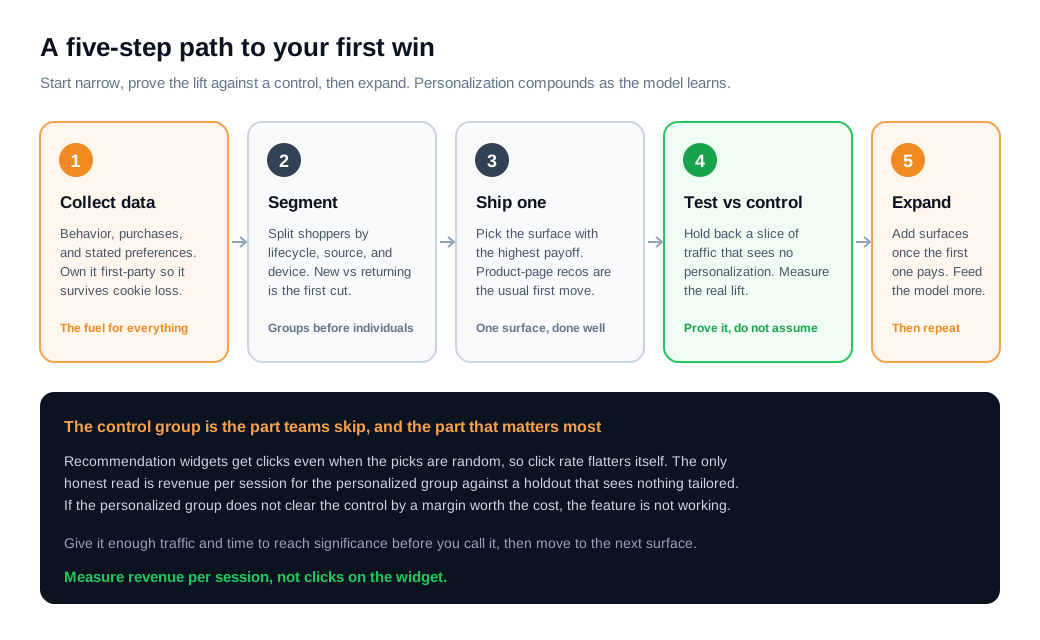
Start with segments before individuals. New versus returning is the first and most valuable cut, since those two groups need almost opposite experiences. Layer in traffic source, device, and lifecycle stage from there. These segment-level rules are quick to build, easy to reason about, and often capture most of the available lift before you touch a machine learning model. From there, pick a single surface with a high payoff, which for most stores is product-page recommendations, and ship it well rather than spreading thin.
The step teams skip is the control group, and it is the one that matters most. A recommendation widget gets clicks even when the picks are random, so click rate flatters itself and proves nothing. The honest measure is revenue per session for the personalized group against a holdout that sees nothing tailored. If the personalized group does not clear the control by a margin worth the cost, the feature is not working, no matter how good the click numbers look. Give the test enough traffic and time to reach significance, then decide.
On tooling, you rarely need a custom build to begin. Most ecommerce platforms ship recommendation blocks, and dedicated personalization and email tools add segmentation, triggered campaigns, and testing on top. For the highest-value or most considered purchases, a human still closes the gap that software leaves. A shopper weighing a $600 order will often decide on a short conversation, so handling those moments as an inbound sales touch, rather than leaving them to a static page, tends to pay back faster than another recommendation module.
What mistakes should you avoid?
The biggest mistake is personalizing in ways that feel invasive rather than helpful, because the same data that powers relevance can tip into creepy and cost you the trust a sale depends on. Gartner research found that more than 38 percent of customers will stop doing business with a company when they find its personalization efforts creepy, a warning laid out in the firm's survey on the pitfalls of personalization. Referencing something a shopper never knowingly shared, or following them around with an item they already bought, reads as surveillance and does the opposite of what you intended.
Trust is fragile in this area for a reason. Twilio's research on personalization and data found that consumers want tailored experiences yet remain wary of handing over their information, with a large share unsure whether brands will use it responsibly, a tension documented in the company's report that shoppers want personalization but do not trust brands with their data. The fix is to lean on data shoppers gave you on purpose, be transparent about what you collect, and personalize in ways that visibly help rather than surprise.
Two other traps are worth naming. The first is the filter bubble: personalize so aggressively that a shopper only ever sees more of what they already looked at, and you strangle discovery, which caps basket size and long-term value. Keep some room for fresh and complementary items. The second is thin data. Personalization built on a handful of signals produces recommendations that miss, and a wrong recommendation is worse than none, since it tells the shopper the store does not understand them. Wait until a segment has enough behavior behind it before you tailor hard, and let the generic experience carry visitors you barely know.
Key takeaways
- Ecommerce personalization tailors the store to the shopper, reshaping content, recommendations, and offers by behavior, history, and stated preferences instead of showing everyone the same page.
- You can personalize almost any surface, from the homepage and product recommendations to search ranking, cart add-ons, triggered email, and live conversation, with product recommendations carrying the most weight.
- Conversion and order value multiply, so a modest 8 percent conversion lift and 12 percent AOV lift can compound into a 21 percent revenue gain on the same traffic, as the worked example shows.
- First-party data is the foundation, combining behavioral, transactional, and zero-party signals you own directly so the program keeps working as third-party cookies disappear.
- Start narrow and prove it with a control group, shipping one high-value surface, measuring revenue per session against a holdout, and expanding only after the lift is real.
- Relevance helps, surveillance hurts, so personalize with data shoppers gave you knowingly and avoid the creepy tactics that push more than a third of customers away.

Written by
Nilas MylerCo-founder & CTO, Glimpze
Nilas is the co-founder and CTO of Glimpze, an inbound sales tool that turns high-intent website visitors into live conversations. A former SEO consultant for some of the largest companies in Denmark, he writes about speed-to-lead, inbound sales, and conversion rate optimization — the technical and operational mechanics of turning traffic into pipeline.


