
On this page
A landing page has one job. Someone arrives with a specific question in their head, and the page either answers it fast enough to earn the next click or it loses them to the back button. Most pages sit somewhere in the disappointing middle, converting a few percent of the traffic that a marketing budget worked hard and paid real money to buy.
Landing page optimization is the discipline of closing that gap on purpose. It is unglamorous and measurable, a rare pairing in marketing. A single headline rewrite or a shorter form can move a conversion rate by double digits, and the only honest way to know is to test the new version against the one you already have.
This post covers what landing page optimization is, what counts as a good conversion rate, which elements to fix first, how the match between your ad and your page changes the numbers, how much a slow page quietly costs, and how to test a variant without fooling yourself.
What is landing page optimization?
Landing page optimization is the process of improving a single page so that a larger share of its visitors complete the action it was built for, whether that is a signup, a demo request, a purchase, or a download. It is a focused subset of conversion rate optimization, or CRO, aimed at the one page where a visitor makes a decision rather than at the entire funnel around it, as Glassbox frames it.
The work is a loop that you run again and again. You look at how the current page performs, form a hypothesis about why some visitors leave, change one thing, measure the result against the original, and keep the version that wins. Opinions and taste get a vote in the first draft. After that the data decides, because the point of optimization is to replace guesses about what visitors want with evidence of what they actually do.
What you are optimizing is a short list of elements that every landing page shares: the headline and value proposition, the supporting copy, the hero visual, the call to action, any form, the social proof, and the raw speed at which all of it loads. Each of those is a lever.
Relevance scales with specificity, which is why volume plays a role too. HubSpot's benchmark data found that companies growing from 10 to 15 landing pages saw a 55% increase in leads, because more targeted pages create more chances to match a specific offer to a specific audience. The rest of this post is about which levers move the numbers most and how to pull them without breaking what already works.
What is a good landing page conversion rate?
A good landing page conversion rate depends heavily on your industry and your traffic source, but the current cross-industry median sits at about 6.6%. That figure comes from Unbounce's Conversion Benchmark analysis of roughly 57 million conversions across 41,000 landing pages in late 2024, and it is a useful reality check against the inflated "10% or bust" numbers that float around marketing blogs.
The spread underneath that median matters more than the median itself. Unbounce's data puts SaaS pages near a 3.8% median and financial services closer to 8.4%, with some sectors well into double digits. A software free-trial page and a legal intake form are playing different games, so a rate that would be excellent for one would be a warning sign for the other.
Traffic source shifts the number just as much. A page taking cold display traffic and the same page taking warm email traffic from your own list will convert at very different rates, because the two audiences arrive with different levels of intent. That is why the benchmark works as a starting orientation, not a grade. The rate worth chasing is one that beats your own page from last quarter, measured on the same traffic.
What elements should you optimize first?
Optimize the elements a visitor meets first and weighs most heavily: the headline and value proposition, the primary call to action, the form, and the speed at which the page loads. These four decide most conversions before a visitor ever reads your carefully written body copy.
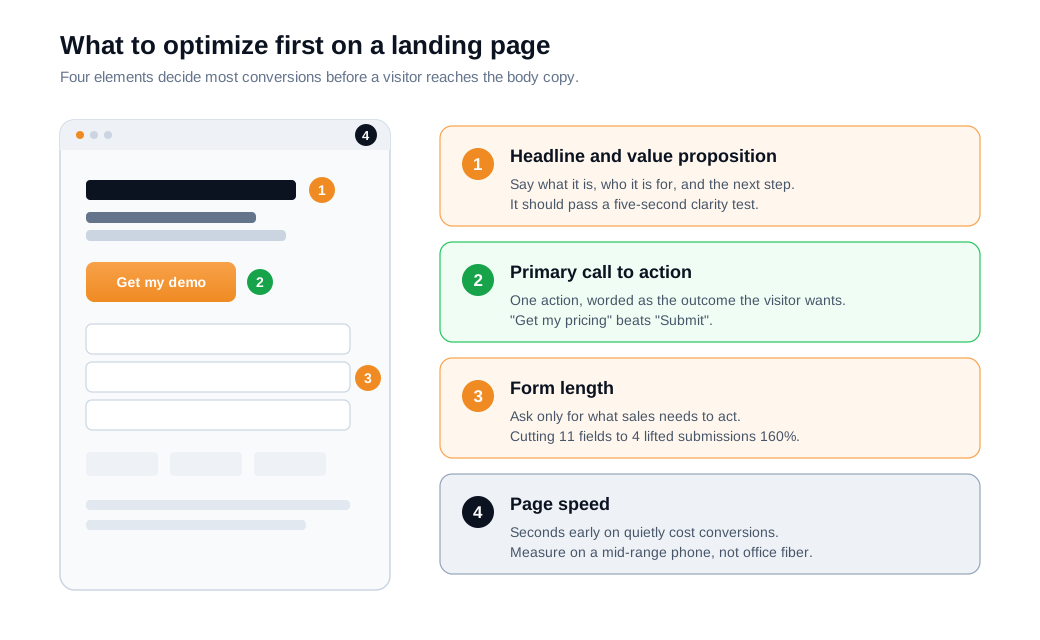
Start with the headline and value proposition, because they carry the heaviest load. Within a few seconds of landing, a visitor is trying to answer three questions: what is this, is it for me, and what do I do next. If your headline makes them work for those answers, many will leave before you get a second chance. A quick gut check is the five-second test: show the top of your page to someone unfamiliar with it for five seconds, then ask what you do and who it is for. If they cannot say, clarity is your first fix, ahead of anything else.
Next, tighten the call to action. A landing page should have one primary action, repeated as needed, rather than a scatter of competing buttons that split the decision. Copy that names the outcome, like "Get my pricing" or "Start my trial," reliably beats a vague "Submit," because it tells the visitor what happens when they click.
Then look hard at any form, since forms are where motivated visitors quietly give up. The most cited illustration comes from Imaginary Landscape, a web firm that cut its contact form from 11 fields to 4 and saw submissions rise by 160%, one of the cases documented in Venture Harbour's review of form-length studies. Every field you ask for is a small tax on completion, so the discipline is to request only what your sales team truly needs to act and to collect the rest later.
Here is the arithmetic that makes form length worth the attention. Say a demo page draws 4,000 visitors a month and converts 3% of them on a long form, which is 120 requests. If trimming the form to its essential fields lifts completion by even half of what Imaginary Landscape saw, to roughly 4.4%, that same traffic returns about 176 requests. Nothing else changed, yet the page produced 56 more conversations a month from visitors you already paid for.
Social proof and the hero visual matter too, though they tend to reinforce a decision rather than trigger it, which is why they sit below the top four on the priority list.
How does message match affect conversions?
Message match is how closely your landing page repeats the promise, wording, and look of whatever a visitor clicked to reach it, and closing the gap between the two is among the highest-leverage changes in the whole practice. When the ad says one thing and the page says another, the visitor feels a small jolt of doubt about whether they are even in the right place, and doubt is where conversions go to die.
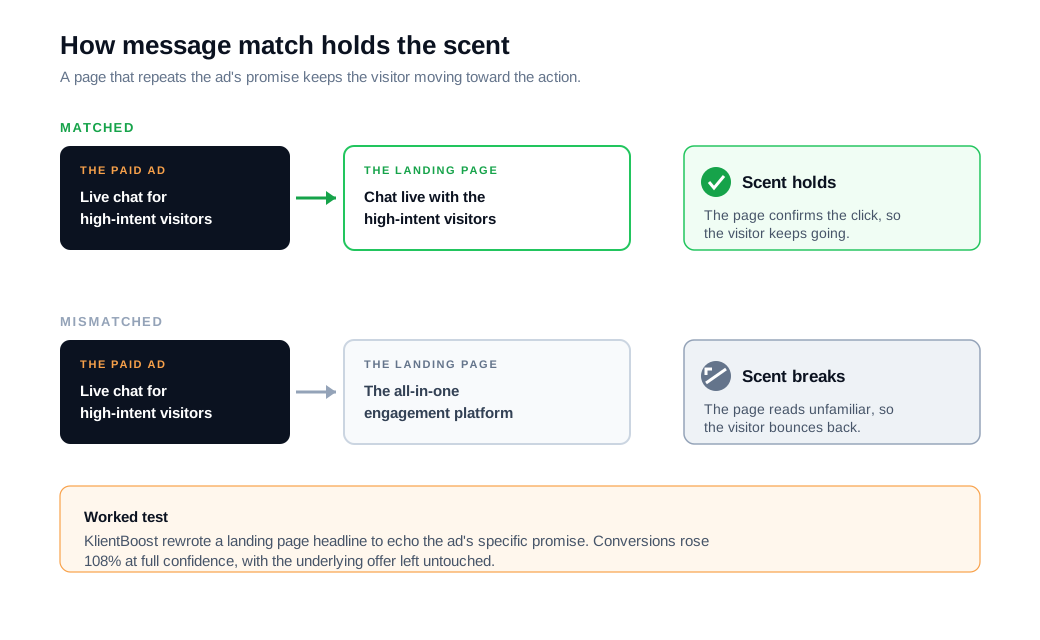
The idea has an older name: information scent, popularized by Bryan Eisenberg, who described visitors as following a scent trail from the ad toward the thing they want, the way an animal tracks a smell. When the ad's headline, keywords, and imagery reappear on the landing page, the scent holds and the visitor keeps moving. When the page smells different, the trail breaks and they double back to the search results, as CXL lays out in its long-running work on scent.
The lifts are real and sometimes large. KlientBoost reported a 108% increase in conversion rate, at full confidence, from rewriting a landing page's headline and subhead to match the specific benefit its ad promised, plus a separate 66% lift from carrying an ad's "Fully Free for Life" wording straight onto the page. Neither test touched the offer. They only made the page confirm what the click had already promised.
A worked example shows the mechanism. Imagine a Google Ads headline that reads "Live chat for high-intent visitors" pointing at a landing page whose headline says "The all-in-one customer engagement platform." Both describe the same product, yet a visitor who clicked the first has to translate the second before they trust they are in the right place, and a share of them will not bother. Change the page headline to echo the ad, to something like "Chat live with the visitors most likely to buy," and the translation step disappears. The visitor's own words are waiting for them, so the page confirms the click instead of quietly questioning it.
How much does page speed affect landing page conversions?
Page speed affects landing page conversions directly and steeply, because every extra second of load time hands an impatient visitor another reason to leave before the page can make its argument. Speed is the one optimization that costs you conversions even when everything else on the page is right.
Portent's analysis of conversion data found that conversion rates drop by an average of about 4.42% with each additional second of load time in the first five seconds, and that a site loading in one second converts roughly 2.5 times higher than one loading in five. The damage is front-loaded, which means the first few seconds are the ones worth fighting for.
Mobile raises the stakes. In the "Milliseconds Make Millions" study that Google ran with Deloitte across 30 million mobile sessions, a 0.1-second improvement in load time was associated with an 8.4% lift in retail conversions and a 9.2% rise in average order value. A tenth of a second is below the threshold most people can notice, yet it showed up clearly in the money.
The practical order of attack rarely changes: compress and correctly size images, cut render-blocking scripts, and be ruthless about third-party tags, since analytics, chat, and ad pixels each add weight. Measure on a mid-range phone over a normal connection rather than office fiber, since that is closer to what visitors actually experience.
How do you test landing page variants?
You test landing page variants by writing one clear hypothesis, changing a single element, splitting traffic evenly between the current page and the new version, and running the test until it reaches a pre-set sample size and statistical significance. The discipline in that sentence is what separates a real result from a lucky streak.
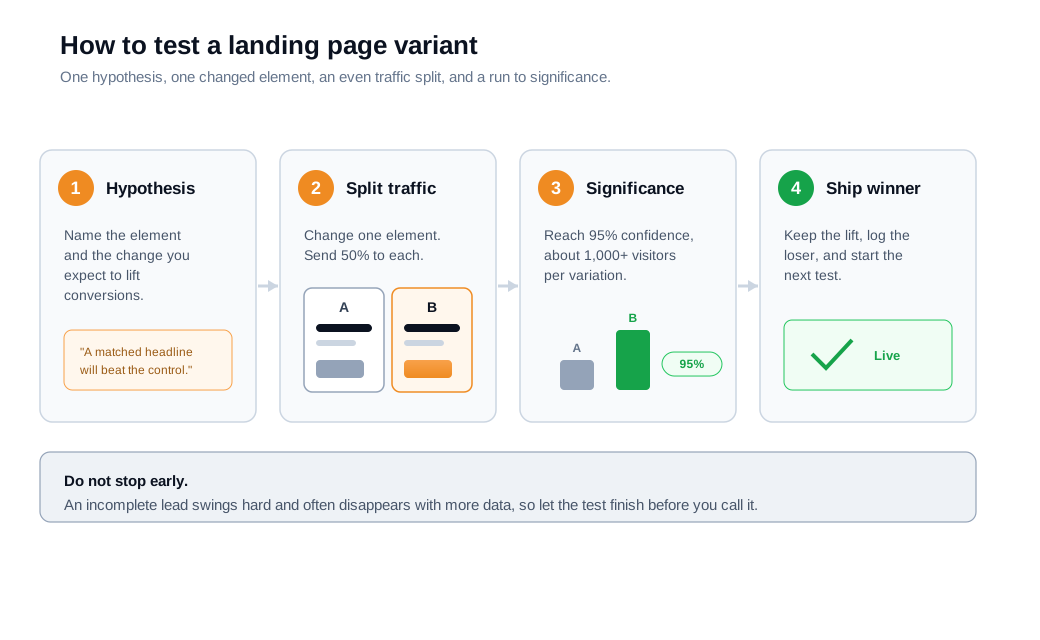
Change one thing at a time. If you rewrite the headline, recolor the button, and shorten the form in the same test, a win tells you the bundle worked but not which piece earned it, and you learn nothing you can reuse on the next page. Isolating the variable is the only way a test teaches you something.
Size the test before you launch it and let it run to significance. A common working target is 95% confidence, which means a p-value under 0.05, so there is only about a 5% chance the result is noise, and a rough rule of thumb is on the order of 1,000 visitors per variation for a typical page, with smaller expected lifts needing far more, as Contentful's testing guide describes. Just as important, do not stop the moment the variant edges ahead. Early leads swing hard and often vanish with more data, so peeking and quitting is one of the most common ways teams fool themselves.
Here is a worked example. A signup page gets 8,000 visitors a month and converts 4% to trials, which is 320 trials. You hypothesize that a headline matching your top ad will lift it, and you need roughly 1,000 visitors per variation to read a change of this size, so about 2,000 visitors total, well inside a month of traffic. If the variant lands at 5% and the result clears 95% confidence, that is 400 trials a month, 80 more than before, and close to 1,000 more over a year from a single headline change. If it comes back flat, you have spent one test window and gained a cleaner idea of what your visitors respond to, then you move to the next hypothesis.
Quantitative tests tell you which version wins, but they cannot tell you why a visitor hesitated on the version that lost. That gap is where talking to people helps. Session recordings and on-page surveys close some of it, and on a high-intent page, giving a stuck visitor a way to ask in the moment through live chat instead of a form and a wait surfaces the exact objection a heatmap can only hint at. For inbound sales teams, that in-the-moment answer often rescues a conversion the page alone would have lost, and it doubles as raw material for the next test.
Key takeaways
- Landing page optimization is a repeating loop. You form a hypothesis, change one element, measure against the original, and keep the winner, trading guesses for evidence with each pass.
- Judge yourself against the right benchmark. The cross-industry median is about 6.6%, but SaaS, finance, and events live in different ranges, so the rate worth beating is your own page's last quarter.
- Fix the top four elements first. The headline and value proposition, the call to action, the form, and load speed decide most conversions before body copy gets read.
- Message match is high-leverage and cheap. Repeating the ad's promise and wording on the page held KlientBoost tests up by 66% to 108%, because a matched page confirms the click rather than questioning it.
- Speed is a silent tax. Portent found conversions falling about 4.42% per second early on, and a 0.1-second mobile gain tracked with an 8.4% retail lift in Google and Deloitte's data.
- Test one variable to significance and do not peek. Size the test up front, aim for 95% confidence, and pair the numbers with live conversations to learn why the loser lost.
TAGS

Written by
Nilas MylerCo-founder & CTO, Glimpze
Nilas is the co-founder and CTO of Glimpze, an inbound sales tool that turns high-intent website visitors into live conversations. A former SEO consultant for some of the largest companies in Denmark, he writes about speed-to-lead, inbound sales, and conversion rate optimization — the technical and operational mechanics of turning traffic into pipeline.


