On this page
A mid-market software company runs the numbers on its inbound funnel and finds a familiar gap. Around 700 people fill a form, start a chat, or ask a pricing question every month. Four reps work the list, reach maybe half of it before the rest cool off, and spend most of the week on research and data entry instead of talking to buyers.
AI in sales is the set of tools aimed at that gap. It can answer a question at 2 a.m., score a lead the moment it arrives, draft the follow-up, and write the whole exchange back to the CRM, which frees reps for the conversations that close. The same tools can also state a wrong price with total confidence, leak deal terms into a public model, or flood buyers with outreach they tune out in seconds. Both sides are real, and both are worth pinning down before you spend a budget on them.
This guide covers what AI in sales means, the use cases that work today, the benefits worth counting, the risks and pitfalls to manage, how to adopt it responsibly, and whether the return justifies the spend.
What is AI in sales?
AI in sales is the use of machine learning and generative models to handle or assist the repeatable parts of selling, from scoring leads and drafting emails to answering buyer questions and updating the CRM. It spans two broad families of technology that do different jobs.
Predictive AI reads patterns in your historical data. It scores leads by how likely they are to convert, forecasts which deals will close, and flags accounts worth a rep's attention. Generative AI produces language: it drafts outreach, summarizes a call, answers a product question in a chat window, and turns messy notes into a clean CRM record. The newest layer, agents, chains those abilities together to run a multi-step task like qualifying a visitor and booking a meeting with limited supervision.
Adoption is already broad. Salesforce's 2026 State of Sales research reports that 87% of sales organizations now use some form of AI, and 54% of sellers say they have used AI agents. Gartner projects that by 2027, 95% of sellers' research workflows will begin with AI, up from less than 20% in 2024. The question for most teams is no longer whether to use AI, but which parts of the job to hand it.
What are the top AI sales use cases?
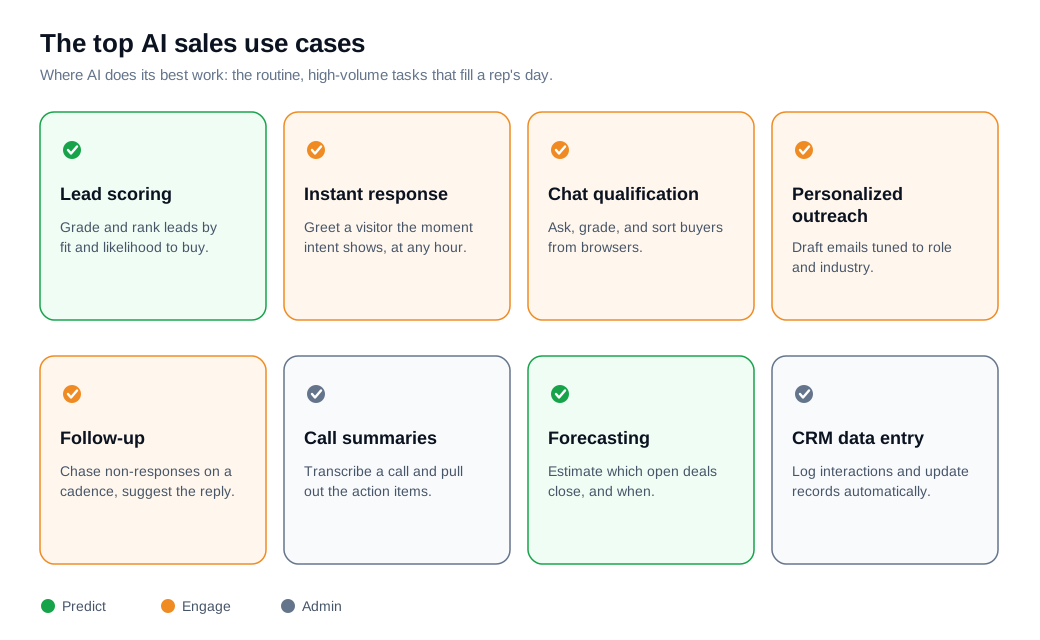
The top AI sales use cases cluster around the routine, high-volume work that fills a rep's day: lead scoring, instant lead response, chat qualification, personalized outreach, follow-up, call summaries, forecasting, and CRM data entry. These tasks share a shape. They repeat, they follow patterns, and a correct output looks the same every time.
The common use cases break down like this:
- Lead scoring and prioritization. Predictive models grade each lead on behavior, firmographics, and past deals, so reps work the most promising ones first.
- Instant lead response. An AI chat assistant greets a visitor the moment intent shows, at any hour, in place of a static contact form.
- Chat qualification. The assistant asks a few qualifying questions, grades the answers against your criteria, and separates buyers from browsers.
- Personalized outreach. Generative models draft first-touch emails and sequences tuned to a prospect's role and industry.
- Follow-up. AI chases non-responses on a cadence and suggests the next message, so leads stop slipping through the cracks.
- Call and meeting summaries. Models transcribe a call, pull out the action items, and write them back without a rep taking notes.
- Forecasting. Predictive AI estimates which open deals will close and when, tightening the pipeline picture.
- CRM data entry. The AI logs interactions and updates records automatically, the admin work reps most want off their plate.
HubSpot's 2026 data on AI in B2B sales found reps rank CRM data entry, meeting notes, and scheduling as the tasks AI helps them most with, the structured work that eats a workday without closing anything. Instant response and qualification sit at the front of an inbound sales motion, where speed decides whether a warm visitor turns into a conversation or a competitor's lead.
What benefits does AI deliver?
AI's clearest benefit is time: it removes the research, drafting, and data entry that eat most of a rep's week, then routes that recovered time toward selling. The size of the problem is well documented. Salesforce found sellers spend under 40% of their working hours actually selling, with the rest lost to admin, research, and inbox work.
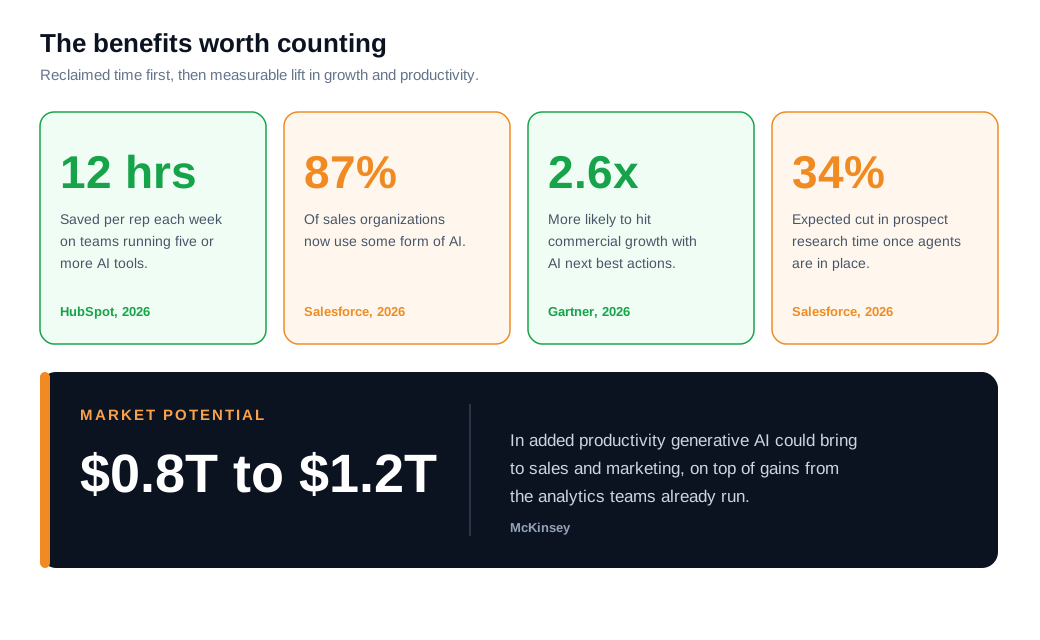
The time savings are measurable. HubSpot's 2026 research found that 64% of salespeople save one to five hours a week by using AI to automate manual tasks, and teams running five or more AI tools save roughly 12 hours per rep per week. Salesforce reports that sellers expect agents, once fully in place, to cut prospect research time by 34% and email drafting by 36%. The same research found 89% of sellers say AI deepens their understanding of customers and 87% say it makes their job less stressful.
The revenue case is starting to firm up too. Gartner found that sales organizations giving reps AI-enabled next best actions are 2.6x more likely to achieve commercial growth, and that teams which prioritize upskilling sellers on AI are 2.4x more likely to post strong revenue growth. At the market level, McKinsey estimates generative AI could add the equivalent of $0.8 trillion to $1.2 trillion in productivity across sales and marketing, on top of gains already coming from older analytics.
Here is a worked example that turns those figures into capacity. Take the 700 inbound leads and four reps from the opening. Say each rep saves 10 hours a week once AI handles research, drafting, and CRM logging, a figure that sits between HubSpot's one-to-five-hour range for a single tool and its 12-hour range for a full stack. Four reps times 10 hours is 40 hours a week reclaimed, close to a fifth rep's worth of selling time, with no new hire. Point that time at the qualified subset of leads while the AI answers all 700 instantly, and the team covers a funnel it used to leave half-worked. The AI closed nothing on its own. It made the reps' hours count for more.
What are the risks and pitfalls of AI in sales?
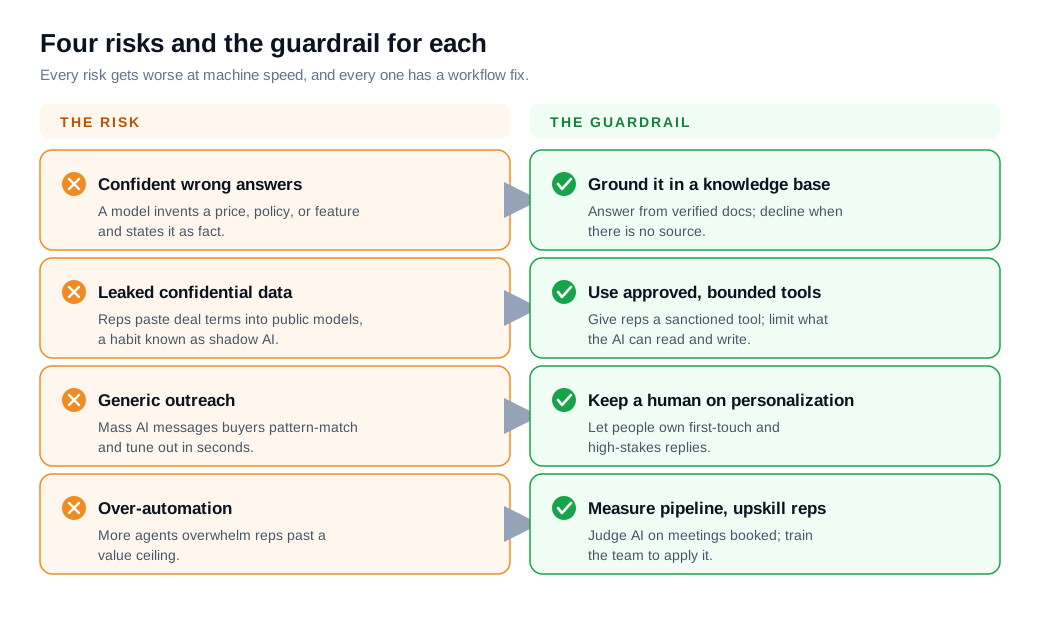
The main risks are confident wrong answers, leaked confidential data, generic outreach that erodes trust, and over-automation that overwhelms reps instead of helping them. Each one gets worse at the volume AI is built to produce.
The first is hallucination. A language model can state a price, a policy, or a feature that does not exist and present it as fact. IBM defines AI hallucinations as outputs that are factually inaccurate or ungrounded relative to the source data, and calls this the primary obstacle to deploying AI where accuracy matters, because without guardrails an enterprise ends up relying on a system that is confidently wrong. In sales, a fabricated discount or compliance claim can become a promise you never meant to make.
The second is data exposure. Reps under time pressure paste deal terms, pricing, and customer details into public chatbots, a practice known as shadow AI that can leak confidential information outside your systems. Poor or biased training data compounds the problem, producing mis-targeted personalization and, in regulated contexts, privacy and compliance exposure.
The third is buyer trust. Skepticism about machine answers is already priced in: in Gartner's survey of 645 B2B buyers, 51% said they were more likely to encounter misleading information from generative AI than from a sales rep, and 69% still turn to a rep to validate AI-generated insights before they commit. Mass outreach that buyers pattern-match as machine-written in seconds only speeds up the tune-out.
The fourth is over-automation. Gartner predicts AI agents will outnumber human sellers 10 to 1 by 2028, yet fewer than 40% of sellers will report those agents improved their productivity. Gartner describes a value ceiling, where piling on more agents past a point stops adding output and starts overwhelming reps. More AI is not automatically more selling.
How do you adopt AI responsibly?
Adopt AI responsibly by grounding it in verified data, keeping a human on anything that carries money or commitment, bounding what it can access, and measuring outcomes instead of activity. The failures above are mostly workflow problems, and a short set of guardrails covers most of them.
- Ground it in real docs. Tie any customer-facing AI to a verified knowledge base so it answers from your actual product, and have it say it does not know rather than guess. A careful AI assistant setup is what keeps the answers honest.
- Keep a human on the decisions that matter. Let AI qualify, draft, and schedule, but escalate pricing, negotiation, and any explicit request for a person straight to a rep.
- Bound what it can touch. Give the AI a narrow set of tools and permissions, and give reps an approved tool so they stop pasting deal terms into public models.
- Route the output fast. A qualified lead is worth nothing sitting in a queue. A tight routing and notifications setup gets it to the right rep in seconds.
- Measure pipeline, not messages. Message volume is easy to inflate. Judge AI on qualified meetings and revenue, the way you would judge a rep.
- Upskill the team. Gartner's finding that upskilled teams are 2.4x more likely to grow says the tool alone is not the win. Reps need to know how to apply it.
Set up that way, AI earns its place as the layer that catches every visitor and protects your reps' time for the conversations that decide a deal.
Is AI in sales worth the investment?
For most inbound teams, AI in sales pays off when it targets a specific bottleneck and gets measured on pipeline. Bought as a vague general upgrade, it tends to disappoint, which is why the productivity data is so split.
The upside is real and quantified. Teams that give reps AI-enabled next best actions are 2.6x more likely to grow, upskilled teams 2.4x, and the market-level productivity McKinsey models runs into the hundreds of billions. The caution sits right next to it: fewer than 40% of sellers say their AI agents actually improved productivity, and a majority of buyers still want a person to check the machine's work before they buy.
Read together, those figures point to the same conclusion. AI in sales returns the most when it is pointed at a clear problem, such as slow lead response or lost admin hours, grounded in your real data, and kept on a short leash around anything that touches money. Aimed that way at the 700-lead funnel, it turns a half-worked list into full coverage and buys back roughly a rep's worth of selling time. Bolted on without a target, it produces more messages and more risk without the pipeline to justify either.
Key takeaways
- AI in sales covers two technologies. Predictive models score and forecast, generative models draft and answer, and agents chain the two, with 87% of sales organizations already using some form of AI.
- The best use cases are repetitive. Lead scoring, instant response, qualification, outreach, follow-up, call summaries, forecasting, and CRM data entry are where AI performs, since reps spend under 40% of their time actually selling.
- The core benefit is reclaimed time. Teams running five or more AI tools save around 12 hours per rep each week, and sales organizations using AI next best actions are 2.6x more likely to grow.
- The risks scale with volume. Hallucinated answers, leaked deal data through shadow AI, generic outreach, and over-automation all get worse at machine speed, and 51% of buyers already expect misleading information from generative AI.
- Responsible adoption is a workflow. Ground the AI in verified docs, keep a human on money decisions, bound its access, route fast, and measure meetings and pipeline rather than message volume.
- The return depends on aim. AI pays off against a named bottleneck and honest measurement, which is why fewer than 40% of sellers report productivity gains while upskilled, focused teams are 2.4x more likely to grow.
TAGS

Written by
Nilas MylerCo-founder & CTO, Glimpze
Nilas is the co-founder and CTO of Glimpze, an inbound sales tool that turns high-intent website visitors into live conversations. A former SEO consultant for some of the largest companies in Denmark, he writes about speed-to-lead, inbound sales, and conversion rate optimization — the technical and operational mechanics of turning traffic into pipeline.


