
On this page
- What makes a B2B lead generation strategy actually work?
- Which B2B lead gen channels perform best?
- How does content marketing generate leads?
- How do webinars and events drive leads?
- How does account-based marketing generate leads?
- Why does response speed decide whether your strategies pay off?
- How do you measure lead generation strategy ROI?
- Key takeaways
- Sources
Most B2B teams do not have a lead problem. They have a strategy problem. They run six tactics at once, measure almost none of them cleanly, and cannot say with a straight face which one produced last quarter's pipeline. So the budget gets spread evenly across everything, the weak channels quietly drain the strong ones, and the team stays busy without getting better.
The strategies that actually work look different. They pick a small number of channels that fit the buyer, capture intent at the moment it peaks, and get a real person in front of the good leads before the interest fades. Everything in this guide comes back to those three moves.
Below, we rank the channels that produce real B2B pipeline, break down how content and webinars generate leads, cover account-based marketing, explain why response speed makes or breaks the system, and finish with how to measure ROI using a worked example.
What makes a B2B lead generation strategy actually work?
A B2B lead generation strategy works when it matches a proven channel to genuine buyer intent and then moves the resulting lead to a human quickly, before that intent cools. Channel, intent, and speed are the three levers, and most programs are strong on one and weak on the other two.
Start with how B2B buyers actually behave. Gartner's research on the buying journey finds that buyers spend only about 17% of the entire journey meeting with any potential supplier, and a majority now prefer a rep-free experience for most of it. Buyers research quietly, compare options, and build a shortlist long before they want a sales call. A strategy that fights that behavior, by gating everything behind a form and a callback, loses to one that meets buyers where they already are.
The common failure is optimizing for lead count. A dashboard full of names looks healthy until you notice most of them had no budget or authority. Strategies that hold up optimize for qualified pipeline instead, which changes both which channels you fund and how fast you respond.
Which B2B lead gen channels perform best?
The B2B channels that perform best are organic search and content, webinars and events, email, LinkedIn, paid search, and referrals, and they trade sharply between cost and buyer intent. No single channel wins for every company, so the strongest teams run a portfolio of three or four and cut the rest.
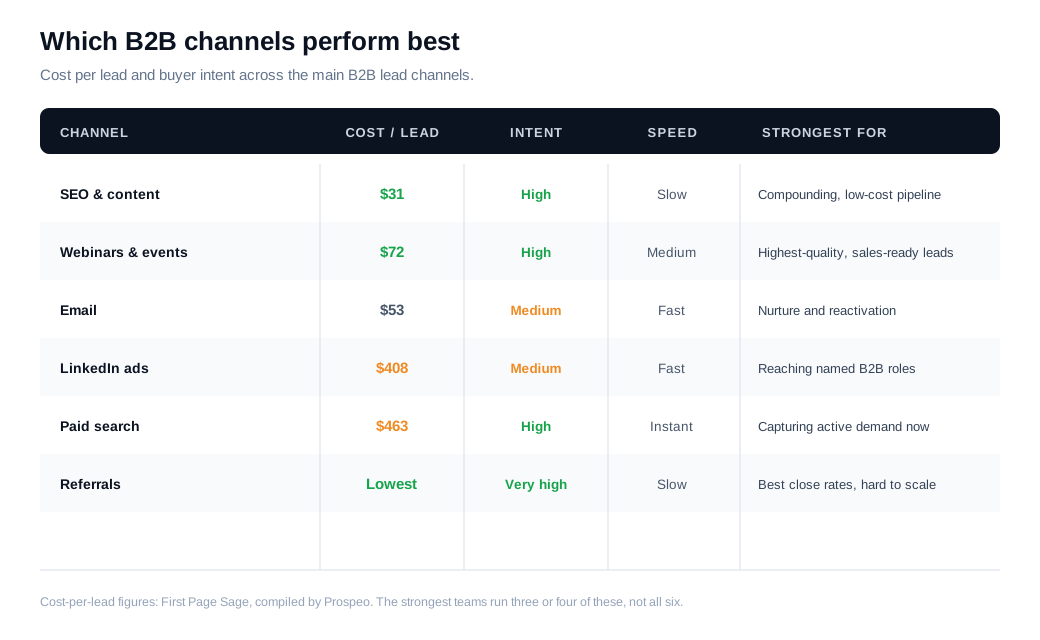
Organic search and content is the workhorse. Well-targeted content ranks for the questions buyers ask, then keeps pulling traffic long after it ships, which is why its cost per lead stays low. First Page Sage's benchmark puts SEO near $31 per lead, the cheapest of the major channels, as compiled in Prospeo's cost-of-lead-generation report.
Webinars and events sit at the high-intent end. Someone who registers and shows up has raised a clear hand, and 73% of B2B marketers say webinars produce their best-quality leads, per Callbox's 2026 lead generation benchmarks. Email is the reliable middle: cheap to run once someone opts in, and strong for nurturing the leads that other channels create.
LinkedIn dominates B2B social, with 89% of B2B marketers using it and 80% of B2B social leads coming from the platform, again per Callbox. Paid search buys speed at a premium, with First Page Sage pegging it near $463 per lead, and referrals convert best of all but resist scaling on demand. With the median B2B cost per lead now around $213, picking the right mix matters more than working every channel at once.
How does content marketing generate leads?
Content marketing generates leads by ranking for the questions buyers type into search, answering them well enough to earn trust, then giving readers a low-friction way to identify themselves. The content does the attracting; a form, a chat, or an offer does the capturing.
The economics are the reason it anchors most B2B strategies. Demand Metric's widely cited finding is that content marketing generates about three times as many leads as traditional outbound while costing 62% less, per compiled lead generation statistics. A single ranking page can produce leads for years at a falling cost, which no paid channel can match.
It also fits the rep-free buyer. Because most of the B2B journey happens before anyone talks to sales, the company whose content answers the early questions gets on the shortlist. Gated assets like a benchmark report or a template can capture a contact detail in exchange for the download, though gating everything cuts your reach, so most teams gate only their highest-value pieces and leave the rest open.
The weak spot is capture. The average visitor will read and leave without filling in anything, so pairing content with a lower-friction option, like a live chat window on a high-intent page, catches buyers who would never complete a form. That turns a passive reader into a named lead while the question is still fresh in their mind.
How do webinars and events drive leads?
Webinars and events drive leads by asking attendees to register with real contact details, then filtering for intent through who actually shows up and engages. Registration captures the lead; attendance and engagement grade it.
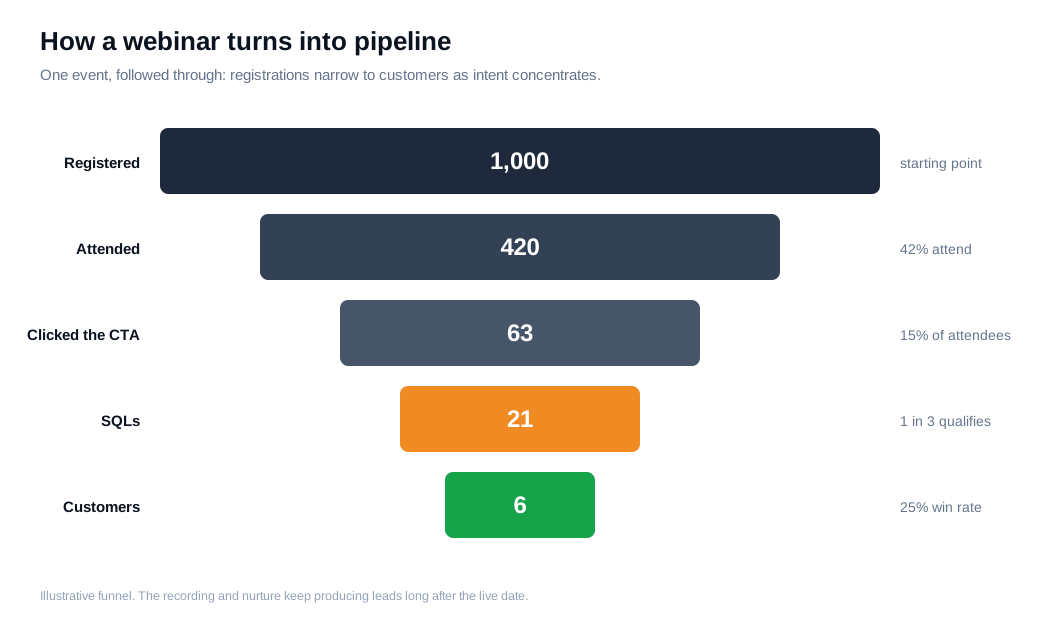
The appeal is quality. A webinar lead has given you 30 to 60 minutes of attention on your topic, which is why 73% of B2B marketers rate webinars as their highest-quality lead source, per Callbox, at a cost near $72 per lead. That combination of mid-range cost and high intent is rare.
Here is how the math tends to run. Say a webinar draws 1,000 registrations and 42% attend, giving 420 live attendees. If 15% of them click the call to action or request a follow-up, that is 63 warm leads. At a one-in-three qualification rate you get 21 SQLs, and at a 25% win rate, roughly 6 new customers from one event. The registrants you did not convert still enter nurture, and the recording keeps generating leads after the live date.
The leads decay fast once the session ends, so follow-up speed decides the return. A live video call or personal demo offered to engaged attendees within a day, rather than a generic thank-you email a week later, is what turns webinar interest into booked pipeline.
How does account-based marketing generate leads?
Account-based marketing generates leads by inverting the usual funnel: instead of casting wide and filtering down, you pick a short list of high-value accounts and coordinate marketing and sales around each one. Fewer targets, far more personalization per target.
The returns explain the popularity. Compiled 2026 benchmarks put ABM's average ROI well above traditional programs, with mature ABM efforts reporting materially higher win rates and larger deal sizes, per AdRoll's ABM statistics roundup. The mechanism is fit. Rather than waiting for your best accounts to find you, you go to them with a message built for their exact situation.
ABM works because it reaches the buyers who never fill out a form. The largest, most valuable accounts rarely download an ebook, so they only enter the pipeline through targeted outreach. Run well, ABM feeds those named accounts your best content, warms them with ads, and hands a rep a reason to reach out, which turns cold enterprise logos into a live inbound sales conversation. The catch is cost per account, so ABM earns its place on your highest-value targets, not across your whole market.
Why does response speed decide whether your strategies pay off?
Response speed decides the payoff because B2B intent decays by the hour, so a lead that waits for a reply is often a lead you have already lost. Every strategy above spends money to create a moment of peak interest, and that moment is short.
The data here is stark. The MIT and InsideSales Lead Response Management study found that contacting a lead within five minutes made a rep 21 times more likely to qualify it than waiting 30 minutes. Harvard Business Review's "The Short Life of Online Sales Leads" reached the same conclusion across 1.25 million leads: firms that responded within an hour had far better odds of a meaningful conversation than those that waited even 60 minutes longer.
This is the cheapest lever in the whole system. You have already paid to generate the lead, so shaving the response from hours to minutes lifts conversion without spending another dollar on traffic. It is also where most teams leak the most pipeline, because a form filled in at 9 a.m. that gets a reply at 4 p.m. usually reaches someone who has already moved on.
Closing that gap is a matter of routing and tooling. Instant lead routing and notifications that alert the right rep the second a qualified lead appears, plus a way for high-intent visitors to talk to a person on the spot, are what convert a good strategy into booked meetings. A real-time tool like Glimpze exists to close exactly that gap, catching interest at its peak instead of letting it sit in a queue.
How do you measure lead generation strategy ROI?
You measure lead generation strategy ROI by comparing the revenue a strategy produced to what it cost, then dividing the gain by the cost, but the number only means something when you track cost per lead and conversion alongside it. A cheap lead that never closes is a false economy, and an expensive lead that reliably becomes a customer is often a bargain.
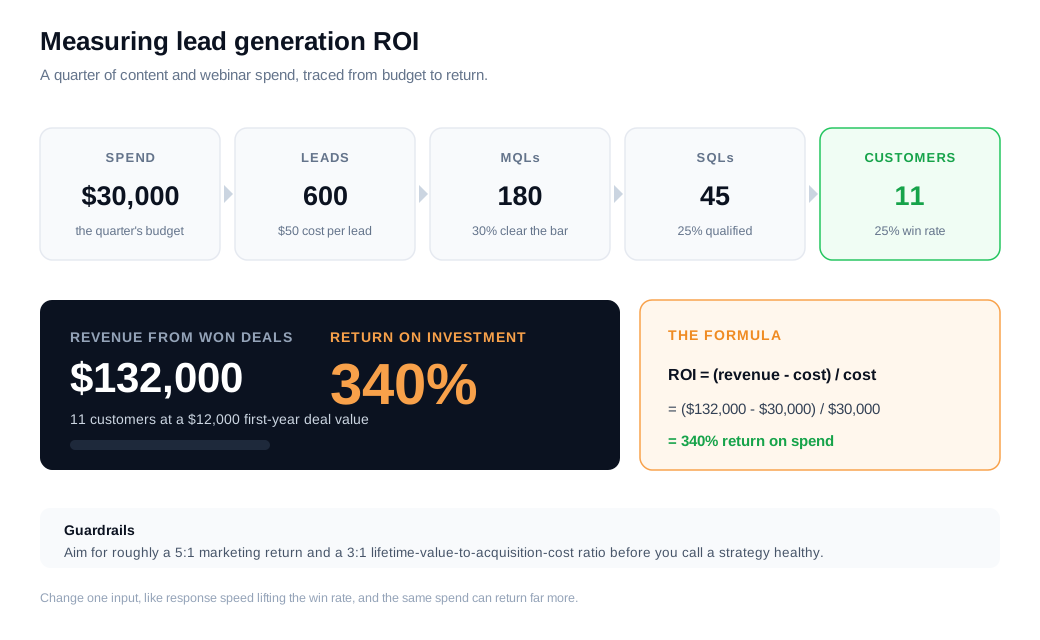
Start with cost per lead: total spend divided by leads generated. Then layer conversion on top, because cost per lead alone hides quality. Most teams track cost per SQL or cost per opportunity too, which folds lead quality back into the figure. The ROI formula itself is simple: revenue from won deals minus cost, divided by cost, expressed as a percentage.
Here is a worked example. A company spends $30,000 in a quarter on a content and webinar program and generates 600 leads, a blended cost per lead of $50. Suppose 30% clear the marketing bar (180 MQLs), sales qualifies 25% of those (45 SQLs), and 25% of those close (about 11 customers). At a first-year deal value of $12,000, that is $132,000 in revenue against $30,000 spent, or a 340% return. Change one input, say response speed, and lift the SQL-to-customer rate from 25% to 32%, and the same funnel produces 14 customers and a 460% return on identical spend.
Two guardrails keep the number honest. A blended marketing ROI around 5:1 is a common benchmark for a healthy program, and an LTV:CAC ratio of at least 3:1 tells you the economics are sustainable rather than bought. Whatever your target, judge each strategy against pipeline and revenue rather than raw lead volume, or you will keep funding the channels that look busiest instead of the ones that pay.
Key takeaways
- Working strategies match channel, intent, and speed. Pick channels that fit your buyer, capture intent at its peak, and get a human on the good leads fast; most programs nail one of the three and neglect the rest.
- Channels trade cost against intent. SEO and content compound cheaply near $31 per lead, webinars deliver high-intent leads near $72, and paid search buys speed at a premium above $460.
- Content is the cheapest compounding channel. It generates roughly 3x the leads of outbound at 62% less cost, but it only pays off when you pair it with a real way to capture readers.
- Webinars produce the highest-quality leads. 73% of B2B marketers rate them best, because attendance and engagement filter for intent, provided the follow-up is fast.
- Speed-to-lead is the cheapest lever you have. Answering within five minutes made reps 21x more likely to qualify a lead, and you have already paid to generate it.
- Tie ROI to revenue, not lead count. Track cost per lead and conversion together, aim for a 5:1 marketing return and a 3:1 LTV:CAC ratio, and fund the channels that produce pipeline.
TAGS

Written by
Daniel SemeckyCo-founder & CEO
Daniel is the co-founder and CEO of Glimpze. He spends his days talking to revenue teams about how to catch high-intent visitors before they bounce, and writes about inbound sales, lead conversion, and building a motion where marketing and sales actually share a number.


