
On this page
Your marketing team hands sales 300 "qualified" leads from last month's webinar. A rep works the top of the list, gets two answered calls and a run of dead numbers, and by Thursday has drifted back to prospecting their own accounts. The 300 names sit untouched. Marketing reports a strong month. Sales reports a dry pipeline. Both teams are looking at the same list and reaching opposite conclusions.
The word doing the damage in that story is "qualified." A marketing qualified lead is supposed to mean something precise, and when it does not, the label turns into noise that sales quietly learns to ignore. Define it well and the MQL becomes one of the most useful signals in your funnel, a short list of the people most worth a real conversation.
This guide defines a marketing qualified lead in plain terms, breaks down the fit and behavior criteria that earn the label, shows what a real MQL looks like, separates MQLs from sales qualified leads, and walks through how to set a threshold you can defend, with a worked example.
What is a marketing qualified lead?
A marketing qualified lead (MQL) is a contact who matches your ideal customer profile and has engaged with your marketing enough to be worth passing to sales, but whom a rep has not yet spoken to. It is marketing's informed bet that this person is more likely to buy than the average name in your database.
The operative word is bet. An MQL has not told a salesperson they want to buy. They have shown a pattern of behavior that, on average, precedes a purchase, so marketing forwards them for a closer look. Adobe frames the MQL as a lead the marketing team judges more likely to become a customer than other leads, based on fit and engagement, per Adobe's MQL primer. HubSpot puts the same idea in a plainer image: an MQL is closer to window shopping than to walking up to the register, as its guide to marketing qualified leads describes.
That distinction is where the value and the trouble both live. Treated as a prompt to start a conversation, the MQL earns its place. Treated as a finished result to celebrate, it flatters marketing's numbers while sales works around it. The rest of this guide is about keeping it the former.
What criteria make a lead an MQL?
The criteria that make a lead an MQL fall into two dimensions, fit and behavior, and a definition that leans on only one of them will mislead you. Fit answers whether you should sell to this person at all. Behavior answers whether they are showing any sign of wanting to talk.
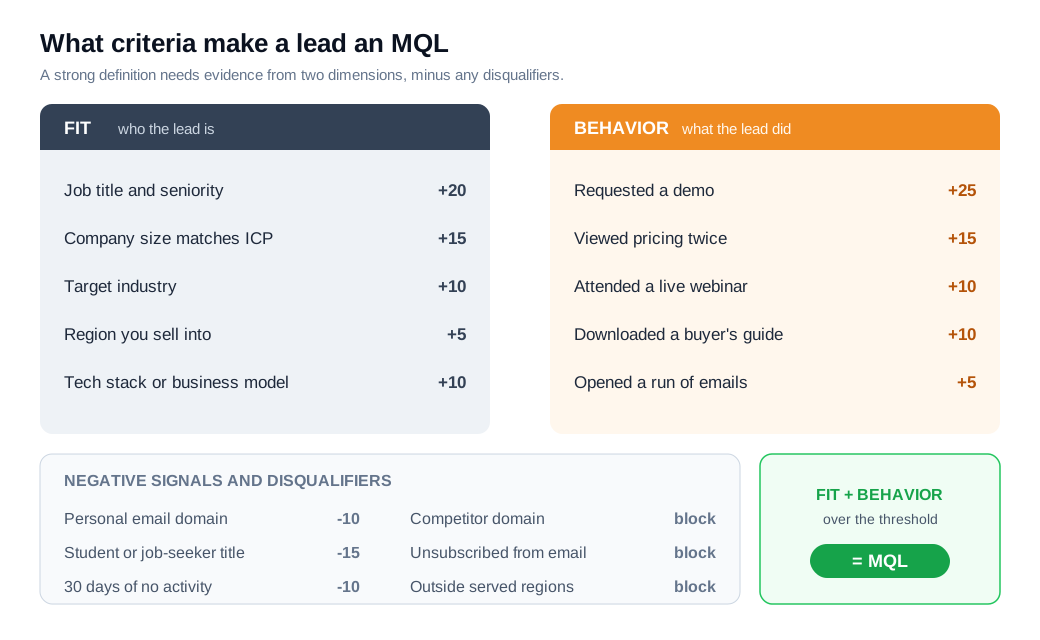
Fit is the stable, who-they-are layer, drawn from firmographic and demographic data: job title and seniority, company size, industry, region, and sometimes tech stack or business model. A director of operations at a 300-person software company in your target market is a strong fit whether she showed up today or last quarter. Fit tells you a lead is worth pursuing. It says nothing about timing.
Behavior is the moving, what-they-did layer, and it is where intent shows up. Requesting a demo, viewing the pricing page twice in a week, attending a live webinar, downloading a bottom-of-funnel buyer's guide, or clicking through a run of emails all signal a person leaning toward a decision. Weight these by effort. A repeat pricing visit and a demo request should count for far more than a single ebook grab, which is easy to do and easy to fake.
The third piece is subtraction. Strong definitions include negative signals and hard disqualifiers so scores cannot only climb: a personal email domain, a student or job-seeker title, a competitor's domain, or 30 days of silence should pull a lead back down or knock it out entirely. Without deductions, weak and stale leads slowly drift over the line and clog the queue. The specific weights are yours to set, and they should reflect your industry, your price point, and your buyer, rather than a template you copied.
What does a marketing qualified lead look like?
A marketing qualified lead looks like a specific person taking specific actions, which is why vague criteria produce vague leads. The clearest way to pin the definition down is to write it as a sentence a rep could check in ten seconds.
Here is one: a contact who is a director or above at a company with 50 to 500 employees in software, who has requested a demo or viewed the pricing page at least twice, and who has opened three or more emails in the past 30 days. Everything in that sentence is observable. Two people could look at the same record and agree on whether it qualifies.
Compare that to three real contacts. Priya, a director of revenue operations at a 300-seat SaaS company, booked a demo after her second visit to the pricing page, a clean MQL on both fit and behavior. Marco used a personal Gmail address to grab one ebook and never returned, so he is fine to nurture but is not an MQL. A VP at a perfect-fit account who downloaded a case study nine months ago and has been silent since is the right person at the wrong time, so they belong in a re-engagement track, not on a rep's call list today. The label only means something when it separates the Priyas from the other two.
How does an MQL differ from an SQL?
An MQL differs from a sales qualified lead (SQL) in one word: certainty. An MQL is marketing's prediction that a contact might buy, built from fit and behavior. An SQL is a rep's confirmation that the contact is worth selling to, built from an actual conversation.
The handoff between them runs through contact. A rep reaches out to an MQL, runs light discovery, and checks the lead against a framework such as BANT (budget, authority, need, timeline). If a genuine need, a workable budget, and a real timeline hold up, the MQL becomes an SQL. If they do not, it recycles to nurture with a reason attached. The buyer has usually shifted from researching a problem to evaluating a solution, and their actions show it: they ask about pricing, compare you to a named competitor, or book a meeting.
Ownership is the other half of the split. Marketing owns the MQL and is measured on how many it produces and how well they convert. Sales owns the SQL and is measured on what closes. That division is healthy, and it puts a seam right in the middle of your funnel where pipeline tends to leak. Teams that treat their website as an inbound sales channel try to shrink that seam by confirming fit and intent in a live conversation while the visitor is still on the page, rather than scheduling a callback for the next day.
How do you define MQL thresholds?
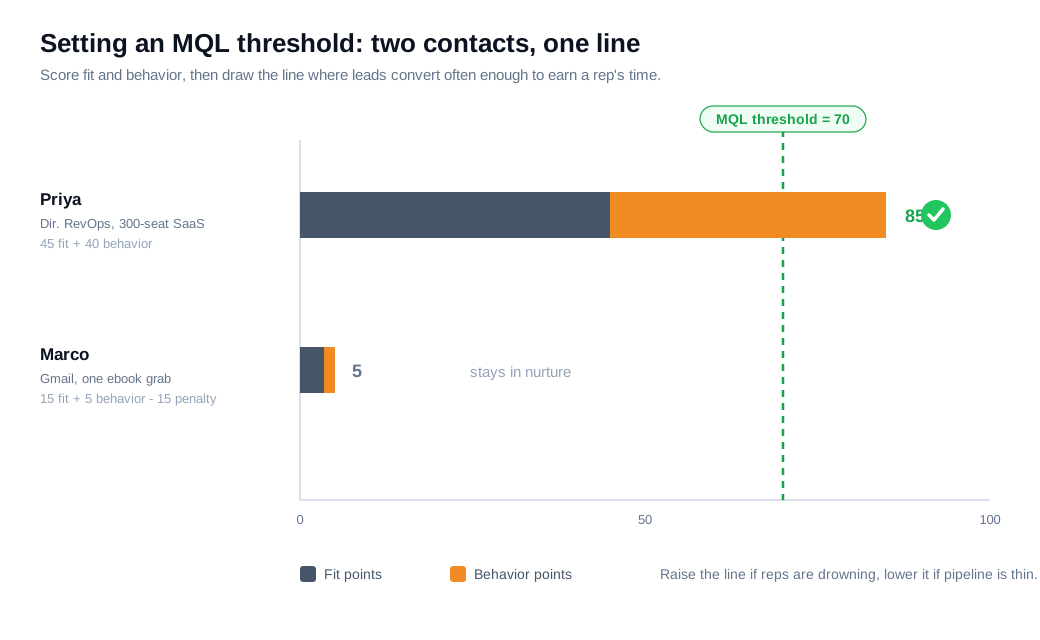
You define an MQL threshold by scoring fit and behavior, then drawing the line at the point total above which leads convert to real opportunities often enough to justify a rep's time. The threshold is a dial you calibrate against data, not a number you guess once and leave alone.
Start with a written definition both teams sign. The MQL definition should name the firmographic criteria that qualify an account, the behavioral actions that count, the point threshold if you score, and the explicit disqualifiers, and it should carry the signature of both the head of marketing and the head of sales. Pair it with a service level agreement: marketing commits to a volume and quality of MQLs, and sales commits to a response time and a status update on every one. Fast routing and notifications are what make that response time real rather than aspirational.
Here is the worked example. Take a 100-point model with a threshold of 70. Priya, the RevOps director, earns 45 fit points (director title, right company size, target industry) and 40 behavior points (demo request, two pricing views, an opened email series), for a total of 85. She clears 70, becomes an MQL, and routes to a rep the same minute. Marco earns 15 fit points, 5 behavior points for the ebook, then loses 15 for the personal domain and thin engagement, netting 5. He stays in nurture, which is the correct outcome. If reps start complaining that MQLs feel cold, raise the line. If pipeline runs thin and sales has spare capacity, lower it.
Calibrate the number against your own closed deals, not a blog's suggestion. Look at the scores your actual customers carried when sales first engaged them, and set the line just below that band. A common starting point sits somewhere in the 60 to 80 range, refined every quarter as conversion data comes in. The signal that your threshold is right is the conversion rate it produces downstream.
What is a good MQL-to-SQL conversion rate?
A good MQL-to-SQL conversion rate sits in the mid-teens for most industries and climbs into the 18 to 22 percent range for B2B SaaS, with behavioral scoring pushing the best teams near 40 percent. First Page Sage puts the cross-industry average at 13 percent, ranging from around 11 percent in fintech to 26 percent in sectors like HVAC and insurance, per its MQL to SQL conversion benchmarks.
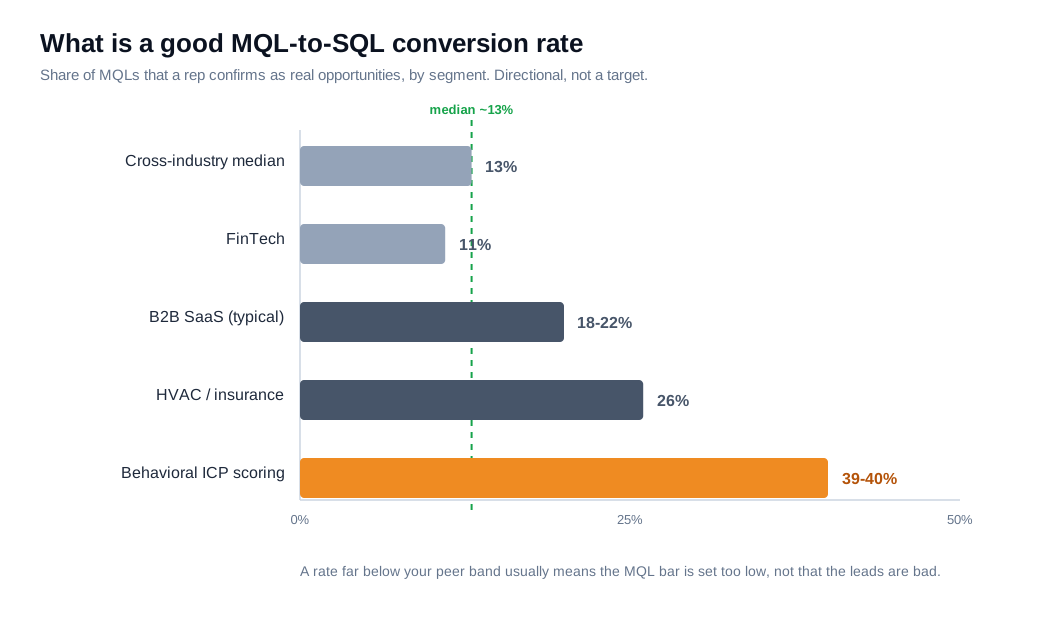
Treat those figures as directional, because the rate is a function of where you draw your own line. The formula is simple: SQLs divided by MQLs over the same period, times 100. Loosen the definition to inflate MQL volume and the conversion rate falls even though nothing real improved. Tighten it and the rate rises. Cross-industry roundups land in the same mid-teens band, and Data-Mania's benchmark compilation also centers near 13 percent.
If your rate sits well below your peer band, the usual cause is an MQL bar set too low, flooding sales with names that were never ready. The two levers that move the number honestly are a stricter, shared definition and faster follow-up. Because most B2B buying happens before anyone fills out a form, speed matters as much as scoring. Gartner finds that buyers spend just 17 percent of their total buying time meeting with all potential suppliers combined, so the window to reach a fresh MQL is short, per Gartner's B2B buying journey research. Some teams close that window by putting a real conversation on the high-intent page itself, letting a qualifying visitor start a live chat the moment interest peaks instead of waiting for a callback.
Are marketing qualified leads still relevant?
Marketing qualified leads are still relevant for many teams, though the classic single-contact MQL is under real pressure in complex deals. The metric works best where an individual or a small group decides, cycles are short, and one engaged person can carry the sale. There, an MQL is a fair proxy for interest and a good trigger for outreach.
The pressure comes from how larger B2B purchases actually happen. Forrester has argued for retiring the MQL in favor of buying groups, on the grounds that real deals are committee decisions rather than individual ones, a case it lays out in Saying Goodbye to MQLs. Score one lead in isolation and you miss the other four or five people quietly shaping the decision, which is why more teams now track engagement across a whole account or buying group.
There is a second reason to avoid treating the MQL as a finish line: most qualified leads are not ready to buy when they first convert. Roughly half of qualified leads are still early in their research, which is why nurturing matters as much as routing, per the lead nurturing statistics compiled by Salesgenie. An MQL that is not sales-ready should keep receiving useful, low-pressure touches until its behavior signals a shift, at which point it re-enters the scoring model with a higher total.
The honest read is that the MQL is a useful signal that has often been mistaken for a trophy. When it fails, the cause is usually a weak definition or a sales team that ignores the handoff, rather than the concept itself. Keep the MQL if it fits your motion, agree on it with sales in writing, and treat every one as a reason to start a conversation.
Key takeaways
- An MQL is marketing's educated bet on who might buy. A marketing qualified lead matches your ideal customer profile and has engaged enough to be worth a sales look, though a rep has not yet confirmed real buying intent.
- The criteria are fit plus behavior, minus disqualifiers. Who the lead is decides whether to pursue them; what they did decides whether they are ready to talk; negative signals keep weak and stale leads out of the queue.
- Write the definition as a checkable sentence. Specific titles, company sizes, and actions let two people agree on whether a record qualifies, which is what turns "qualified" from a slogan into a signal.
- An MQL differs from an SQL by certainty and ownership. Marketing predicts with a score; a rep confirms with a conversation and checks budget, authority, need, and timing.
- The threshold is a dial, set from your own closed deals. Start near 60 to 80 points, calibrate against the scores your real customers carried, and adjust as conversion data comes in.
- A healthy MQL-to-SQL rate runs mid-teens, higher for SaaS. Around 13 percent across industries and 18 to 22 percent for B2B SaaS, and a much lower rate usually means the bar is set too low.
TAGS

Written by
Daniel SemeckyCo-founder & CEO
Daniel is the co-founder and CEO of Glimpze. He spends his days talking to revenue teams about how to catch high-intent visitors before they bounce, and writes about inbound sales, lead conversion, and building a motion where marketing and sales actually share a number.


