
On this page
- What is a lead nurturing campaign?
- Why do most leads never convert without nurturing?
- How do you build a lead nurturing campaign step by step?
- How do you segment leads for nurturing?
- What content moves leads down the funnel?
- How long should a lead nurturing campaign be?
- How do you measure nurture performance?
- Key takeaways
- Sources
Most of the leads your marketing generates are not ready to buy the day they arrive. Someone downloaded a guide, sat through a webinar, or compared two vendors on a Tuesday afternoon, then went quiet. Left alone, most of those contacts fade out and get filed under bad leads, when the real problem is that nobody stayed in touch in a way that was worth their attention.
A lead nurturing campaign is how you stay in touch on purpose. Run well, it walks a cold contact toward a buying decision with a sequence of relevant, timed touches. Run badly, it becomes a generic newsletter that trains people to archive you on sight.
This post covers what a nurture campaign actually is, why unnurtured leads leak away, how to build one step by step, how to segment your list, what content fits each stage, how long the sequence should run, and how to measure whether it works.
What is a lead nurturing campaign?
A lead nurturing campaign is a planned series of touches, usually email plus a few supporting channels, that builds a relationship with a prospect who is interested but not yet ready to buy and guides them toward a decision at their own pace. IBM frames lead nurturing as the ongoing process of developing relationships with buyers at every stage of the funnel by giving them the information they need when they need it.
The word campaign matters. A single follow-up email is not a campaign, and neither is a monthly newsletter that goes to everyone regardless of what they care about. A nurture campaign has a defined entry point, a goal, a sequence of steps, and an exit, which is usually the moment a lead becomes qualified enough to hand to sales.
The channels can vary. Email carries most nurture programs because it is cheap, measurable, and easy to automate, but the strongest ones also use retargeting ads, social touches, and real-time conversations when a lead shows up ready to talk. The point is consistency of message across those channels, so a prospect who reads an email, sees an ad, and then lands on your pricing page meets the same story each time.
Why do most leads never convert without nurturing?
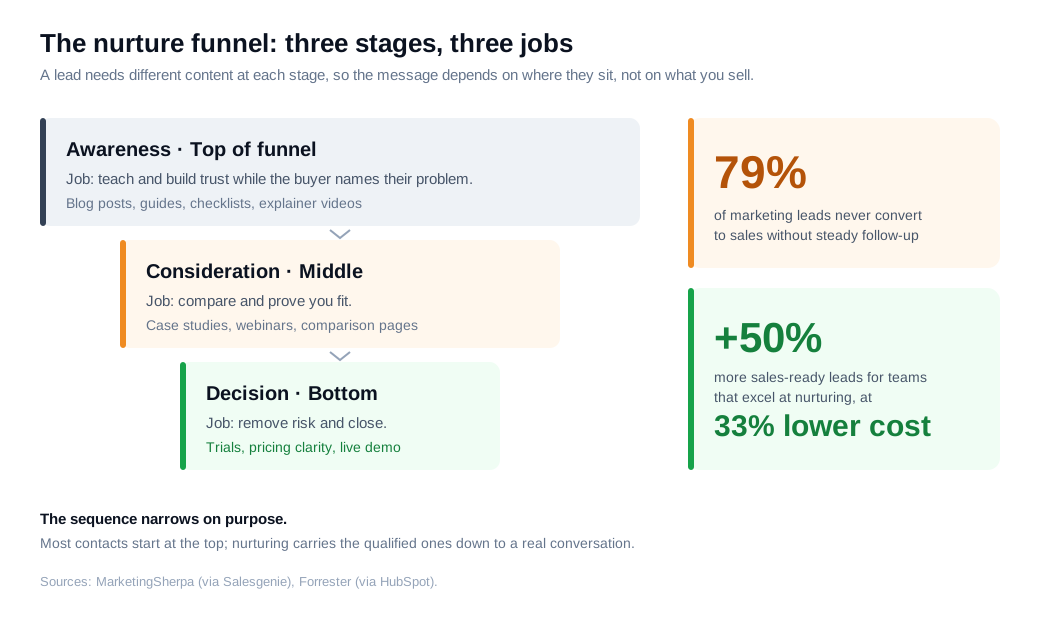
Most leads never convert because they enter a buying process that can run for weeks or months, and without a reason to keep engaging, they drift to whichever vendor is in front of them when they are finally ready. A widely cited MarketingSherpa figure, compiled in this lead nurturing statistics roundup, puts the share of marketing leads that never turn into sales at 79 percent, with weak follow-up as the common cause.
The upside of fixing that is well documented. Forrester's research, referenced in HubSpot's lead nurturing statistics, found that companies which excel at nurturing generate 50 percent more sales-ready leads at 33 percent lower cost. The same compilation cites an Annuitas study showing nurtured leads make purchases that are 47 percent larger than those of non-nurtured leads.
Read those numbers with a clear head. They compare organizations that nurture well against those that barely nurture at all, so they describe a ceiling rather than a guarantee. The mechanism behind them is simple enough to trust: buyers reward the vendor who stayed useful and present while they were still deciding, and they forget the one who sent a form receipt and disappeared.
How do you build a lead nurturing campaign step by step?
You build a lead nurturing campaign by defining one goal and entry trigger, mapping the buyer journey, segmenting your leads, creating content for each stage, setting a cadence, routing hot leads to a person, and then measuring and refining the whole thing. Treat those as seven concrete steps rather than a vague strategy.
Start with the goal and the trigger. Decide what a completed nurture looks like, for example a booked demo or a qualified reply, and decide what drops a lead into the campaign, such as a content download or a repeat visit to a high-intent page. A campaign without a clear exit runs forever and reports nothing useful.
Next, map the journey your buyers actually take, from first realizing they have a problem to picking a vendor. For each stage, write down the questions a prospect is asking and the objection that keeps them from moving forward. That map becomes the spine of your content plan, because every touch should answer the next real question rather than restate your pitch.
Then segment, build stage-based content, and set the timing, which the following sections cover in detail. The step teams skip most often is the handoff. When a nurtured lead raises their hand, the campaign should stop emailing and route that person to a rep fast, through lead routing and notifications that alert the right owner the moment intent spikes. A lead who replies with a buying question and gets another automated newsletter is a lead you are actively losing.
Finally, instrument everything from day one. If you cannot see where leads stall inside the sequence, you cannot fix it, and you will be tuning subject lines while the real leak sits three emails deeper.
How do you segment leads for nurturing?
You segment leads for nurturing by combining who they are with what they do, so fit and behavior together decide which track each lead enters. Fit covers firmographics and role, such as company size, industry, and job title. Behavior covers actions, such as which pages they viewed, what they downloaded, and how recently they engaged.
The two dimensions answer different questions. Fit tells you whether a lead is worth pursuing at all. Behavior tells you how close they are to buying right now. A director at a target-sized company who just visited your pricing page twice belongs in a very different track than a student who grabbed one top-of-funnel guide.
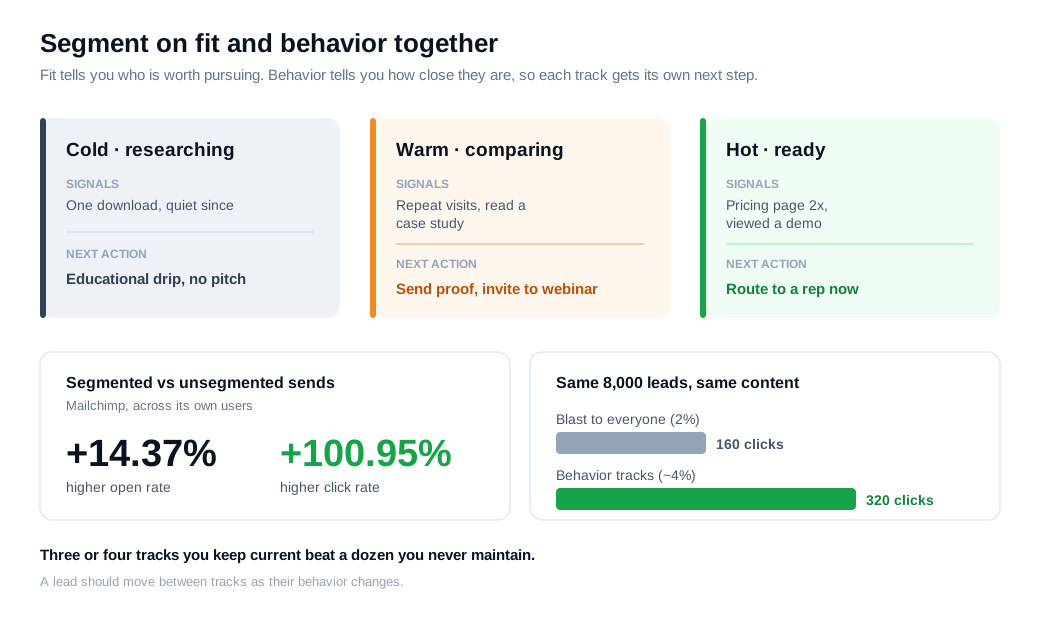
Segmentation pays off in the numbers. Mailchimp's analysis of its own users found that segmented campaigns earned open rates 14.37 percent higher and click rates 100.95 percent higher than non-segmented sends to the same audiences. Campaign Monitor, drawing on DMA data in its guide to email lead nurturing, attributes as much as a 760 percent revenue increase to segmented and targeted campaigns.
Here is a worked example. Say you have 8,000 leads and blast every message to all of them at a 2 percent click rate, which is 160 clicks. Split that list into three behavior-based tracks and lift the click rate to roughly 4 percent on the relevant sends, and the same list produces around 320 clicks from content people actually asked for. You added no leads and spent nothing extra, you just stopped sending the wrong email to the wrong person.
Keep the number of segments manageable. Three or four tracks you maintain well beat a dozen you never keep current, and a lead should be able to move between them as their behavior changes.
What content moves leads down the funnel?
The content that moves leads down the funnel changes by stage: educational material at the top, comparison and proof in the middle, and de-risking, hands-on content at the bottom. Marketers map this with the TOFU, MOFU, and BOFU shorthand, which Lucidchart lays out in its guide to the content funnel.
At the top of the funnel, the buyer is naming a problem, so the content teaches. Blog posts, checklists, short guides, and explainer videos help someone understand their situation without asking them to consider your product yet. Pushing a demo here is like proposing on a first date.
In the middle, the buyer is weighing options, so the content compares and proves. Case studies, webinars, product overviews, and honest comparison pages help a prospect see how you stack up and whether other companies like theirs succeeded with you. This is where an interested lead does the bulk of their evaluation, and where a well-placed live chat conversation can answer the specific question a case study almost addressed.
At the bottom, the buyer is close to deciding and mostly wants their remaining risk removed. Free trials, pricing clarity, implementation details, and a real conversation carry the most weight here. For a considered purchase, a short live video call or screen share walks a buyer through the exact workflow they were unsure about, which no PDF can match, and it is where an inbound sales motion earns its keep. Match the content to the stage and you stop wasting bottom-of-funnel effort on people who are still at the top, and the reverse.
How long should a lead nurturing campaign be?
A typical nurture campaign runs four to six emails over two to four weeks, but the correct length is set by your sales cycle rather than a fixed rule. A self-serve product with a one-week decision needs a short, fast sequence, while an enterprise purchase with a six-month cycle needs a longer, slower one that stays useful without becoming noise.
Front-load the value and space out the later touches. Guidance compiled in this overview of email lead nurturing sequences points to sending your first message immediately after opt-in, then tapering the frequency as the sequence goes on. The welcome message is the most-opened email you will send, routinely posting open rates above 80 percent, far higher than a standard campaign, so the first 24 hours after someone opts in is worth your best content.
Let timing follow behavior wherever you can. A calendar drip sends the same email to everyone on the same day whether or not they are ready, while a behavior-triggered program advances a lead when they click, revisit, or view a key page. If a lead opens your pricing page on day two of a two-week sequence, the sequence should react to that signal instead of finishing its scheduled emails first.
Watch for fatigue at the other end. Frequency that feels attentive in week one feels like harassment in week four, and consumers unsubscribe quickly once messages pile up, so give the later touches room to breathe and give leads an easy way to change how often they hear from you.
How do you measure nurture performance?
You measure nurture performance with a funnel of metrics that connects engagement to revenue, starting with email engagement, moving through MQL-to-SQL conversion, and ending with influenced pipeline and revenue. Any single metric on its own can mislead you, so read them as a chain.
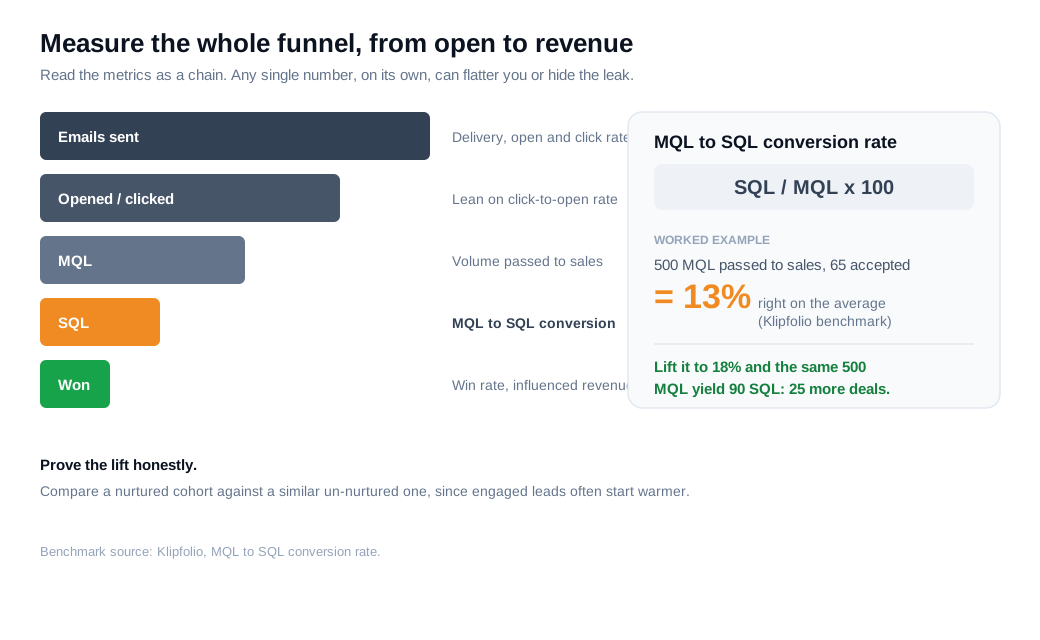
At the top, track open and click rates, and lean on click-to-open rate more than raw opens, which have grown unreliable. These tell you whether your content and segmentation are landing, and they are the fastest signals to act on when a sequence underperforms.
The metric that ties nurturing to sales is the MQL-to-SQL conversion rate, the share of marketing qualified leads that sales accepts as genuine opportunities. The formula is straightforward: divide sales qualified leads by marketing qualified leads and multiply by 100. Klipfolio reports the average MQL-to-SQL conversion rate sits around 13 percent, with strong programs running well above it.
Here is the worked example. A nurture campaign passes 500 MQLs to sales in a quarter, and sales accepts 65 of them as SQLs, giving a 13 percent MQL-to-SQL rate, right on the benchmark. If tighter segmentation and better stage-based content lift that to 18 percent, the same 500 MQLs produce 90 SQLs, which is 25 extra real opportunities without generating a single new lead. That is the argument for nurturing in one line.
Below that, measure influenced pipeline and revenue so you can defend the program's budget, and always compare a nurtured cohort against a similar un-nurtured one rather than trusting the headline lift, since engaged leads are often warmer to begin with.
Key takeaways
- A nurture campaign is a defined sequence with a start and an end. It has an entry trigger, staged content, and an exit when a lead becomes qualified, which is what separates it from a newsletter that goes to everyone.
- Unnurtured leads leak away by default. A commonly cited figure puts non-converting marketing leads near 79 percent, while strong nurturing has been linked to 50 percent more sales-ready leads at 33 percent lower cost.
- Segment on fit and behavior together. Segmented campaigns have shown roughly 14 percent higher opens and 100 percent higher clicks, and splitting an 8,000-lead list into behavior tracks can double relevant clicks with no added spend.
- Match content to the stage. Teach at the top, compare and prove in the middle, and de-risk with trials, pricing clarity, and live conversations at the bottom, rather than pushing a demo on someone still naming their problem.
- Let behavior set the timing, and hand off fast. Four to six touches over a few weeks suits many cycles, but a behavior-triggered sequence that routes a hot lead to a rep beats a fixed calendar drip.
- Measure the whole funnel, not one metric. Read engagement, MQL-to-SQL conversion around a 13 percent benchmark, and influenced revenue as a chain, and lifting conversion a few points can add real opportunities from the same leads.
TAGS

Written by
Daniel SemeckyCo-founder & CEO
Daniel is the co-founder and CEO of Glimpze. He spends his days talking to revenue teams about how to catch high-intent visitors before they bounce, and writes about inbound sales, lead conversion, and building a motion where marketing and sales actually share a number.


