
On this page
Two software companies chase the same buyer. One books a demo, sends a rep, and negotiates for six weeks before the buyer ever touches the product. The other lets that buyer sign up free, reach a useful result in ten minutes, and invite three coworkers before anyone from the company says a word.
The second company is running product-led growth, and for a certain kind of product it wins on cost, on speed, and on how fast it compounds. Over the last decade PLG went from a niche idea to the default playbook for self-serve software. It also gets bolted onto products that need a human to explain them, which is why the results across the market are so uneven.
This post covers what product-led growth is, how the model actually works, how it compares to sales-led growth, when it fits and when it does not, the real role sales still plays, examples worth studying, and how to get started.
What is product-led growth?
Product-led growth is a go-to-market strategy where the product itself does most of the work of acquiring, activating, and expanding customers, instead of a sales team carrying every buyer from first contact to signed contract. People sign up, use the product, reach a result on their own, and only talk to a human later, if at all.
The model rests on one shift in who proves the value. In a traditional motion, a rep demos the software and the buyer imagines using it. In a product-led motion, the buyer uses the software first and decides from their own experience. A free trial, a freemium tier, or an interactive sandbox does the job the pitch used to do. Salesforce frames PLG as a way to lower acquisition cost by relying on self-service instead of a large team running every demo and closing every deal.
That description fits a lot of familiar products. Slack, Dropbox, Zoom, Figma, Calendly, and Notion all grew by letting individuals adopt the tool before any company signed a contract. The common thread is that the product is easy to try, quick to deliver value, and often more useful once a coworker joins.
How does product-led growth work?
Product-led growth works as a loop rather than a funnel: users sign up, reach value quickly, build a habit, invite others, and those new users start the cycle again. Each turn lowers the cost of the next customer, because the product rather than paid advertising is doing the acquiring.
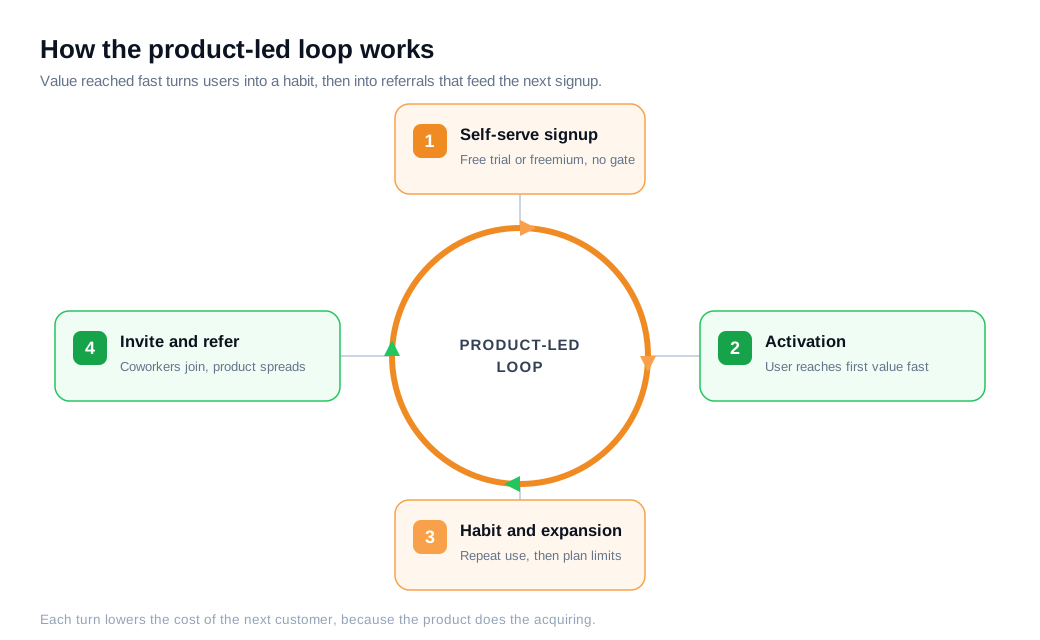
Walk the loop one stage at a time.
Acquisition is self-serve. A visitor can start using the product without a demo request or a sales call, usually through a free trial or a freemium plan. Marketing and organic search bring people to the door, and nothing gates it.
Activation is the make-or-break stage. The user has to reach the product's core value fast, the moment where the tool visibly solves the problem they came for. Teams call this time-to-value, and shortening it is the most valuable thing a PLG company can do. A common rule of thumb is that if a typical user cannot reach a useful result in roughly fifteen minutes, the product is not ready for a pure self-serve motion.
Retention and expansion come from habit and depth. Users who reach value come back, use more features, and eventually bump into the limits of the free plan. In team-based products they invite coworkers, which raises retention and pulls in new users at no acquisition cost.
The engine underneath all of this is data. Because the product is the main touchpoint, every click is a signal. PLG companies watch which actions predict that a free user will pay, then define a product-qualified lead (PQL): a user who has crossed an activation threshold that correlates with buying. That PQL is the handoff point where a light sales or success touch can help, and I come back to it below.
The efficiency case is real but narrow. OpenView's product benchmarks found that product-led companies, especially those with a freemium model, are twice as likely to grow revenue 100 percent year over year as sales-led peers. The same research shows how leaky the top of the funnel is: only about 5 percent of freemium signups convert to paid, per OpenView's 2022 Product Benchmarks report. Volume and a low cost per signup are what make that 5 percent add up.
Product-led growth vs sales-led growth: what is the difference?
The core difference is who does the convincing: in product-led growth the product proves its own value through use, while in sales-led growth a person proves it through demos, proposals, and relationships. Almost everything else, the cost structure, the buyer, the speed, follows from that.
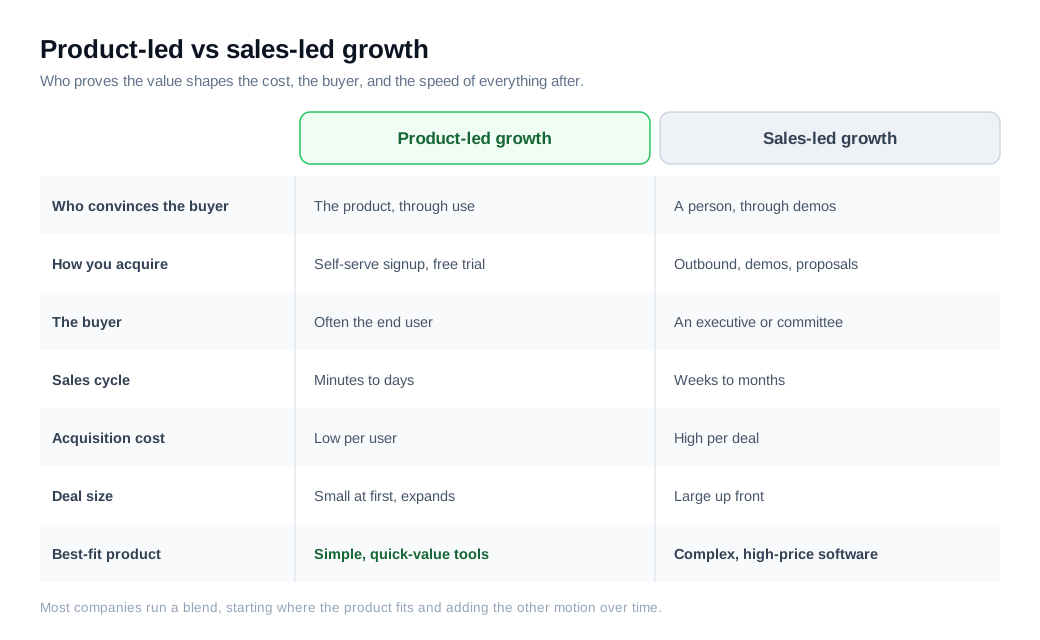
Sales-led growth suits complex, expensive, high-consideration purchases. A rep qualifies the account, runs tailored demos, handles security and procurement, and negotiates a contract. Deal sizes are large, the cycle is long, and customer acquisition cost is high but justified by the contract value. This is how most enterprise software with a five- or six-figure annual price still sells.
Product-led growth suits products a person can adopt alone. Acquisition cost per user is low, the buyer is often the end user rather than an executive, and the cycle can run in minutes instead of months. The trade-off is that many signups never convert, and the ones who do usually start small.
The two motions are not a simple either-or. McKinsey's analysis of 107 publicly listed B2B SaaS companies found that product-led firms grow faster than sales-led ones on average, but that a small group of outperformers accounts for most of that gap. Adopting a self-serve motion did not lift most companies at all. The lesson is that PLG is a strong fit for some products and a poor one for others, which is the next question.
When is PLG the right model?
PLG is the right model when a user can experience real value on their own, quickly, without a human explaining it. If those conditions hold, the product can carry acquisition. If they do not, forcing PLG produces a pile of dead signups and near-zero conversion.
A few conditions tend to decide it:
- Fast time-to-value. A new user should reach a useful outcome in one short session. Products that need days of setup, data migration, or a services engagement struggle to convert self-serve.
- The product explains itself. If a buyer needs a person to translate features into value, that is a sign the value is not yet visible in the product, and marketing or sales has to carry it.
- A large, reachable market. PLG runs on volume. Because conversion rates are low and initial deals are small, you need many signups for the math to work.
- Natural expansion or virality. Products that get better as coworkers join, or that spread through shared documents and invites, compound in a way single-player tools do not.
The reverse is just as clear. As Elena Verna argues in a widely shared piece on why not every company should do PLG, product-led growth is the wrong starting point when the product is hard to experience without help, when enterprise buyers hold all the decision-making power, or when your existing sales and marketing motion is not yet predictable. Complex developer platforms, heavily regulated tools, and products with a long implementation are usually better served by a sales-led or hybrid approach.
Most companies do not pick one and stop. They start where their product fits and add the other motion as they move up or down market, which is why the sharper question is not whether to use sales at all, but where.
What role does sales play in PLG?
Sales still matters in product-led growth, but it enters later and works differently: reps engage users who have already found value in the product, then help them expand, rather than selling the software cold from the first call. This hybrid is often called product-led sales.
The handoff runs on the product-qualified lead. Instead of chasing every free signup, the sales team focuses only on users who have crossed an activation threshold that predicts buying, such as inviting several teammates or using a core feature repeatedly. Those users are already leaning in. ProductLed's benchmark survey of more than 600 SaaS companies found that trials using PQLs convert to paid at about 25 percent, against a 9 percent median for free-to-paid conversion without them, close to a threefold difference in efficiency.
Here is a worked example of why the handoff pays off.
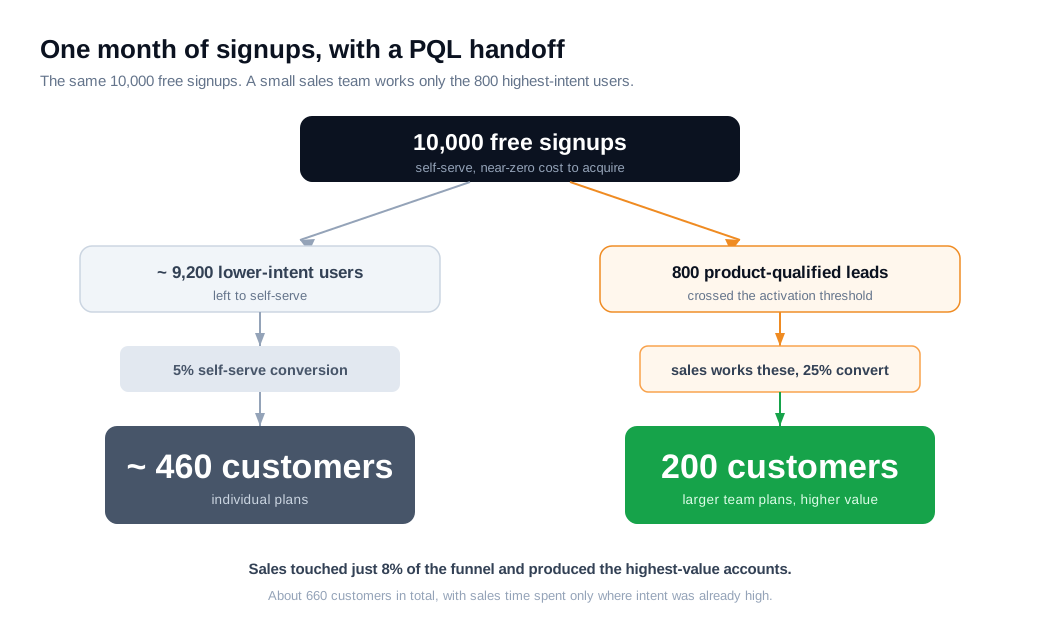
Say a product gets 10,000 free signups in a month. Left entirely to self-serve, about 5 percent convert, so roughly 500 people pay, most on a small individual plan. Now add a product-led sales layer. Suppose 800 of those signups cross the PQL threshold, showing team usage and repeat engagement. A small sales team works only those 800, and at the 25 percent PQL rate it lands about 200 of them, on larger team plans worth several times the individual price. The remaining lower-intent users keep self-converting in the background at around 5 percent, near 460 more customers. Sales touched 8 percent of the funnel, spent its time on the users most likely to buy, and produced the highest-value accounts.
McKinsey describes the same evolution. In product-led sales, reps stop trying to land the biggest possible deal on the first call and instead focus on landing the account, proving value, then expanding it over time. The signal that tells them when to reach out is the PQL. Without one, a sales team has no way to know which self-serve users are worth a call.
The moment of contact matters as much as the target. A PQL is a person actively using your product right now, so the best time to reach them is while they are still in it, not in a follow-up email two days later. Catching that user with live chat or a quick screen share when they hit a plan limit or land on the pricing page turns a self-serve moment into a conversation, which is the heart of a modern inbound sales motion. Triggering that outreach automatically when someone crosses an activation threshold, through proactive nudges, keeps the touch timely without a rep watching a dashboard all day.
What are some examples of product-led growth?
The clearest examples of product-led growth are consumer-grade SaaS tools that a single person can adopt and then spread through a team. Each one shows a different acquisition mechanic worth copying.
Slack grew by letting a team sign up free and start chatting in minutes, with no sales gate, so adoption spread channel by channel inside a company before any contract existed. Dropbox turned its own product into a referral engine, giving both sides extra storage for an invite, so the free tier recruited new users on its own. Calendly runs on a built-in loop, since every meeting link you send is a small demo of the product to whoever books the time. Figma spread because design is inherently multiplayer, pulling in engineers and product managers each time a file was shared. Zoom used a freemium plan with a well-judged time limit that gave away real value while nudging heavy users to pay.
The pattern under all of them is the same. The product is easy to start, delivers something useful fast, and becomes more valuable or more visible when another person joins. If your product has none of those properties, the examples are a warning as much as an inspiration.
How do you get started with PLG?
Start with time-to-value: find the fastest path to your product's core value and remove every step that is not required to reach it. The rest of a product-led motion is built on users getting to that first result before they lose interest.
A practical sequence:
- Define your activation moment. Pick the single action that best predicts a user will stick and eventually pay, such as importing data, publishing a first project, or inviting a teammate, and make it the goal of the first session.
- Strip onboarding to the essentials. Cut required fields, defer any setup that is not needed for first value, and pre-load templates or sample data so a new account is never a blank screen. Every removed step raises completion.
- Instrument the funnel. Track signups, activation rate, and conversion by cohort so you can see where users drop off and whether a change actually helped. You cannot improve what you do not measure.
- Define your PQL. Decide which combination of usage and firmographic fit marks a user as ready for a human touch, and agree on it across product, success, and sales so everyone acts on the same signal.
- Add a human touch at high intent. Give engaged users an easy way to reach a person inside the product, and reach out when someone hits a limit or lingers on pricing. A free plan makes this cheap to test on real traffic, and a tool like Glimpze's free tier lets you try the live-conversation layer without committing budget.
- Time the upgrade ask to need. Prompt an upgrade when a user bumps into a plan limit or finishes a high-value action, not on a fixed day of the trial. The context does the persuading.
Do these in order. Most teams jump to pricing experiments and paywalls while their activation rate is still low, which optimizes the wrong end of the funnel. Get users to value first, then worry about capturing it.
Key takeaways
- Product-led growth lets the product acquire, activate, and expand customers, so buyers experience value through a free trial or freemium plan before they ever talk to sales.
- The model runs as a loop, not a one-way funnel, where fast time-to-value drives the retention, expansion, and referrals that lower the cost of the next customer.
- PLG fits products with quick, self-evident value and a large market, and it backfires on complex or enterprise tools that need a person to explain the value.
- PLG and sales-led growth sit on a spectrum, and McKinsey's data shows only a subset of product-led companies outperform, so product fit matters more than the label.
- Sales still closes, just later, engaging product-qualified leads who have already found value and convert near 25 percent against 9 percent for undifferentiated free users.
- Start with time-to-value and activation, define a clear PQL, and add a human touch at the moment of high intent rather than experimenting with paywalls first.
TAGS

Written by
Daniel SemeckyCo-founder & CEO
Daniel is the co-founder and CEO of Glimpze. He spends his days talking to revenue teams about how to catch high-intent visitors before they bounce, and writes about inbound sales, lead conversion, and building a motion where marketing and sales actually share a number.


