On this page
Most conversion programs do not stall because the team ran out of ideas. They stall because a small set of avoidable mistakes drains the return out of every test that follows. Across 2,288 audited experiments, only about 19 percent reached statistical significance, according to Conversion Team's benchmark data, and even at companies with mature experimentation cultures the odds are humbling. In the experiments Microsoft ran, roughly one third of tested ideas moved the target metric in the right direction, one third did nothing, and one third made things worse, as Ron Kohavi and Stefan Thomke reported in Harvard Business Review.
Those numbers are not an argument against testing. They are an argument for doing it well, because when most ideas are flat or negative, the cost of a sloppy process is enormous. A borrowed "winner" that earned another brand a fortune can turn into a six-figure monthly loss on your own site, as the CRO agency SplitBase describes seeing again and again. The mistakes below are the ones that do that kind of damage.
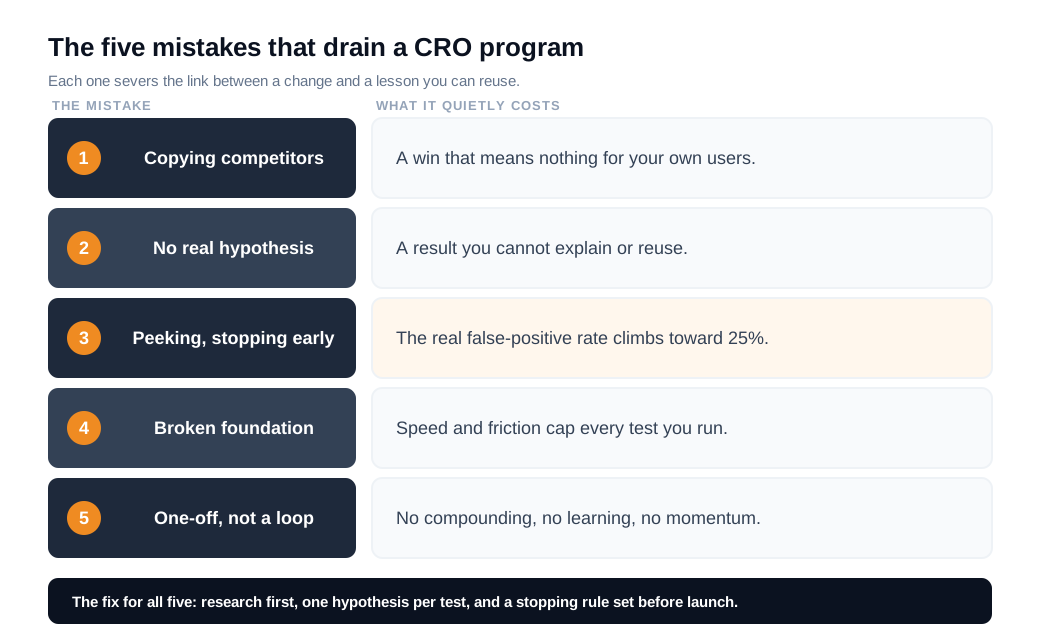
This post covers the CRO mistakes that cost the most: copying competitors without context, testing without a hypothesis, stopping tests early, optimizing pages that are broken underneath, and treating optimization as a one-off. It closes with the disciplined process that avoids all of them.
What are the most common CRO mistakes?
The most common CRO mistakes are process failures rather than design failures: copying competitors without context, running tests with no real hypothesis, stopping tests the moment they look good, optimizing pages whose foundation is broken, and treating conversion work as a one-time project instead of a loop. None of these is about taste or creativity. Each one breaks the chain that turns a change into reliable, reusable knowledge.
They share a root cause. A test is only worth running if it can teach you something whether it wins or loses, and every mistake on this list severs that link. Copy a competitor and a win tells you nothing about your own users. Skip the hypothesis and you cannot explain the result. Peek and stop early and the result may be noise. Test on a page that loads in six seconds and the tool is optimizing a leak it cannot see.
Why is copying competitors risky?
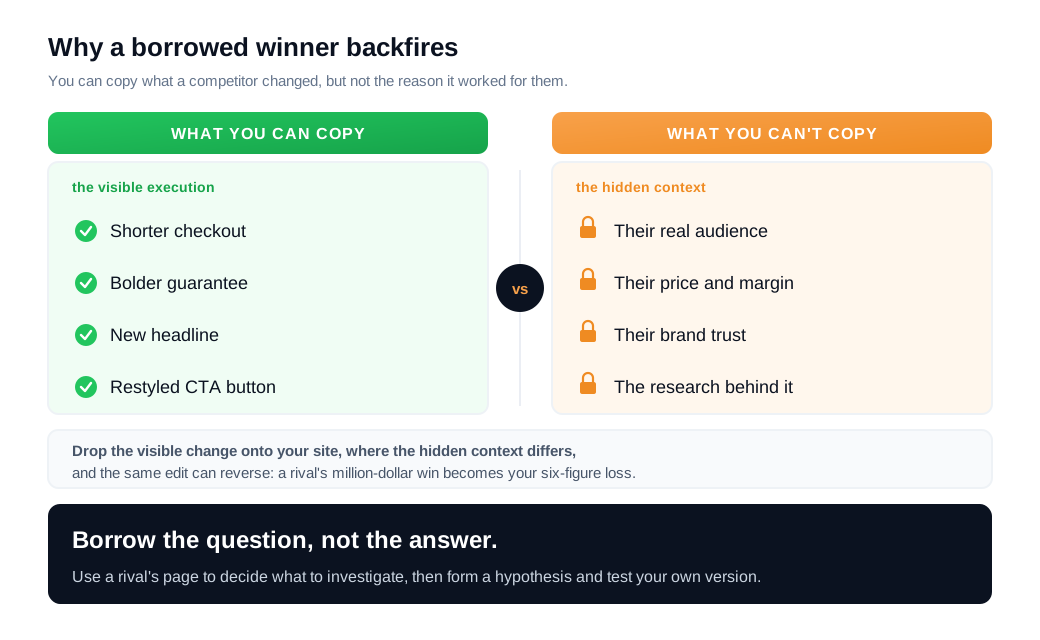
Copying a competitor is risky because you can see what they changed but never why it worked, and the "why" is the part that has to match your own audience, price, traffic mix, and brand trust. A shorter checkout, a bolder guarantee, or a stripped-down pricing page may have won for them because of a specific problem their customers had. Drop the same execution onto your site, where that problem may not exist, and you are running a coin flip with your revenue.
SplitBase, an agency that has spent more than a decade on eight- and nine-figure ecommerce brands, calls these "borrowed winners" and warns that a tactic which made a million dollars for one brand can become a hundred-thousand-dollar-a-month loss for another, because the copy carries the execution without the research behind it. Their teams treat competitor pages as prompts for their own research rather than ready-made answers.
Here is a worked example. Say a competitor removes the account-creation step from checkout and reports a lift. You copy it. On their site, most buyers were repeat purchasers who found forced signup redundant, so removing it cleared a real block. On your site, most buyers are first-timers who actually want an account to track a high-consideration order, and guest-only checkout quietly lowers your repeat-purchase rate. Same change, opposite result, because the underlying user is different.
The better move is to borrow the question. If a rival's checkout is shorter, ask whether yours has steps that do not earn their place, then form a hypothesis and test your own version. That keeps the useful signal, a place worth investigating, without importing someone else's answer to a problem you may not have.
How does testing without a hypothesis fail?
Testing without a hypothesis fails because a win or loss with no stated reason teaches you nothing you can reuse, so the program never compounds. If you pit A against B on a whim and B wins by 15 percent, you have a number and no idea what produced it. You cannot apply the lesson to the next page, because there is no lesson, only an outcome.
A hypothesis is what converts a result into knowledge. It names the evidence you saw, the change you will make, the effect you expect, and the metric that will prove you right or wrong. When the test ends, a hypothesis lets a loss be informative: the specific belief was wrong, and you can cross it off. Without one, a losing test is just a shrug.
Consider two teams testing the same new headline. Team one writes: "because exit surveys show visitors do not understand what the product does, a benefit-led headline will raise demo requests." Team two swaps the headline because it "feels stronger." Both get a flat result. Team one has learned that clarity was not the blocker on that page and can move to the next suspected cause. Team two has learned nothing and will probably re-test a cosmetic variation next week.
The evidence half of a hypothesis, the "because," is the hard part, and it rarely comes from a dashboard. Analytics show where people drop off, not why. The why comes from session recordings, on-page surveys, and real conversations. Watching the questions a hesitant visitor asks in a live chat on a high-intent page surfaces the exact objection a funnel report will never name, and that objection is the raw material for a hypothesis worth testing.
Why does stopping a test early wreck the result?
Stopping a test the moment it crosses significance, a habit called peeking, wrecks the result because each extra look is another chance for random noise to trip the threshold, which pushes your true false-positive rate far past the 5 percent you believe you are running. Statistical significance assumes you set the sample size in advance and looked once, at the end. Check repeatedly and stop on the first green number and you are quietly running many tests in place of one.
The inflation is not small. Analysis of the peeking problem shows that checking five times can lift the real false-positive rate above 14 percent, and around twenty looks can push it toward 25 percent, five times the rate you signed up for. Many "wins" declared this way are variations that were never actually better.
The fix is boring and it works. Calculate the sample size and duration before launch from your baseline rate and the smallest effect worth detecting, then hold to both. Run at least one full business cycle, usually two weeks at a minimum, so weekday, weekend, and returning-visitor behavior all count. Decide the stopping rule up front and the temptation to call an early winner disappears.
Should you fix the foundation before you optimize?
You should fix speed, mobile experience, and obvious breakage before you optimize anything, because no testing tool can rescue a page that loads slowly or a checkout that leaks for structural reasons. Running clever experiments on a broken foundation is like repainting a house with a cracked slab. The polish does not hold.
Speed alone moves real money. In the Google and Deloitte study "Milliseconds Make Millions," which analyzed more than 30 million mobile sessions across 37 brands, improving mobile load time by just 0.1 seconds raised retail conversion rates by 8.4 percent and lifted lead-generation progression to the form-submission page by 21.6 percent, as documented on web.dev. If a tenth of a second does that, a two-second delay is erasing tests you have not even run yet.
Structural friction does the same in checkout. Baymard Institute puts the average documented cart-abandonment rate at 70.22 percent across 50 studies, and much of it traces to avoidable causes like forced account creation and long, confusing forms, per Baymard's benchmark data. Fixing those raises the ceiling every later test has to operate under.
There is a targeting version of this mistake too. Teams optimize the pages they find ugliest instead of the pages where good-fit buyers actually decide. For a business that runs its site as an inbound sales channel, the highest-value pages are usually the ones where a qualified visitor is choosing whether to talk to you, and those deserve attention before a low-traffic blog post ever gets an A/B test.
How do you build a disciplined CRO process?
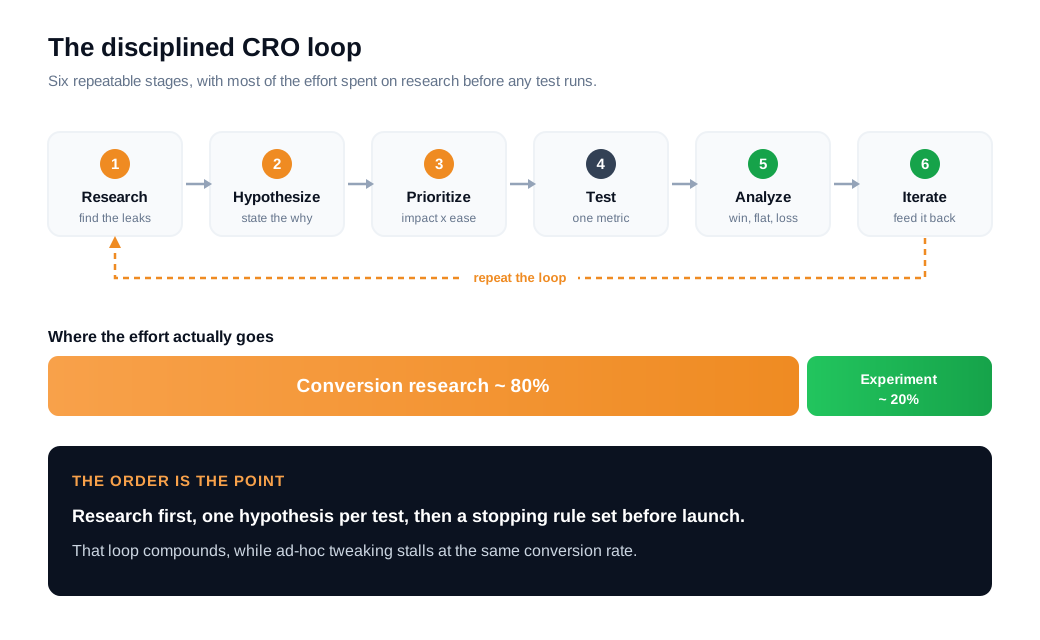
You build a disciplined CRO process by running a repeatable loop, research, hypothesis, prioritize, test, analyze, iterate, and by treating conversion research as most of the work rather than an afterthought. Peep Laja, who founded CXL, frames CRO as roughly 80 percent conversion research and 20 percent experimentation. The order matters. Research decides which tests are worth running, and tests with no research behind them are the random changes this whole article warns against.
Research means diagnosing where the site leaks money before touching anything, using both quantitative and qualitative sources: analytics and heatmaps to find where people drop off, plus surveys, session recordings, and support and sales conversations to learn why. Those findings become a ranked list of problems. Each problem becomes a hypothesis. You prioritize by expected impact and effort, run the test to its pre-set sample size, read it against one primary metric, then feed the outcome back into the research pile and start again.
A quick worked example shows the prioritization step. Suppose research surfaces three problems: a confusing pricing table, a slow product page, and a dated footer. Score each from 1 to 10 on potential upside, importance of the traffic, and ease of the fix. The pricing table scores 9, 9, and 6, the product page 7, 8, and 4, and the footer 3, 2, and 9. Averaged, the pricing table wins at 8.0, so it goes first, ahead of the footer that felt satisfying to fix but could not move revenue.
Discipline is also what most programs lack, which is why it is an edge. Maturity assessments consistently show the majority of companies stuck at ad-hoc or occasional testing rather than a structured process, as Neil Patel's CRO maturity model lays out. A written hypothesis, a fixed duration, a single primary metric, and a logged result for every test are unglamorous habits, and they are most of the difference between a program that compounds and one that thrashes.
Guarding against the local maximum matters here as well. Endless small tweaks to an existing design can climb toward a ceiling while a fundamentally better design sits unexplored, a trap the Interaction Design Foundation describes as the local maximum. A mature loop mixes small optimizations with the occasional bigger swing, so you are not polishing a button color on a page that needs rethinking. Keeping a live view of who is on the site and what they are struggling with, whether through recordings or a real-time chat window on key pages, keeps the research half of the loop fed with fresh evidence instead of last quarter's assumptions.
CRO mistakes: FAQs
How is CRO different from A/B testing?
CRO is the whole discipline of raising the share of visitors who take a desired action, and A/B testing is one tool inside it. A program can involve research, prioritization, UX fixes, and copy changes that never touch a split test, especially on low-traffic pages where you cannot reach significance. Treating A/B testing as the entire practice ignores everything that happens before and after the test.
How long before a CRO program shows results?
Expect months, not days, for a program to show durable results, because a single test usually runs two weeks or more and most tests do not win. The compounding value comes from running many cycles, so a program that logs its learnings and iterates will pull ahead of one chasing a single big win. Judge progress by the quality of your research and hypotheses, not by the outcome of any single test.
What is a realistic A/B test win rate?
A realistic win rate is roughly one in five to one in four tests reaching a clear positive result, so plenty of flat and losing tests are normal. A low win rate usually points to weak hypotheses rather than bad luck, which is why the research phase is where the biggest gains come from. Treat losing tests as information that stops you from shipping a bad idea across the whole site.
Key takeaways
- Most CRO mistakes are process failures, not design flaws. Copying competitors, skipping the hypothesis, peeking, and testing on a broken foundation all break the link between a change and a reusable lesson.
- Borrow the question, not the answer. A competitor's winning tactic carries their audience and research, so use their pages to decide what to investigate, then test your own version.
- A test with no hypothesis cannot teach you anything. Name the evidence, change, effect, and metric up front so even a loss tells you which belief was wrong.
- Decide sample size and duration before launch, then wait. Peeking and early stopping can push the real false-positive rate toward 25 percent, so a fixed stopping rule is non-negotiable.
- Fix speed, mobile, and structural friction first. A 0.1-second mobile speedup moved retail conversion by 8.4 percent in the Google and Deloitte study, and no test outruns a slow or leaking page.
- Discipline is the edge, because most teams lack it. A repeatable loop of research, hypothesis, prioritization, testing, and logged results compounds while ad-hoc tweaking stalls.
TAGS

Written by
Nilas MylerCo-founder & CTO, Glimpze
Nilas is the co-founder and CTO of Glimpze, an inbound sales tool that turns high-intent website visitors into live conversations. A former SEO consultant for some of the largest companies in Denmark, he writes about speed-to-lead, inbound sales, and conversion rate optimization — the technical and operational mechanics of turning traffic into pipeline.


