On this page
- What are the most common ecommerce conversion mistakes?
- How do hidden costs kill conversions?
- Why does forcing shoppers to create an account cost sales?
- How does a slow site lose sales?
- How do thin product pages and missing reviews cost sales?
- How do you audit and fix these issues?
- Ecommerce conversion mistakes: FAQs
- Key takeaways
- Sources
A shopper finds the product, reads enough to want it, and adds it to the cart. At checkout a shipping fee they did not expect lands above the total, and they close the tab. The interest was real. The order still did not happen.
Most stores do not lose money because nobody wants what they sell. They lose it in the short gap between wanting and buying, where a small set of avoidable mistakes drains intent that already exists. Extra costs alone are the reason 48 percent of shoppers give when they abandon a cart for a stated reason, according to Baymard Institute's analysis of 50 abandonment studies. Closing that gap is almost always cheaper than buying more traffic to pour into it.
This post covers the ecommerce conversion mistakes that cost the most: hidden costs, forced account creation, slow pages, thin product content, and a checkout you have never watched a stranger use. It ends with a simple way to audit your own funnel and fix the biggest leak first.
What are the most common ecommerce conversion mistakes?
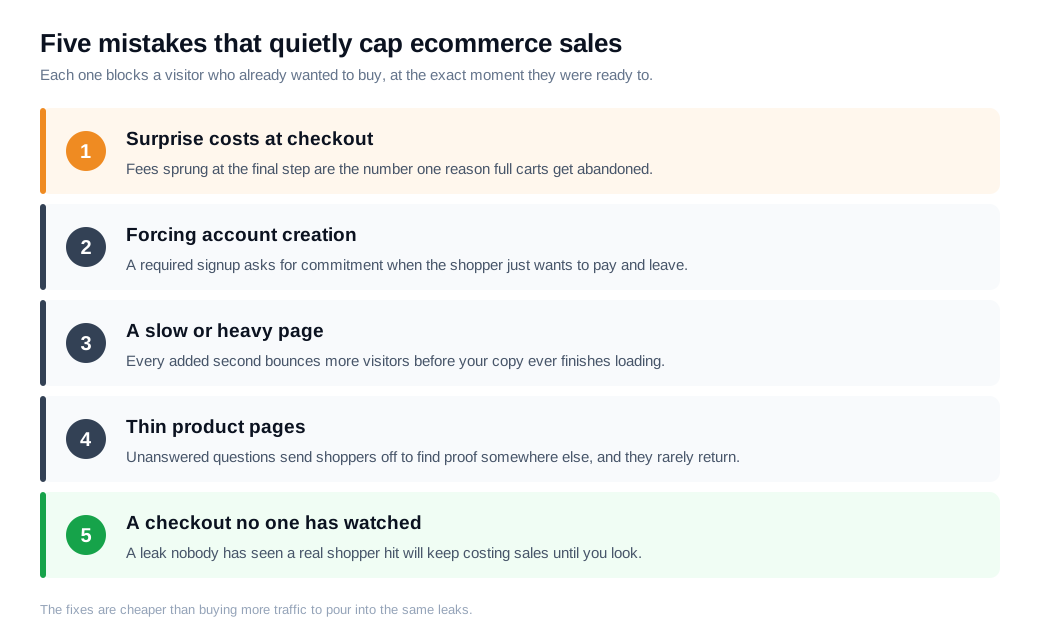
The most common ecommerce conversion mistakes are friction and surprise at the moment of purchase: unexpected costs, a forced account, a slow or clumsy page, product pages that fail to answer basic questions, and a checkout the team has never watched a real shopper struggle through. None of them is a taste problem. Each one punishes a visitor who has already decided to buy.
That is what makes them expensive. Across 50 studies, Baymard puts the average documented cart-abandonment rate near 70 percent. A large share of that is casual browsing, but plenty of it is ready buyers hitting a wall you can remove. The pattern repeats on mobile, where the average ecommerce conversion rate sits around 2.85 percent against 3.85 percent on desktop, per Oberlo's device benchmarks, even though phones now carry most of the traffic. So the same mistakes do the most damage in the place where the most people shop.
The rest of this article takes the five that leak the most money, in the order a visitor meets them.
How do hidden costs kill conversions?
Hidden costs kill conversions because shipping, tax, and fees that only appear at the final step read as a bait-and-switch, and they are the single biggest reason shoppers abandon a full cart. In Baymard's data, 48 percent of shoppers who abandon for a reason point to extra costs being too high, more than any other cause, as eMarketer summarized from the same research.
The damage is about timing as much as amount. A shopper who sees a $9.99 delivery charge on the product page folds it into the decision and keeps going. Spring the identical fee at the last screen and it reads as a penalty for having gotten that far, so people leave on principle even when they could afford it.
Here is a worked example. Say a store sells a $60 product, gets 40,000 checkout starts a month, and completes 25 percent of them, so 10,000 orders and $600,000 in monthly revenue. Suppose surprise fees are part of why three quarters of carts never close. Showing the full cost earlier and adding a free-shipping threshold lifts completion from 25 percent to 28 percent, a three-point gain. That is 11,200 orders instead of 10,000, worth $672,000, an extra $72,000 a month from a change that adds no products and buys no ads.
The fix is to make the total honest and early. Show shipping on the product and cart pages, not only at the end. Set a free-shipping threshold if your margins allow, since a clear "free over $50" often nudges a larger order rather than a smaller one. If a fee is unavoidable, name it before checkout so it never arrives as a shock.
Why does forcing shoppers to create an account cost sales?
Forcing shoppers to create an account before they can pay costs sales because it demands effort and commitment (a new password, another marketing list) at the precise moment they only want to buy and go. Baymard's checkout research finds that a required account is one of the top reasons for abandonment, cited by roughly a quarter of shoppers who leave a cart, which is why the institute recommends making guest checkout prominent.
The reasoning is simple from the shopper's side. They came to buy one thing, and a signup wall turns a two-minute purchase into a chore. For a first-time buyer who is not yet sure they will return, that chore is easy to skip by closing the tab.
Guest checkout removes the block without giving up the relationship. Let people buy as a guest, then offer a one-click account on the confirmation screen, where you can create it from the email and details they already entered. You still capture the customer, just after the sale instead of in front of it. The hesitation a signup wall creates is also the kind of doubt a short exchange can clear, so a live chat window on the cart or checkout page can catch a stalling buyer and answer the question keeping them from finishing.
How does a slow site lose sales?
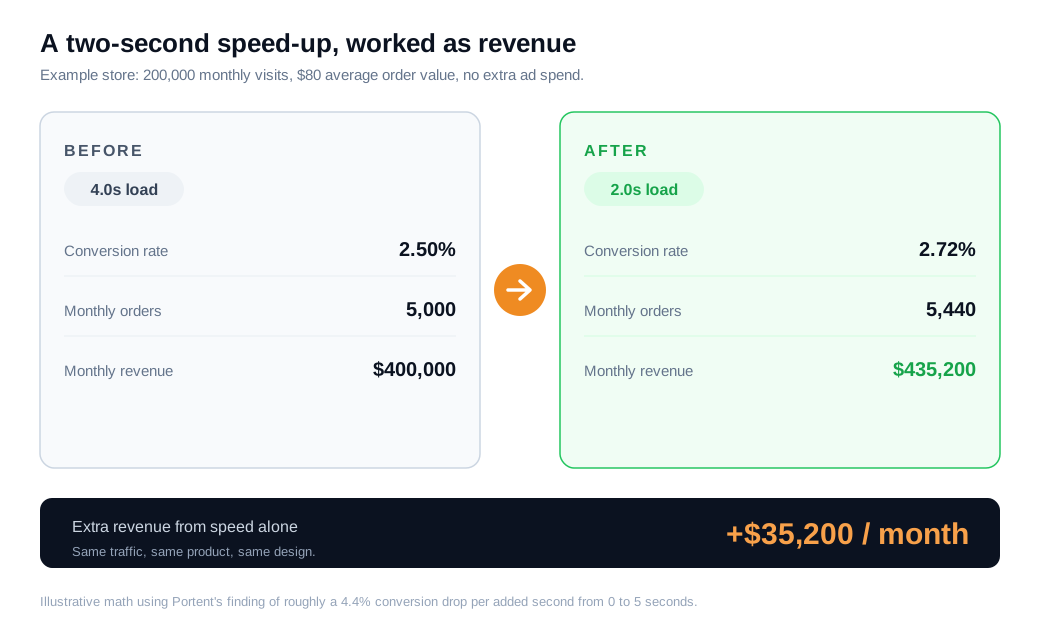
A slow site loses sales because every extra second of load time bounces more visitors and drops conversion before your page has finished painting. The relationship is well measured. Portent's analysis of more than 100 million page views found conversion rate falls about 4.4 percent for each additional second of load time between zero and five seconds, and a one-second page converts roughly three times better than one that takes five.
Google's field data shows the same from the bounce side. Think with Google reports that 53 percent of mobile visits are abandoned when a page takes longer than three seconds to load. Because mobile already converts lower than desktop, a sluggish phone experience compounds a gap you are starting behind on.
Work the money. A store with 200,000 visits a month, a 2.5 percent conversion rate, and an $80 average order value books 5,000 orders and $400,000 a month. Its main content currently paints in about four seconds. Using Portent's roughly 4.4 percent drop per second, cutting load time to two seconds lifts conversion by about 9 percent in relative terms, to near 2.72 percent. Same traffic, 5,440 orders, $435,200, or an extra $35,200 a month with no new spend.
Real brands report the same shape. The Deloitte and Google study Milliseconds Make Millions isolated speed across dozens of brands and found that a 0.1-second improvement in mobile load time raised retail conversions by 8.4 percent and average order value by 9.2 percent. A tenth of a second moved real revenue, which means a two-second delay is quietly erasing orders you never see. For a store that runs its site as an inbound sales channel, speed is one of the few levers you can pull without touching the offer, the design, or the traffic mix.
How do thin product pages and missing reviews cost sales?
Thin product pages and missing reviews cost sales because a shopper who cannot answer "will this work for me?" from the page in front of them will either leave to find proof elsewhere or not buy at all. The product page is where the decision actually happens, and a page that skips sizing, materials, shipping timelines, or return terms forces the visitor to do research you should have done for them.
Reviews carry a large part of that proof, and the effect is measurable. Northwestern University's Spiegel Research Center found that a product page displaying five reviews converts 270 percent higher on average than the same page with none, and that the lift reached 380 percent for higher-priced items where buyers feel more risk, in its study with PowerReviews. Reviews work because they answer the questions your own copy cannot credibly answer about itself.
The fixes are concrete. Use enough clear photos to show the product from every angle that matters. Write specs and descriptions that address the questions buyers actually ask, then put ratings and recent reviews where the price and add-to-cart button live. Answer shipping and returns on the page rather than burying them in a policy link. For high-consideration or expensive items, where a static page cannot cover every question, offering a live video call or screen share with a rep gives the hesitant buyer a way to get a real answer before they commit.
How do you audit and fix these issues?
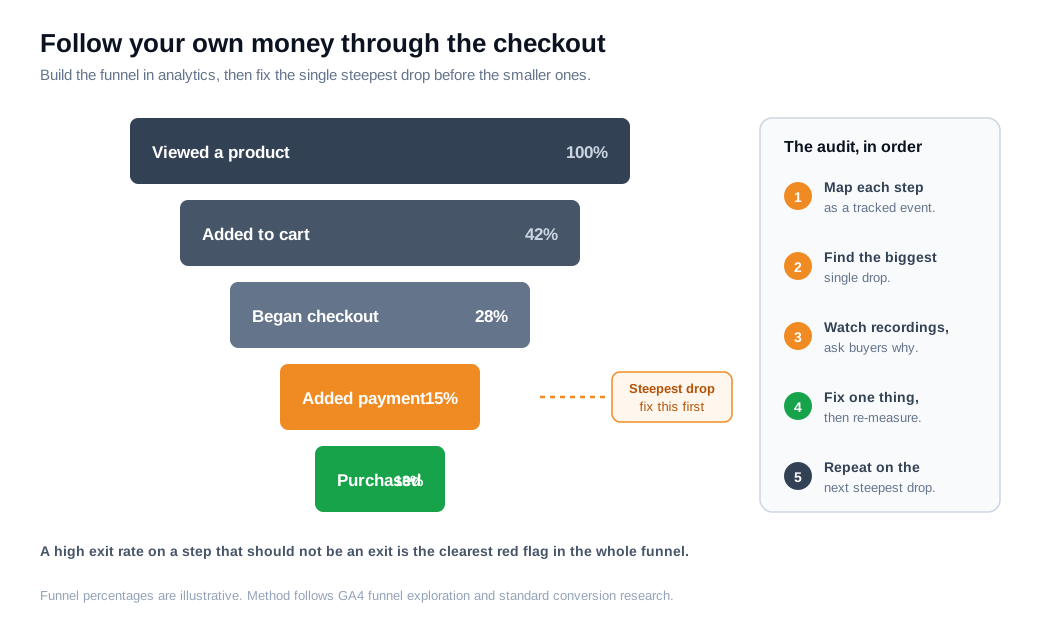
You audit these issues by following your own money through the funnel, one measured step at a time, then fixing the single steepest drop before any of the smaller ones. Guesswork is what produces the random redesigns that never move the number. The point of the audit is to replace opinions about what is wrong with evidence about where buyers actually leave.
Start with the quantitative map. Build a checkout funnel in your analytics tool covering viewed a product, added to cart, began checkout, added payment, and purchased, then read the drop between each step. CXL's guide to funnel analysis makes the same point that a high exit rate on a step that is not meant to be an exit is the clearest signal of a fixable leak. Whichever transition loses the most people is where you work first.
Then get the why, because analytics show where people leave, not why. Watch session recordings on the leaking step to see the hesitation, add a short on-page survey, and read your support and sales conversations for the objection that keeps coming up. A proactive nudge or a chat prompt on a high-intent page surfaces the exact question a funnel chart will never name, and that question is what you fix next.
Prioritize by impact and effort, change one thing at a time, and return to the same funnel report to confirm the drop shrank before you move on. That loop, measure, diagnose, fix one thing, re-measure, is what turns a list of suspected problems into a steadily rising conversion rate.
Ecommerce conversion mistakes: FAQs
What is a good ecommerce conversion rate?
A good ecommerce conversion rate usually falls in the 2 to 3 percent range for an established store, though it varies widely by industry, price point, and traffic source. Device matters too, since mobile typically converts around a point lower than desktop, so judge your rate against your own segments rather than a single global average. Track the trend after each fix instead of chasing a benchmark number, because a rate that climbs month over month is worth more than one that looks good on paper.
How much does cart abandonment really cost?
Cart abandonment costs more than most stores realize, since the average documented rate is near 70 percent, and a meaningful share of that is buyers blocked by fixable friction rather than idle browsers. The recoverable portion is the part driven by surprise costs, forced accounts, and clumsy checkouts, all of which you control. Fixing those raises the ceiling that every marketing dollar has to work under.
Should I use discount popups to lift conversions?
Discount popups can lift conversions, but they treat the symptom rather than the cause and can train shoppers to wait for a code. Fix the underlying friction first, honest pricing, a fast page, a guest checkout, and a product page that answers real questions, then test incentives on top. An offer layered over a broken checkout rarely recovers as much as the checkout fix would have on its own.
Key takeaways
- Most ecommerce conversion mistakes punish buyers who already decided to purchase. Surprise costs, forced accounts, slow pages, thin product content, and untested checkouts each block intent that is already there.
- Extra costs are the number one cart killer. Baymard finds 48 percent of shoppers who abandon for a reason blame high extra costs, so show shipping and fees early and use a free-shipping threshold.
- A forced account is easy to remove and expensive to keep. Roughly a quarter of abandoners cite a required signup, so make guest checkout prominent and offer the account after the sale.
- Speed is a revenue lever you control directly. Portent found conversion drops about 4.4 percent per second, and a two-second improvement can be worth six figures a year on the same traffic.
- Product pages and reviews do the convincing. A page with five reviews converts about 270 percent better than one with none, so answer real questions on the page and put proof next to the buy button.
- Audit by following your own funnel. Find the steepest drop, learn why with recordings and real conversations, fix one thing, and re-measure before moving on.

Written by
Nilas MylerCo-founder & CTO, Glimpze
Nilas is the co-founder and CTO of Glimpze, an inbound sales tool that turns high-intent website visitors into live conversations. A former SEO consultant for some of the largest companies in Denmark, he writes about speed-to-lead, inbound sales, and conversion rate optimization — the technical and operational mechanics of turning traffic into pipeline.


