
On this page
- What is an onboarding email sequence?
- Why do onboarding emails drive activation?
- What emails should an onboarding sequence include?
- How do you time and trigger onboarding emails?
- How long should an onboarding email sequence be?
- How do you measure an onboarding sequence's impact?
- What are the most common onboarding email mistakes?
- Key takeaways
- Sources
A SaaS product signs 2,000 free trials in a month and sends every one of them the same thing: a single welcome email with a login link. Two weeks later most of those trials have gone cold, and the team blames the market. The email was fine. The silence after it was the problem.
An onboarding email sequence closes that silence. It is the automated set of messages that carries a new signup from the confirmation screen to the first moment your product does something useful for them, and it is one of the cheapest levers a growth team has for turning trials into activated accounts.
This guide covers what an onboarding email sequence is, why it moves activation, which emails belong in it, how to time and trigger them, how long the sequence should run, how to measure whether it is working, and the mistakes that quietly leak signups.
What is an onboarding email sequence?
An onboarding email sequence is an automated series of emails that guides a new user from signup to their first real result with your product. Each message has one job: move the user one step closer to the action that predicts whether they stay.
The sequence usually begins the moment an account is created and ends when the user reaches activation, the event where the product first does the thing they signed up for. That might be connecting a data source, inviting a teammate, publishing a first page, or sending a first campaign. Everything before that event is effort the user is spending with no return yet, so every email either shortens the path to it or gets ignored.
It helps to separate the onboarding sequence from two things it gets confused with. A newsletter is broadcast to everyone on the same day, regardless of what any individual has done. A promotional drip sells. An onboarding sequence teaches, and it reacts to a single user's progress. The sequence also runs alongside in-app onboarding rather than replacing it. The checklist and tooltips work while the user is logged in, while the email sequence reaches the roughly two-thirds of trials who close the tab and would not come back on their own.
Why do onboarding emails drive activation?
Onboarding emails drive activation because they reach users in the exact window when most of them quietly disappear, and they do it at almost no marginal cost. The average B2B SaaS product activates only about 37% of signups, according to Userpilot's benchmark across 62 companies, which means nearly two-thirds of trials never feel the product work. Email is the one channel that can pull those people back after they have left the app.
The performance gap between onboarding email and ordinary marketing email is wide. Campaign Monitor reports that welcome emails see about 4 times the open rate and 5 times the click-through rate of a standard campaign, because the user just raised their hand and expects to hear from you. Relevance compounds the effect. An Experian study found that personalized emails deliver 6 times higher transaction rates than generic ones, and an onboarding email tied to what a specific user has or has not done is personalization at its most concrete.
The retention math is what makes the effort worth it. Structured onboarding, of which email is a core part, lifts 90-day retention from about 52% to 76% in Wyzowl's research. Keeping a customer also costs a fraction of finding a new one, with Harvard Business Review putting acquisition at five to twenty-five times the cost of retention. An onboarding sequence defends revenue you already paid to win, which is why it tends to return more than almost anything else a small growth team can build.
What emails should an onboarding sequence include?
A strong onboarding sequence includes five core emails: a welcome that sets one goal, a first-step nudge, a use-case email, a proof email, and a check-in that catches stalled users. Products with a longer setup add a few more, but these five carry most of the load.
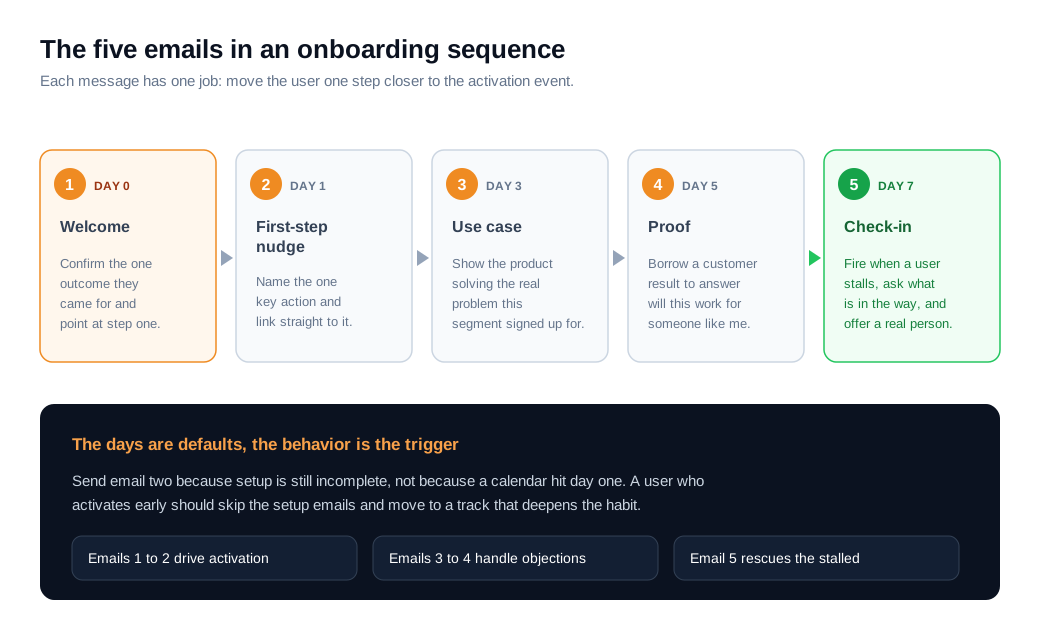
The welcome email is the highest-value message you will ever send, so it should do one thing well: confirm the outcome the user came for and point at the single first step. Skip the feature tour. A well-built welcome message flow can carry this automatically, greeting each new account and routing it toward the right first action.
The first-step nudge follows a day or so later and exists only to get the user to the activation event. It names the one action that matters, links straight to it, and says how long it takes. The use-case email comes next and shows the product solving a real problem, ideally the one this segment signed up for, with a short walkthrough or a two-minute video rather than a wall of features.
The proof email borrows credibility, using a customer result or a concrete before-and-after to answer the quiet question every trial is asking: will this actually work for someone like me. The check-in closes the set. It fires when a user has stalled, asks what is in the way, and offers a real person. Pairing that email with a live chat prompt or a quick screen share means the reply lands somewhere a rep can act on it in the moment, instead of a day later.
How do you time and trigger onboarding emails?
You time onboarding emails by user behavior first and the calendar second, so each message arrives because of what the user did rather than which day it happens to be. A behavioral trigger reads the product's event data and sends only when it is relevant: the setup email fires when setup is still incomplete, the celebration email fires the moment the user hits the activation event, and the stalled-user email fires after a defined period of no activity.
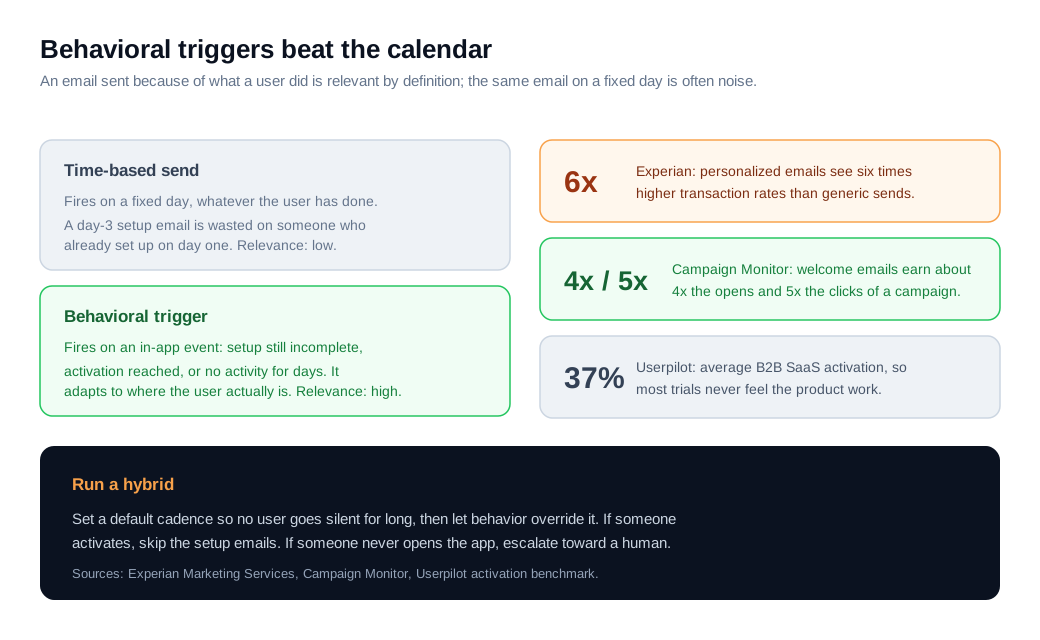
The reason behavioral beats time-based is relevance. An email sent because a user failed to connect their data is useful by definition, while the same email on a fixed day-three schedule is noise if they connected on day one and already got value. Userpilot's guidance on email onboarding is to tie messages to in-app events so the content adapts to where each user actually is, which lifts click-through and keeps the sequence from talking past people.
In practice you run a hybrid. Set a default cadence so no user goes silent for too long, then let behavior override it. If someone activates on day one, they should skip the "here is how to get started" emails entirely and move to a track that deepens the habit. If someone never opens the app, the sequence should escalate toward a human. The same logic powers in-product proactive nudges, and the email sequence is the version of that idea that works after the user has left the tab. Keep sends inside working hours in the user's time zone, and cap the frequency so the sequence guides rather than nags.
How long should an onboarding email sequence be?
An onboarding sequence should be long enough to reach the activation event and no longer, which for most products means five to eight emails over roughly two weeks. Simple tools with a fast time to value can activate a user in three or four emails. Complex or enterprise products, where setup involves data, permissions, and multiple stakeholders, may need ten or more spread across thirty days.
Tie the length to the trial, not to a template. A 14-day trial and a 30-day trial call for different pacing, and the sequence should deliver its most important message, the push to activation, well before the trial's midpoint while the user still has time to build a habit. Any email that does not move the user toward value or answer a real objection is a candidate to cut.
How do you measure an onboarding sequence's impact?
You measure an onboarding sequence's impact by activation rate and downstream retention, tracked by cohort, rather than by open rates. Opens and clicks tell you whether an email is readable, while activation tells you whether the sequence is doing its job. Group users by the week they signed up, follow that fixed cohort forward, and compare activation before and after you change the sequence.
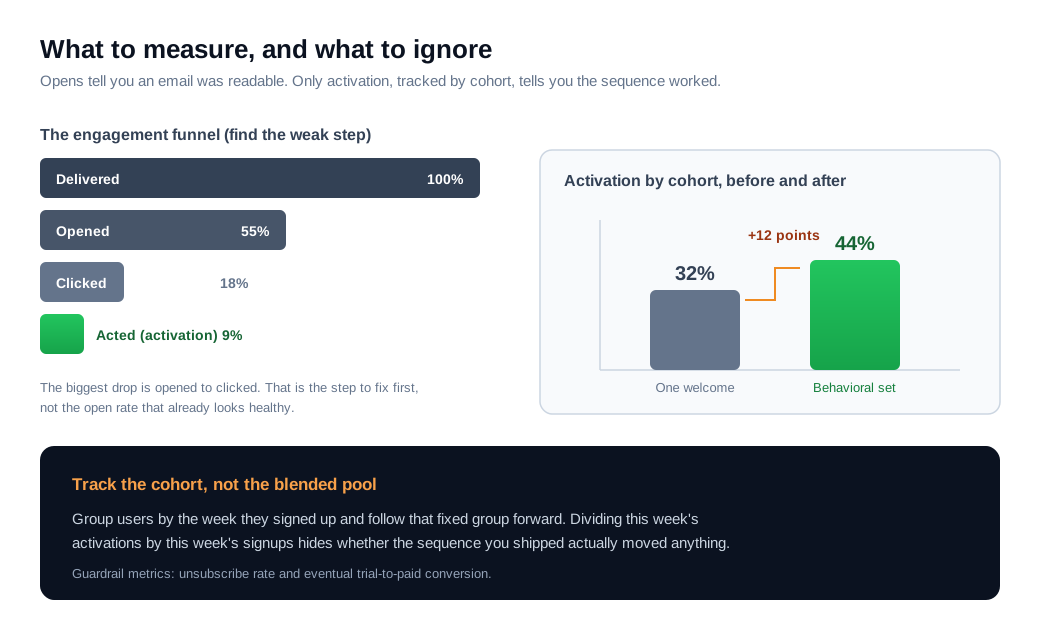
Here is the math on one cohort. A B2B SaaS priced at $49 a month signs 2,000 free trials a month, and its only onboarding touch is a single welcome email. Of those trials, 32% reach the activation event, which here is connecting a data source and building one report. The team replaces the lone welcome with a five-email behavioral sequence: a goal-setting welcome, a first-step nudge sent while the data source is still unconnected, a use-case email, a proof email, and a stalled-user check-in that offers a live chat or a two-minute screen share. Activation climbs to 44%.
On 2,000 trials, that is 240 more activated accounts a month from the same signups. Because activated trials in this product convert to paid at roughly four times the rate of trials that never activate, even a conservative read adds about 39 new paying customers a month, near $1,900 in new monthly recurring revenue from a single cohort, and it recurs every month the sequence runs. The dollar figures are illustrative, and the mechanism behind them is real: an onboarding sequence removes the reasons a trial stalls before the product gets a chance to prove itself.
Beyond activation, watch a short list. Use activation rate by cohort as the headline number, the per-email funnel of delivered, opened, clicked, and acted to find the weak step, unsubscribe rate as a guardrail against sending too much, and eventual trial-to-paid conversion to confirm the activation lift carries through to revenue.
What are the most common onboarding email mistakes?
The most common onboarding email mistakes come from sending on the company's schedule instead of the user's behavior. The first is the feature dump, a welcome email that lists everything the product does instead of pointing at the single first step, which slows the user down at the exact moment speed matters most.
The second is the fixed calendar that ignores what the user did. Sending a "finish setting up" email to someone who finished on day one wastes the message and trains them to ignore the next one. The third is measuring the wrong thing, celebrating a 60% open rate while activation sits flat, because opens are easy to move and value is not.
The fourth is the dead end, an email that asks a question or invites a reply, then routes that reply into an unmonitored inbox. When a stalled user finally answers "yes, I am stuck," the response needs to reach a person who can help while the intent is still warm. The fifth is never stopping. Once a user activates, the onboarding sequence should end and hand off to a different track, because continuing to send "get started" emails to someone who already did is a fast way to burn the goodwill the sequence earned.
Key takeaways
- A sequence is the automated path from signup to first value. It is the ordered set of emails a new user receives on the way to activation, and everything before that event is effort you want to shorten.
- Email reaches the trials who leave the app. Only about 37% of B2B SaaS signups activate, welcome emails earn roughly 4 times the opens of a normal campaign, and personalization lifts transaction rates around 6 times.
- Five emails carry most sequences. A goal-setting welcome, a first-step nudge, a use-case email, a proof email, and a stalled-user check-in, with more added only when setup is genuinely long.
- Trigger on behavior, not the calendar. Send the setup email because setup is incomplete, celebrate the moment activation happens, and run a default cadence only as a fallback.
- Measure activation by cohort, not opens. In the worked example, a behavioral sequence lifted activation from 32% to 44%, adding about 39 paying customers and near $1,900 in new monthly recurring revenue from one cohort.
- The common mistakes ignore behavior. Feature dumps, fixed calendars, vanity open rates, dead-end replies, and sequences that never stop are the leaks worth closing.

Written by
Nilas MylerCo-founder & CTO, Glimpze
Nilas is the co-founder and CTO of Glimpze, an inbound sales tool that turns high-intent website visitors into live conversations. A former SEO consultant for some of the largest companies in Denmark, he writes about speed-to-lead, inbound sales, and conversion rate optimization — the technical and operational mechanics of turning traffic into pipeline.


