
On this page
A new user signs up, clicks around for ninety seconds, and closes the tab. They never come back. Somewhere in that minute and a half, the product failed to show them the one thing it does better than anything they were using before. Multiply that by thousands of sign-ups and you have the quiet leak that drains most software companies.
The fix has a soft-sounding name that points at something you can actually measure. An aha moment is the point where a user first feels your product's core value, the instant the tool stops being a curiosity and becomes useful. Find that moment, learn which actions lead to it, and you can rebuild onboarding to get far more people there before their attention runs out.
This post covers what an aha moment really is, what they look like in real products, how to find yours in the data, whether every product even has one, how the aha moment relates to activation, and how to get new users there faster.
What is an aha moment?
An aha moment is the first time a user experiences your product's core value and understands why it is worth using. It is the shift from "I signed up for this" to "I see what this does for me."
The term comes from growth practitioner Sean Ellis, who also coined "growth hacking" and helped early Dropbox and Eventbrite grow. In a long interview with GrowthHackers, Ellis describes the aha moment as the point where the utility of the product clicks: the user gets what it is for, why they need it, and what they get out of using it. Everything in early growth, in his framing, is about pulling more people to that click and pulling it earlier.
Sign-up is not the aha moment. Neither is finishing a product tour, watching a demo video, or filling in a profile. Those are the walk up to the door. The aha lands when a real person does the thing your product exists to do and gets something back: the dashboard fills with their own data, the first message gets a reply, the file appears on a second device. It is a private, in-the-head realization, which is exactly what makes it slippery to work with. You cannot open your analytics and query a feeling. So the practical job is to find an observable behavior that reliably stands in for it, then design the first session around that behavior.
What do aha moments look like in real products?
Aha moments look different in every product because each one delivers value in its own way, but the well-documented examples all share a shape: a small, specific early action that flips a user from trying the product to keeping it.
The most cited example is Facebook. Its growth team, led by Chamath Palihapitiya, compared cohorts of users who stuck around against those who drifted off and found one pattern that stood out. As Mode recounts the story, users who connected with seven friends in their first ten days almost always stayed, because at that point the feed had enough people in it to be worth returning to. Seven friends in ten days became the number the whole team organized around.
Other companies found their own version of the same thing. Appcues has catalogued several: Twitter saw retention climb once a new user followed around 30 accounts and had a timeline that kept updating, Slack pointed at a team sending roughly 2,000 messages, the point where it starts to replace internal email, and Dropbox reduced its aha to a single act, putting one file in one folder so it syncs across devices.
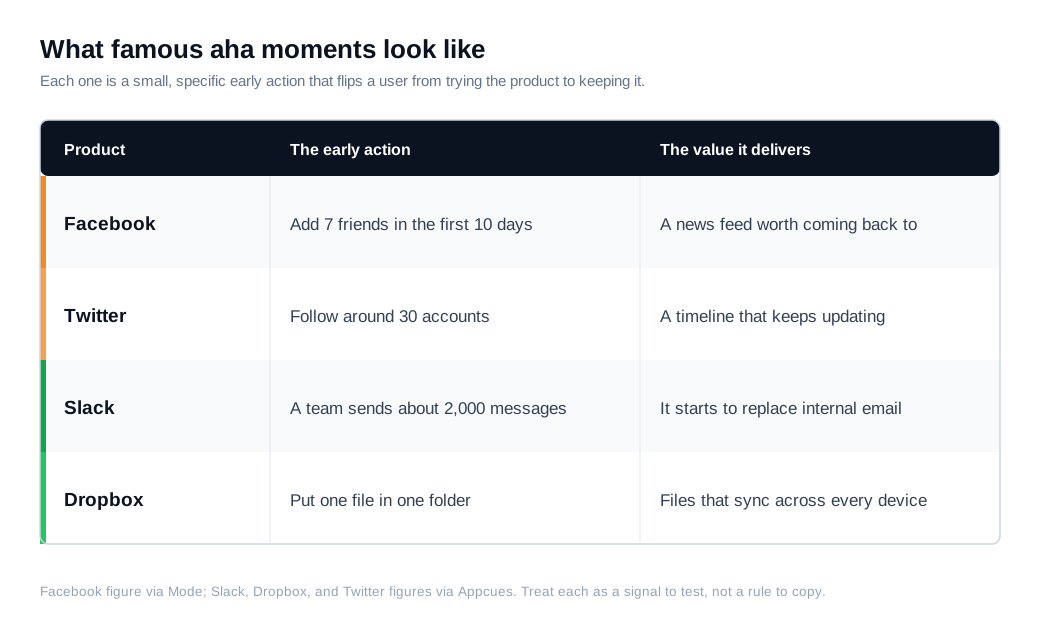
The pattern under all four is the same. Each action is early, specific, and inside the user's own control, and each one is the smallest step that lets the product show its value rather than describe it. That is what you are hunting for in your own product, and the way to find it is in your data rather than in a meeting.
How do you identify your aha moment with data?
You identify your aha moment by comparing the early behavior of users who stayed against the behavior of users who left, then finding the earliest action that separates the two groups. That separating action is your candidate.
The method is empirical. Take a large set of past users and split them into two groups: the ones still active after 30, 60, or 90 days, and the ones who churned. Then look backward at what each group did in their first days. You are searching for the earliest in-product behavior that the retained group did and the churned group mostly skipped. Product analytics tools automate this search. Amplitude's Compass chart scans the events new users performed in their first days and reports which ones best predict whether they became retained users, which is how it surfaces candidate aha moments without you guessing at them first.
Here is a worked example with numbers. Suppose you run a team analytics tool and pull three months of sign-ups. You define one candidate action, connecting a data source and building one dashboard in the first week, and split the cohort by whether they did it. The group that did it retains at 46% after 30 days. The group that did neither retains at 11%. That roughly fourfold gap is a strong signal that this action is close to your aha moment, and it hands you a clear intervention: get more new users to build that first dashboard in week one.
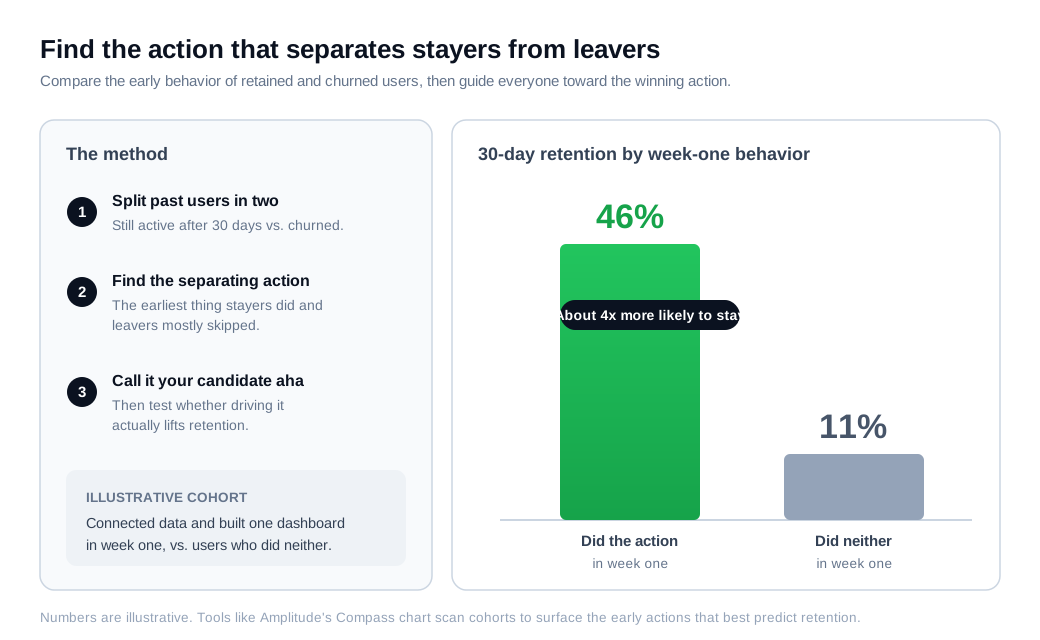
A good candidate has four traits. It correlates strongly with long-term retention, so it predicts something real. It happens early, ideally in the first session, so you can still influence it. It sits inside the user's control rather than behind a sales call or a teammate's approval. And it maps to genuine value instead of a vanity click like uploading a profile photo. Run the same analysis by segment, too. Users from branded search and users from a cold ad often reach value through different actions, and a blended view can hide the one that matters for each.
Does every product have a single aha moment?
Not every product has one clean magic number, and treating a simple correlation as the cause of retention is the most common way teams get this wrong. The seven-friends story is memorable, so it is easy to assume every product hides an equally tidy threshold, waiting to be discovered.
Mixpanel makes this case bluntly in a piece titled Magic numbers are an illusion. The core warning is about correlation versus causation. Users who use a given feature may retain longer simply because power users tend to touch every feature, so the feature looks predictive while causing none of the retention on its own. Forcing indifferent users through that action will not make them stick, because the action was a symptom of engagement, not its source. Mixpanel also points out that many products have several moments that shape a user's lifecycle rather than one decisive tipping point.
So treat any magic number as a hypothesis, not a law. Its real value is as a rallying point, a short phrase that lets product, marketing, and success teams aim at the same goal. To move from correlation toward something you can trust, run an experiment: deliberately drive one group of new users toward the candidate action, hold back a comparable group, and see whether the treated group actually retains better. If it does, you have a lever. If it does not, you found a symptom, and it is back to the data. That discipline is what separates a useful aha moment from a coincidence you talked yourself into.
How does the aha moment relate to activation?
The aha moment is the realization inside a user's head; activation is the observable action in your analytics that proves they got there. One is the goal, the other is the yardstick you use to measure progress toward it.
You cannot count a feeling, so activation is the event you count instead. You design onboarding to create the aha, then track activation as its proxy. Sometimes they are the same moment. Often the activation event is a slightly later action that confirms the realization stuck, like a user returning the next day to do the valuable thing again. Keeping the two ideas linked but distinct stops a familiar mistake: celebrating a metric that is easy to move but does not track value, such as "completed the tour," while real activation stays flat.
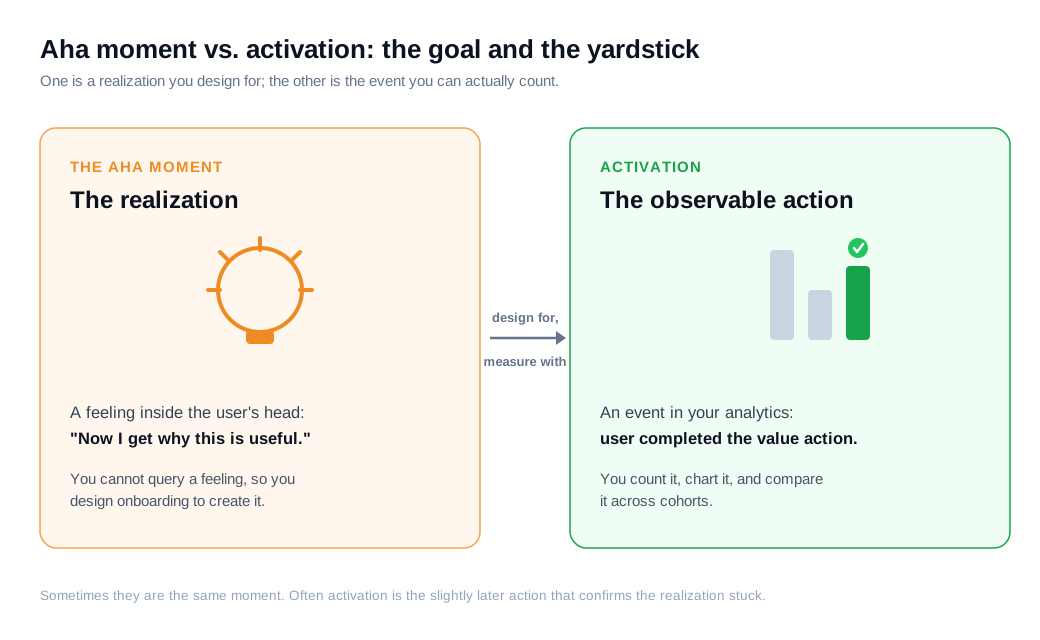
This is also why the aha moment matters well beyond the onboarding team. Activation sits at the seam where the money you spent acquiring a user turns into a user who stays. A person who never reaches value rarely retains, rarely expands, and never refers, so the pattern shows up weeks ahead of any retention chart. Get the aha right, define a clean activation event around it, and you get an early read on whether this month's cohort will grow or leak. For a deeper look at measuring the event side of this, our companion piece on activation rate walks through the cohort math.
How do you get users to the aha moment faster?
Get users to the aha moment faster by cutting every step between sign-up and first value, pointing them at one clear action, and stepping in with a person when a high-intent user stalls. The clock you are racing is time-to-value, the gap between sign-up and that first click of usefulness, and shortening it is the single most valuable thing onboarding can do. Amplitude's work on time to value ties a shorter gap directly to stronger retention.
Strip onboarding to the essentials. Audit the path from sign-up to the value moment and remove or defer everything that is not required to reach it. Profile completion, teammate invites, integration setup, and customization can all wait until after the user has seen the product work. Appcues frames time-to-value the same way: every non-essential step you cut raises the share of users who make it to first value.
Kill the blank page. An empty dashboard reads like homework. Preload sample data, ship templates, and offer "try it now" flows so a new account shows something useful before it asks for a commitment. The goal is that the product demonstrates its value in the first session instead of promising it.
Point at one action with a checklist. A short, outcome-based checklist ("connect a data source," "build your first dashboard," "invite a teammate") beats a passive tour, because it gives the user a reason to move rather than a thing to watch. Keep it to three to five steps, and make the first one the action closest to your aha.
Personalize the first run. A one-question welcome screen that captures a new user's role or use case lets you route them straight to the workflow they came for. This is where a documented welcome-message flow earns its keep, turning a generic starting point into a path aimed at that specific user's aha.
Add a human touch where intent is high. This is the most underused lever in self-serve products. A user who stalls halfway through setup, or lingers on the pricing page mid-trial, is the most valuable and most fragile traffic you have. Reaching that exact person in the moment, with a live chat message or a quick call, rescues interest that an email two days later would let cool. When the sticking point is easier to show than to type, a short screen share or video call can walk the user past it in a couple of minutes. You do not need to chase every free sign-up. You need a reliable way to reach the small group showing real intent, and firing that outreach automatically when someone stalls, through proactive nudges, keeps the touch timely without a rep watching a dashboard all day.
Above all, treat the path to your aha moment as a funnel and chart the drop-off at each step. Find the biggest leak between sign-up and first value, fix that one, and measure again. Every point you add compounds, because it flows straight into activation, retention, and the cost of acquiring the next customer.
Key takeaways
- An aha moment is a realization, not a sign-up. It is the first time a user experiences your product's core value and understands why it is worth using, a concept Sean Ellis put at the center of early growth.
- The famous examples share one shape. Facebook's seven friends in ten days, Slack's 2,000 messages, and Dropbox's one file in one folder are each a small, specific, early action that lets the product show value instead of describing it.
- Find yours in the data. Compare retained and churned users, look for the earliest action that separates them, and pick a candidate that is predictive, early, in the user's control, and tied to real value.
- Guard against a false magic number. A correlation is not proof, since power users touch every feature, so validate a candidate with an experiment before you build the whole product around it.
- Aha is the goal, activation is the yardstick. The realization lives in the user's head, while activation is the observable event you count, chart, and compare across cohorts.
- Speed is the main lever. Cut steps, kill the blank page, guide users to one action, and add a human touch through live chat or a quick call when a high-intent user stalls.

Written by
Nilas MylerCo-founder & CTO, Glimpze
Nilas is the co-founder and CTO of Glimpze, an inbound sales tool that turns high-intent website visitors into live conversations. A former SEO consultant for some of the largest companies in Denmark, he writes about speed-to-lead, inbound sales, and conversion rate optimization — the technical and operational mechanics of turning traffic into pipeline.


