
On this page
- What causes buyer hesitation in online shopping?
- How do real-time chat and video build buyer confidence?
- When in the buyer's journey should you offer help?
- Does live video help more than chat for high-consideration purchases?
- How do you measure real-time support's impact on conversion?
- What mistakes make real-time support backfire?
- Key takeaways
- Sources
A shopper has a $180 pair of boots in the cart. They have read the description twice, opened the size chart, and scrolled back through the reviews.
They are not confused about the product. They are stuck on a small doubt: will these fit, and can they send them back for free if they do not. Nobody answers, so they close the tab and tell themselves they will decide later.
That pause has a name. Buyer hesitation is the gap between wanting a product and being willing to pay for it, and it is where most online revenue quietly leaks.
The Baymard Institute puts the average documented cart abandonment rate at 70.22%, and a large share of it traces back to doubts a short conversation could have settled before the shopper left.
This post covers what causes buyer hesitation online, how real-time chat and video build confidence, when in the journey to step in, whether video beats chat for expensive purchases, how to measure the effect on conversion, and the mistakes that make real-time support backfire.
What causes buyer hesitation in online shopping?
Buyer hesitation online comes mostly from perceived risk, not a lack of interest, and it clusters around three doubts: whether the product is right, whether the total cost is fair, and whether the store can be trusted with money and returns.
A visitor who is already on the product page has cleared the interest bar. What stops them is uncertainty they cannot resolve on their own.
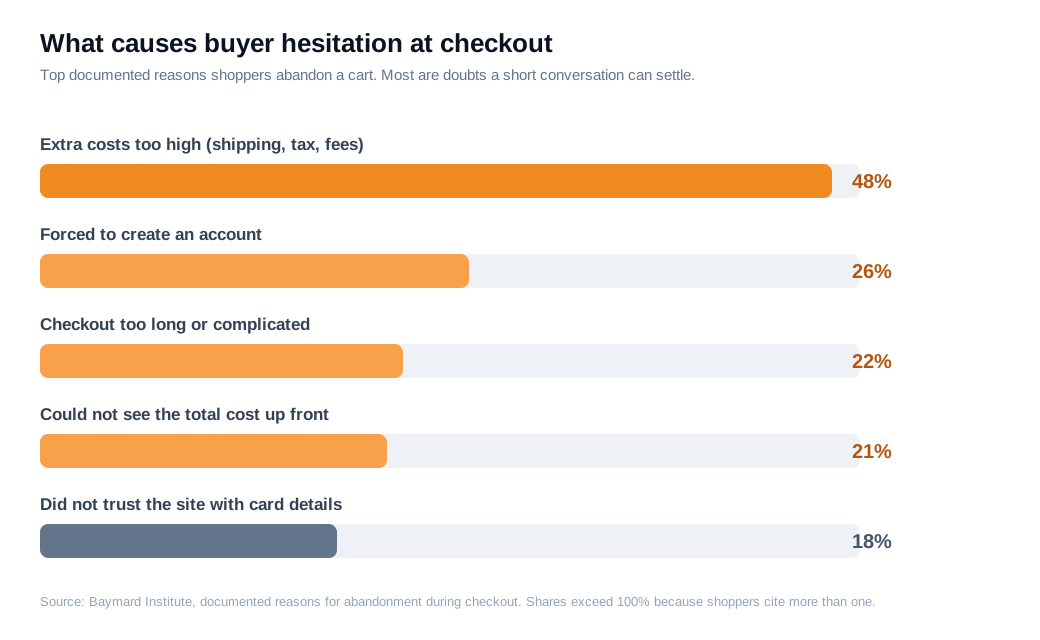
Baymard's research on why people leave during checkout maps the risk directly:
- Extra costs like shipping and tax appearing too high is the top reason, cited by roughly 48% of abandoners and holding the number one spot for years.
- Being forced to create an account drives about 26% away.
- A checkout that felt too long or complicated accounts for around 22%.
- Not being able to see the total cost up front is near 21%.
- Roughly 18% do not trust the site with their card details.
Each of those is a doubt, and most of them can be answered in a sentence.
Product uncertainty is the other half. When a buyer cannot tell whether a jacket runs small or whether a device is compatible with what they already own, they stall.
Reviews are the usual fix, and the effect is large. Research from Northwestern University's Spiegel Research Center found a product with five reviews is 270% more likely to be purchased than one with none, with the lift reaching 380% on higher-priced items where the perceived risk is greater.
Reviews cover the common questions, but they cannot answer the specific one a given shopper is holding at 11 p.m.
One caveat keeps this honest. A large portion of abandoned carts are simply people browsing or comparing options who were never ready to buy, and no amount of support will convert them.
The point is to separate that group from the shoppers who left over a real, answerable doubt, because the second group is the one real-time support recovers.
How do real-time chat and video build buyer confidence?
Real-time chat and video build confidence by resolving a specific doubt in the seconds it takes a shopper to feel it, before they leave to check later and forget to come back.
The timing is the whole advantage. The person is on the product page, the tab is open, and one accurate answer stands between them and a decision.
The data on chat engagement is consistent, if directional. Forrester has reported that shoppers who use web chat are around 2.8 times more likely to convert than those who do not, and that roughly 45% of US online adults will abandon a purchase if they cannot find a quick answer to a question.
Read the multiple as a ceiling rather than a promise, since people who start a chat were often warmer to begin with, so part of the gap is who chats rather than the chat itself. Even discounted, the direction is clear: an answered question keeps a shopper in the funnel that an unanswered one loses.
Chat handles most doubts, and a conversation carries a second signal beyond the answer. A real person replying in twelve seconds tells a nervous buyer that a human is behind the store, which quietly lowers the trust risk that a checkout page never addresses on its own.
For doubts that are hard to describe in text, live video and screen share go further, because the rep can show the product on camera, walk through a size comparison, or demonstrate a feature the buyer was unsure about. A tool like live chat covers the routine questions, and video takes over when text starts to stall.
Put rough numbers on it. Say a store gets 40,000 sessions a month and converts 2%, which is 800 orders at a $120 average, or $96,000. Suppose real-time support engages 4% of sessions, so 1,600 conversations.
If half of those chats involve a shopper who had a genuine doubt, and support saves even a fifth of that group, that is 160 recovered orders worth about $19,000 a month from sales the store was otherwise losing at the fit and shipping questions.
When in the buyer's journey should you offer help?
Offer help at the points where hesitation actually spikes — the product page, the cart, and the checkout — and trigger on behavior rather than a timer so the invitation reaches shoppers who are weighing a decision instead of everyone who lands.
A pop-up that greets every visitor after five seconds trains people to dismiss chat on reflex, and it can convert worse than showing nothing at all.
Good triggers key off what the visitor is doing:
- A shopper who lingers on a product page for 40 to 60 seconds, or returns to the same item a second time, is showing the kind of interest a quick fit or compatibility answer can turn into an order.
- A cart sitting untouched while the visitor goes idle is a nudge point.
- A stall on a checkout step for a minute or more is the highest-value moment on the entire site, since the doubt there is usually about shipping cost, a coupon field, or payment security.
- Exit intent on the cart or checkout is the last chance to catch the session before it ends.
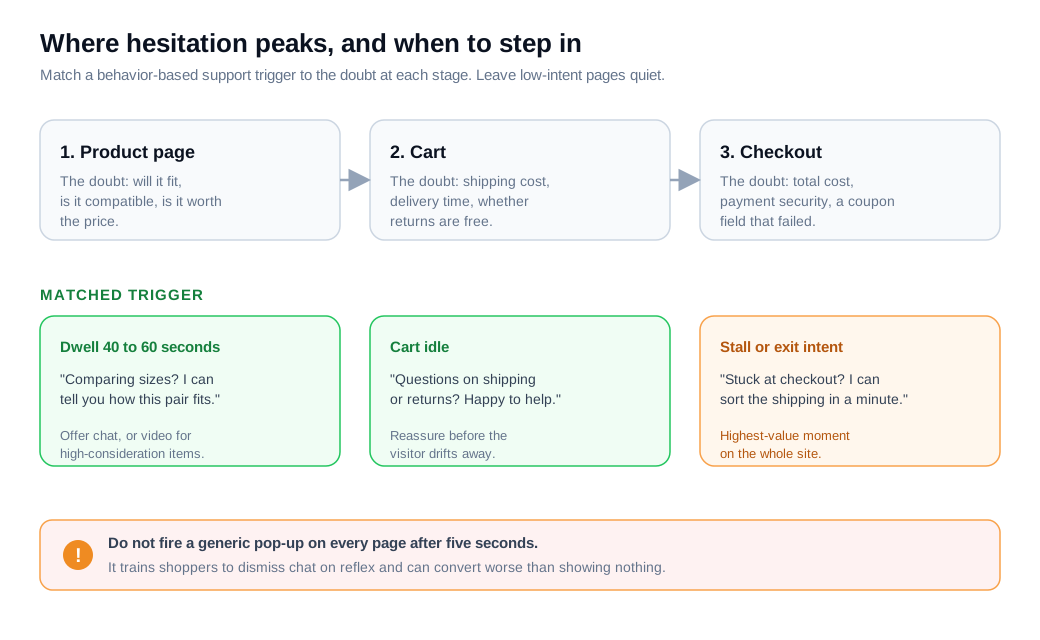
The message has to name the situation. "Comparing sizes? I can tell you how this pair fits" beats a wave from a stranger, and "Stuck at checkout? I can sort the shipping in a minute" beats "How can I help?"
Tuning these proactive outreach rules to real behavior, then leaving low-intent pages quiet, is most of the setup work. The goal is to appear exactly when a doubt forms and stay invisible the rest of the time.
Does live video help more than chat for high-consideration purchases?
Live video helps more than text for high-consideration purchases because the doubt is usually about something you can show, and a 90-second camera view or screen share answers it faster than any paragraph.
On a $30 t-shirt, a shopper mostly needs a quick fact, and text is perfect for that. On a $600 mattress, a $1,200 camera, or a made-to-measure sofa, the buyer is weighing specs and fit they do not fully understand, and reading three messages about it can raise the doubt instead of settling it.
Video closes that gap two ways. It lets the rep demonstrate rather than describe, holding the fabric up to the lens or sharing a screen to compare two models side by side.
It also puts a face on the store at the exact moment the buyer is deciding whether to trust it with a large sum, which matters more as the price climbs. This is the same logic behind reviews carrying a bigger lift on expensive items, where risk is higher and reassurance is worth more.
There is a measurable upside beyond conversion. Shoppers who talk to a rep before buying tend to spend more, since a helpful conversation naturally surfaces the right size, the better model, or the accessory that completes the order.
Treat the interaction as an inbound sales moment on a storefront, where the job is to move a considered purchase forward, and video becomes a tool for both confidence and basket size rather than a support cost.
How do you measure real-time support's impact on conversion?
Measure it with a holdout test, showing the support widget to most of your eligible traffic and hiding it from a random slice, then comparing the conversion rate of the two groups so you isolate the sales support actually added from the sales that would have happened anyway.
Attribution alone will overstate the effect, because it credits support with buyers who were always going to purchase. Incrementality testing, the standard method for separating real lift from correlation, is what makes the number defensible.
Start with the tagging. Fire events like chat started and chat engaged into GA4 or your analytics tool, attach a session or user ID, and attribute orders that follow within a 24 to 48 hour window.
That gives you support-touched revenue, which you can compute as engaged conversations multiplied by their conversion rate multiplied by average order value. It is a useful directional read, and it overstates the effect, because it includes the buyers who never needed help.
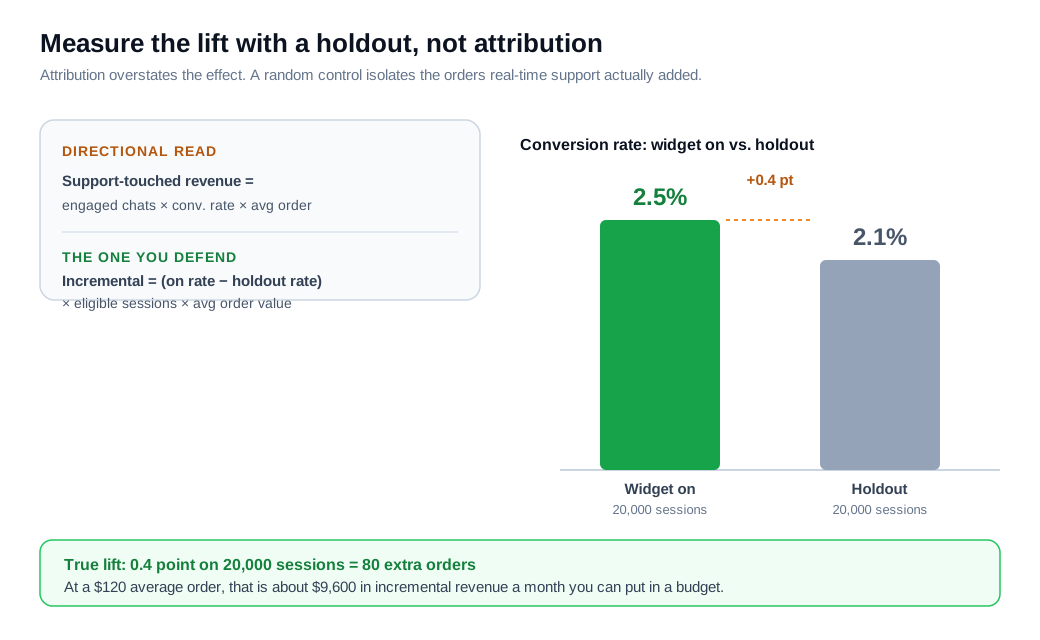
Here is the arithmetic on a holdout. Take 40,000 eligible sessions a month at a $120 average order, and split them evenly so 20,000 see the support widget and 20,000 do not. Say the widget group converts at 2.5% overall and the holdout at 2.1%.
That 0.4 point difference on 20,000 sessions is 80 extra orders a month, worth about $9,600 in incremental revenue. That figure survives a budget conversation in a way a vendor's headline multiple never will.
Run the test long enough to reach a stable result, then keep support-touched revenue as a directional gauge and the holdout number as the one you defend.
What mistakes make real-time support backfire?
The mistakes that hurt most are an unstaffed widget, invitations that fire on every page, replies that arrive after the shopper has already left, and treating every visitor as a support ticket instead of a hesitant buyer. Each one caps the return before real-time support gets a fair test.
An unstaffed widget is the worst, because it advertises help and then leaves a doubtful shopper typing into silence, which confirms the exact fear that made them hesitate. If you cannot cover a time slot, switch the widget to an honest offline state that captures the question and an email, or let an AI assistant answer the routine ones and route anything valuable to a person.
Generic pop-ups are the second trap, fixed by the behavior-based triggers above. Slow replies are the third, since a two-minute wait on a high-intent question loses the shopper you were closest to converting.
The fourth is a mindset problem: a hesitant buyer needs reassurance and a nudge, and answering them like a ticket-closing help desk misses the sale sitting in front of you. Most platforms, including Glimpze, offer a free tier, so you can test staffing and triggers against your own traffic before committing budget.
Key takeaways
- Hesitation is perceived risk, not lost interest. Shoppers stall over fit, total cost, and trust, and Baymard's checkout data shows most of those doubts are answerable in a sentence.
- Real-time answers keep doubtful shoppers in the funnel. Forrester reports chat engagers convert around 2.8 times more often, and roughly 45% of shoppers abandon a purchase without a quick answer.
- Trigger on behavior at the points where hesitation spikes. Fire on product-page dwell, an idle cart, a stalled checkout, or exit intent with a message that names the doubt, and leave low-intent pages quiet.
- Use video for high-consideration purchases. When the doubt is about fit, scale, or how something works, a short camera view or screen share settles it faster than text and lifts spend.
- Prove the impact with a holdout, not attribution. Compare a widget group against a random control to isolate the incremental orders support added, and defend the budget on that number.
- Avoid the failure modes that confirm a buyer's fear. An unstaffed widget, generic pop-ups, slow replies, and a help-desk mindset each cap the return before support pays off.

Written by
Nilas MylerCo-founder & CTO, Glimpze
Nilas is the co-founder and CTO of Glimpze, an inbound sales tool that turns high-intent website visitors into live conversations. A former SEO consultant for some of the largest companies in Denmark, he writes about speed-to-lead, inbound sales, and conversion rate optimization — the technical and operational mechanics of turning traffic into pipeline.


