On this page
Every closed-lost record in your CRM has a reason attached, usually one word: "price," "timing," "competitor." That word is almost always wrong. When researchers compare the reasons sellers write down against the reasons buyers actually give, the two line up only about 15% of the time, which means most of your loss data is fiction the moment a rep enters it.
That matters because a large share of those losses had little to do with your product being worse. Corporate Visions, drawing on buyer feedback across more than 100,000 B2B transactions, found that 53% of buyers say the vendor they turned down could have won the deal if not for a fixable misstep during the sales process. Something correctable happened, and nobody recorded it.
This post covers what a lost-deal analysis is, why it belongs in your quarter, how to run one step by step, how many deals you need to talk to, the patterns worth hunting for, and how to turn what you learn into a higher win rate.
What is a lost-deal analysis?
A lost-deal analysis, usually called win-loss analysis, is a structured review of why buyers chose you, a competitor, or nobody at all, built from direct buyer feedback instead of the guesses reps enter at close. You gather a sample of recently decided deals, ask the buyers what really drove the decision, sort what you hear into consistent categories, and read the result for patterns you can act on.
The word "lost" in the name is slightly misleading, because the strongest programs interview won deals too. A win you cannot explain is as dangerous as a loss you cannot explain, since you may be crediting your product for a deal the buyer closed for a reason you could lose next quarter. Pairing wins with losses is what lets you tell a real advantage from a lucky one.
The core idea is that the person who bought, or chose not to, holds information no internal dashboard has. Your pipeline stages, activity counts, and stated loss reasons all describe what your team did. Only the buyer can tell you what the buyer experienced, and that experience is what decided the deal.
Why should you analyze lost deals?
You should analyze lost deals because the reasons recorded in your CRM are mostly inaccurate, and the true reasons point at changes that lift the win rate on pipeline you are already generating. You do not need more leads to win more. You need to stop losing the winnable ones the same way every quarter.
Start with how unreliable the default data is. Clozd's research finds that buyer-reported and seller-reported loss reasons agree only around 15% of the time, so roughly five out of six closed-lost codes in a typical CRM are wrong or incomplete. A rep who just lost a deal is not a neutral witness. "Lost on price" is an easier note to type than "I never reached the economic buyer," so the comfortable reason gets recorded and the real one disappears.
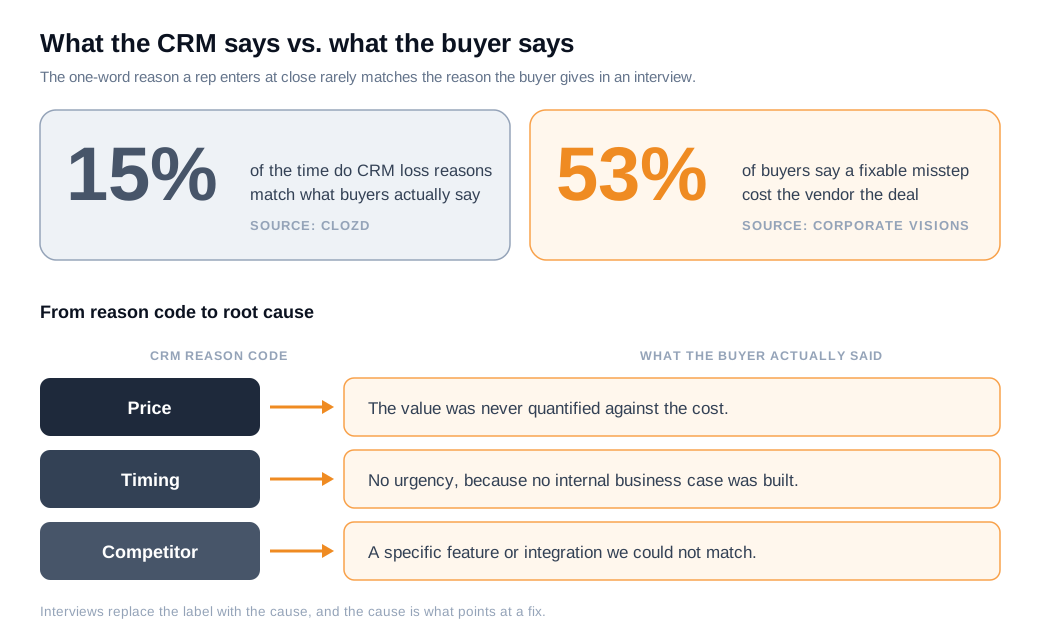
Then consider how much of the loss column is recoverable. If more than half of losses trace back to a correctable misstep, as the Corporate Visions figure suggests, the return on fixing one recurring misstep is high, because the fix applies to every future deal that would have hit the same wall. A win-loss program is the cheapest revenue you can buy, since the deals are already in your funnel and the only cost is a handful of conversations and the discipline to act on them.
There is a second payoff that reaches past sales. Coded loss data tells product which feature gaps actually cost revenue, tells marketing which competitor claims keep landing, and tells enablement which stage of the process reps keep fumbling. One quarter of honest interviews can settle debates that opinion has been circling for a year.
How do you run a loss analysis?
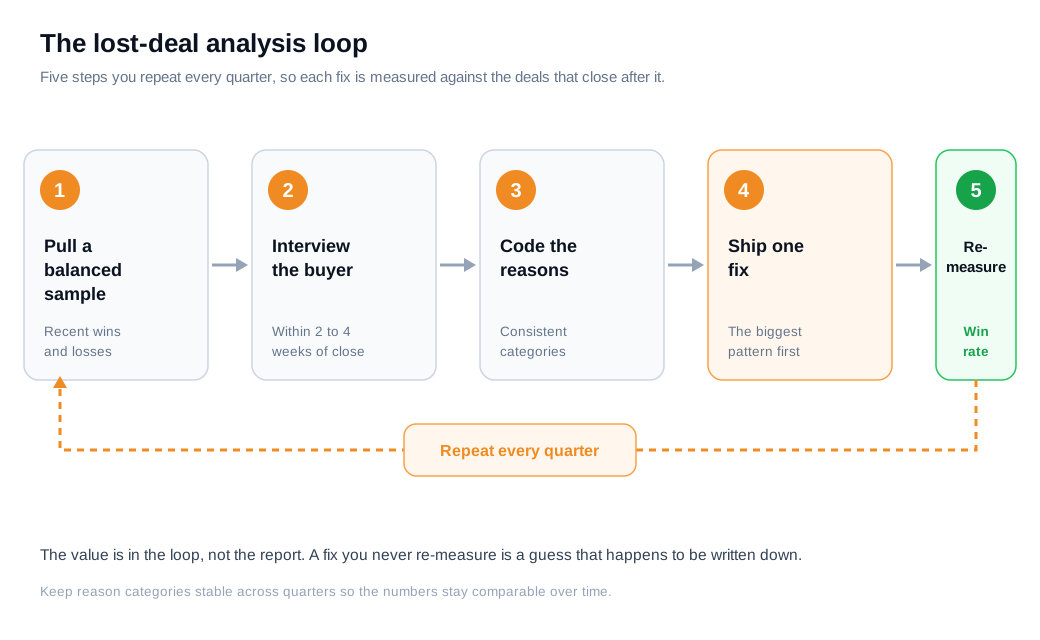
You run a loss analysis by pulling a balanced sample of recently decided deals, interviewing the buyers with a neutral interviewer soon after the decision, coding what you hear into consistent reason categories, and reviewing the tally for patterns before you change anything. The mechanics are simple. The discipline is in doing it the same way every quarter so the numbers stay comparable.
The steps hold whatever tool you use:
- Pick a narrow question. "Why do we lose?" produces vague answers. "Why do enterprise deals stall after the demo?" produces answers you can act on.
- Pull a balanced sample of wins and losses that closed recently, spread across your main segments so one big account cannot skew the read.
- Interview the buyer within two to four weeks of the decision. After about 30 days buyers start rationalizing the choice, and after 60 they can barely remember who else they evaluated.
- Use a neutral interviewer. The rep who worked the deal is usually the wrong person to run its post-mortem, because the buyer will soften feedback to spare their feelings and the rep will steer away from their own mistakes.
- Code every interview into the same reason categories, then read the distribution before drawing conclusions.
The interview itself should be open and quiet. Ask what problem they were solving, who else made the shortlist, what nearly changed their mind, and what the winning vendor did that you did not. Then stop talking. The most useful line in a win-loss interview is almost always something the buyer volunteers after an awkward pause, not an answer to a leading question. Keep the guide short, keep your opinions out of it, and let them narrate the decision in their own order.
How many lost deals do you need to analyze?
You need enough interviews to see a reason repeat, which for most teams means at least 10 wins and 10 losses per quarter, and 30 to 40 if you want to break the results down by segment. The goal is a pattern you can trust, and a single dramatic story is not one. You are looking for the same reason showing up across independent conversations.
Here is a worked example. Say you closed 180 deals last quarter, 40 won and 140 lost. You do not have to interview all 140. Select 12 losses and 12 wins that closed in the last six weeks, spread across your main segments. If 7 of the 12 lost buyers describe the same stall at the same stage, that is not noise, that is a pattern worth a fix. If the reasons scatter with no repeat, widen the sample before you conclude anything.
Push the sample toward 35 interviews and you can slice it. Split enterprise from mid-market and you might find that enterprise losses cluster on security review while mid-market losses cluster on price sensitivity, which are two different problems with two different owners. Segment-level reads are where win-loss earns its keep, because the fix for one segment often has nothing to do with the fix for another.
One caution on volume. More interviews are only better if you keep the reason categories stable, because renaming or resplitting categories mid-program destroys your ability to compare this quarter to last. Decide the taxonomy once, then hold it. Consistency over time beats a bigger one-off sample.
What patterns should you look for?
Look for the loss reasons that cluster, the gap between what reps recorded and what buyers said, and the single category that shows up most often, because that is where the recoverable revenue sits. A win-loss report is not a list of anecdotes. It is a distribution, and the shape of that distribution tells you where to spend your one unit of change.
Here is what a coded quarter can look like. You interview 24 lost buyers. The CRM said 15 of the 24 were "lost on price." After the interviews, the tally reads: no decision or status quo, 8; chose a competitor's specific feature, 6; timing and reprioritization, 4; poor fit you should have disqualified early, 3; and price genuinely too high for the budget, 3. Only 3 of those 15 "price" losses were actually about price. The other 12 were a value problem, an urgency problem, or a discovery problem wearing a price label.
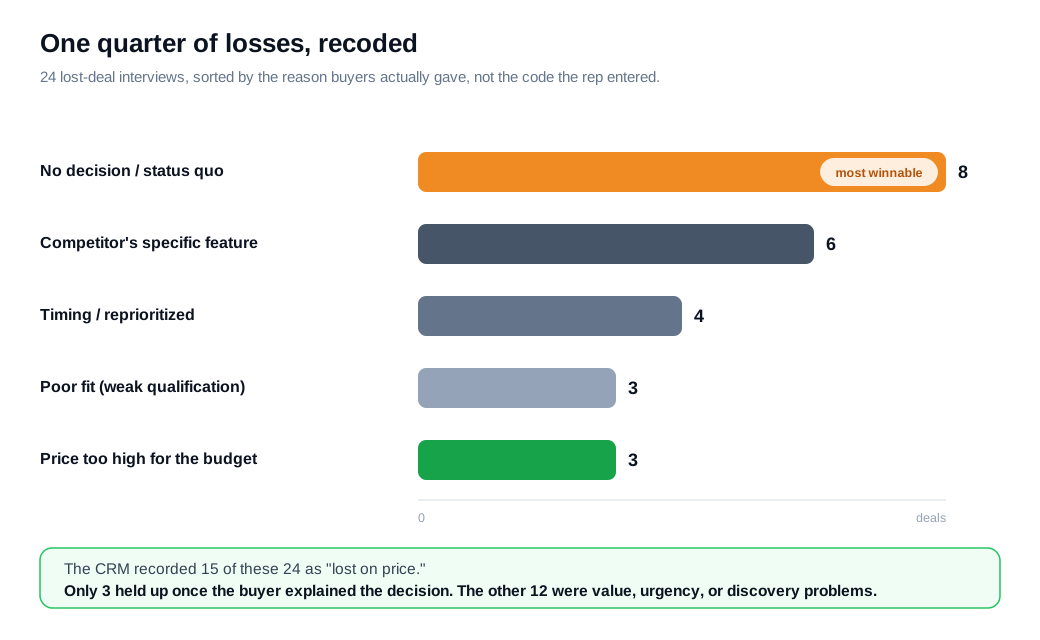
A few patterns recur often enough to name. The "no decision" or status quo bucket is frequently the largest loss category and the most recoverable, because nothing changed except timing, and the buyer who did nothing this quarter still has the problem next quarter. Clozd's teams point out that these stalled deals are among the easiest to revive, since you lost to inertia rather than to a competitor. Price, as the example shows, is usually a stand-in for value the buyer never saw quantified. And competitor losses that all name the same missing feature or integration are a product signal, not a selling signal.
The other pattern to watch is where in the funnel deals die. Losses concentrated right after discovery point at qualification and needs analysis. Losses after the demo point at differentiation or proof. Losses at the very end, after a verbal yes, point at procurement, security, or a champion who could not carry it internally. Tagging the stage alongside the reason turns a flat list into a map of where your process leaks.
How do you turn findings into action?
You turn findings into action by picking the one loss pattern with the highest volume, assigning it to the team that owns the fix, shipping a single change, and re-measuring win rate on the cohort of deals that close after it. A win-loss report that ends in a slide deck changes nothing. The value is in the loop, and the loop only closes when you measure whether the fix moved the number.
A worked example shows the upside. Suppose you run at a 22% win rate on 200 qualified opportunities a quarter, so 44 wins. Your analysis shows that a quarter of your losses stall at "no decision" because buyers never built an internal business case. You add a one-page business-case template and a mid-cycle executive check-in for those deals. If that converts even 8 of the previously stalled opportunities, your win rate moves from 22% to 26% on the same pipeline, and none of it required a single new lead.
Match the owner to the pattern. A product gap goes to the roadmap conversation with the revenue it cost attached. A competitor claim that keeps landing goes to marketing as battlecard fuel. A stage that reps keep fumbling goes to enablement as coaching. Many of the most common correctable losses, though, are operational: a buyer who waited too long for a reply, a demo that missed their context, an executive who never got looped in. When the pattern points at slow or late follow-up, the fix is speed. Reaching a high-intent buyer while the question is still open, over live chat or a quick call, closes a gap that a next-day email leaves wide, which is the heart of a modern inbound sales motion built on speed-to-lead. When losses cluster on demos that felt generic, a live screen share or video call that walks a specific buyer through their own use case does more than any polished recording.
Then close the loop. Tag the deals that enter the pipeline after your change, compare their win rate against the earlier cohort at the same stage, and keep the changes that bend the line up. Run the whole cycle again next quarter. Lost-deal analysis is not a project you finish. It is a quarterly habit that compounds, because each fix you confirm is one you never have to lose to again.
Key takeaways
- Your CRM loss reasons are mostly wrong. Buyer and seller explanations agree only about 15% of the time, so acting on unverified closed-lost codes means acting on fiction.
- Over half of losses are winnable. Corporate Visions found 53% of buyers say a fixable misstep cost the vendor the deal, which makes win-loss the cheapest revenue in your funnel.
- Interview soon, neutrally, and in balance. Talk to buyers within two to four weeks of the decision, use someone other than the deal's rep, and pair at least 10 wins with 10 losses so patterns are trustworthy.
- Read the distribution, not the anecdotes. The largest cluster and the funnel stage where deals die tell you where to spend your one change, and "no decision" is usually the biggest and most recoverable bucket.
- Fix one pattern, then measure. Assign the top loss reason to the team that owns it, ship a single change, and compare the win rate of deals that close after the fix against the ones before it.
- Make it a quarterly loop. A report that ends in a deck changes nothing, while a habit of finding, fixing, and re-measuring one pattern per quarter compounds into a durable win-rate gain.
TAGS

Written by
Daniel SemeckyCo-founder & CEO
Daniel is the co-founder and CEO of Glimpze. He spends his days talking to revenue teams about how to catch high-intent visitors before they bounce, and writes about inbound sales, lead conversion, and building a motion where marketing and sales actually share a number.