
On this page
A deal closes for $40,000. Marketing says its webinar created it. The account executive credits her discovery call. The paid team points at the retargeting ad the buyer clicked the night before signing. All three played a part, and on most teams none of them can prove how much.
Sales attribution is how you settle that with data instead of volume. Get it right and you can see which channels and conversations actually move revenue, then fund more of what works and less of what only looks busy.
Get it wrong and you quietly defund the channels that fill your funnel while over-rewarding whatever happened to touch the deal last.
This post covers what sales attribution is, why it is hard in B2B, the models you can choose from, how credit gets divided across touchpoints, the difference between sourced and influenced pipeline, how to turn attribution into a budget decision, and the mistakes that distort the whole exercise.
What is sales attribution?
Sales attribution is the practice of assigning credit for a closed deal to the marketing and sales touchpoints that helped produce it, so you can measure which interactions actually generate revenue rather than just activity.
It connects each won deal back to the ads clicked, pages viewed, emails opened, demos taken, and calls held along the way, then divides the credit among them using a rule you pick in advance.
The output is a dollar figure attached to each channel, campaign, or rep, in place of a raw count of leads or clicks. A form-fill total tells you a channel is busy. An attributed-revenue figure tells you whether that channel pays for itself, which is the number a budget owner can actually act on.
People often split the idea in two. Marketing attribution focuses on the campaigns and channels that draw a buyer in, while sales attribution follows the credit all the way to closed-won revenue and the human interactions that get a deal over the line.
In practice they run on the same plumbing and the same models, and most teams treat them as one closed-loop system that reports revenue by source. Vendor and analyst guides, including Marketing Evolution, describe attribution as the method for distributing credit across every touch a buyer makes before purchase, then tying that credit to the deal it produced.
Why does sales attribution matter?
Sales attribution matters because a modern B2B purchase involves far too many touchpoints and people for anyone to credit the right one from memory. The buying journey has grown long and crowded, and gut feel now points at the wrong channel more often than not.
The numbers make the case:
- Forrester found that B2B buyers now average 27 interactions during a buying cycle, up from 17 a few years earlier, and that self-guided digital touches make up more than half of them.
- Gartner reports that a typical buying group holds 6 to 10 stakeholders, each doing independent research, and that buyers spend only about 17 percent of the journey meeting with any supplier's sales team.
Put those together and a single deal can carry dozens of touches across a committee of buyers, most of them happening before a rep is ever involved. A last-click view credits whatever happened right before the signature and buries the ad, the article, and the webinar that did the early work.
Attribution exists to give each of those touches its fair share, so the report you hand to finance reflects the journey the buyer actually took rather than the last step of it. That is also what makes it possible to hold spend accountable, because a channel with no attributed revenue has no defense at budget time.
What attribution models exist?
Attribution models split into two families: single-touch models that hand all the credit to one interaction, and multi-touch models that spread it across several. The model you choose is the rule that decides who gets paid for a deal, so it shapes every number downstream.
Single-touch models are the simplest:
- First-touch attribution gives 100 percent of the credit to the interaction that first found the buyer, which measures what fills the top of the funnel.
- Last-touch gives all of it to the final interaction before the deal closed, which measures what tends to close.
Each is easy to run and easy to misread, because real buyers pass through many touches that a single-touch view throws away.
Multi-touch models divide the credit:
- Linear attribution splits it evenly across every touch.
- Time-decay weights later touches more heavily, on the logic that recent interactions sit closer to the decision. HubSpot applies a seven-day half-life, so a touch eight days before the close earns half the credit of one the day before.
- U-shaped attribution puts 40 percent on the first touch and 40 percent on the lead-creation touch, with 20 percent shared across the middle.
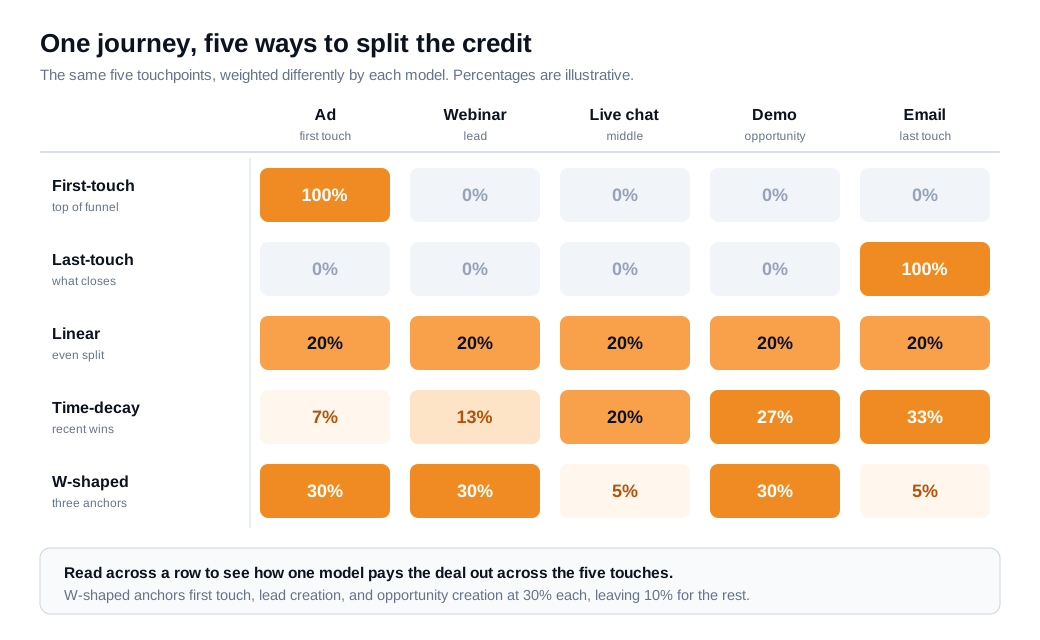
- W-shaped attribution, common in B2B because pipeline is the currency, adds a third anchor. The Pedowitz Group describes it as 30 percent each to first touch, lead creation, and opportunity creation, with the last 10 percent spread across everything else.
Full-path and algorithmic models extend the idea further, either adding a fourth anchor at closed-won or letting software learn the weights from your own data.
No model is objectively correct. Each answers a different question, and the honest move is to pick one primary model that matches how you sell, then read the others as second opinions rather than switching between them to flatter a channel.
How do you attribute across touchpoints?
You attribute across touchpoints by capturing every interaction, stitching those interactions to one buyer and one deal, and then applying your chosen model to divide the credit. Three jobs, and all three have to work or the report lies.
- Capture comes first. Tag every campaign link with UTM parameters (source, medium, campaign), write those values into hidden form fields and dedicated CRM fields so they survive from click to contact record, and log the offline and human touches your pixels never see, from a demo to a phone call to a "how did you hear about us" answer.
- Identity resolution comes next. You stitch anonymous sessions to a known contact once they convert, and you tie each contact to the account and the opportunity, because in B2B the credit belongs to a buying group, not one email address.
- Only then do you apply the model, within an attribution window that defines how far back a touch can still earn credit.
Here is a worked example. A $40,000 deal touches five stages: the buyer clicks a paid search ad, registers for a webinar (lead creation), opens a live chat on your pricing page, books a demo (opportunity creation), and finally replies to a proposal email.
- First-touch hands the entire $40,000 to paid search.
- Last-touch hands all of it to the proposal email.
- Linear splits it evenly, $8,000 to each of the five touches.
- W-shaped gives 30 percent each to the ad, the webinar, and the demo ($12,000 apiece), then splits the remaining 10 percent between the chat and the email ($2,000 each).
Same deal, same touches, and paid search swings from $40,000 of credit to $12,000 to nothing at all, depending only on the rule you chose.
That swing is exactly why the model has to be settled before anyone reads the report, and why comparing two periods only means something when both ran on the same model and the same window.
What is the difference between sourced and influenced pipeline?
Sourced pipeline credits the one channel that created a net-new opportunity, while influenced pipeline credits every channel that touched a deal at any point before it closed.
They sound similar and they answer completely different questions, which is why confusing them starts most of the attribution fights between marketing and sales.
Sourced pipeline runs on first-touch mechanics and behaves like a budget metric: it tells you which channels bring in opportunities you would not otherwise have. Influenced pipeline runs on multi-touch mechanics and tells you which channels helped move deals along, including ones that sales originated.
The team at Metadata frames them as two correct answers to two different questions, and notes the usual pattern: marketing directly sources roughly 20 to 40 percent of pipeline while influencing a far larger 60 to 80 percent of deals.
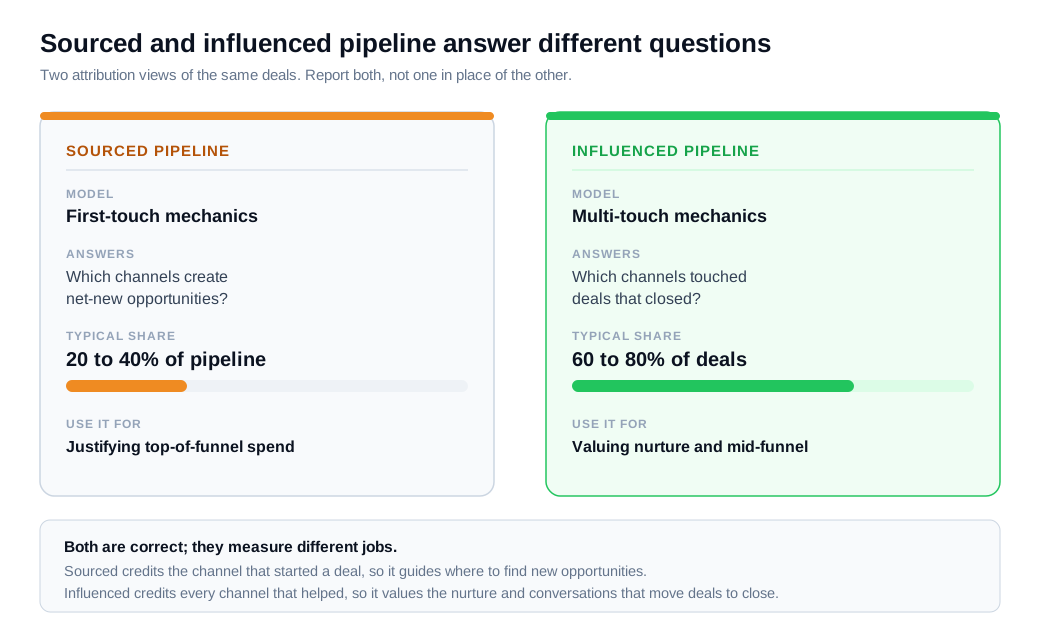
Report both, side by side. Judge a top-of-funnel channel on sourced pipeline and a nurture or mid-funnel program on influence, and the two numbers stop competing and start describing different parts of the same journey. Pick only one and you either erase the channels that start deals or the channels that finish them.
How do you use attribution to allocate budget?
You use attribution to allocate budget by ranking channels on the revenue they actually produce per dollar spent, then moving money toward the channels with the best marginal return and away from the ones that have stopped scaling. The metric that matters here is marginal return, not the headline average.
The distinction is easy to miss and expensive to ignore. Average return on ad spend tells you how a channel performs overall. Marginal return tells you what the next dollar is likely to earn, and it usually falls as spend rises, because early budget reaches the most receptive buyers and later budget fights for more expensive attention.
A channel can look like your best performer on average and still be the worst place to put the next dollar.
Work an example. Channel A returns $5 for every $1 spent at its current level, an average that looks unbeatable. Push its budget from $10,000 to $20,000 and revenue climbs from $50,000 to only $65,000, so the extra $10,000 earned $15,000, a marginal return of 1.5.
Channel B averages a lower $4 per dollar, but lifting it from $10,000 to $20,000 grows revenue from $40,000 to $70,000, a marginal return of 3.0. The next $10,000 belongs in Channel B, even though Channel A wins on the average.
Guidance from Wizaly makes the same point: shift spend toward channels with room to scale and trim the ones that have saturated, using attributed revenue rather than clicks as the input.
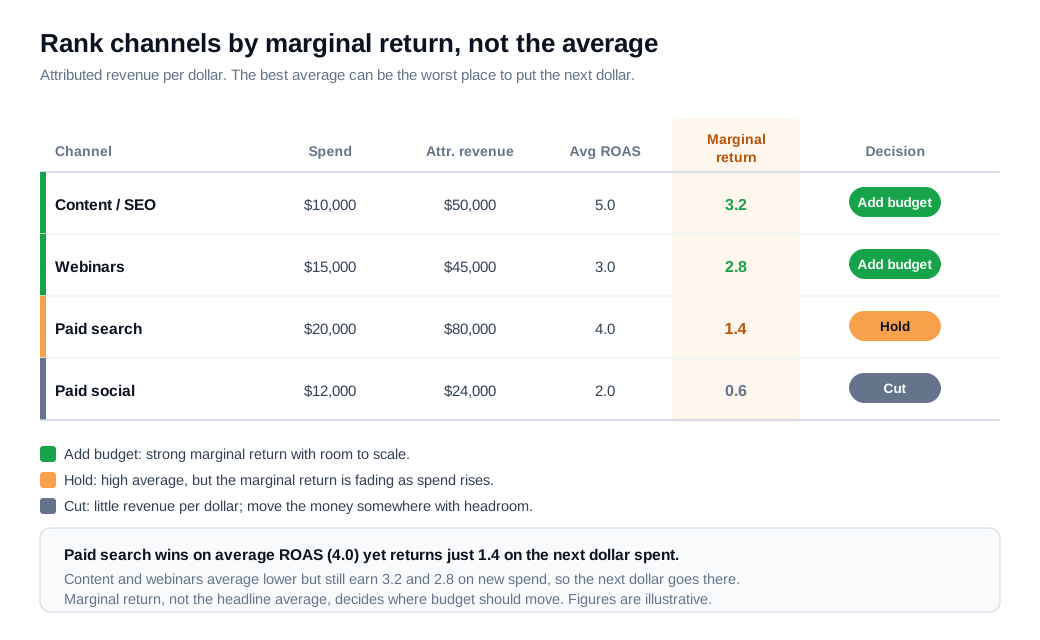
One caution before you cut. A channel can convert poorly at last touch and still start the journeys that close elsewhere, so check its first-touch and influenced numbers before you zero it out. Rebalance in steps rather than all at once, retest, and revisit quarterly, because the marginal returns drift as campaigns, creative, and seasons change.
What mistakes distort sales attribution?
The most common mistake is trusting last-touch attribution on its own, which overcredits the bottom of the funnel and starves the awareness work that filled it. It rewards the demo request and the branded search while making the article, the podcast, and the referral that started everything look worthless.
Four more traps recur:
- The dark funnel is the biggest. A large share of B2B touches happen in places no tracker sees, from peer Slack groups to review sites to a forwarded email, so a self-reported "how did you hear about us" field is worth adding as a cross-check.
- Switching models between quarters makes every channel look like it improved or collapsed for reasons that have nothing to do with performance.
- Judging a channel on a handful of deals turns random luck into a budget decision, so wait for a meaningful sample before you act.
- Failing to stitch contacts to accounts scatters the credit for one buying group across several unlinked records, which quietly understates the channels that reach committees.
Real-time conversations are one of the touches teams most often lose. When a high-intent visitor opens a live chat on your pricing page, that exchange is a genuine, high-value touchpoint, and it belongs in the record like any ad click or email.
Logging it, routing it to the right rep, and firing the routing and notifications that tie the conversation back to the contact keeps it from vanishing from your attribution.
For inbound sales teams, the fast reply and the clean data are two halves of the same job: the conversation wins the deal, and the logged touchpoint proves which source sent the buyer who had it.
Key takeaways
- Sales attribution assigns revenue credit to touchpoints, connecting each closed deal back to the ads, content, and conversations that produced it so you measure dollars rather than activity.
- B2B is what makes attribution necessary, because Forrester counts 27 interactions per buying cycle and Gartner counts 6 to 10 stakeholders, far more than any gut call can track.
- The model is the rule that pays out, with single-touch models crediting one interaction and multi-touch models such as linear, time-decay, U-shaped, and W-shaped spreading credit across the journey.
- The model changes the answer, since the same $40,000 deal can hand paid search $40,000, $12,000, or nothing depending only on which model you picked.
- Sourced and influenced pipeline answer different questions, so report both: sourced shows which channels create opportunities, influenced shows which channels help close them.
- Allocate on marginal return, not the average, moving the next dollar toward channels with room to scale, checking first-touch contribution before cutting, and rebalancing in steps each quarter.
TAGS

Written by
Daniel SemeckyCo-founder & CEO
Daniel is the co-founder and CEO of Glimpze. He spends his days talking to revenue teams about how to catch high-intent visitors before they bounce, and writes about inbound sales, lead conversion, and building a motion where marketing and sales actually share a number.


