
On this page
A sales rep opens a fresh lead and sees one line: an email address. No company, no title, no way to tell whether this is a buyer with budget or a student writing a term paper. So the rep does what most reps do. They burn ten or fifteen minutes on Google and LinkedIn piecing together who this person is before they even decide whether the lead is worth a call.
Multiply that by every name in the queue and you have found where a lot of selling time quietly goes. Enrichment is the fix for the specific version of that problem where the record is too thin to act on: it fills in the missing context automatically, before a human ever has to go looking.
This guide defines lead enrichment, explains why it matters, breaks down the data it adds, walks through how the process runs, shows how enriched data sharpens routing and scoring, compares the tools that automate it, and closes with a worked example in real numbers.
What is lead enrichment?
Lead enrichment is the process of adding verified third-party and first-party data to a lead record, so a thin entry (often just a name or email) becomes a complete picture of who the person is, what company they work for, and whether they deserve a rep's time. Cognism describes it as filling the gaps in your existing records with accurate, current detail, either at the moment a lead is created or in bulk across a whole database.
The starting point is almost always incomplete. A visitor fills in a short form with an email, or a chat widget captures a first name, and that fragment lands in the CRM. Enrichment appends the rest: the company and its size and industry, the person's job title, the tools they run, and signals about whether they are actively researching a purchase.
Two ideas separate enrichment from a simple data import. It works from an identifier you already hold rather than from a list you bought, and it keeps running, refreshing records as people change jobs and companies grow. The output is a record a rep can qualify at a glance instead of a name they have to investigate.
Why does lead enrichment matter?
Lead enrichment matters because the data in most B2B systems is both incomplete the moment it arrives and decaying every month after, which quietly breaks routing, scoring, personalization, and follow-up. A record that looks fine today is often wrong by next quarter.
Data decay is the core problem. B2B contact data goes stale at roughly 22.5 percent a year, about 2.1 percent a month, and the main driver is ordinary human movement: Landbase's compilation of decay research reports that around 70 percent of business contacts change roles, companies, or responsibilities within twelve months. A database you cleaned in January is meaningfully wrong by summer, and nobody sends a memo when a champion switches jobs.
Incomplete data is the other half, and the cost of it lands on the rep. Salesforce's State of Sales research found sellers spend under 30 percent of their time actually selling, with manual research and CRM upkeep eating large chunks of the rest. Every field enrichment fills automatically is a field a human does not have to hunt down.
There is a conversion angle too. Long forms are where sign-ups go to die: Chili Piper's write-up on form shortening notes that removing a single field can lift click-through by around 26 percent, and B2B forms with more than five fields tend to convert worse than shorter ones. Enrichment lets you ask a visitor for an email, then fill in company, size, and title behind the scenes, so you collect a short form and still hand sales a full profile.
What data does lead enrichment add?
Lead enrichment adds four broad layers of data: firmographic (the company), technographic (its tech stack), intent and behavioral (buying signals), and contact and role data (how to reach the actual decision maker). Vendors slice these further, but the four layers cover what a sales team needs to qualify and personalize.
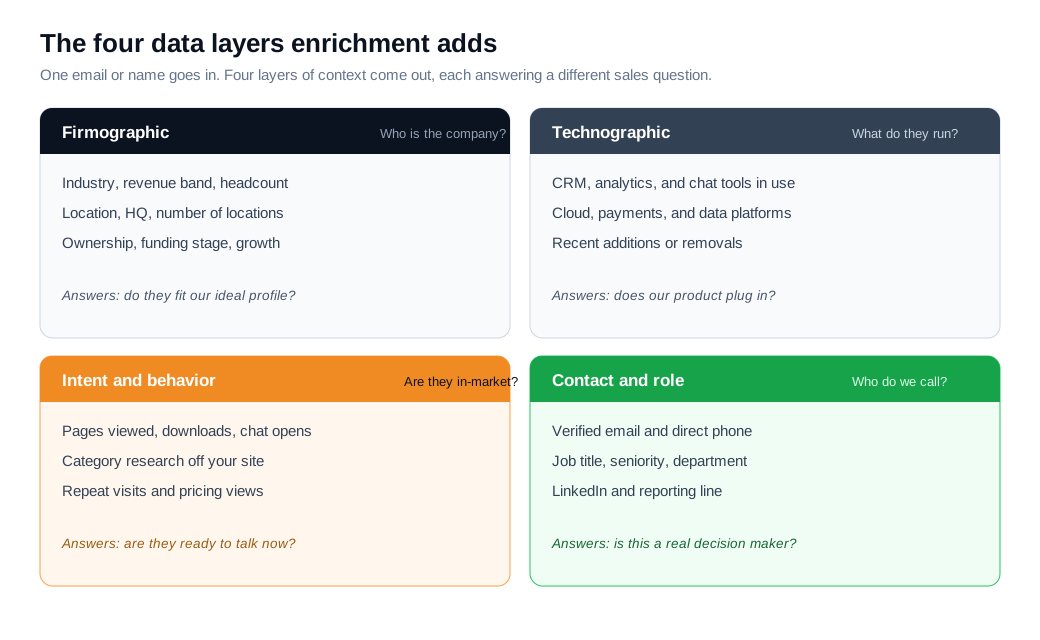
Firmographic data describes the company: industry, revenue band, employee count, location, ownership, and funding stage, as Factors.ai lays out in its enrichment breakdown. It answers the first question any rep asks, which is whether this account even fits who you sell to.
Technographic data describes what the company runs. Knowing a prospect already uses Salesforce, Segment, or a competing chat tool tells you whether your product plugs into their stack or replaces something in it, per Smartlead's rundown of enrichment data types. For a lot of software companies, one technographic field predicts fit better than any other.
Intent and behavioral data describes what the person is doing right now. On-site behavior (pages viewed, pricing visits, chat opens) plus off-site category research signal whether someone is in-market or just browsing. This is the layer that decays fastest and matters most for timing, because intent from three weeks ago tells you little about today.
Contact and role data describes who you are actually dealing with. A verified email, direct phone, job title, seniority, and department turn a generic address into a named decision maker, or flag that you are talking to an intern. Accuracy here varies by provider, which is why teams check match rates before they commit.
How does lead enrichment work?
Lead enrichment works by taking one identifier you already have (an email, a domain, or a company name), matching it against one or more data providers, and writing the returned fields back into your CRM, either in real time as the lead arrives or in scheduled batches across your database. The two modes solve different problems.
Real-time enrichment fires the moment a lead is created. A visitor submits a form, and within a second or two the record is filled with company, size, title, and a score, before the lead ever reaches a rep. This is what makes short forms and instant routing possible in the first place.
Batch enrichment runs on a schedule against records you already hold. It re-verifies emails, updates job titles after people move, and fills gaps in old leads, which is how you fight the monthly decay rate instead of letting the database rot in place.
Under the hood, most providers use a waterfall. They check the highest-quality source first, and if it returns nothing, they fall through to the next, and the next, until a field is filled or the options run out. Tools like Clay built their whole product around this approach, chaining dozens of sources so match rates stay high.
Two cautions apply in practice. Match rates are never 100 percent, so plan for records that stay partial no matter how many sources you chain. And under GDPR and similar rules you need a lawful basis to enrich and store personal data, which is why European teams lean toward compliance-first providers.
How does enrichment improve lead routing and scoring?
Enrichment improves routing and scoring by giving both systems the fields they need to make good decisions, because a lead you cannot describe is a lead you cannot score or route correctly. Scoring ranks leads by fit and intent, routing sends them to the right person fast, and both fall apart on empty records.
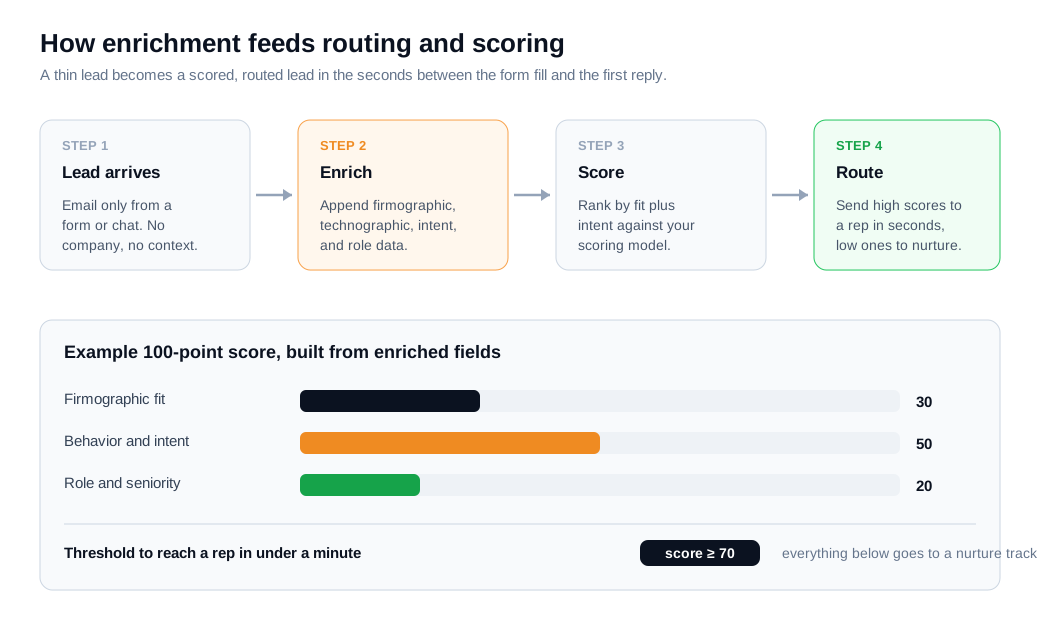
Scoring is the first beneficiary. A common model spreads 100 points across firmographic fit, behavioral intent, and role, then sets a threshold that flags the top slice as sales-ready. Compiled lead-scoring research links formal scoring to better ROI, and none of those points can be assigned without enriched fields to grade. A record with no company and no title cannot clear any threshold, so it sits in a queue unread while a good lead goes cold.
Routing is the second. Once a lead is scored, enriched fields decide where it goes: by territory, by company size, by industry, or straight to a named account owner. A high score can trigger instant assignment while a low score drops into a nurture track. Doing this well needs routing and notifications that fire the second a qualified lead appears, since the value of a good score collapses if it waits in an inbox.
Speed is why the whole chain matters. The classic Lead Response Management study of more than 15,000 leads found firms that reply within five minutes are far likelier to qualify a lead than those who wait, yet compiled response-time data shows only about a quarter of B2B companies hit that mark. Enrichment is what lets you score and route in the few minutes you have, rather than losing them to manual lookup. On a high-intent page, pairing that with live chat means a scored, enriched visitor can reach a rep while they are still on the site.
What tools automate lead enrichment?
The tools that automate lead enrichment fall into a few camps: broad B2B databases like ZoomInfo, budget-friendly all-in-ones like Apollo, compliance-first providers like Cognism, workflow builders like Clay, and CRM-native layers like Clearbit (rebranded Breeze Intelligence inside HubSpot). Most teams run one core provider plus whatever their CRM offers natively.
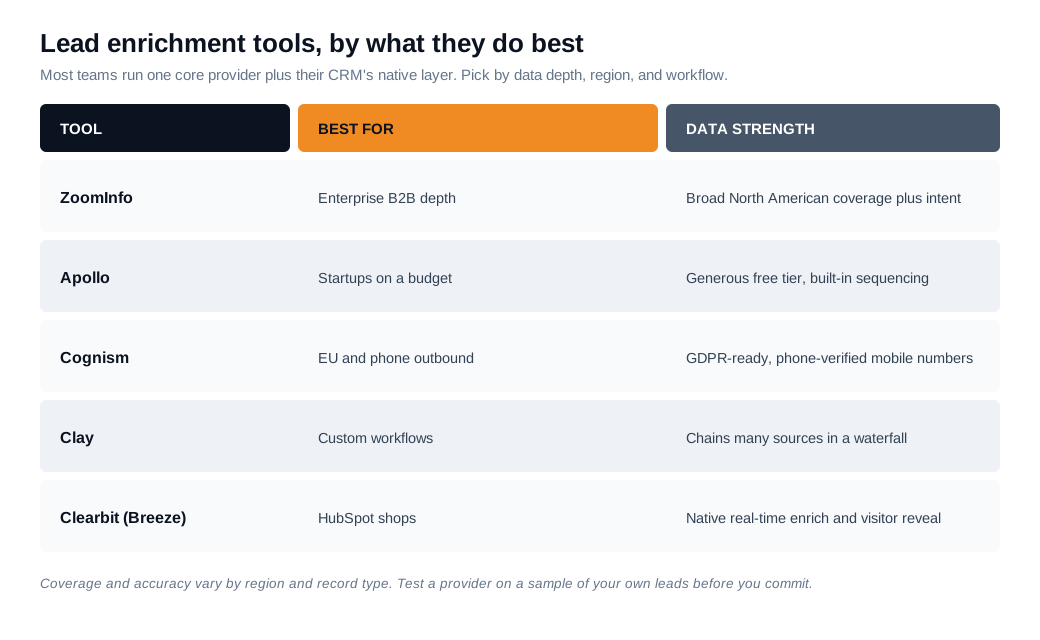
ZoomInfo is the enterprise default, with deep North American coverage and an intent layer on top, according to enrichment-tool comparisons. It is the heavyweight pick when database depth matters more than price.
Apollo pairs a large contact database with a generous free tier and built-in sequencing, which makes it a common first choice for startups. Cognism leans into European coverage and phone-verified mobile numbers, so teams doing GDPR-sensitive or phone-heavy outbound tend to favor it, per compiled tool rankings.
Clay took a different route and became a workflow layer that chains many providers into a single waterfall, so you are not locked to one source's coverage. Clearbit, acquired by HubSpot and rebranded as Breeze Intelligence, is the path of least resistance for HubSpot shops that want real-time enrichment and visitor identification without wiring up a separate tool.
The selection rule is dull but reliable. Match the provider to your region, your record type (email versus phone), and your workflow, then test it on a sample of your own leads before you sign anything. Accuracy claims vary widely, and the only number that counts is the match rate on your data.
What does lead enrichment return in numbers?
Here is a worked example that ties enrichment to pipeline. Say a B2B software company captures 600 leads a month through forms and chat, and today each lead arrives as a bare email with no company or title attached.
Without enrichment, reps triage by hand. Suppose they average ten minutes researching each lead before deciding whether to act. That is 100 hours a month of pure lookup work, and because it is slow, most leads wait hours for a first touch. If 20 percent are genuinely good-fit and only half of those get a timely response, the team works about 60 hot leads well and lets the rest drift.
Now add real-time enrichment. Every one of the 600 leads arrives with company, size, title, tech stack, and an intent-based score already attached, so the 100 hours of manual research falls toward zero. Scoring flags the same 20 percent (120 leads) as high-fit automatically, and because they are scored the instant they land, routing pushes them to a rep in under a minute while interest is live. If timely response now reaches 90 percent of those 120 leads instead of half, the team works about 108 hot leads well, nearly double the earlier 60, from the same raw volume.
The gains compound at the edges. Shorter forms lift capture, so the top of the funnel widens too, and cleaner records mean fewer misrouted leads sitting in the wrong rep's queue. Treating the site as an inbound sales channel, where enriched, high-scoring visitors reach a human immediately, turns speed-to-lead from an aspiration into the default. None of it requires more traffic or more ad budget. It requires knowing who each lead is before you decide what to do with them.
Key takeaways
- Lead enrichment fills thin records with verified data, so a bare email becomes a complete profile of the company, role, tech stack, and intent behind it.
- The problem it solves is real and constant. B2B contact data decays around 22.5 percent a year, and reps lose most of their week to research and admin on incomplete records.
- Four data layers do the work: firmographic fit, technographic stack, intent and behavior, and verified contact and role, each answering a different qualifying question.
- Enrichment is the fuel for scoring and routing. You cannot score or route a lead you cannot describe, and empty fields leave good leads sitting unread.
- Shorter forms plus enrichment win. Ask a visitor for an email, fill in the rest behind the scenes, and capture more leads without losing data quality.
- Pick tools by region, record type, and workflow, then judge them on the match rate against your own leads rather than on headline accuracy claims.
TAGS

Written by
Daniel SemeckyCo-founder & CEO
Daniel is the co-founder and CEO of Glimpze. He spends his days talking to revenue teams about how to catch high-intent visitors before they bounce, and writes about inbound sales, lead conversion, and building a motion where marketing and sales actually share a number.


