
On this page
- What is webinar lead generation?
- Why do webinars generate quality leads?
- How do you promote a webinar for registrations?
- How do you convert attendees into pipeline?
- How do you qualify and score webinar leads?
- How do you measure webinar ROI?
- What does the webinar lead math look like end to end?
- Key takeaways
- Sources
A good webinar does something a landing page cannot. It gets a few hundred people to block an hour on their calendar, show up, and listen to you talk about the exact problem you solve. That hour of attention is the raw material most lead-generation channels never get.
Attention alone is not pipeline, though. Registrations sit in a spreadsheet, half the room never shows, and the recording gets emailed once and forgotten. The teams that treat a webinar as a lead engine, instead of a one-off event, are the ones that turn that hour into meetings and revenue.
This guide covers what webinar lead generation actually is, why webinars produce higher-quality leads than most channels, how to promote one so people register and show up, how to convert attendees into pipeline, how to score the leads you get, and how to measure the return so you can prove the program works.
What is webinar lead generation?
Webinar lead generation is the practice of using a live or on-demand online presentation to attract prospects, capture their details when they register, and move the people who attend toward a sales conversation. The registration form is your lead capture. The session itself doubles as qualification and nurture, because you learn who shows up, who stays, and who asks the pointed questions. The follow-up is where a warm attendee becomes a pipeline record.
That range is why webinars sit across the whole funnel rather than at one stage. A single session can pull in a net-new audience at the top, educate mid-funnel buyers who are comparing options, and give late-stage prospects a reason to talk to sales. Research from Demand Gen Report describes this full-funnel use of webinars among B2B marketers, and a joint State of Webinar Marketing study it published with ON24 found that around 97 percent of B2B marketers now rate webinars as critical or very important to their strategy.
Live and on-demand play different roles. Live sessions carry the intent, since the audience shows up at a set time and interacts in real time. On-demand extends the reach after the fact, and Contrast's benchmark data finds that about 42 percent of total webinar views come from the replay. A program that records every live session and gates the replay keeps generating leads long after the event ends.
Why do webinars generate quality leads?
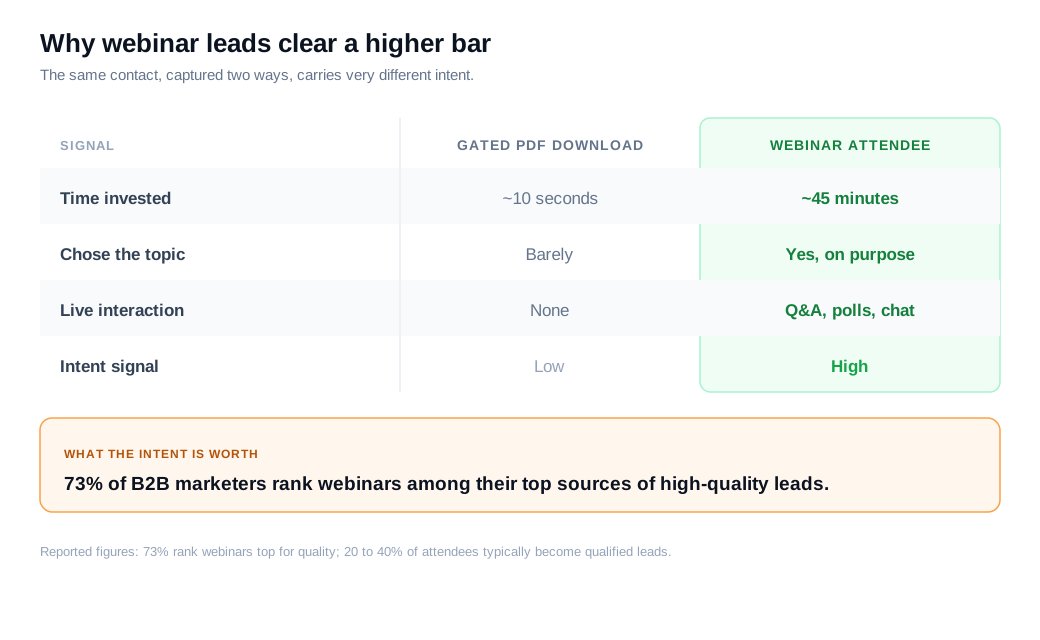
Webinars generate quality leads because attending one is a costly signal: a prospect gives up an hour of a workday to hear about a specific problem, and that time investment filters for real intent in a way a form fill never does. Someone who downloads a PDF spends ten seconds and a throwaway email address. Someone who registers, blocks the time, and shows up has told you the topic matters to them.
The session then sharpens the signal. Live Q&A, polls, and chat surface who is actively wrestling with the problem, and each of those interactions is a qualification cue you can act on later. Martal's analysis of webinar programs reports that 73 percent of B2B marketers rank webinars among their top sources of high-quality leads, and that 20 to 40 percent of attendees typically become qualified leads in the pipeline. Few channels turn raw audience into sales-ready contacts at that rate.
Treating those attendees as an inbound sales audience, rather than names to drop into a newsletter, is the mindset that keeps the quality intact. The intent runs highest during the hour they spend with you, and it fades from there, so the value of a webinar lead is tied to how quickly you act on it.
How do you promote a webinar for registrations?
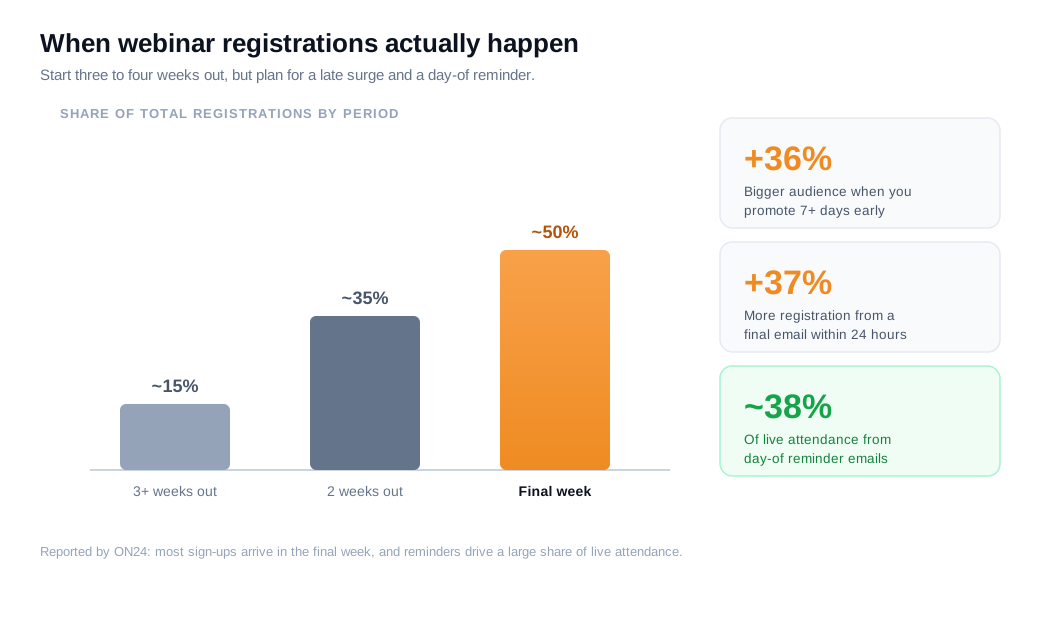
You promote a webinar for registrations by starting three to four weeks out, emailing your own list first, and saving the heaviest push for the final week, when roughly half of all sign-ups actually land. ON24's guidance on webinar promotion notes that most registrations arrive in the week before the event, so a plan that peaks early and then goes quiet is aimed at the wrong window.
Email does most of the work. A short sequence of three to four sends (an announcement, one or two reminders, and a day-of email) covers the calendar without fatiguing the list. ON24 reports that promoting more than seven days ahead can grow the audience by about 36 percent, that a final email within 24 hours of the start can lift registration by roughly 37 percent, and that day-of reminders drive close to 38 percent of live attendance. Skip the reminder and you skip more than a third of your room.
The registration page decides how much of that traffic converts. Contrast's benchmark data from more than a million registrants shows registration pages converting as high as 59 percent, against a rough 30 percent average, and the gap is mostly friction: a short form, a clear promise of what the attendee will learn, and no fields you do not need. Your own site, LinkedIn, and any partners or speakers work as amplifiers, but the email list and the page are the core, because a first-party list already knows you and converts far better than cold traffic.
How do you convert attendees into pipeline?
You convert attendees into pipeline by following up within 24 hours, segmenting by how each person engaged, and routing the hottest attendees to a rep or a booked meeting before the interest cools. The day after a webinar is when attendees still remember why they signed up, and a slow, generic "thanks for attending" wastes it.
Engagement predicts conversion, so the follow-up should not be one email to everyone. ProperExpression's work on post-webinar programs finds that highly engaged attendees convert to sales conversations at 12 to 15 percent, while passive attendees convert at 3 to 5 percent. The person who asked three questions deserves a different message from the person who left after five minutes. Send the recording to everyone, then give the engaged segment a specific next step, usually a demo or a call, while the rest go into nurture.
Speed and routing carry the handoff. When an engaged attendee clicks back to your pricing or product page, meeting them there with live chat turns a warm memory into a live conversation instead of another form. A routing and notifications setup that pings the right rep the moment a known attendee returns keeps the fastest follow-up from depending on someone refreshing a spreadsheet. When a question is easier to show than to type, escalating to a live video call or screen share lets a rep demo the answer and book the next step in the same session, and an AI assistant can field the first questions after hours so a late-night attendee still gets an answer.
How do you qualify and score webinar leads?
You qualify and score webinar leads by weighting the engagement signals from the session, so an attendee who asked a question, stayed 45 minutes, and clicked your offer scores far above a registrant who never appeared. Attendance alone is a weak filter, because a registration only tells you the topic was interesting enough to sign up for.
Build the score from tiers. Published guidance on scoring webinar leads puts high-intent signals (asking a question, clicking a call to action, watching most of the session, booking time) above mid-intent signals (poll responses, moderate watch time), which in turn sit above low-intent ones such as a no-show or a two-minute drop-off. Feed that score into your CRM so sales works the high-intent tier first while the interest is fresh, and send the lower tiers into automated nurture rather than a rep's day. The goal is to spend rep time where the session already showed intent, not to chase every name on the list equally.
How do you measure webinar ROI?
You measure webinar ROI by dividing the pipeline or revenue a webinar produced by everything it cost, then tracking the funnel metrics that explain the number. ON24's framework for calculating webinar ROI starts with total cost: the platform prorated per event, promotion, production, and the team hours that went into building and running it. Set that against output and the formula is pipeline or revenue minus cost, divided by cost, times 100.
Measure two kinds of pipeline. Webinar-sourced pipeline is the deals a webinar created as a first touch. Webinar-influenced pipeline is the larger set of deals where an attendee touched a webinar somewhere in the cycle, and tracking both sourced and influenced pipeline keeps you from underselling a channel that assists more deals than it starts outright. Cost per lead is the fast sanity check: reported webinar figures cluster around 72 dollars per lead, well below the 800-plus dollars common at trade shows.
Watch the funnel metrics that move ROI rather than the vanity ones. Registrations, attendance rate, qualified-lead rate, and sales conversations tell you where the program leaks; email opens and clicks do not. Format matters here too, since Contrast finds that 90-minute webinars hold 67 percent live attendance while 30-minute ones average 44 percent. If your attendance sits at the low end of the 44 to 50 percent benchmark, the fix is promotion and reminders. If attendance is healthy but few attendees convert, the fix is the follow-up.
What does the webinar lead math look like end to end?
Here is a single webinar run all the way through, with benchmark-anchored ratios and illustrative costs, so the levers are easy to see. Start with 400 registrants pulled from an email list and a landing page. At a 45 percent live attendance rate, near the middle of the benchmark, 180 people show up.
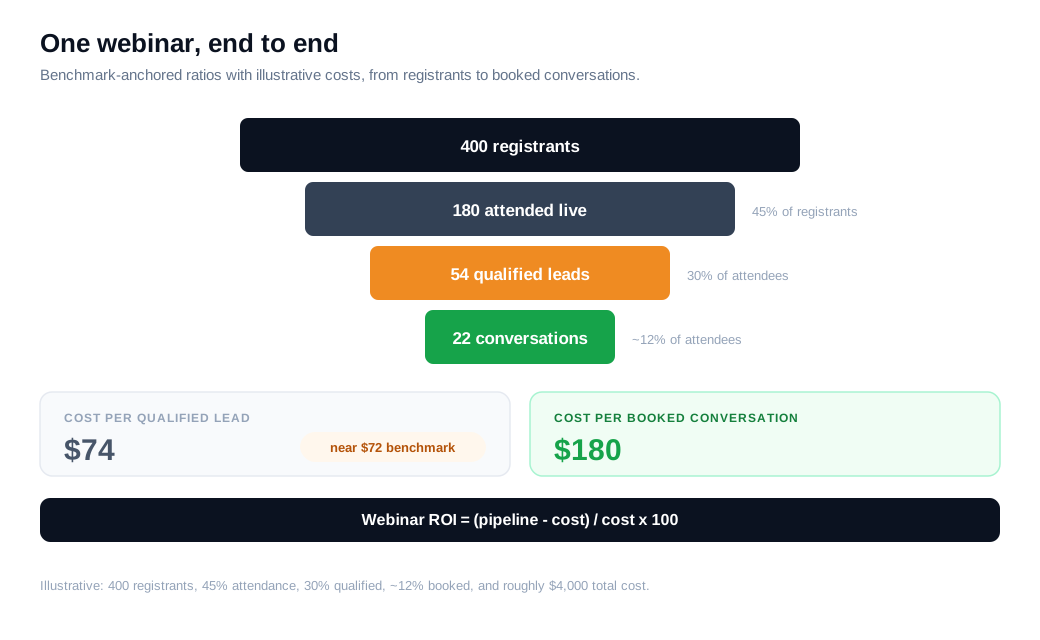
Of those 180 attendees, apply the lower end of the qualified-lead range, 30 percent, and 54 become qualified leads worth a rep's time. Apply the engaged-attendee conversion rate of roughly 12 percent, and about 22 of them book a real sales conversation in the days after. If the whole webinar (platform, promotion, and team time) cost around 4,000 dollars, that works out to a cost per qualified lead near 74 dollars, right on the reported benchmark, and a cost per booked conversation of about 180 dollars.
From there the revenue math is your own. If those 22 conversations close at a 20 percent rate, the webinar sources roughly four deals, and any deal where an attendee appeared later in the cycle counts as influenced pipeline on top. The registrations you did not convert still have value: they are a warm list for the next session and a segment for nurture. The lever, as with any funnel, is how much of that early intent you capture before it fades, which is why speed of follow-up matters more than the size of the audience.
Key takeaways
- Webinars filter for intent: an hour of a prospect's time is a costly signal, which is why 73 percent of B2B marketers rank webinars among their best sources of high-quality leads.
- Weight promotion toward the final week: about half of registrations land in the last seven days, so a day-of reminder and a last-24-hour email protect more than a third of your attendance.
- Follow up by engagement, fast: highly engaged attendees convert at 12 to 15 percent versus 3 to 5 percent for passive ones, so segment the follow-up and route hot attendees within a day.
- Score the session, not the sign-up: weight questions, watch time, and clicks so sales works the high-intent tier first and nurture handles the rest.
- Measure sourced and influenced pipeline: track both against total cost, keep cost per lead near the 72-dollar benchmark in view, and favor pipeline over email opens.
- Capture intent before it fades: the day after a webinar is when attendees are warmest, so a short path from watching to talking is where the pipeline is won.
TAGS

Written by
Daniel SemeckyCo-founder & CEO
Daniel is the co-founder and CEO of Glimpze. He spends his days talking to revenue teams about how to catch high-intent visitors before they bounce, and writes about inbound sales, lead conversion, and building a motion where marketing and sales actually share a number.


