On this page
A ticket comes in on a Tuesday about a report that will not export. A frontline agent tries the usual fixes, none of them land, and by Thursday the same customer is emailing your VP with the subject line "still broken."
What started as a routine question is now a relationship problem, and everyone who touches it feels the temperature rise.
That moment is an escalation, and how a team handles it decides whether the customer walks away angrier or ends up more loyal than before the failure.
The teams that do this well are not calmer under pressure by luck. They run a defined process that decides where a problem goes, who owns it, how often the customer hears from them, and what gets fixed so it never comes back.
This post covers what a customer escalation is, the main types you will see, how to triage them by impact and urgency, how to communicate while the pressure is on, how to prevent repeat escalations, and how to measure whether your handling is getting better.
What is a customer escalation?
A customer escalation is a support issue that gets moved to someone with more skill, more authority, or more urgency than the person who first received it, because the current path is not going to resolve it in time.
The trigger is a gap: the frontline agent lacks the technical context, the permission, or the standing to close the issue, so it has to travel to reach someone who can.
Escalations happen for a small set of reasons. The problem is too technical for tier one, the fix requires a policy exception only a manager can grant, an SLA clock has run out, or the customer is upset enough that keeping them means putting a senior person on the line.
As Intercom describes it, an escalation most commonly starts when first-level agents cannot solve the issue to the customer's satisfaction, and it exists to route the problem to the person with the right skill in the shortest time possible.
An escalation is different from a hard ticket. Plenty of complex issues get solved at tier one without ever escalating. What makes something an escalation is the handoff, the deliberate decision to change who is responsible because the original owner cannot finish the job.
Treating that handoff as a defined step, rather than a panic move, is the whole game.
What are the main types of customer escalation?
Customer escalations come in three shapes, and knowing which one you are dealing with tells you where the ticket needs to go. Zendesk's escalation guide names them as functional, hierarchical, and automated, and most real escalations are one of these or a blend of two.
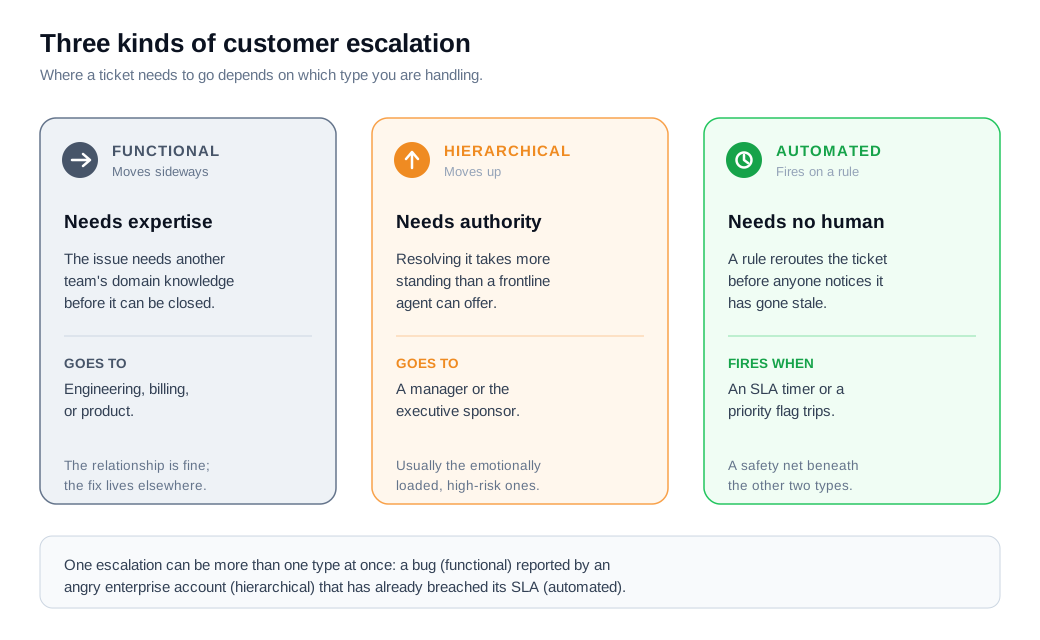
A functional escalation moves sideways. The issue lands with support, but resolving it needs another team's domain knowledge, so it goes to engineering for a bug, to billing for a disputed charge, or to product for a missing capability. The customer's relationship with you is fine; the problem simply lives outside support's reach.
A hierarchical escalation moves up. Resolving it needs more authority than a frontline agent has, usually because the situation carries real risk: a churn threat, a legal angle, a demand for a refund outside policy, or a customer who has asked for a manager by name.
These are the emotionally loaded ones, and they need a person who can make a decision and speak for the company.
An automated escalation fires on a rule. When a ticket sits past its SLA target or a priority flag gets set, the system reroutes it without waiting for a human to notice.
Automated escalation is a safety net under the other two, catching the ticket that would otherwise go stale in a queue nobody is watching.
How do you triage escalations?
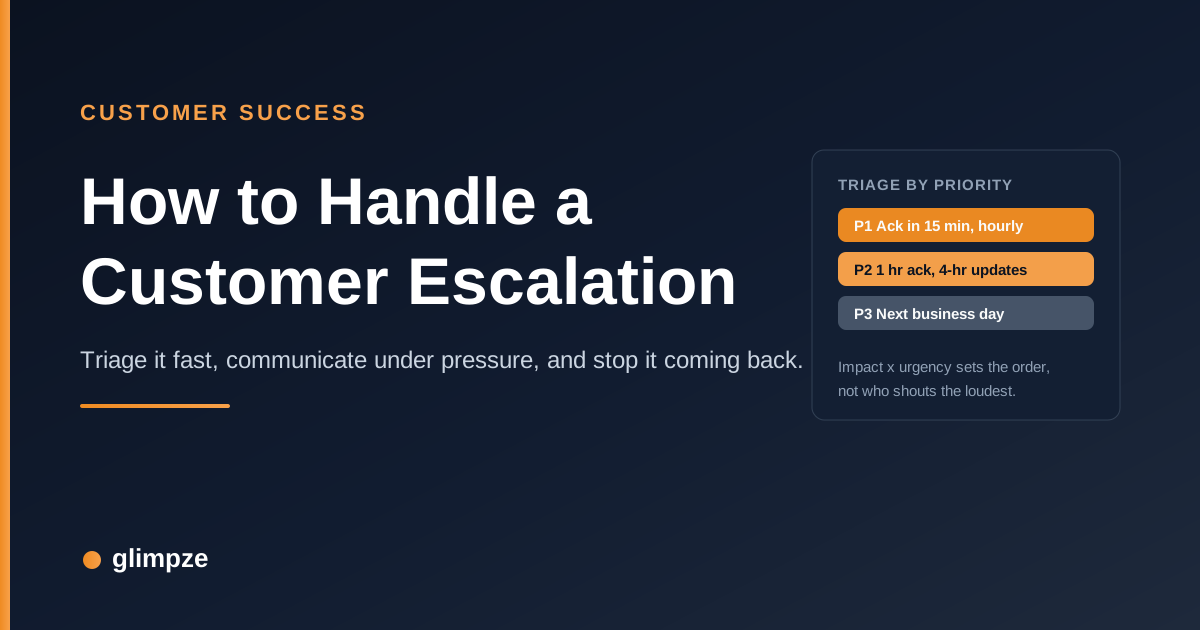
You triage escalations by scoring each one on impact and urgency, assigning a priority level, and attaching a response and update cadence to that level, so the loudest ticket does not automatically jump ahead of the most damaging one.
Impact is how much harm the issue does and to how many people. Urgency is how fast that harm grows. The two together set the priority.
A simple grid does the sorting. High impact and high urgency is a P1, the kind that pulls people off other work immediately. High impact with lower urgency, or a broad but tolerable problem, is a P2. A narrow, low-stakes issue is a P3 or P4 that can wait for the normal queue.
Defining impact and urgency in measurable terms, such as the number of affected users or dollars at risk, keeps the scoring honest instead of leaving it to whoever complains hardest.
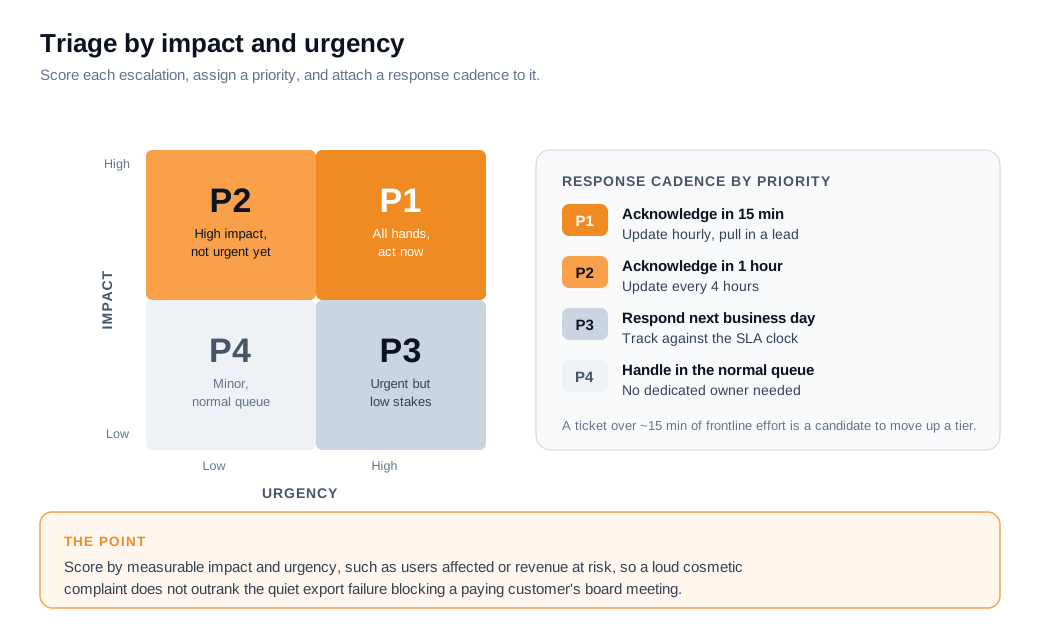
Each priority level carries its own promise. A P1 might mean acknowledge within 15 minutes, pull in a lead, and update every hour until it is fixed. A P2 might mean acknowledge within an hour and update every four hours. A P3 gets a next-business-day response.
Publishing those targets does two things: it tells the customer what to expect, and it stops agents from guessing under pressure.
Wiring the routing so a P1 reaches a named owner the moment it is flagged, through a Slack alert or an assigned task, is what a lead routing and notifications setup is for, because a priority nobody sees is the same as no priority at all.
Here is a worked week. A team logs six escalations. One is a loud email from a small account whose logo color rendered slightly off, written in all caps. Another is a quiet ticket from a mid-market account whose data export silently fails the day before their board meeting.
On volume of complaint, the color issue feels bigger. On impact and urgency, the export failure is the P1, because it blocks a high-stakes deadline for a paying customer, while the color complaint is a P3.
Triage by the grid, and the export failure gets a lead and hourly updates while the color fix goes into the normal queue. Triage by who shouts loudest, and you spend your best people on the wrong problem.
As a rough rule, Zendesk suggests that a ticket taking more than 15 minutes of frontline effort is a candidate to move up a tier, and that the deepest tier should handle only 5 to 10 percent of total volume, which is a useful check that you are not escalating everything.
How do you communicate during a customer escalation?
You communicate during an escalation by acknowledging fast, setting a realistic expectation, and then updating on a fixed cadence even when there is nothing new to report, because silence is what turns a frustrated customer into an angry one.
The first message matters most. A quick acknowledgment that a real person owns the problem lowers the temperature before the fix even starts.
Lead with the emotional side, then the technical one. A frustrated customer wants to feel heard before they hear a plan, so acknowledge the impact, take ownership of getting it resolved, and avoid the reflex to defend or explain who is at fault.
The stakes are concrete: Zendesk's research finds that more than half of customers will switch to a competitor after a single bad experience, and roughly 73 percent will after several, with a large share reporting that a bad support experience left them feeling angry. An escalation is exactly the moment that statistic is deciding your revenue.
Cadence beats content when you have no answer yet. Acknowledge a serious issue within minutes, give a first substantive update within the hour, and then keep to a rhythm the customer can count on, a pattern Trengo recommends as acknowledging quickly and sending frequent updates while an issue is open.
A message that says "still working, next update by 3pm" is worth more than a perfect explanation that arrives six hours late.
Meeting the customer live often does what a thread of emails cannot. A live chat session or a quick screen share surfaces the real blocker in minutes and lets the customer see a human working the problem, which is far more reassuring than a status page.
There is also a research reason to stay focused on solving the problem cleanly rather than dazzling the customer: the Harvard Business Review study Stop Trying to Delight Your Customers found that 96 percent of customers who had a high-effort experience became more disloyal, which means the fastest, lowest-effort path to a resolution protects loyalty better than any grand gesture.
Consider the cadence in practice. A P1 outage takes six hours to fix. Handled with an acknowledgment in 15 minutes and an update every hour, the customer stays, and often thanks the team afterward.
The same six-hour outage handled with a five-hour silence reads as neglect, and that is the account most likely to become one of the switchers in the statistic above. Same fix, same timeline, opposite outcome, decided entirely by communication.
How do you prevent repeat escalations?
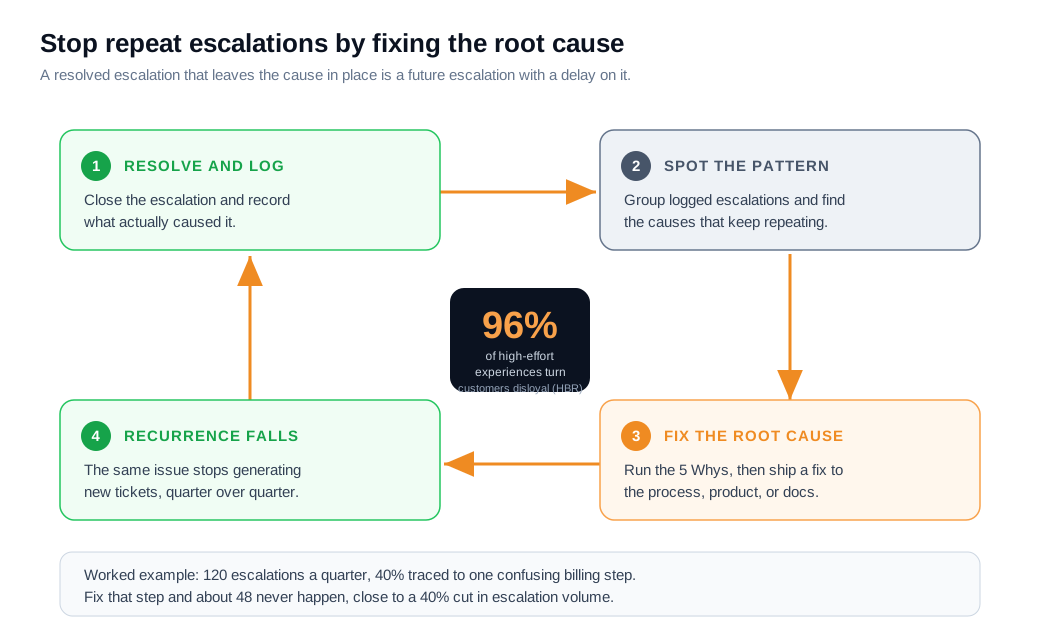
You prevent repeat escalations by treating each one as a defect to investigate, running root cause analysis, and fixing the underlying process so the same issue stops generating new tickets.
A resolved escalation that leaves the cause in place is a future escalation with a delay on it. The save is only half the work.
Root cause analysis is the tool. Rather than stopping at the surface fix, ask why the problem happened, then why that happened, and keep going until you reach a cause you can actually change.
The 5 Whys walks a billing complaint back from "the customer was double-charged" to "the retry logic fires twice on a specific card error," which is a code fix, not a one-off refund. Hiver notes that logging every escalation and looking for patterns in recurring issues, like billing disputes or the same feature confusing new users, is what lets you address root causes before they escalate again.
The highest-leverage prevention move is closing downstream issues before the customer hits them. The same HBR research argues for solving the immediate problem and the next one the customer was about to hit as well, because a customer who has to come back a second time is far more likely to churn.
If an export bug forces a workaround today, tell the customer how to avoid the follow-on problem tomorrow, in the same conversation.
Deflection also prevents escalations by keeping routine issues from ever reaching a queue. A well-tuned AI chat assistant answering the repetitive questions, and a knowledge base that reflects what the last round of escalations taught you, means fewer tickets start on the path that ends in escalation.
Feed each root cause back into training, documentation, and the product, and the pattern shrinks quarter over quarter.
A worked example makes the payoff visible. Say a team logs 120 escalations in a quarter and the analysis shows 40 percent trace to one confusing step in the billing flow.
Redesign that step, and roughly 48 escalations a quarter never happen, which is close to a 40 percent cut in escalation volume from a single fix. That is time your senior people get back, and a cohort of customers who never had the bad experience in the first place.
How do you measure how well you handle escalations?
You measure escalation handling with a small set of numbers tracked as a trend: escalation rate, time to resolution, repeat contact rate, and satisfaction after the fix.
One good week is noise, so the signal lives in whether these move in the right direction across quarters. Watch them together, because any one alone can mislead.
- Escalation rate, the share of tickets that get escalated, tells you whether the frontline is equipped or overwhelmed.
- Time to resolution measures speed once an issue escalates.
- Repeat contact rate, the share of customers who come back about the same problem, is the truest test of prevention, since a falling repeat rate means your root cause work is landing.
- Post-resolution satisfaction, a short CSAT survey after the escalation closes, tells you whether the recovery actually rebuilt the relationship.
That last number can beat expectations. Research on the service recovery paradox finds that a failure recovered exceptionally well can leave a customer more loyal than one who never had a problem at all, an effect documented in a study on service recovery and brand loyalty.
The effect is real but not guaranteed, so it is a reason to handle escalations with care rather than a license to relax, since the same research shows recovery has to clear a high bar to produce it.
Return to the prevention example to see the numbers connect. If the billing-flow fix drops escalations from 120 to about 72 a quarter, and your repeat contact rate on billing issues falls from 18 percent to 6 percent, you have hard evidence that handling the escalations well and fixing their cause changed the outcome.
Pair that with a rising post-escalation CSAT, and you can show leadership that escalation handling is a system that pays back, not a cost center that only ever loses.
Key takeaways
- An escalation is a deliberate handoff, moving a problem to someone with more skill, authority, or urgency because the original path cannot resolve it in time, which makes it a defined step rather than a panic move.
- Know the three types, functional to another team for expertise, hierarchical up the chain for authority and relationship weight, and automated on a rule like an SLA timer, so you route each one to the right place fast.
- Triage by impact and urgency, not volume of complaint, scoring each escalation into a priority level with its own response and update cadence, so the quiet high-stakes issue outranks the loud cosmetic one.
- Cadence beats content under pressure, acknowledging within minutes and updating on a fixed rhythm even with no news, because silence is what turns more than half of customers toward a competitor after a single bad experience.
- Treat every escalation as a defect to investigate, running root cause analysis and closing downstream issues, since fixing one confusing billing step can cut escalation volume by 40 percent and spare a whole cohort the bad experience.
- Measure the trend, not a week, watching escalation rate, time to resolution, repeat contact rate, and post-fix satisfaction together, because a well-recovered failure can leave a customer more loyal than if nothing had gone wrong.

Written by
Nilas MylerCo-founder & CTO, Glimpze
Nilas is the co-founder and CTO of Glimpze, an inbound sales tool that turns high-intent website visitors into live conversations. A former SEO consultant for some of the largest companies in Denmark, he writes about speed-to-lead, inbound sales, and conversion rate optimization — the technical and operational mechanics of turning traffic into pipeline.