
On this page
- Why do high-volume campaigns lower lead quality?
- How do you define lead quality?
- What does poor lead quality actually cost you?
- How does better qualification help?
- How do you balance lead quality and volume?
- What metrics show lead quality is improving?
- What does improving lead quality look like in numbers?
- Key takeaways
- Sources
A marketing team gets handed a lead target, so they widen the nets. Broader keywords, a gated ebook, a lower bid on colder audiences. The lead count climbs and the dashboard turns green. Then sales quietly stops returning the calls, because half the new names are students, tire-kickers, and job seekers who wanted the PDF and nothing else.
That is the trade every growth team eventually hits. Push for more leads and quality slips. Push for quality and the count drops. The trade is real, but it is softer than the dashboard makes it look, because a large share of what passes for volume was never going to buy anyway.
This guide covers why high-volume campaigns dilute quality, how to define lead quality in the first place, what poor quality actually costs, how qualification fixes it, how to hold volume steady while raising quality, and which metrics prove it worked. It closes with a worked example in real numbers.
Why do high-volume campaigns lower lead quality?
High-volume campaigns lower quality because the cheapest way to add more leads is almost always to loosen the filter that was keeping bad-fit people out. Your best-fit audience is finite. Once you have reached most of it, every extra lead comes from a slightly less relevant slice of the market, so the marginal lead is worth less than the one before it.
The mechanics are ordinary. Broadening keywords pulls in searchers with a vaguely related problem. Gating a popular asset captures people who want the asset, not a sales conversation. Lowering the cost-per-lead goal nudges the whole system toward the cheapest names, and the cheapest names are cheap for a reason. None of these moves are wrong on their own, but each one trades precision for reach.
The base rate is worse than most teams assume even before they scale. Research compiled by HubSpot from Gleanster found that only about 25 percent of leads are legitimate enough to advance straight to sales, while roughly half are qualified but not yet ready to buy. If a quarter of a normal funnel is sales-ready, then pouring more cold traffic into the top mostly grows the two-thirds that were never close to a purchase.
So the problem is not volume itself. The problem is that volume added carelessly changes the mix of who shows up, and sales feels that change long before marketing does.
How do you define lead quality?
Lead quality is the likelihood that a lead becomes a paying customer, and you measure it along two axes: fit and intent. Cognism defines a quality lead as one scored on fit, intent, and readiness, which is a useful way to turn a vague feeling about a lead into something you can grade.
Fit asks whether the person belongs in your ideal customer profile: the right company size, industry, role, budget, and geography. Intent asks whether they are showing real buying behavior right now, like a demo request, a pricing-page visit, or a direct question in chat. Fit without intent is a cold prospect you can nurture. Intent without fit is a dead end that will waste a rep's afternoon.
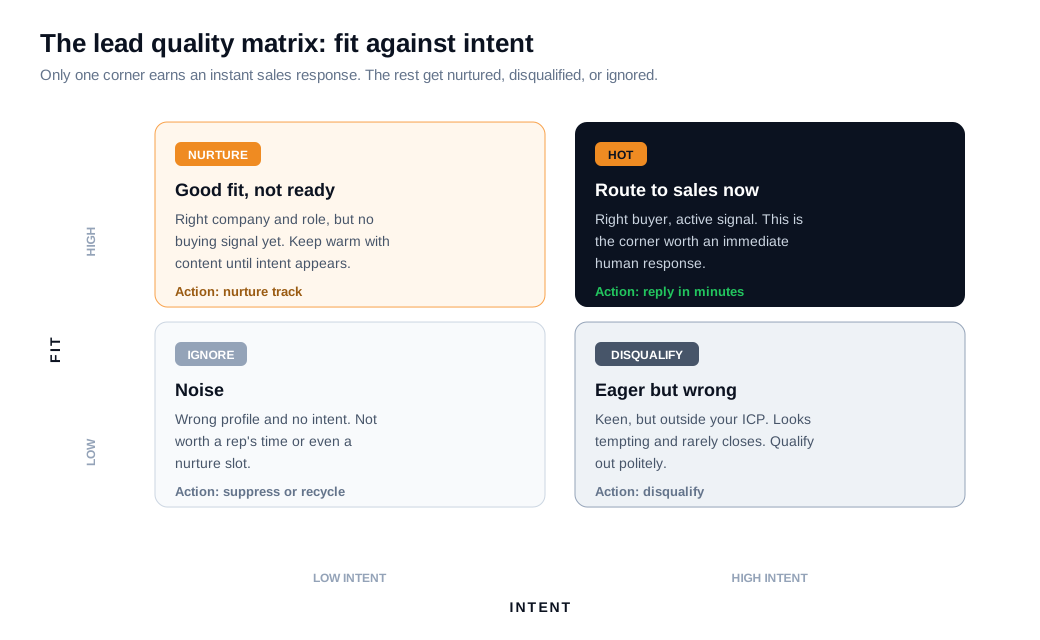
Plot those two axes against each other and you get a simple map for every lead. High fit and high intent is your hot corner, and it deserves an immediate human response. High fit and low intent goes into nurture until a buying signal appears. Low fit and high intent looks tempting because the person is eager, but it rarely closes and should be politely disqualified. Low fit and low intent is noise.
This is also the line between a marketing qualified lead and a raw one. An MQL is a contact who has both engaged with your marketing and cleared a fit-and-intent threshold your two teams agreed on in advance. Engagement alone does not make a quality lead, because a whitepaper download from the wrong company is still the wrong company.
What does poor lead quality actually cost you?
Poor lead quality costs you twice: once in the acquisition budget spent on leads that will never buy, and again in the selling hours your reps burn chasing them. Both costs are large, and both are usually invisible on a lead-count report.
The budget half is stark. A widely cited study summarized by Clickback found that sales and marketing executives believe at least half of their sales effort and half of their lead-generation budget is wasted on leads that are never properly contacted. When most of a funnel is bad-fit, more spend does not buy more customers. It buys more waste.
The time half explains why. When leads arrive unsorted, reps cannot tell the good ones apart, so many good leads sit untouched while reps chase noise. The same research thread notes that roughly half of marketing leads get ignored by sales entirely, which means the 25 percent that were genuinely ready are diluted inside a pile nobody fully works.
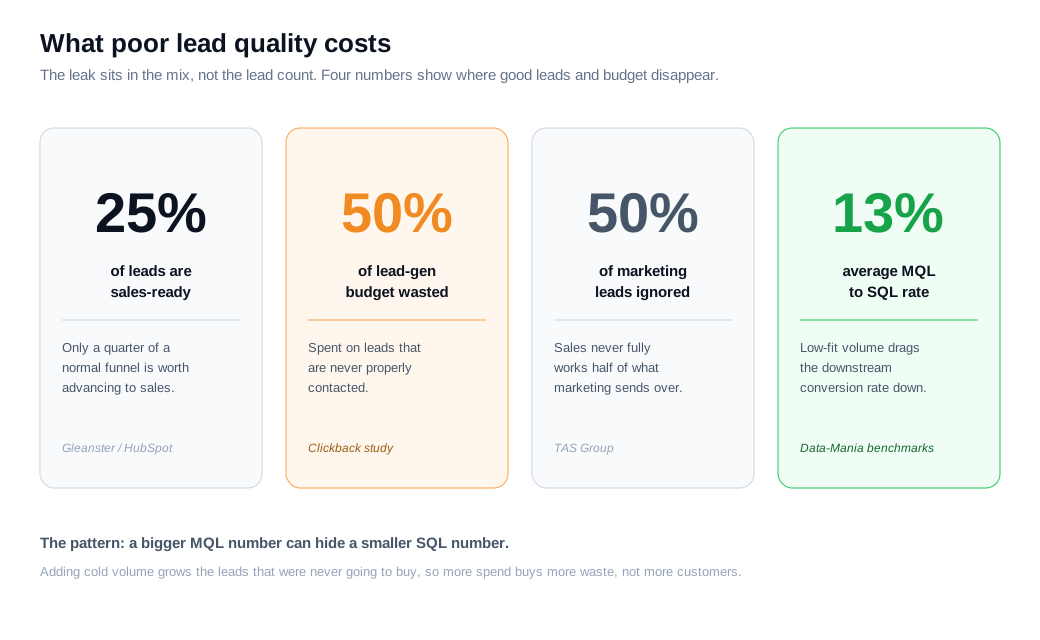
The downstream conversion rate confirms the leak. Benchmarks compiled by Data-Mania put the average marketing qualified lead to sales qualified lead rate near 13 percent, with strong B2B software teams reaching 18 to 22 percent. A funnel stuffed with low-fit volume drags that rate down, so a bigger MQL number can quietly hide a smaller SQL number. Counting leads at the top tells you almost nothing about the revenue at the bottom.
How does better qualification help?
Better qualification helps by concentrating effort on the leads most likely to close, which lifts conversion without adding a single lead to the top of the funnel. When reps spend their hours on fit-and-intent matches instead of on everyone, the same pipeline produces more deals.
The conversion gap is the whole argument. Data gathered by Landbase shows properly scored and qualified leads converting at around 40 percent, against roughly 11 percent for unqualified prospects. A qualified lead is not a little better than an unqualified one. It is several times more likely to turn into revenue, which is why sorting leads before you work them beats working them all.
Qualification also gives structure to a judgment call. Frameworks like BANT (budget, authority, need, and timing) and lead scoring translate fit and intent into a number or a checklist, so leads get ranked consistently rather than by whichever rep happens to open them. Gartner's guidance on qualified leads recommends layering intent data on top of profile fit and even scoring negatively for signals like a careers-page visit that suggest a job seeker rather than a buyer.
Then there is timing, which qualification makes possible. The classic Harvard Business Review analysis of online sales leads found that contacting a lead within the first five minutes makes successful contact far more likely than waiting even half an hour, and that firms responding within an hour were roughly seven times likelier to qualify the lead than those who waited longer. You can only respond that fast to the right leads if a scoring system has already told you which ones they are.
How do you balance lead quality and volume?
You balance quality and volume by refining who you attract and how you qualify them, rather than by switching channels off. As the Pedowitz Group puts it, the fix is to shift spend and content toward audiences and journeys that already convert, then align scoring and routing with sales' definition of a good lead. The goal is a top of funnel that stays wide while the middle gets a lot more selective.
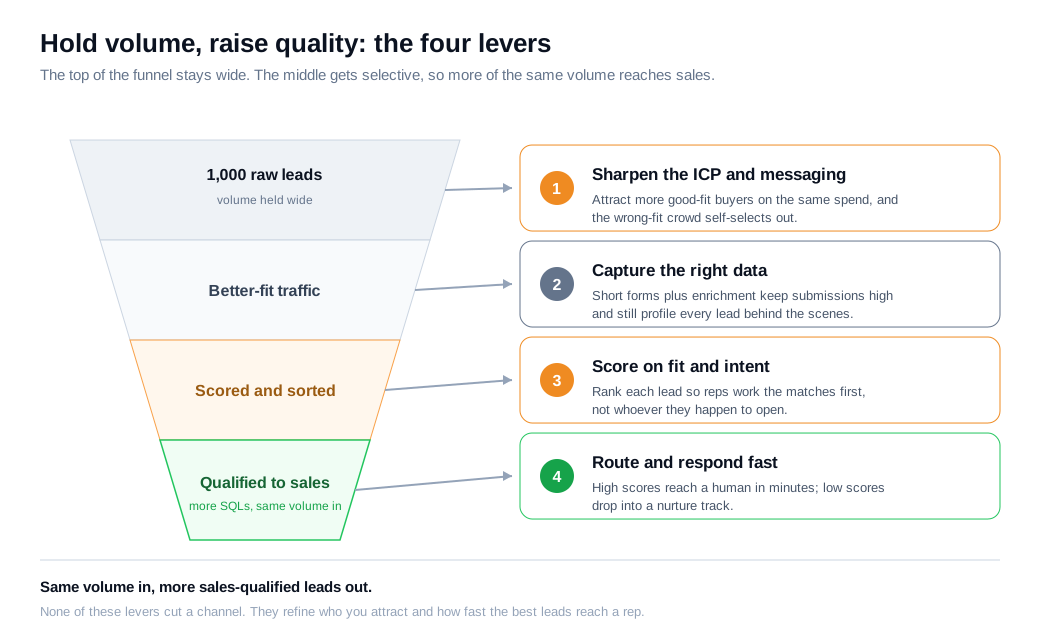
Start by sharpening the ideal customer profile and the messaging around it. When the ad copy, landing page, and offer speak directly to your best-fit buyer, the same budget attracts a higher share of people who look like customers, and the wrong-fit crowd self-selects out before they ever become a lead. Integrate's playbook on lead quality makes tighter targeting and aligned messaging the first move for exactly this reason.
Next, capture the right data without lengthening your forms. Long forms suppress volume, so instead of asking for ten fields, ask for an email and fill in company, size, and role behind the scenes with enrichment or progressive profiling. You keep the high submission rate that protects volume and still hand sales a full profile they can qualify at a glance.
Then score every lead on fit and intent, and route the winners fast. High-scoring, high-intent leads should reach a human in minutes, not the next business day, and the lower scores should drop into a nurture track rather than a rep's call list. Treating your website as an inbound sales channel, where a scored, in-market visitor can start a conversation on the spot, is what turns speed-to-lead from a slogan into a habit. On a high-intent page like pricing, live chat lets a qualified visitor reach a rep while their interest is still live, and clear lead routing and notifications make sure that lead lands with the right person instead of an inbox nobody checks. Volume at the top holds. Quality at the bottom climbs.
What metrics show lead quality is improving?
The metrics that prove lead quality is improving all live downstream of the lead, never in the lead count itself. A rising lead total can hide falling quality, so you have to watch what happens after capture.
Track the marketing qualified lead to sales qualified lead rate first, since it shows how many of your leads clear the sales bar. Watch lead-to-opportunity and cost per sales qualified lead next, because they tie quality to money: better leads should raise the conversion rate and lower the cost of each real opportunity. Then watch sales acceptance rate, win rate, and average sales-cycle length, which get better when reps spend time on fit rather than on noise.
The pairing that matters is quality metrics rising while volume holds flat. If your SQL rate climbs from 13 to 18 percent and your lead count stays steady, you improved quality without paying for it in volume. If the SQL rate climbs only because the lead count collapsed, you did not fix the problem. You just shrank it.
What does improving lead quality look like in numbers?
Here is a worked example that keeps volume fixed and moves only quality. Say a B2B software team generates 1,000 leads a month at a 40 dollar cost per lead, so 40,000 dollars in spend. Historically about 20 percent are good-fit (200 leads), reps chase everything by hand, first responses take most of a day, and the funnel converts 3 percent of all leads into opportunities. That is 30 opportunities a month at roughly 1,333 dollars each.
Now hold the 1,000 leads and the 40,000 dollars exactly where they are, and change only quality. Sharper ICP targeting and matching messaging lift the good-fit share from 20 to 30 percent, so 300 leads now look like real buyers. Scoring flags those 300 the moment they arrive, so reps stop pouring time into the other 700. Faster routing gets a human onto the high-intent ones within five minutes instead of a day.
With effort concentrated on fit and speed, the overall lead-to-opportunity rate rises from 3 to 6 percent. Same 1,000 leads, same budget, but now 60 opportunities a month instead of 30, and the cost per opportunity falls from 1,333 dollars to about 667. Nothing about the top of the funnel grew. The lead count on the report is identical. The pipeline underneath it doubled, purely because the same volume was better sorted and faster served.
That is the shape of the whole exercise. You are not trading volume for quality. You are removing the waste that made volume and quality feel like opposites in the first place.
Key takeaways
- Volume dilutes quality because scaling loosens your filters. Your best-fit audience is finite, so cheap extra leads come from a less relevant slice, and only about 25 percent of a normal funnel is sales-ready to begin with.
- Define quality on two axes, fit and intent. Fit without intent is a nurture candidate, intent without fit is a dead end, and only the high-fit, high-intent corner earns an immediate response.
- Poor quality costs you twice. Around half of lead-gen budget is wasted on leads never contacted, and roughly half of marketing leads get ignored by sales, which drags the MQL-to-SQL rate down toward 13 percent.
- Qualification multiplies conversion. Scored, qualified leads convert near 40 percent versus about 11 percent unqualified, and scoring is what lets you respond to the right leads in the five minutes that matter.
- Hold volume by refining, not cutting. Sharpen the ICP and messaging, shorten forms while enriching behind them, score on fit and intent, then route and respond fast.
- Measure downstream, not at the top. Watch the SQL rate, cost per opportunity, and win rate rise while your lead count stays flat, which is the signal that quality improved for free.
TAGS

Written by
Daniel SemeckyCo-founder & CEO
Daniel is the co-founder and CEO of Glimpze. He spends his days talking to revenue teams about how to catch high-intent visitors before they bounce, and writes about inbound sales, lead conversion, and building a motion where marketing and sales actually share a number.


