
On this page
Two reps run the same demo, on the same product, in the same week. One books eleven calls and closes two. The other books eleven calls and closes five. The deck is identical and the price list has not moved. What separated them was everything around the call: who showed up, how fast the conversation started, whether the cameras were on, and how each rep handled the moment a buyer pushed back.
A video call conversion rate is a controllable number. It moves with a short list of levers, and most of them have nothing to do with talking louder or discounting harder. The teams that improve the rate work the levers the data supports and ignore the ones that only feel productive.
This post covers what a good video call conversion rate looks like, what actually affects it, how speed and preparation change the outcome, how to handle objections when the camera is on, and how to measure and improve the number over time.
What is a good video call conversion rate?
A good video call conversion rate depends on what you count, but for B2B demos a booked-call-to-closed-deal rate near 25% is a widely used benchmark, with strong SaaS teams landing closer to 30%. Revenue.io's demo-to-close data puts the B2B average around 25% and notes it swings hard by context.
Before you judge your own number, pick a denominator and hold it steady. The conversion rate is the share of video calls that reach the outcome you care about, and that outcome changes by stage. A discovery call converts to a qualified opportunity. A demo converts to a closed deal. A support-style call converts to a renewal or an expansion. Blending those into one figure hides where the leak actually is.
Context sets the bar. Revenue.io's breakdown shows smaller segments closing at a higher rate than enterprise, and lower-priced deals closing faster than six-figure ones, because a larger buying committee and a longer evaluation drag the rate down. A 32% demo-to-close rate on sub-$10K deals and an 18% rate on enterprise can reflect the same quality of selling. Compare your rate against your own segment and your own past months, not against a headline figure from a different motion.
The number is worth chasing because it responds to effort. Gong's analysis of remote sales found deals were 127% more likely to close when video was used across the process, so the rate is something you can push on rather than a property of your product.
What affects video call conversion?
Video call conversion is affected most by four things you control: whether the cameras are on, how fast you reach the buyer, how well you listen, and how much friction sits between the buyer and the call. The script matters less than any of them.
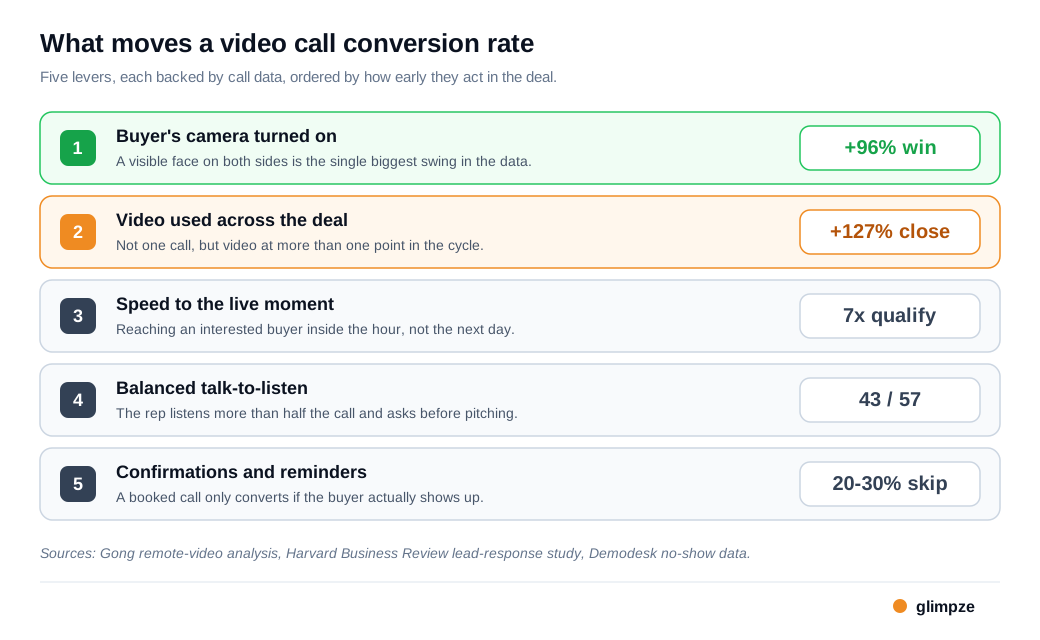
The camera is the biggest single swing in the data. Gong found win rates ran 94% higher when reps sold with video on, and 96% higher when the buyer turned their own camera on. A visible face lets a rep read a flicker of doubt at the price slide or a lean-in at a feature, and adjust before the objection hardens. When only one side is on camera, half of that signal disappears.
The medium works partly because buyers already prefer it. Wyzowl's annual survey found 63% of people would most like to learn about a product from a short video, well ahead of a text article at 12% or a sales call at 5%. Showing up on video meets that preference instead of fighting it.
How the rep uses the airtime is the next lever. Gong's study of B2B calls found top sellers talk about 43% of the time and listen for the other 57%, while the average call runs closer to 60% talking. A rep who listens more asks better questions, learns the real constraint, and pitches something the buyer actually needs.
Friction quietly caps the rate. Meetings that start late because of a download, a login, or a dial-in that will not connect lose momentum before the pitch begins, and Demodesk's rundown of common video problems shows how often technical trouble derails the first minutes. Cutting that friction is why on-site tools matter: letting a high-intent visitor start a live video call in the browser, with no install, keeps the warmest buyers from dropping out at the join screen. Pairing that with live chat gives a hesitant buyer a low-commitment way in before they step up to video.
How does speed to the call affect conversion?
Speed to the call affects conversion more than almost any single in-call tactic, because buyer intent decays by the hour and the first vendor to reach a live conversation tends to win it. A perfect demo three days late loses to a decent one started while the buyer is still in the tab.
The clearest evidence comes from Harvard Business Review's study of online sales leads. Firms that tried to contact a lead within an hour were nearly 7 times as likely to have a meaningful conversation with a key decision maker as those that waited even one more hour, and more than 60 times as likely as those that waited 24 hours or longer. The widely cited five-minute rule sits on the same curve, where every minute of delay bleeds a share of the buyers who were ready to talk.
That decay is why the best place to raise a video call conversion rate is the moment intent peaks. A visitor sitting on your pricing page is a raised hand, and a callback booked for tomorrow gives that hand time to go cold or to book with whoever answers first. Offering a live conversation on the spot, then routing it to an available rep in seconds through tight lead routing and notifications, converts the interest before it fades.
Here is a small illustration. Say ten qualified visitors reach your pricing page in a day. Reach five of them inside the hour and, at HBR's roughly 7x odds of a real conversation, those five drive most of your booked demos. Wait until the next morning for the other five and the pool that answers shrinks to a fraction. Same ten hands, very different pipeline, decided by response time alone. For teams built around inbound, this speed is the spine of an inbound sales motion.
How does preparation increase conversion rates?
Preparation increases conversion by closing the two biggest leaks around a video call before it starts: the buyer who never shows, and the demo that talks past what the buyer came for. Both are fixable in the hours before the call, and both cost you deals silently when they are ignored.
Start with attendance, because a call that does not happen converts at zero. No-show rates on booked B2B calls commonly run in the 20% to 30% range, and Demodesk's guidance on the problem points to a reminder cadence that pulls that number down: a confirmation at booking, a reminder 24 hours out, another an hour before, and a same-day nudge by SMS, each carrying the join link, a one-line agenda, and an easy way to reschedule. Keeping the first call short, closer to fifteen or twenty minutes than a full hour, lowers the bar to actually attend.
Then prepare the call itself. A rep who has read the buyer's company, role, and likely use case can open with a specific reason for the meeting instead of a generic tour, and can tailor the demo to the two features that matter rather than the twenty that do not. That homework shows up as sharper questions on the call, and Gong's research found that reps who ask more of the right questions, then listen, close more often than reps who lead with a pitch. Preparation is what makes the 43-to-57 talk-to-listen split possible, because you cannot ask a good follow-up about a business you did not bother to understand.
A short pre-call checklist covers most of it: confirm the attendee and their role, note one recent company signal worth mentioning, write the single outcome you want from the call, and pick the two moments in the product that speak to their use case. Ten minutes of that beats another rehearsal of the same script.
How do you handle objections on camera?
Handle objections on camera by slowing down, pausing before you answer, and asking a question instead of assuming what the concern means, which is exactly the behavior Gong found separates reps who close from reps who lose. The camera makes composure visible, so staying calm is worth more here than anywhere else in the call.
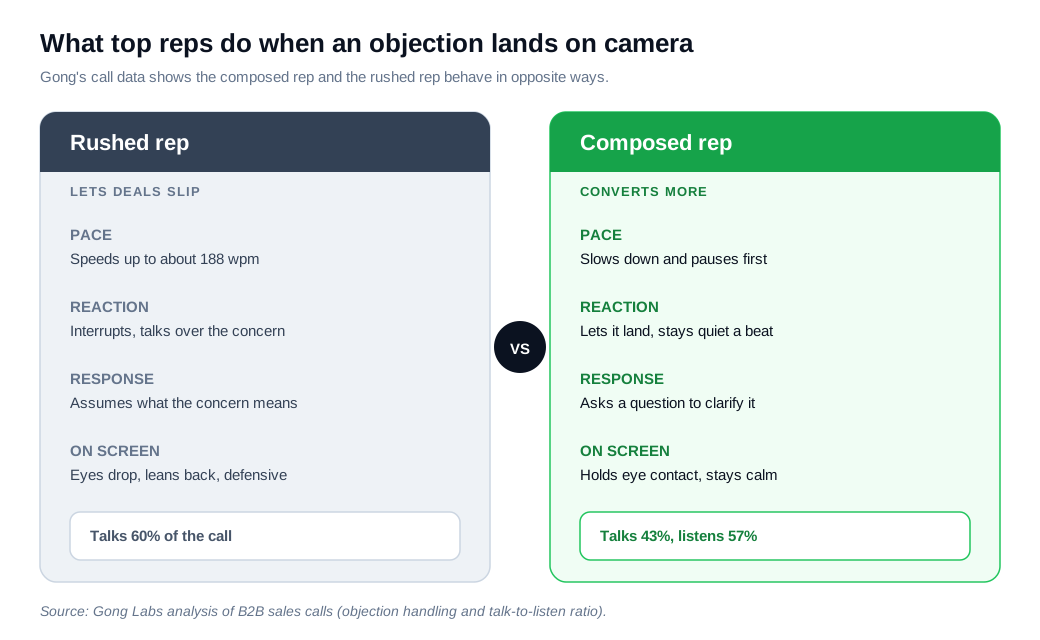
Gong's call data draws a sharp line between the two. Successful reps pause for longer after an objection than at any other point in the call, as if the pushback shifts them into slow motion. Average talking speed on a call runs near 173 words per minute, but a flustered rep speeds up to about 188 as the objection lands, and the faster talk reads as defensiveness. The losing pattern is to interrupt, talk over the concern, and answer a question the buyer never actually asked.
The composed move is to let the objection finish, sit in a beat of silence, then ask what is behind it. "When you say the price is high, is it the number itself or the way it is packaged?" That single question turns a wall into information, and it often surfaces a concern you can actually solve rather than the one you assumed.
On camera, two extra habits help. Look at the lens, not your own thumbnail, so the buyer feels met rather than studied. And keep your face and shoulders still while you listen, because a rep who visibly tenses at the word "budget" tells the buyer the objection landed harder than it should have. The visible calm is part of the answer.
How do you measure and improve video call conversion?
Measure video call conversion as a short funnel, booked to showed to talked to closed, plus two in-call signals, the talk-to-listen ratio and how often objections recover, then fix the weakest stage before touching anything else. A single blended close rate hides which of those stages is actually leaking.
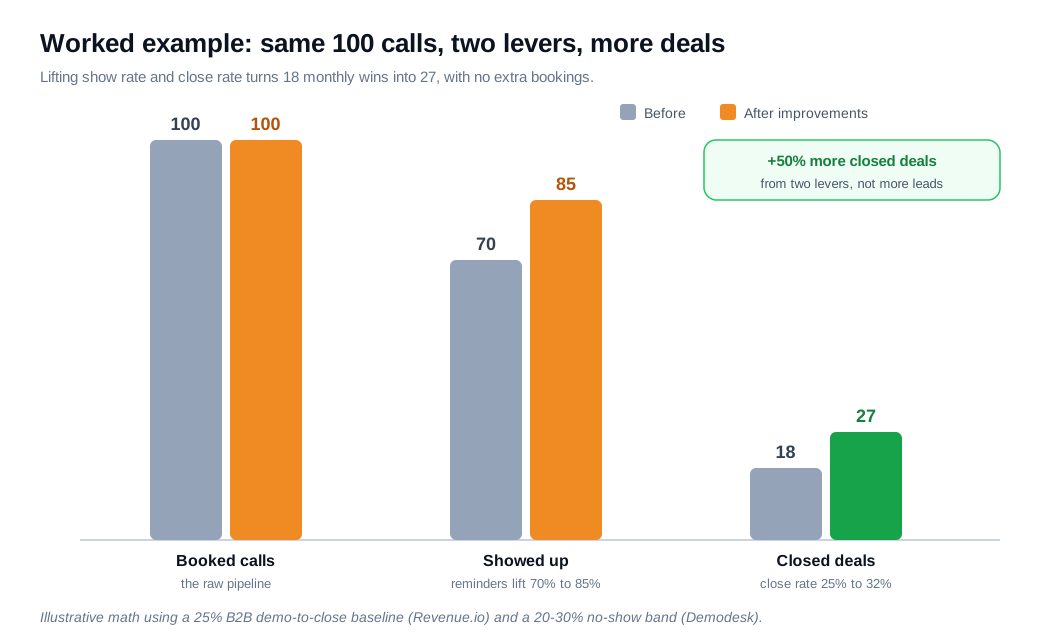
Here is a worked example. A team books 100 video calls in a month. At a 70% show rate, 70 calls happen, and at the 25% B2B demo-to-close benchmark, that is about 18 closed deals. Now pull two levers. Tighten the reminder cadence and the show rate climbs to 85, so 85 calls happen. Get more cameras on and sharpen discovery, and the close rate on those calls rises to 32%. The month now produces about 27 deals. That is a 50% lift from the same 100 bookings, with no extra leads bought and no new reps hired.
The example works because each lever attacks a different stage. Reminders fix attendance. Camera-on selling and better questions fix the in-call close rate. If you only tracked the blended figure, you would see 18 deals become 27 and not know which change earned it. Measured stage by stage, you can tell that reminders added roughly 4 deals and the in-call work added the rest, then invest accordingly.
Instrument the two in-call signals with a call-recording or conversation-analytics tool, which timestamps talk-to-listen ratio and flags the moments an objection came up and whether the deal moved forward afterward. Segment before you conclude, since a call that followed a warm inbound signal will convert differently from a cold one, and judge each cohort against itself. Then close the loop where intent is highest by routing a high-intent visitor straight to a live rep, and you can test the whole setup on a page or two, weighing the pieces on the pricing page before committing. Track booked meetings and closed deals rather than call volume, because more calls feel productive while a higher conversion rate is what pays.
Key takeaways
- A video call conversion rate is a number you can move. For B2B demos a booked-to-closed rate near 25% is a common benchmark, and Gong found deals 127% more likely to close when video runs across the process.
- Cameras on is the single biggest lever. Gong measured win rates 94% higher when reps sell with video on and 96% higher when the buyer's camera is on, so getting both faces visible beats almost any script change.
- Speed decides who wins the interested buyer. HBR found contact within an hour makes a meaningful conversation nearly 7 times likelier than an hour later, so reach the raised hand while the intent is fresh.
- Preparation plugs the quiet leaks. A reminder cadence pulls the 20% to 30% no-show band down, and pre-call research turns a generic tour into a tailored demo with sharper questions.
- Objections reward composure. Top reps pause, slow down from the flustered 188 words per minute back toward a calm pace, and ask a question instead of assuming, all of which read louder on camera.
- Measure the funnel by stage, not as one blurred rate. Track booked, showed, talked, and closed plus the talk-to-listen ratio, then fix the weakest stage first, the way the worked example turned 18 monthly deals into 27.
TAGS

Written by
Daniel SemeckyCo-founder & CEO
Daniel is the co-founder and CEO of Glimpze. He spends his days talking to revenue teams about how to catch high-intent visitors before they bounce, and writes about inbound sales, lead conversion, and building a motion where marketing and sales actually share a number.


