
On this page
A decade ago a field rep booked a flight, drove to a client's office, shook hands, and ran one demo before lunch. Today that same rep runs six demos before lunch from a desk, shares a screen with a buyer in Denver at 9 a.m. and one in Berlin at 10, and never leaves the chair. The pitch did not change. The room did.
That shift is what a virtual selling strategy has to account for. When the handshake, the whiteboard, and the walk to the parking lot all disappear, the parts of selling that used to happen by accident have to be designed on purpose. A strategy is how you design them.
This post covers what virtual selling is, how it differs from selling in person, what a virtual selling strategy actually includes, how to enable reps to run it, how to measure whether it is working, and how to stand one up in about a month.
What is virtual selling?
Virtual selling is running the sales process through digital channels, video calls, phone, email, chat, async video, and shared documents, instead of meeting the buyer in person. A rep qualifies, demos, negotiates, and closes without sitting in the same room as the buyer, using screens and software to do the work a conference table used to do.
The practice is now the default in B2B rather than a fallback. RAIN Group's research found that 71% of sellers conduct more than half of their sales virtually, a 163% jump from before the pandemic. McKinsey's B2B buyer surveys point the same way: buyers now move through an average of ten interaction channels on the way to a purchase, up from five in 2016, and at many stages about two-thirds of them prefer remote or self-service contact to meeting a rep face to face.
Virtual selling is a channel and a set of behaviors, while a virtual selling strategy is the documented plan that decides which channel carries which stage, who does what, and how you will know if it worked. A single rep with a webcam and a calendar link already sells virtually. The strategy is what keeps a team of them from each inventing a private version of the job.
How does virtual selling differ from in-person selling?
Virtual selling differs from in-person selling in four ways that shape the whole strategy: rapport has to be built inside the meeting instead of around it, attention is fragile because the buyer is one tab away, reading the room is harder because most body language is cropped off-screen, and reach climbs while the cost per meeting falls.
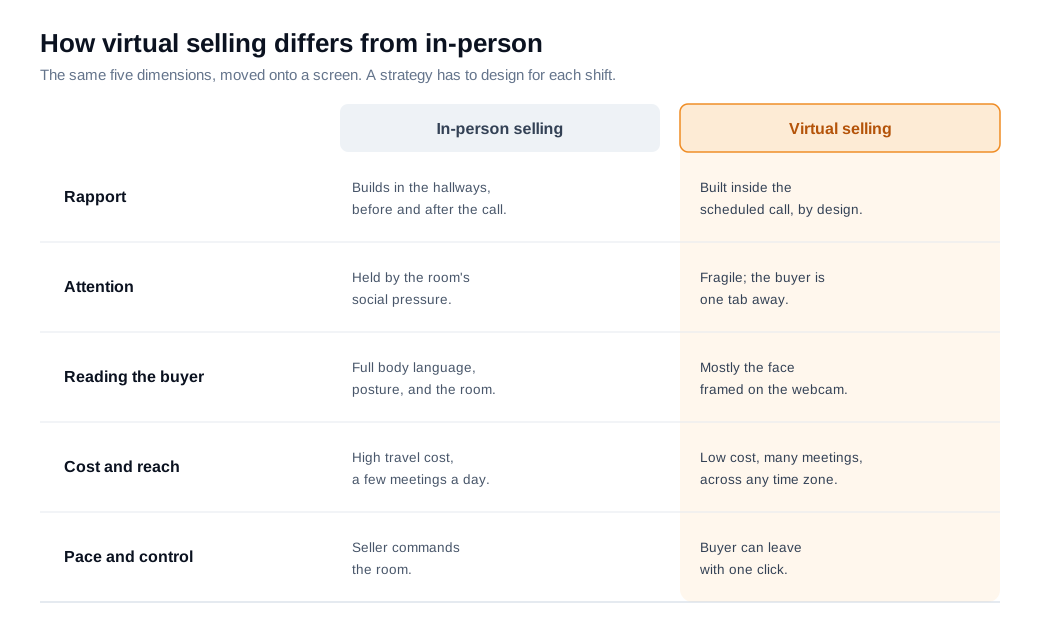
Rapport is the first thing to change. In person, trust builds in the margins, the walk from reception, the coffee, the small talk before the laptop opens. On a video call those margins vanish, so every trust-building moment has to happen inside the scheduled time. The RAIN Group guidance on keeping buyers engaged treats this as a design problem: you plan the opening and the interaction points the way you would plan an agenda.
Attention is the second. A buyer in your office feels social pressure to stay in the conversation. A buyer on a call is one click from their inbox, and RAIN Group found that 91% of sellers struggle to gain and keep buyer attention in virtual meetings. That single number is why so much of a virtual strategy is about interaction, short segments, questions, and shared screens, rather than a monologue.
Reading the room is the third. The posture and micro-expressions a rep reads across a table are mostly outside a webcam frame, which is exactly why the camera matters. Gong analyzed web-based sales meetings and found win rates roughly 96% higher when the buyer turned their own camera on, because a visible face hands the rep the reactions to adjust to in real time.
Reach is the fourth, and it runs the other way. One rep can run demos in three time zones in a day with no travel, so the cost per meeting drops and the number of meetings a rep can hold climbs. That does not make virtual better at everything. McKinsey's "rule of thirds" holds that at any stage of a purchase, roughly a third of buyers prefer in-person contact, a third prefer remote video or phone, and a third prefer digital self-service. A good strategy plans for that mix instead of betting the motion on one channel.
What does a virtual selling strategy include?
A virtual selling strategy includes six building blocks: a channel-and-stage map, a defined buyer journey, a content and demo library, a tech stack, rep enablement, and a measurement loop. Miss any one and the others leak. A great demo library with no way to route a hot lead to a rep, or tight routing with reps who freeze on camera, both stall in the same place.
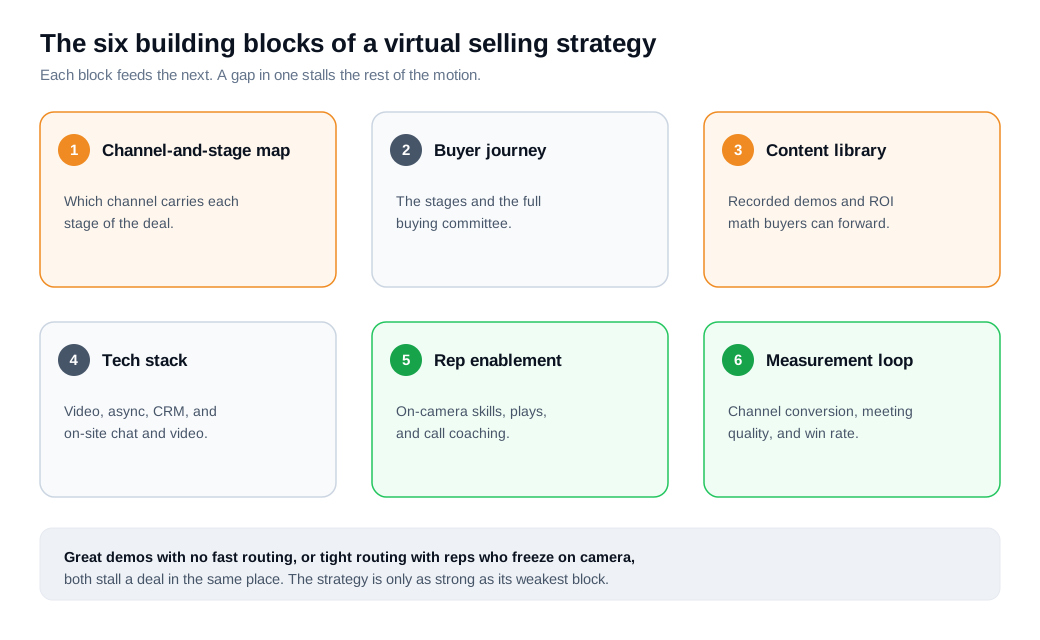
The channel-and-stage map is the spine. You decide which channel carries which stage: a short async video or email for the first touch, a live video call for discovery and the demo, chat for quick questions, and a shared document plus a call for the contract. The rule of thirds shapes this map. Leave a clean self-serve path for the buyers who want to read the pricing page and the docs without talking to anyone, and leave a fast human path for the ones who want a person now. On your own site, that fast path can be a live video call the visitor starts in the browser while they are still on the pricing page, with live chat on your website as the low-commitment way in for a buyer who would rather type a question first and step up to video once a rep is on.
The buyer journey defines the stages and the buying committee, so a rep knows who else needs a forwardable recording. The content and demo library holds the recorded walkthroughs, one-pagers, and ROI math that travel to people who never joined the call. The tech stack is the plumbing: video conferencing, async recording, a CRM, conversation intelligence to record and analyze calls, scheduling, and on-site chat and video for inbound sales. Rep enablement and the measurement loop are big enough to take on their own below.
How do you enable reps for virtual selling?
You enable reps for virtual selling by training the specific on-camera skills, standardizing the tools and plays, coaching from recorded calls, and routing high-intent leads to them fast. The skills are learnable and measurable, so treat weak virtual selling as a gap to close rather than a trait.
Start with the skills the medium demands. On-camera presence, a genuinely interactive demo, virtual discovery that asks and listens instead of presenting, and screen-share discipline that does not bury the buyer's face under a slide. RAIN Group's data shows these separate the best from the rest: top-performing sellers are 63% more likely to excel at selling with video and 28% more likely to excel at leading masterful virtual conversations and presentations. Those are trainable behaviors, not personality types.
Standardize the plays next. A single demo environment, a call template, and a follow-up cadence mean a new rep runs the motion the same way the best rep does, and the whole team improves together instead of one seat at a time. Keep the plays where reps already work, inside the CRM, so the strategy is not a document nobody opens.
Coach from recordings, not memory. Conversation intelligence captures every call, so a manager reviews what actually happened, the talk-to-listen ratio, the camera-on rate, the moment the buyer went quiet, rather than a rep's summary of it. That turns coaching into a data exercise.
Then close the speed gap. A virtual buyer who raises a hand cools fast, so the strategy needs lead routing and notifications that put the right rep on the right buyer within minutes, not the next business day. A Slack ping the moment a target account lands on the pricing page is worth more than a lead scoring model that runs overnight.
How do you measure a virtual selling strategy?
Measure a virtual selling strategy with three layers: channel-level conversion (which channel moves deals forward), meeting quality (show rate, camera-on rate, talk-to-listen ratio), and the pipeline outcome (win rate and cycle length on virtually-run deals against the rest). The meeting metrics are leading indicators. They tell you weeks earlier what the win rate will do.
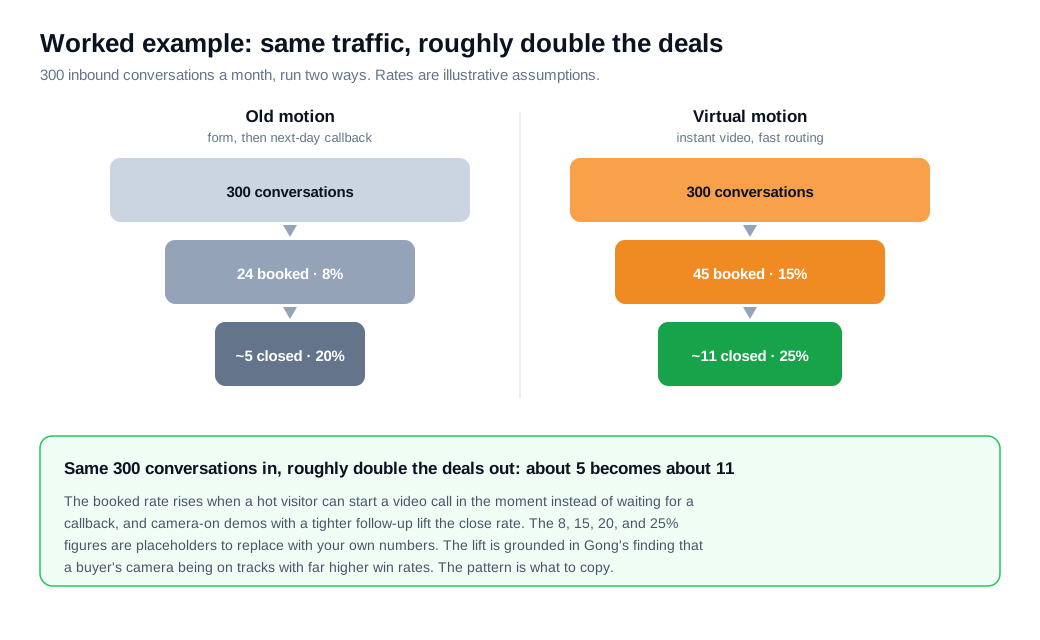
Here is a worked example. Suppose a team gets 300 inbound conversations a month. In the old motion, a visitor fills out a form and waits for a next-day callback, about 8% book a meeting (24 meetings), and 20% of those close, which is roughly 5 deals. Now put the strategy to work. Instant video on the pricing page and routing that reaches a rep in minutes lift the booked rate to 15% (45 meetings), and camera-on demos plus a tighter recorded follow-up lift the close rate to 25%, which is about 11 deals. Same traffic, roughly double the deals. The 8, 15, 20, and 25 are assumptions for your team to replace with real numbers, but the shape is grounded in Gong's finding that a buyer's camera being on tracks with far higher win rates.
Segment before you conclude. A self-serve buyer and a rep-led buyer should never be judged on the same close rate, and a 30-second async intro should not be measured against a 40-minute demo. Compare like with like, watch the camera-on rate and show rate because they move first, and track which channel actually advanced a deal rather than which one felt busy. Meetings that hold attention are the signal. Activity counts are the noise.
How do you build a virtual selling strategy in 30 days?
You build a virtual selling strategy in about 30 days by mapping one channel-to-stage flow, equipping reps with a single standard demo and follow-up play, wiring the tools that route and record, and setting a baseline you can beat. Narrow beats broad, because a strategy that tries to fix every stage at once tends to fix none.
In week one, map the flow and take a baseline. Write down which channel carries each stage and pull your current booked rate, show rate, and close rate so you have a number to measure against. In week two, wire the tools: async recorder, video conferencing, CRM, conversation intelligence, and on-site chat and video so a high-intent visitor can reach a person fast. In week three, run the enablement, one demo script, one follow-up cadence, one recorded practice call per rep, reviewed on camera. In week four, run the motion live and read the leading indicators.
Keep the first pass small and cheap. Most tools, including free tiers, let you test the on-site pieces on a page or two before you roll them out, and you can weigh the pieces on the pricing page before committing. Keep what beats your week-one baseline, cut what does not, and add the next stage only once the first one holds.
Key takeaways
- A virtual selling strategy is the documented plan for running the full sales cycle over digital channels, deciding which channel carries which stage, who does what, and how you will measure it.
- The medium changes four things: rapport moves inside the meeting, attention gets fragile, body language is cropped, and reach goes up while cost per meeting drops. Design for all four.
- It has six building blocks: a channel-and-stage map, a buyer journey, a content and demo library, a tech stack, rep enablement, and a measurement loop, and a gap in any one stalls the rest.
- Enable reps on skills, not vibes. Train on-camera presence and interactive demos, standardize the plays, coach from recorded calls, and route hot leads to a person within minutes.
- Measure three layers. Channel-level conversion, meeting quality (camera-on rate, show rate, talk-to-listen), and pipeline outcome, using the meeting metrics as the early warning.
- Build it in 30 days, narrow first. Map one flow, set a baseline, wire routing and recording, run one standard play, then scale only what beats the number you started with.
TAGS

Written by
Daniel SemeckyCo-founder & CEO
Daniel is the co-founder and CEO of Glimpze. He spends his days talking to revenue teams about how to catch high-intent visitors before they bounce, and writes about inbound sales, lead conversion, and building a motion where marketing and sales actually share a number.


