
On this page
Marketing closes the quarter ahead of target: 900 marketing qualified leads, up 20 percent. Sales opens the same 900 records and finds most of them missing a phone number, a use case, or any note about why the person raised a hand.
Both teams did their job. Revenue still drained out of the seam between them.
That seam is where handoff friction lives. It is the drag a buyer feels each time they cross from one team to the next and have to re-explain themselves, wait for someone to open the file, or sit in a queue nobody is watching.
It almost never appears on a single dashboard, because no one person owns the moment, and that is exactly what makes it so easy to ignore and so expensive to keep.
This guide covers what handoff friction is, where handoffs break between teams, how a poor one quietly loses revenue, how to standardize the criteria that move a lead, how to automate the mechanical parts, and how to measure whether the friction is shrinking.
What is handoff friction between revenue teams?
Handoff friction is the delay, lost context, and dropped ownership a lead or customer runs into every time it moves from one revenue team to the next.
Revenue teams here means the full go-to-market chain: marketing, sales development, account executives, and customer success, with revenue operations (RevOps) sitting underneath to connect them.
Every handoff has two moving parts that people tend to blur. Routing decides who gets the record. The briefing decides what they know when they get it.
A lead can be routed perfectly to the right account executive and still stall, because that rep opens a blank record and re-runs the discovery the buyer already sat through.
The cost of that repetition is steep, because the buyer's attention is thin to begin with. Gartner's research on the B2B buying journey found that a typical purchase now involves a buying group of six to ten decision makers, and that buyers spend only about 17 percent of their total time meeting with any potential supplier.
Split across two or three vendors, the time any single rep gets is a sliver. Make the buyer spend part of it repeating themselves and you have burned attention you cannot get back.
Where do handoffs break between teams?
Handoffs break at three predictable seams, and each one fails in its own way. Mapping them is the fastest route to the exact place your pipeline leaks.
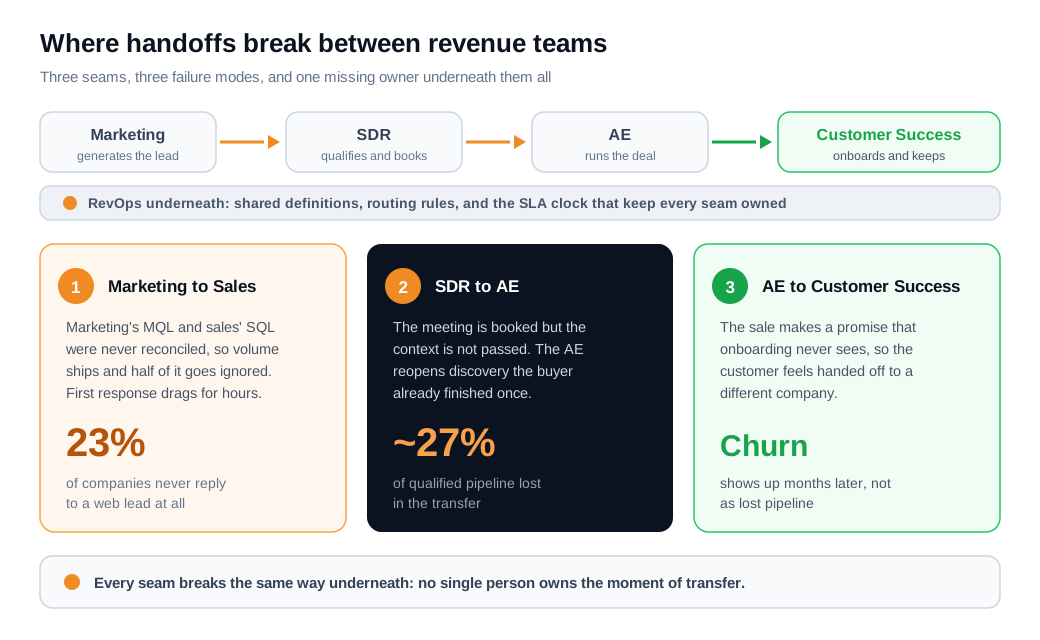
The first seam is marketing to sales, where a marketing qualified lead (a form fill, a demo request, a high-intent visit) is passed to a sales development rep or straight to sales.
It breaks when the two teams never agreed on what "qualified" means, so marketing ships volume and sales quietly ignores half of it. It also breaks on speed. Harvard Business Review's audit of 2,241 companies found that 23 percent never responded to a web lead at all, and the average responder took more than a day and a half.
The second seam is SDR to AE, where a booked meeting or a qualified opportunity moves from the rep who created it to the rep who will run the deal.
This is the highest-stakes transfer, because real money is now attached, and it usually breaks on missing context rather than weak leads. One analysis across 200-plus sales teams put the loss at roughly 27 percent of qualified pipeline, driven by AEs who open a call with basic questions the SDR already answered.
The third seam is AE to customer success, which fires after the deal closes and passes the new account to onboarding.
Handle it roughly and the customer feels like they bought from one company and got handed to another, which surfaces months later as churn rather than as lost pipeline.
Underneath all three sits the same root cause: no single owner watches the moment of transfer, which is the gap RevOps exists to close.
How does poor handoff lose revenue?
Poor handoffs lose revenue three ways: they leak qualified pipeline you already paid to create, they slow every deal that survives, and they erode retention when the sale sets an expectation onboarding never sees.
The bill is large and mostly invisible, because it is spread across steps no single team reports on.
Start with the leak. One widely cited IDC estimate puts the cost of poor sales and marketing coordination at around 10 percent of annual revenue.
Forrester's work on revenue operations points the other way: organizations that align people, process, and technology across their go-to-market functions have been found to generate as much as 36 percent more revenue and 28 percent more profit than siloed peers. That friction lands straight on the P&L.
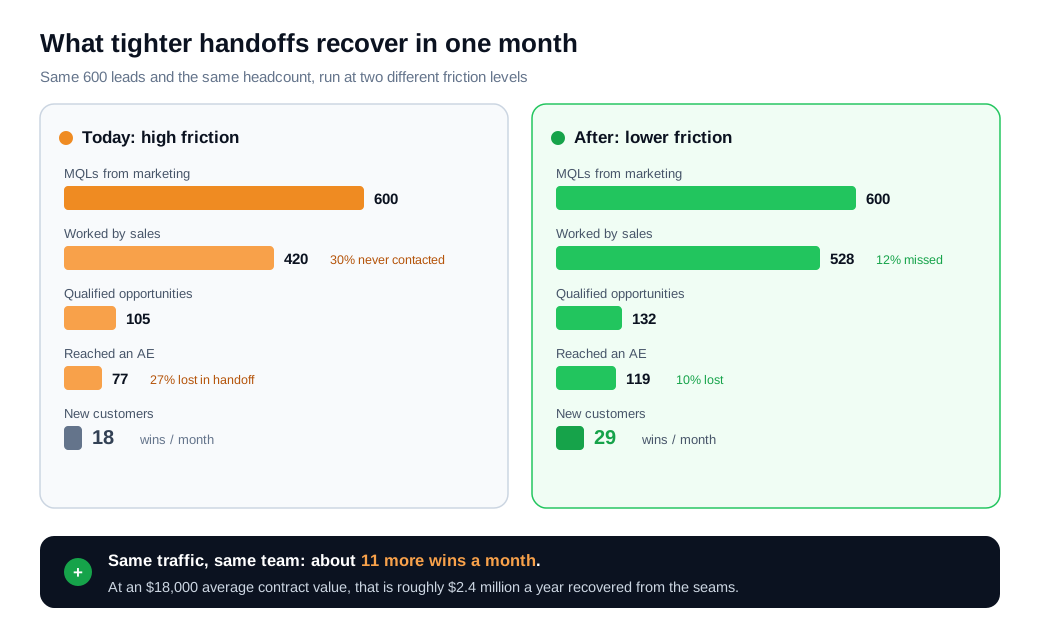
Now the worked example. Say marketing passes 600 MQLs a month. If the marketing-to-sales seam loses 30 percent to no-contact and slow response, 420 get worked. SDRs qualify a quarter of those into opportunities, so 105 reach the SDR-to-AE handoff, where 27 percent leak, leaving 77 real opportunities. At a 24 percent close rate, that is about 18 new customers a month.
Now tighten both seams. Cut the marketing-to-sales leak to 12 percent and the SDR-to-AE leak to 10 percent. The same 600 MQLs now yield 528 worked, 132 opportunities, 119 that reach an AE, and about 29 wins.
That is 11 extra customers a month from the same traffic and the same headcount. At an $18,000 average contract value, the recovered revenue is around $198,000 a month, close to $2.4 million a year, out of a process nobody put on a dashboard.
The slow-deal cost is quieter but just as real. A handoff that adds a two-day queue between "qualified" and "first AE call" throws away the speed advantage the research keeps confirming: reaching a lead within five minutes rather than thirty makes you about 21 times more likely to qualify it.
Friction loses the deals it drops and slows the ones it keeps.
How do you standardize handoff criteria?
You standardize handoff criteria by writing one shared definition of what qualifies a record to move, agreed by both the sending and the receiving team, and enforcing it as required fields rather than a suggestion.
The most common cause of handoff friction is that marketing's "qualified" and sales' "qualified" are two different things that were never reconciled.
Start with the stage definitions. Write down, together, what makes a lead a marketing qualified lead, what makes it a sales qualified lead, and what makes it a sales accepted lead.
The useful definition is the one your own data supports: an MQL is whatever marketing and sales agree actually predicts a real buying conversation, documented as a shared spec and signed off by both sides. Vague thresholds are what let one team hit its number while shipping records the next team cannot use.
Then attach three things to every handoff:
- Exit criteria: the specific fields that must be filled before a record can advance, so no lead moves with an empty "use case" or a missing next step. A short, enforced list beats a long, optional one, because the optional one is the one busy reps skip.
- A service-level agreement on speed, so the receiving team commits to a first touch inside a set window. Companies that run an active SLA between marketing and sales are 34 percent more likely to report better year-over-year ROI.
- A named owner for the transfer itself, which is the piece RevOps holds.
Keep the spec living. Review the definitions and the field list on a quarterly cadence against what actually closed, and retire any criteria that stopped predicting anything.
Standardizing has one purpose: letting a lead cross a seam without a human having to stop and interpret it.
How do you automate handoffs?
You automate a handoff by wiring four pieces into your CRM: a trigger, a rule check against your shared criteria, an assignment action, and a context-rich notification, so the right rep is alerted the instant a record qualifies.
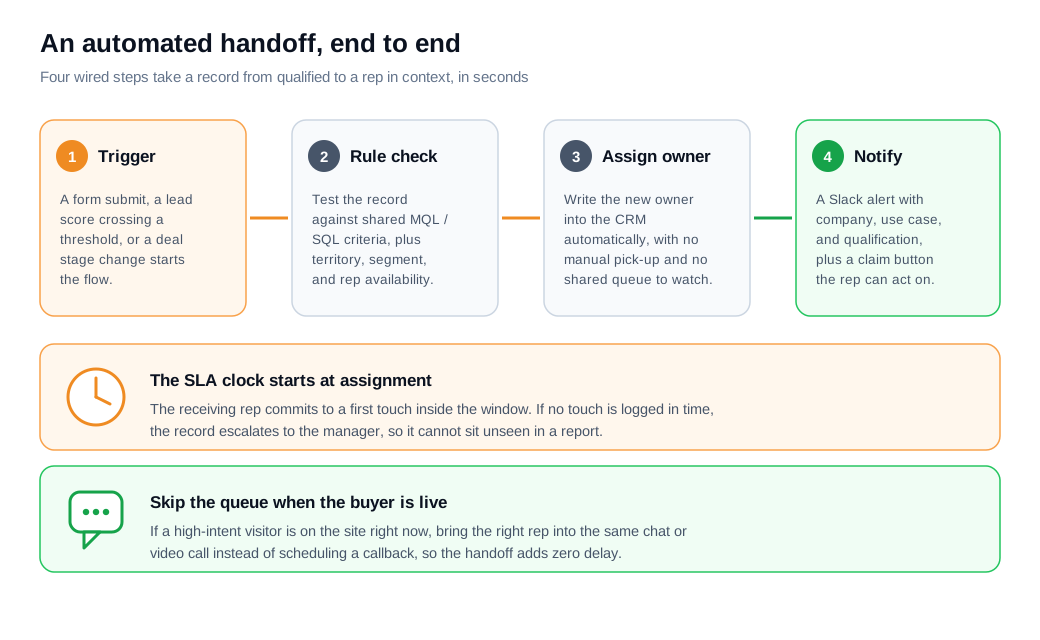
- The trigger is the event that starts the flow: a form submission, a lead score crossing a threshold, or a deal-stage change.
- The condition checks the record against the standardized criteria you just wrote, plus territory, segment, and rep availability.
- The action writes the new owner into the CRM.
- The notification pings that owner with the context they need to act, and this is the step that earns the automation its keep.
A Slack or CRM alert that fires the moment a lead is assigned, carries the company, the use case, and the qualification, and includes an "open in CRM" or "claim" button turns a five-minute SLA into a target a rep can actually hit.
That is the job of a solid routing and notifications setup, and it is why a Slack integration often matters more than the routing logic by itself. Pair it with an escalation rule: if no first touch is logged inside the SLA window, alert the rep's manager so the record cannot rot unseen.
Automation also lets you skip the queue entirely when the buyer is live. If a high-intent visitor is on your pricing page right now, the fastest handoff does not schedule a call for tomorrow.
It brings the right rep into the same live chat session, or escalates to a live video call or screen share, while interest is at its peak.
Treating your website as an inbound sales channel, rather than a form that files leads for later, is what makes a zero-delay handoff possible. Automate the mechanics (the assignment, the alerting, the field checks) and leave the conversation to people.
How do you measure whether handoff friction is shrinking?
Measure handoff friction with four numbers at every seam: time from qualified to first touch, the share of handed-off records that get worked at all, how complete the required fields are on arrival, and how each stage converts to the next.
Track them per seam, not just for the funnel overall, because an average hides the exact place a handoff is failing.
- Time to first touch is your speed-to-lead reading, and it is the number most directly tied to conversion. Watch it against the SLA you set, per seam and per rep, and treat repeated misses as a process problem before a people problem.
- Worked rate is your leakage gauge: of everything handed off, how much got a first action at all. An assignment nobody acts on counts the same as no assignment, so a rising uncontacted rate is an early warning that a seam is clogging.
- Field completeness measures whether context is actually traveling. If records keep arriving with blank use-case fields, the exit criteria are not being enforced.
- Stage-to-stage conversion ties it together, showing whether a tighter handoff is producing more opportunities and more closed-won, or just shifting the same leak somewhere else.
Put these four numbers on one RevOps dashboard, review them on a set cadence, and the friction stops being invisible. The moment a seam has an owner and a number, it starts to improve.
Key takeaways
- Handoff friction is delay, lost context, and dropped ownership. It appears every time a lead or customer crosses from one revenue team to the next, and it rarely shows on a single report because no one owns the moment.
- Three seams do most of the damage. Marketing to sales, SDR to AE, and AE to customer success each fail differently, and the first two decide whether a deal happens at all.
- The cost is real money, not a soft metric. Poor coordination has been tied to roughly 10 percent of annual revenue, and tightening two leaky seams in a simple model recovered about 11 deals a month.
- Standardize before you automate. Agree on one shared definition of a qualified lead, make the key fields mandatory, set a speed SLA, and name an owner for the transfer.
- Automate the mechanics and keep the conversation human. Wire a trigger, a rule check, an assignment, and a context-rich notification, and hand off inside the live session when the buyer is already on your site.
- Measure each seam, not just the funnel. Track time to first touch, worked rate, field completeness, and stage conversion per handoff, and review them on a cadence so friction has a number and an owner.

Written by
Daniel SemeckyCo-founder & CEO
Daniel is the co-founder and CEO of Glimpze. He spends his days talking to revenue teams about how to catch high-intent visitors before they bounce, and writes about inbound sales, lead conversion, and building a motion where marketing and sales actually share a number.


