
On this page
- What is sales enablement?
- Why does sales enablement matter now?
- What does a sales enablement function do?
- What content and tools does sales enablement provide?
- How is sales enablement different from sales operations?
- What does sales enablement look like in practice?
- How do you measure sales enablement impact?
- Key takeaways
- Sources
A typical sales rep spends less than a third of the week actually selling. The rest goes to hunting for the right case study, rebuilding a deck that already exists somewhere, updating the CRM, and sitting in internal meetings. That gap between the job and the busywork is the problem sales enablement was built to close.
Enablement is the function that makes the average rep perform more like the best one. It gathers the content, training, coaching, and tools a seller needs, then puts them within reach at the moment a deal calls for them. Done well, it moves win rates and quota attainment, the numbers that matter more than any activity dashboard.
This guide covers what sales enablement is, why it matters now, what the function does day to day, the content and tools it provides, how it differs from sales operations, a worked example, and how to measure whether any of it is working.
What is sales enablement?
Sales enablement is the ongoing process of giving your sales team the content, training, coaching, and tools they need to sell more effectively. Gartner defines it as providing the sales organization with the information, content, and tools that help sellers sell more effectively, delivered where and when reps need them, per its guide to sales enablement.
The word "ongoing" carries a lot of weight. Enablement is a discipline that runs continuously as the product ships new features, the market shifts, and the buying committee changes shape. A single onboarding week gets a rep started and then leaves them to drift. The function exists to keep every rep current, equipped, and coached long after that first week ends.
The test for whether enablement is working is simple. Can a rep walk into any conversation already prepared, with the right proof, a clear message, and an answer for the objection they are about to hear? When the answer is yes across the whole team, including the reps who are not natural closers, the function is doing its job.
It sits at a crossroads. Enablement pulls messaging and content from marketing, deal knowledge from sales, and feature detail from product, then packages all of it into something a seller can use under pressure. That cross-functional position is why the role has grown from a nice-to-have into a named function with its own budget and charter.
Why does sales enablement matter now?
Sales enablement matters now because selling has gotten harder while reps have less time to do it well. Salesforce's State of Sales research found that reps spend under 30% of their week on direct selling, with the rest lost to admin, data entry, internal meetings, and searching for materials, a pattern that has barely improved in five years, per Salesforce's reporting on the study.
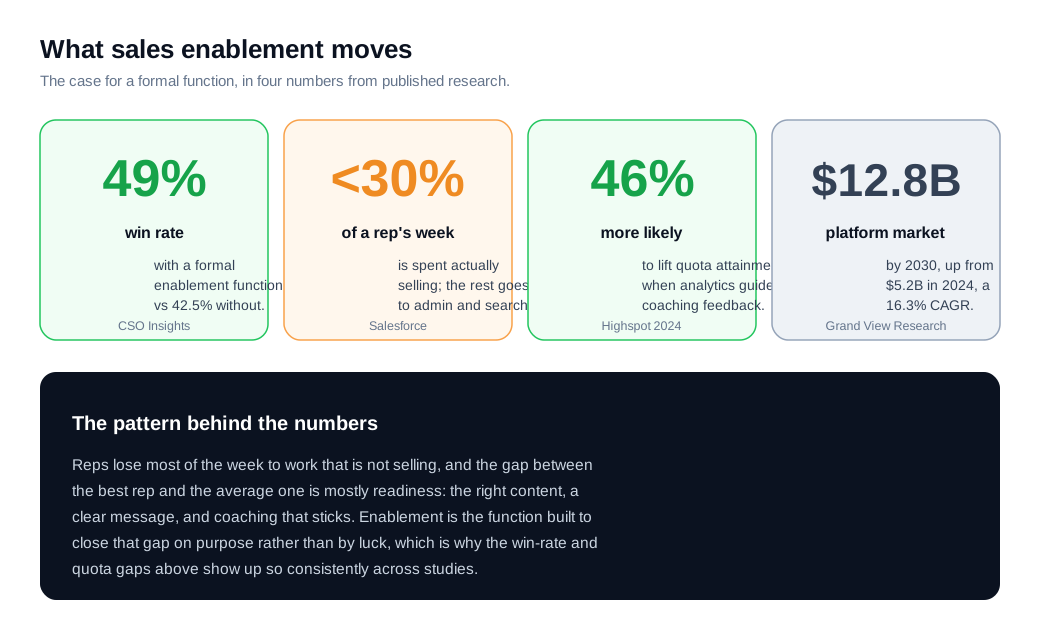
The payoff for closing that gap is well documented. CSO Insights, the research arm behind the widely cited Fifth Annual Sales Enablement Study, found that organizations with a formal enablement function reported a 49% win rate on forecast deals, compared with 42.5% for those without one. The same body of research tied a documented enablement charter to meaningfully higher quota attainment across the sales team.
Coaching quality compounds the effect. Highspot's tenth annual State of Sales Enablement Report found that teams using conversation analytics to guide coaching were 46% more likely to increase rep quota attainment, and teams that measured training effectiveness with analytics were 36% more likely to reduce seller ramp time.
The money is following the outcomes. Grand View Research valued the sales enablement platform market at $5.23 billion in 2024 and projects it will reach $12.78 billion by 2030, a 16.3% compound annual growth rate, in its market analysis. Spending on this scale is a signal that buyers now treat seller readiness as a controllable input to revenue rather than a matter of individual talent.
What does a sales enablement function do?
A sales enablement function owns everything that makes a rep ready to sell: onboarding and training, coaching, sales content, the tech stack, and the process and measurement that tie them together. In practice the work breaks into four pillars that feed each other.
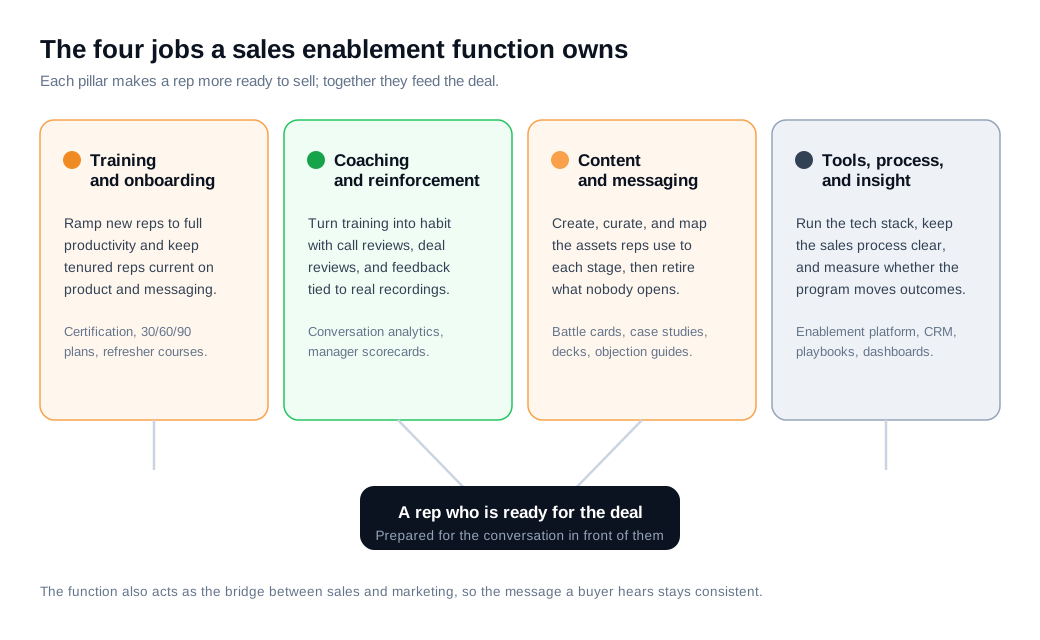
Training and onboarding is the first pillar. Enablement designs the path that takes a new hire from day one to full productivity, then keeps tenured reps current as products and messaging change. This is where structured 30-60-90 plans, certification checkpoints, and refresher courses live, because a rep who cannot explain the product cannot sell it.
Coaching is the second, and it is what turns training into habit. A single workshop fades within weeks unless someone reinforces it against real deals. Enablement runs call reviews and deal reviews, often using recorded conversations, and helps front-line managers coach with a shared scorecard rather than gut feel. This is the pillar that Highspot's data ties most directly to quota attainment.
Content and messaging is the third pillar. Enablement creates, curates, and organizes the assets reps put in front of buyers, maps each one to a stage of the sale, keeps the library current, and retires anything nobody opens. The goal is that a rep finds the right proof in seconds instead of building a one-off from scratch.
The fourth pillar is tools, process, and insight. Enablement runs the enablement platform, keeps the sales process legible, and measures whether the whole program moves outcomes. Across the pillars the function also acts as the bridge between sales and marketing, so the message a buyer hears from a rep matches the message on the website. Team size varies widely, and in many companies a single person carries all four pillars, which makes ruthless prioritization part of the job.
What content and tools does sales enablement provide?
Sales enablement provides two categories of material: the buyer-facing content reps use in front of prospects, and the internal tools and training that get reps ready to use it. Both matter, and confusing them is a common way programs go wrong.
Buyer-facing content is what the prospect actually sees: case studies, one-page overviews, ROI calculators, pricing documents, demo scripts, and proposal templates. Internal, seller-facing content is what the rep uses to prepare: battle cards on competitors, objection-handling guides, discovery question banks, call scripts, and full sales playbooks that string the pieces together by stage.
On the tooling side, the modern stack usually includes a content management or enablement platform, the CRM, a learning system for training, conversation intelligence for call analysis and coaching, and a searchable knowledge base reps can query mid-deal. A tool like an AI chat assistant can also front a knowledge base so a rep, or a buyer researching on the site, gets a straight answer instead of digging through a folder.
The reason all of this needs an owner is that content sprawls and then rots. Forrester has reported that a large majority of the content B2B marketing produces, on the order of 60% to 70%, goes unused by sales, sitting on portals nobody searches, as summarized in Curata's write-up of the Forrester research. Enablement exists partly to fix that: to make the few assets that work easy to find, and to prune the rest so the good material is not buried.
Volume is not the point. A library of two hundred decks that contradict each other slows a rep down. A tight set of assets, each mapped to a real moment in the sale and kept honest with usage data, is what actually helps. Building a clear, searchable knowledge base that reps and buyers can both draw from is often worth more than another quarter of content production.
How is sales enablement different from sales operations?
Sales enablement makes reps better at selling, while sales operations makes the sales machine run. The two functions sit next to each other in most revenue organizations and are easy to confuse, but they answer different questions.
Sales operations owns the systems and the numbers. It administers the CRM, builds forecasts and reports, plans territories and quotas, manages compensation, and keeps the process efficient. When a lead needs to reach the right rep the moment it comes in, that plumbing is an operations job, which is why lead routing and notifications usually live on the ops side of the house rather than with enablement.
Enablement owns readiness. It builds the skills, the content, and the coaching that determine how well a rep performs once ops has put the deal in front of them. Operations makes sure the pipeline is measured and the leads are routed. Enablement makes sure the person receiving the lead knows what to do with it.
The two overlap on tools and process, and in many companies they now report into the same leader under the banner of revenue operations. That consolidation makes sense, because a smooth process with unprepared reps produces the same missed number as a prepared rep buried under broken systems. The useful distinction to keep is direction: operations points at the machine, enablement points at the people running it.
What does sales enablement look like in practice?
In practice, sales enablement looks like diagnosing where a team is losing deals, then building the specific training, content, and coaching that fixes it. A worked example makes the mechanism concrete.
Suppose a B2B software company has 20 reps, an average deal worth $24,000, and a win rate of 22% on qualified opportunities. New hires take about five months to reach full productivity. Reviewing lost deals, the enablement leader spots two patterns: reps fumble the same three competitor comparisons, and newer reps ramp slowly because onboarding is a stack of documents with no checkpoints.
So the leader builds four things. First, a structured onboarding path with a certification a rep has to pass before working live deals. Second, a battle card for each of the three competitors plus a short objection-handling guide, mapped to the exact points in the sale where those objections surface. Third, a trimmed content library of the twelve assets that actually get used, with the duplicates retired. Fourth, a monthly call-review rhythm using conversation intelligence, so managers coach against real recordings instead of memory.
The results below are illustrative, not a guarantee, though the mechanism is real. Say the four pillars lift the team win rate from 22% to 26% as reps handle objections cleanly and reach for the right proof. Across roughly 300 qualified opportunities a year, that team was closing 300 times 0.22 times $24,000, or about $1.58 million. At a 26% win rate it closes 300 times 0.26 times $24,000, about $1.87 million, an extra $288,000 from a four-point move. Onboarding certification pulls ramp from five months toward three and a half, so each new hire starts contributing about six weeks sooner.
None of that required a bigger headcount. It came from making reps ready for conversations they were already having, which is the same instinct behind a strong inbound sales motion: catch the moment of intent, and make sure the person who answers is prepared to win it.
How do you measure sales enablement impact?
You measure sales enablement impact by tying it to business outcomes like win rate, quota attainment, ramp time, and deal size, not by counting how many training sessions you ran. Session counts prove the work happened. They say nothing about whether reps got better or the number moved, so the honest approach measures across three tiers.
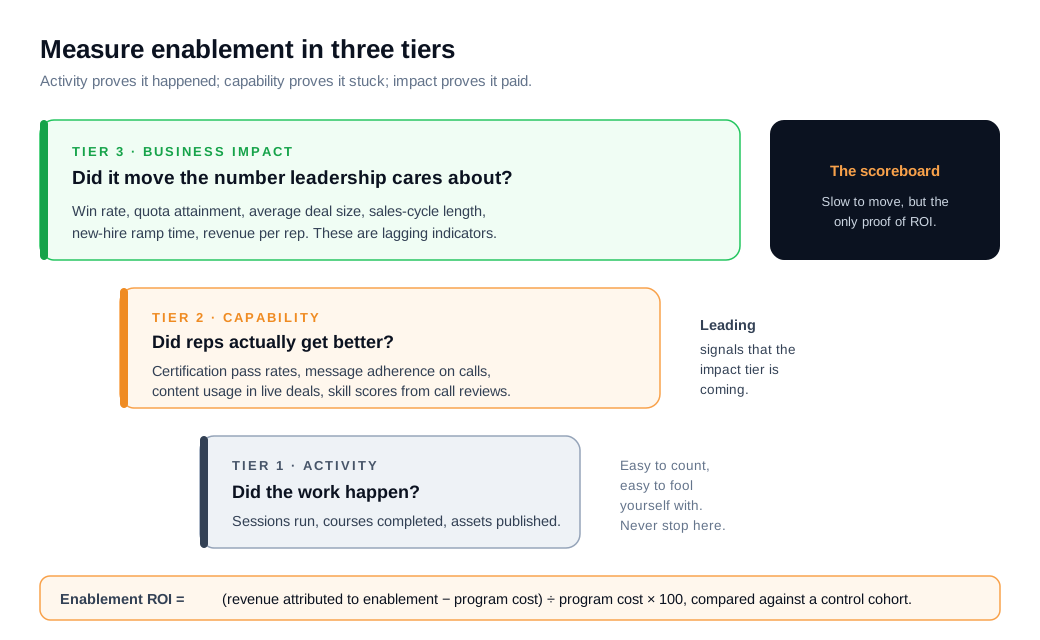
The first tier is activity. Sessions run, courses completed, and assets published are easy to count and easy to fool yourself with. They belong on the dashboard as a check that the program is alive, and nowhere near the top of it.
The second tier is capability, and it asks whether reps actually improved. Certification pass rates, message adherence on recorded calls, content usage inside live deals, and skill scores from call reviews are leading indicators that the impact tier is coming. This is where enablement earns the right to claim credit later, because a rep who is measurably better on calls tends to show up in the win rate a quarter or two on.
The third tier is business impact: win rate, quota attainment, average deal size, sales-cycle length, new-hire ramp time, and revenue per rep. These are lagging indicators, slow to move and heavily influenced by factors outside enablement's control, which is exactly why you triangulate them with the two tiers below rather than reading any single number in isolation.
To translate impact into a return, the working formula is revenue attributed to enablement minus program cost, divided by program cost, times 100. Attribution is the hard part, so the credible way to run it is against a control cohort: compare reps or deals that used a new play, piece of content, or coaching track against a matched group that did not. Without that comparison you are guessing, and a guess dressed up as a percentage is worse than an honest range. Measured across all three tiers, enablement stops being a cost center that runs workshops and becomes a lever you can point at the specific number you need to move.
Key takeaways
- Sales enablement is an ongoing readiness function, giving reps the content, training, coaching, and tools to sell effectively, as Gartner frames it, and it runs continuously rather than as a one-time onboarding week.
- It matters because reps have little time to sell well, spending under 30% of the week selling, and formal enablement is tied to a 49% win rate versus 42.5% without it.
- The function has four pillars, training and onboarding, coaching, content and messaging, and tools with process and measurement, and it bridges sales and marketing so the message stays consistent.
- Content splits into buyer-facing and seller-facing, and the job is findability over volume, since a large share of B2B marketing content goes unused when nobody curates it.
- Enablement and sales operations are complements, with operations running the machine, systems, forecasting, and routing, while enablement builds the people who work the deals.
- Measure across three tiers, activity, capability, and business impact, and prove ROI against a control cohort rather than crediting enablement for every closed deal.

Written by
Daniel SemeckyCo-founder & CEO
Daniel is the co-founder and CEO of Glimpze. He spends his days talking to revenue teams about how to catch high-intent visitors before they bounce, and writes about inbound sales, lead conversion, and building a motion where marketing and sales actually share a number.


