
On this page
A rep is one signature away from the biggest deal of the quarter. The customer wants a 38% discount, quarterly billing instead of annual, and a custom liability clause. The rep pings finance on Slack, forwards a thread to legal, and waits. Four days later the buyer, who had budget approved and real momentum, has gone quiet. The buyer never balked at the price. The deal died waiting for an internal yes.
That queue is exactly what a deal desk exists to fix. It is the function that catches non-standard deals, prices and structures them, and returns a clear answer fast enough that momentum survives. Done well, it is invisible to the buyer and a relief to the rep.
This post covers what a deal desk is, what it does day to day, who staffs it, when a company is big enough to need one, how to stand one up, and how to tell whether it is working.
What is a deal desk?
A deal desk is a cross-functional function, sometimes a full team and sometimes a defined process, that reviews, prices, structures, and approves non-standard commercial deals. Salesforce describes it as a group that streamlines the closing of complex and non-standard deals, coordinating across sales, finance, legal, and operations to handle everything from quote to cash.
The load-bearing word is non-standard. Most deals in a healthy business follow a template: list price, standard terms, a discount inside policy, a signature. Those never need a desk. The desk exists for the deals that fall outside the template, the ones with a deep discount, custom billing, a bespoke service-level commitment, or a legal redline, where a single wrong call costs real margin or creates a liability.
Think of it as a shared brain for hard deals. Instead of every rep improvising an answer to "can I offer this?", the desk holds the pricing logic, the guardrails, and the authority to say yes, so the answer stays consistent and comes back quickly.
What does a deal desk do?
A deal desk reviews and approves pricing and deal structure, making sure each non-standard deal stays inside the company's rules on price, profitability, and risk. Forrester's guidance frames that as the baseline job: check the price structure, the profitability, and the solution components before a quote reaches the buyer.
Mature desks do more. Forrester notes that as a desk grows, it takes on request-for-proposal (RFP) responses, advises reps on how to structure and negotiate complex deals, and starts capturing competitive and business intelligence from the deals it sees. The day-to-day work usually includes:
- Reviewing quotes and configurations for errors before they reach the buyer.
- Approving or reshaping non-standard discounts, terms, and payment schedules.
- Coordinating sign-off from finance, legal, and leadership so the rep does not have to chase each one.
- Advising on deal strategy: how to package, price, and defend a competitive deal.
- Reconciling messy deals at quarter-end and feeding what it learns back into pricing.
The through-line is coordination. A desk sits at the seam between sales, which wants the deal closed, and finance and legal, which want it safe, and it makes that trade-off in one place instead of letting the deal ricochet between inboxes.
Who should be on a deal desk?
A deal desk is staffed by a small core of deal analysts plus named representatives from finance, legal, and operations who get pulled in as each deal requires. Salesforce's overview describes the desk as working closely with sales, finance, accounting, operations, and legal, acting as the liaison between them.
In practice there are three roles. Deal desk analysts run the desk day to day: they read the intake, check the numbers, and own the turnaround. Cross-functional approvers from finance, legal, and product stay on call for the deals that hit their thresholds. Operations specialists keep the systems, the configure-price-quote rules, and the workflows running underneath.
Who the desk reports to varies. Forrester and Salesforce both note it can sit under the CFO, the VP of Sales, the chief revenue officer, or the VP of revenue operations, depending on whether the company treats it mainly as a margin control or a sales accelerator. There is no single correct answer, and the reporting line signals which trade-off the company cares about most.
Team size scales with three things: deal volume, average deal complexity, and how much of the approval flow is automated. A company doing a handful of custom deals a quarter can run the desk as one analyst's part-time job. A high-volume enterprise motion might need several analysts plus dedicated finance and legal partners.
When does a company need a deal desk?
A company needs a deal desk when enough of its deals stop fitting the standard playbook that approvals become a recurring bottleneck. The trigger is rarely headcount or revenue on its own. It is deal complexity: the share of deals that need a custom price, a non-standard term, or a legal change.
The clearest signal is the first real enterprise deal. Enterprise buyers routinely ask for volume discounts, milestone or quarterly billing, custom service levels, and bundled services, and each of those is a decision someone has to own. DealHub notes that the common triggers are frequent order-form errors and slow approvals, the exact symptoms that surface once non-standard deals become regular rather than rare.
A useful rule of thumb, common in revenue operations circles, is that once roughly one in five of your deals falls outside the standard playbook, it is time to formalize a desk. Below that, ad hoc approvals from a manager work fine. Above it, the exceptions are frequent enough to need an owner and a process.
Here is a worked example. Picture a Series B SaaS company closing about 120 deals a quarter. A year ago almost all of them were self-serve or light-touch at list price. Now the company is moving upmarket, and 26 of those 120 deals, just over one in five, involve a discount past policy, custom billing, or a redlined contract. Each one currently pings the VP of Sales and the CFO directly over Slack, and the average approval takes three to five days of back-and-forth. Two deals slipped last quarter because the buyer cooled while waiting. That company has crossed the line. The cost of not having a desk (slipped deals, inconsistent discounts, a VP acting as a bottleneck) now outweighs the cost of standing one up.
Speed is the hidden tax here. Salesforce's State of Sales research found reps spend under 30% of their time actually selling, with chasing internal approvals among the tasks that eat the rest. Every day a deal sits in a queue is a day the rep manages process instead of selling, and a day the buyer's momentum decays. Fast, rule-based routing and notifications for approval requests is one lever that turns a multi-day queue back into a same-day answer.
How do you set up a deal desk?
You set up a deal desk by defining what counts as non-standard, building an intake-to-decision process with clear owners and deadlines, and publishing an approval matrix so no one has to guess who signs off. Umbrex's playbook lays the process out in five stages: intake, review, decision, execution, and learn.
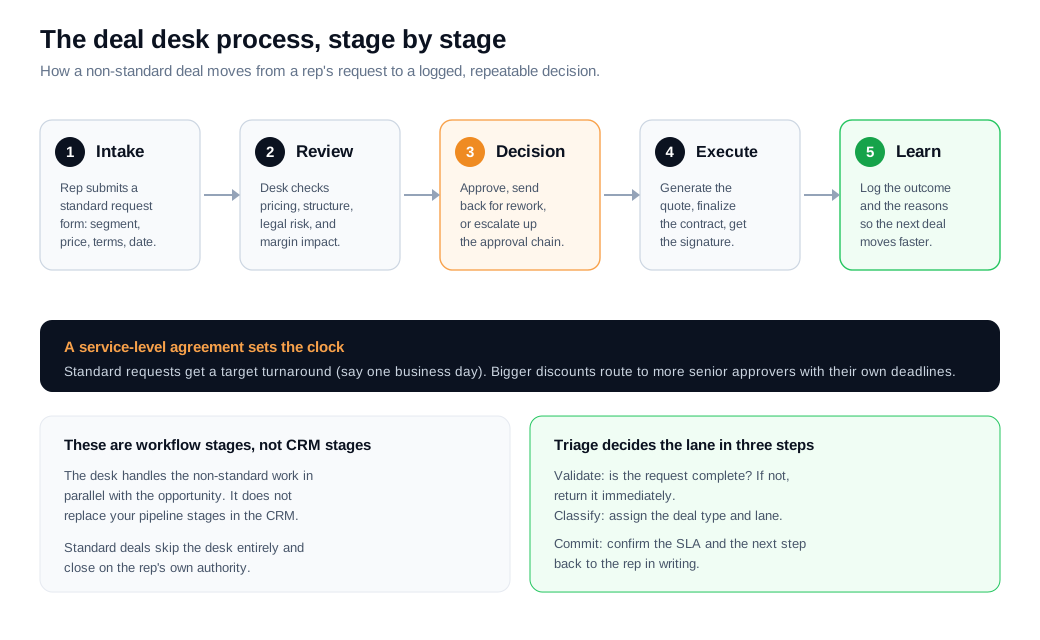
Start with intake. Build one standard request form that captures the account segment, the proposed price versus list, the discount and any non-standard terms, and the close date. Umbrex's guidance on triage keeps this tight: validate that the request is complete (and return it at once if it is not), classify the deal type and lane, then commit an SLA and next step back to the rep in writing. A form that is too long goes unused, and one that is too short means chasing missing details later.
Then set the rules. Two artifacts do most of the work: a service-level agreement that says how fast each type of request gets an answer, and an approval matrix that maps discount and deal size to the person who can approve it. The SLA protects momentum, and the matrix removes the "who do I even ask?" question.
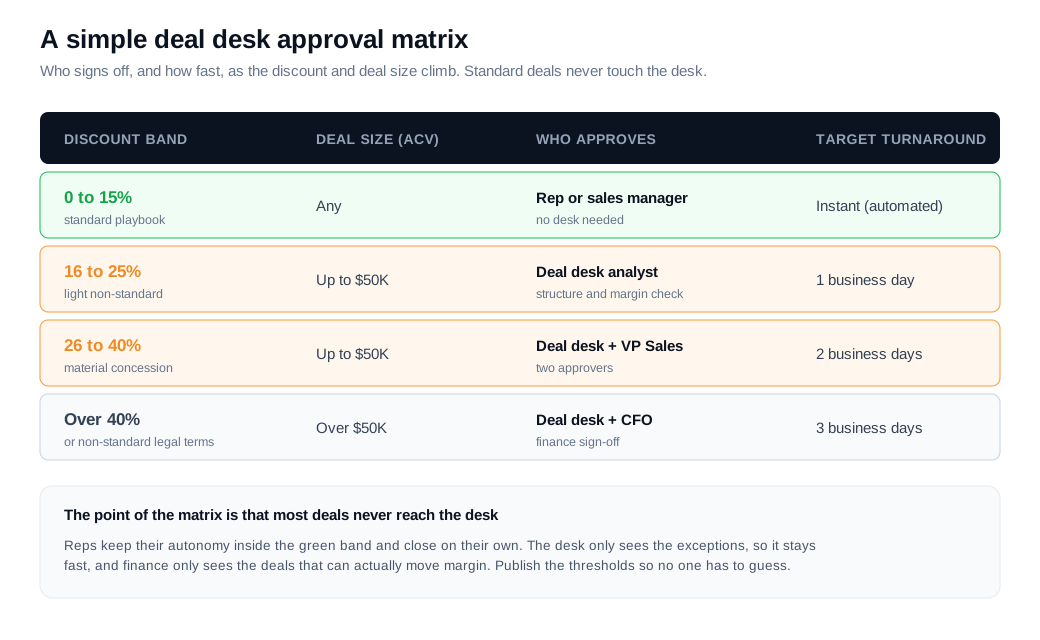
Here is a worked version of that matrix. Discounts of 0 to 15% stay with the rep or their manager and clear instantly, no desk involved. A 16 to 25% discount up to $50K in annual contract value routes to a deal desk analyst with a one-business-day target. A 26 to 40% discount adds the VP of Sales as a second approver and a two-day target. Anything past 40%, or any deal over $50K with non-standard legal terms, needs the CFO to sign off, with a three-day target. DealHub describes the automated version: configure-price-quote (CPQ) rules flag a discount over the threshold and hold the quote until the right approver clears it. Whatever the numbers, the principle holds. Most deals stay in the bottom band and never reach the desk, which is what keeps the desk fast.
Finally, close the loop. The fifth stage, learn, is the one teams skip. Log every decision and its reason, then review the pattern. If the desk keeps approving the same 30% discount for a given segment, that is a signal to move it into standard policy so reps can grant it without a ticket. A desk that never feeds its decisions back into pricing just becomes a slower approval queue.
How do you measure whether a deal desk is working?
You measure a deal desk by comparing the deals it supports against the deals it never touched, across five metrics: cycle time, win rate, discount rate, margin, and leakage. Umbrex's metrics guidance frames these five as the balance between speed, commercial outcome, and value protection.
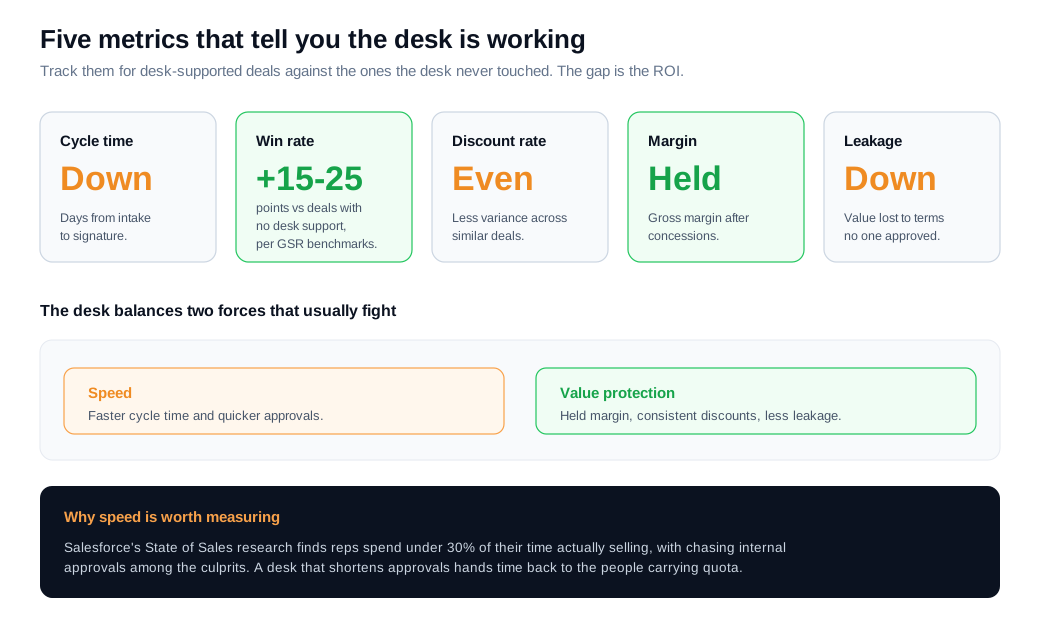
Cycle time and approval turnaround measure speed: how many days from intake to a decision, and from decision to signature. Win rate measures whether the desk helps deals close. GSR's analysis of deal desk KPIs describes a win-rate premium of 15 to 25 percentage points on desk-supported deals versus comparable deals without support, which is the clearest single sign the desk earns its keep.
The other three protect value. Discount consistency checks that similar deals in the same segment get similar discounts, so pricing stays fair and defensible. Margin tracks gross margin after every concession is counted. Leakage measures value lost to terms and discounts that slipped through without proper approval. A desk that closes deals fast but bleeds margin is failing, and so is one that guards margin so hard that deals die in the queue.
For the upside case, Asana's guide cites figures, attributed to PwC, that a deal desk can cut sales cycle times by up to 40% and lift sales productivity by up to 20%. Treat those as a ceiling rather than a promise and measure your own before-and-after, but the direction is consistent: faster approvals, more consistent pricing, more selling time returned to the team.
What are the signs a deal desk is slowing you down?
The clearest sign a deal desk has become a bottleneck is that reps start routing around it, and the fix is almost always scope, not more headcount. A desk is meant to remove friction from hard deals, so when it adds friction to easy ones, something is misconfigured.
Watch for three failure modes. The first is scope creep, where standard deals get dragged into the desk because the thresholds sit too low. Widen the bottom band so reps keep their autonomy. The second is a missing or ignored SLA, where requests sit for a week because no one owns the clock. Publish a turnaround and add an escalation rule when it is missed. The third is a desk that approves but never learns, so the same exceptions keep coming back as tickets instead of becoming policy.
A deal desk is worth having when your non-standard deals are frequent, valuable, and slow. It is overhead when your deals are simple and your reps could close them alone. The honest test is the worked example above: count the share of deals that fall outside your playbook, and time how long approvals actually take. If both numbers are climbing, a desk will pay for itself. If they are low and stable, keep approvals lightweight and revisit the question next year, when a serious inbound sales push into larger accounts may change the math.
Key takeaways
- A deal desk owns your non-standard deals. It is the cross-functional function that prices, structures, and approves the deals that fall outside your standard playbook, so reps stop improvising and margin stops leaking.
- Its core job is fast, safe approvals. The desk checks price, structure, and risk, coordinates finance and legal sign-off, and returns a decision before the buyer's momentum fades.
- Deal complexity is the trigger, not company size. When roughly one in five deals needs custom pricing or terms, and approvals start slipping deals, it is time to formalize a desk.
- Setup is a process, not a hire. Build a standard intake form, a service-level agreement, and a published approval matrix that keeps most deals off the desk entirely.
- Measure supported versus unsupported deals. Track cycle time, win rate, discount consistency, margin, and leakage, where a real desk shows a clear win-rate and speed premium.
- A desk that adds friction to easy deals is misconfigured. Widen the thresholds, enforce the SLA, and feed repeat approvals back into standard pricing.

Written by
Daniel SemeckyCo-founder & CEO
Daniel is the co-founder and CEO of Glimpze. He spends his days talking to revenue teams about how to catch high-intent visitors before they bounce, and writes about inbound sales, lead conversion, and building a motion where marketing and sales actually share a number.


