
On this page
- What is social proof, and why does it move conversions?
- What types of social proof exist?
- How much does social proof actually lift conversions?
- How do reviews and logos affect trust?
- How many reviews do you need, and does a perfect rating help?
- Where should you place social proof?
- How do you avoid fake-looking social proof?
- Key takeaways
- Sources
A visitor lands on your pricing page, likes what they see, and then stops. The product looks right and the copy is clear, but they have never heard of you, and buying means trusting a stranger with money. What usually breaks that stall is a signal that other people, ideally people like them, already made the same choice and were glad they did.
That signal is social proof, and it is one of the more reliably measurable levers in conversion work. Northwestern's Spiegel Research Center found that showing reviews on a product page raised its purchase likelihood by as much as 270%. The catch is that social proof done carelessly can work in reverse, reading as staged or generic enough to lower trust rather than raise it.
This post covers what social proof is and why it works, the main types, how much it actually lifts conversions, how reviews and logos build trust, how many reviews and what rating you need, where to place it, and how to keep it from looking fake.
What is social proof, and why does it move conversions?
Social proof is the tendency for people to copy the actions of others when they are unsure what to do, and it moves conversions because buying from an unfamiliar company is exactly the kind of uncertain decision where we look to the crowd for a cue.
The idea was named by psychologist Robert Cialdini in his 1984 book Influence, where he listed it among the core principles of persuasion. The Nielsen Norman Group describes the same mechanism for interfaces in its work on social proof in the user experience: people are guided by other people's behavior, so a design can represent the crowd's actions to influence a user. Under uncertainty we assume others know something we do not, and their choices become a shortcut.
On a website that uncertainty runs high. The visitor cannot hold the product, cannot read your face, and has no relationship with you yet. Reviews, ratings, customer counts, and recognizable logos stand in for the reassurance a friend's recommendation would give. NN/G's research on trustworthy design frames it from the trust side: credibility is built gradually as skepticism is overcome, and visible evidence that others already rely on you is one of the fastest ways to move a doubtful visitor along.
The effect is strongest when the proof comes from people the visitor sees as similar to themselves. A B2B buyer cares more that three companies in their own industry use you than that you have a million total users somewhere. Hold on to that similarity idea, because it decides which proof to show where.
What types of social proof exist?
Social proof comes in several distinct types, and each answers a different question in the buyer's head, so the strongest pages combine a few rather than leaning on one.
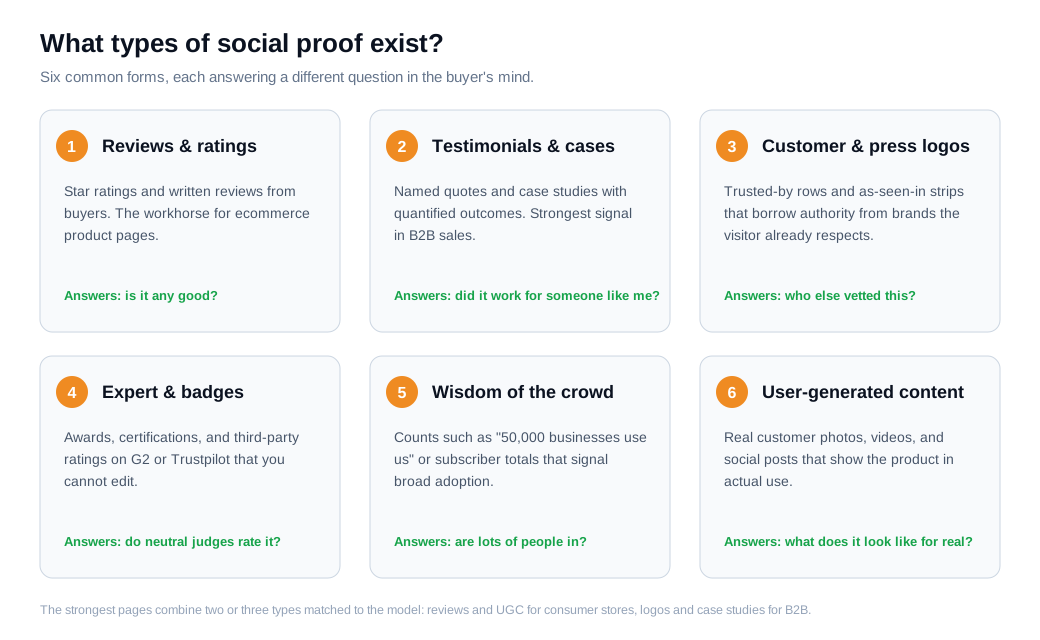
Reviews and ratings are the workhorse for ecommerce, pairing a star average with written detail about what buyers actually experienced. Testimonials and case studies do the same job for higher-consideration and B2B purchases, where a named quote with a quantified outcome carries more weight than a star count. Customer and press logos, the "trusted by" row and the "as seen in" strip, borrow authority from brands the visitor already respects.
Three more rounds it out. Expert and third-party signals include awards, certifications, and ratings on independent sites like G2 or Trustpilot that a company cannot edit. Wisdom-of-the-crowd proof uses numbers, such as "50,000 businesses use us" or a subscriber count, to signal broad adoption. User-generated content, the photos, videos, and social posts real customers make, shows the product in genuine use and tends to read as the most authentic of all.
The aim is to answer several questions at once, because a shopper who is convinced the product is good may still wonder whether anyone like them has actually bought it.
How much does social proof actually lift conversions?
Social proof can lift conversions by double or triple digits, though the size of the effect depends on the price of what you sell and how much proof was already there.
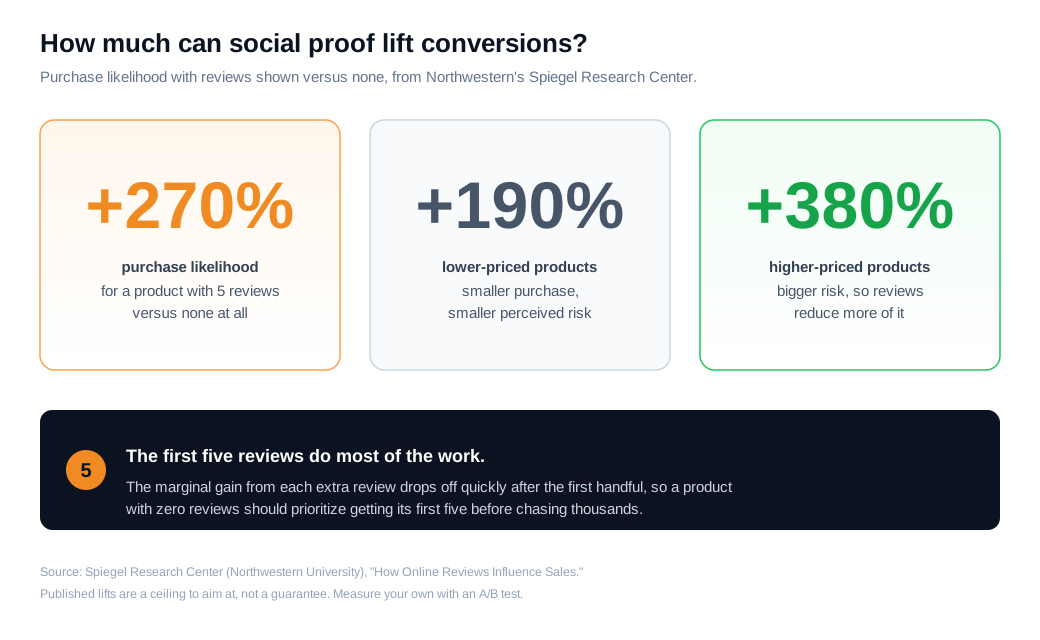
The most cited figures come from the Spiegel Research Center, which analyzed reviews and sales across a large consumer-goods retailer and a high-end retailer. Showing reviews raised the purchase likelihood of a product by 270% compared with showing none. The effect scaled with price: for lower-priced products the lift was around 190%, and for higher-priced ones it reached 380%, because a bigger purchase carries more perceived risk and reviews reduce more of it.
Field tests point the same direction. In a VWO case study, the recruitment site WikiJob added three short customer testimonials to a landing page and saw purchases climb 34%.
Here is the arithmetic on an ordinary page. Say a SaaS pricing page draws 8,000 visitors a month and converts 2% of them to a free trial, which is 160 trials. You add a strip of six named customer logos and a three-line testimonial with a specific outcome next to the primary button. If that lifts trial conversion to 2.5%, roughly a quarter of what the strongest tests report, you now collect 200 trials from the same traffic. That is 40 more trials a month, 480 a year, with no extra ad spend. Because social proof is a page element rather than a traffic channel, the lift applies to every visitor who was already going to see the page.
Treat published numbers as a ceiling to aim at, not a promise. The gains depend on execution and placement, so add the proof and measure your own lift with an A/B test rather than assuming someone else's percentage.
How do reviews and logos affect trust?
Reviews and logos build trust by transferring credibility the visitor already has: reviews from other buyers who took the same risk, and logos from brands the visitor already respects.
Reviews reduce uncertainty by answering the questions your marketing copy cannot admit to. That is why buyers weight them so heavily. BrightLocal's 2024 consumer review survey found that 49% of consumers trust online reviews as much as personal recommendations from friends and family. Where the review lives changes its weight, too. NN/G notes that people tend to trust testimonials on independent sites more than the glowing ones a company hand-picks for its own page, which is part of why a visible Google or G2 rating often lands harder than an on-site quote.
Responding to reviews matters as much as collecting them. In the same BrightLocal survey, 88% of consumers said they would use a business that replies to all of its reviews, compared with 47% for a business that never responds. A calm, public reply to a critical review signals a real company that stands behind its product, which reassures the next reader far more than a wall of untouched praise.
Logos work through borrowed authority. A row of recognizable customer logos tells a B2B visitor that companies they respect already vetted this and stayed, collapsing months of due diligence into a glance. The effect hinges on relevance and honesty: logos of firms in the visitor's own industry beat bigger but unrelated names, and a logo you are not entitled to display is both a trust risk and, if it implies an endorsement that never happened, a legal one.
There is a live version of the same signal. When a visitor can see that a real person answers within seconds over live chat, the responsiveness itself works as proof that a staffed, accountable business sits behind the page. For inbound sales teams, that in-the-moment answer both converts the individual visitor and demonstrates, right then, the service that every testimonial on the page is quietly promising.
How many reviews do you need, and does a perfect rating help?
You need far fewer reviews than most people assume, since the first five carry most of the lift, and a flawless five-star average actually converts worse than a slightly imperfect one.
Spiegel's data shows that the jump from zero to five reviews delivers most of the 270% swing, and the marginal benefit of each additional review drops off quickly after that. A product with no reviews should treat getting its first handful as the priority, because you do not need thousands to capture the bulk of the value.
The rating number is where intuition misleads people. Spiegel found that purchase likelihood peaks in the 4.0 to 4.7 range and then declines as the average approaches 5.0. A perfect score reads as filtered or fake, while a 4.5 with a few three-star reviews reads as honest. An occasional negative review, answered well, can raise conversion by making the positive ones believable.
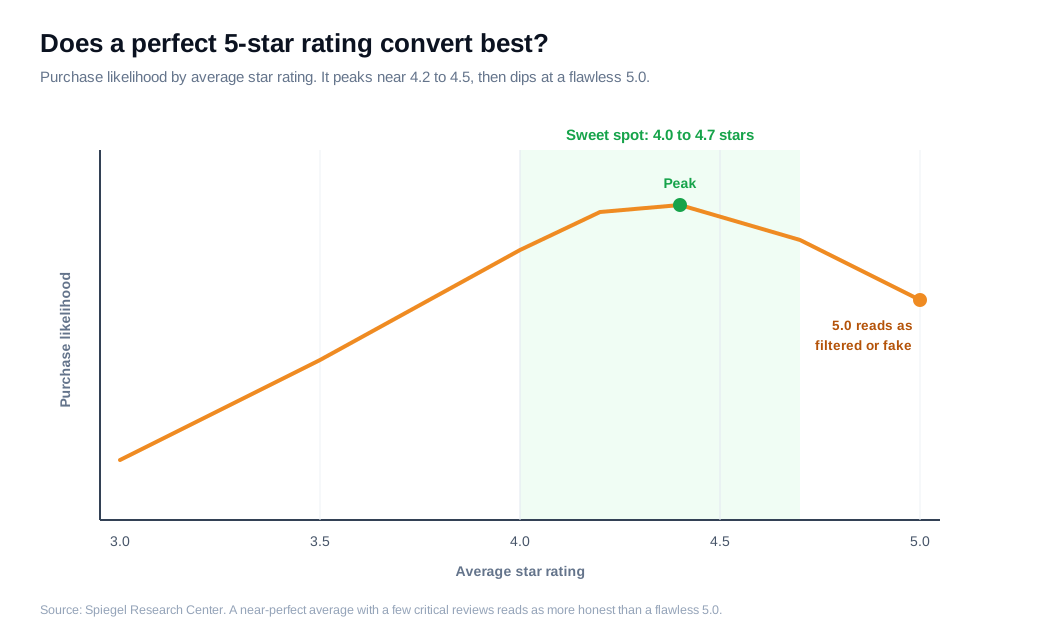
How you present the numbers matters as well. The Baymard Institute found that shoppers distrust a star average when they cannot see how many ratings it is based on, so you should always show the review count alongside the average and, where you can, the full distribution. A 5.0 from two reviews is weaker proof than a 4.4 from four hundred, and only the count tells the visitor which they are looking at.
The practical version is short. Collect at least a handful of recent reviews on every key product or plan, show the count and the star breakdown, and resist the urge to scrub every criticism into a suspiciously spotless average.
Where should you place social proof?
Place social proof at the moments of doubt, next to the price, the signup button, and any claim a visitor is likely to question, because proof only works if it is in view exactly when hesitation strikes.
The WikiJob test makes the case cleanly. As documented in the VWO case study, the same three testimonials had no discernible effect when they sat lower on the page, then lifted purchases 34% once they were moved above the fold, near the decision. Placement, rather than the testimonials themselves, produced the win.
A few placement rules follow from that. Put a short quote or a rating strip right beside the primary call to action, so the last objection is answered in the same glance as the button. On the pricing page, the highest-doubt moment on most sites, add a plan-specific testimonial or a customer logo row at the point of commitment. On product and category pages, show star ratings where the visitor is actively comparing options. In each case, match the proof to who is on that page and how far along they are.
For complex or high-consideration purchases, doubt often collects around one specific unanswered question rather than a general lack of trust, and a static testimonial cannot address it. That is the point to offer a real-time answer, through live chat or a proactive nudge, so the visitor gets their exact reassurance instead of leaving the page to hunt for it elsewhere.
How do you avoid fake-looking social proof?
You avoid fake-looking social proof by keeping it specific, verifiable, and honestly sourced, because a testimonial that reads as staged does more damage than no testimonial at all, and since October 2024 fabricated reviews are also illegal in the United States.
The legal floor changed with the FTC's final rule on consumer reviews and testimonials, effective October 21, 2024. It bans creating, buying, or selling fake reviews, including AI-generated ones, paying people to write reviews that express a particular sentiment, and using insider reviews from employees or their families without clearly disclosing the relationship. For knowing violators, penalties reach up to $51,744 per violation.
Beyond the law, fakes fail on their own terms because shoppers have learned to spot the seams. The tells are familiar: a wall of five-star reviews with no criticism anywhere, vague quotes like "Great product, highly recommend" with no name attached, stock-photo faces, and an "as seen in" strip you cannot actually back up. Fake social proof is worse than none, because getting caught costs you the trust you were trying to build.
Real proof looks different. Use full names, roles, and companies, with a link or photo the visitor could check when the customer allows it. Favor specific, quantified outcomes, since "cut our response time from six hours to nine minutes" carries more than generic praise. Let the ratings show their natural spread, including the occasional three-star, which the Spiegel rating curve suggests actually helps. Lean on third-party ratings from Google, G2, or Trustpilot that the visitor knows you cannot edit. And use real-time counters only when the events behind them are genuine, since a fabricated "someone just bought this" popup is both a trust risk and, under the new rule, a prohibited fake indicator.
NN/G's principle of up-front disclosure applies throughout: label any sponsored or incentivized review clearly. Honesty here is far cheaper than rebuilding trust after a visitor notices the seam.
Key takeaways
- Social proof works because buying is an uncertain decision. Facing an unfamiliar company, visitors look to the crowd for a cue, and evidence that similar people already chose you is what breaks the stall.
- Combine a few types matched to your model. Consumer stores lean on reviews and user-generated content, while B2B leans on named logos, case studies, and third-party ratings that answer different buyer questions at once.
- The first few reviews do the heavy lifting. Spiegel found five reviews raised purchase likelihood by 270%, with sharply diminishing returns after that and a larger effect on higher-priced products.
- A perfect rating converts worse than a near-perfect one. Purchase likelihood peaks around 4.0 to 4.7 and dips at 5.0, so show the review count and distribution rather than chasing a spotless average.
- Placement decides the payoff. WikiJob's testimonials did nothing low on the page and lifted sales 34% once moved above the fold, so put proof next to the price and the button where doubt actually happens.
- Fake-looking proof costs more than none, and is now illegal. Keep testimonials specific and verifiable, since the FTC's 2024 rule bans fabricated reviews with penalties up to $51,744 per violation.
TAGS

Written by
Nilas MylerCo-founder & CTO, Glimpze
Nilas is the co-founder and CTO of Glimpze, an inbound sales tool that turns high-intent website visitors into live conversations. A former SEO consultant for some of the largest companies in Denmark, he writes about speed-to-lead, inbound sales, and conversion rate optimization — the technical and operational mechanics of turning traffic into pipeline.


