On this page
Somewhere between the signup form and the pricing page, most of your trial users quietly decide not to become customers. They don't email you to say why. They just stop logging in.
If you've ever pulled up your trial-to-paid number and had no idea whether it's good, bad, or completely normal, you're not alone: the range across real SaaS companies is wide enough that a single "average" is close to useless.
This post covers what a good free trial conversion rate actually looks like broken out by trial type, why requiring a credit card upfront changes the number so much, what the data says about why trials fail to convert in the first place, and what to actually do about it.
What's a good free trial conversion rate in 2026?
The honest answer is: it depends almost entirely on whether your trial requires a credit card upfront, more than it depends on your industry, your pricing, or your product.
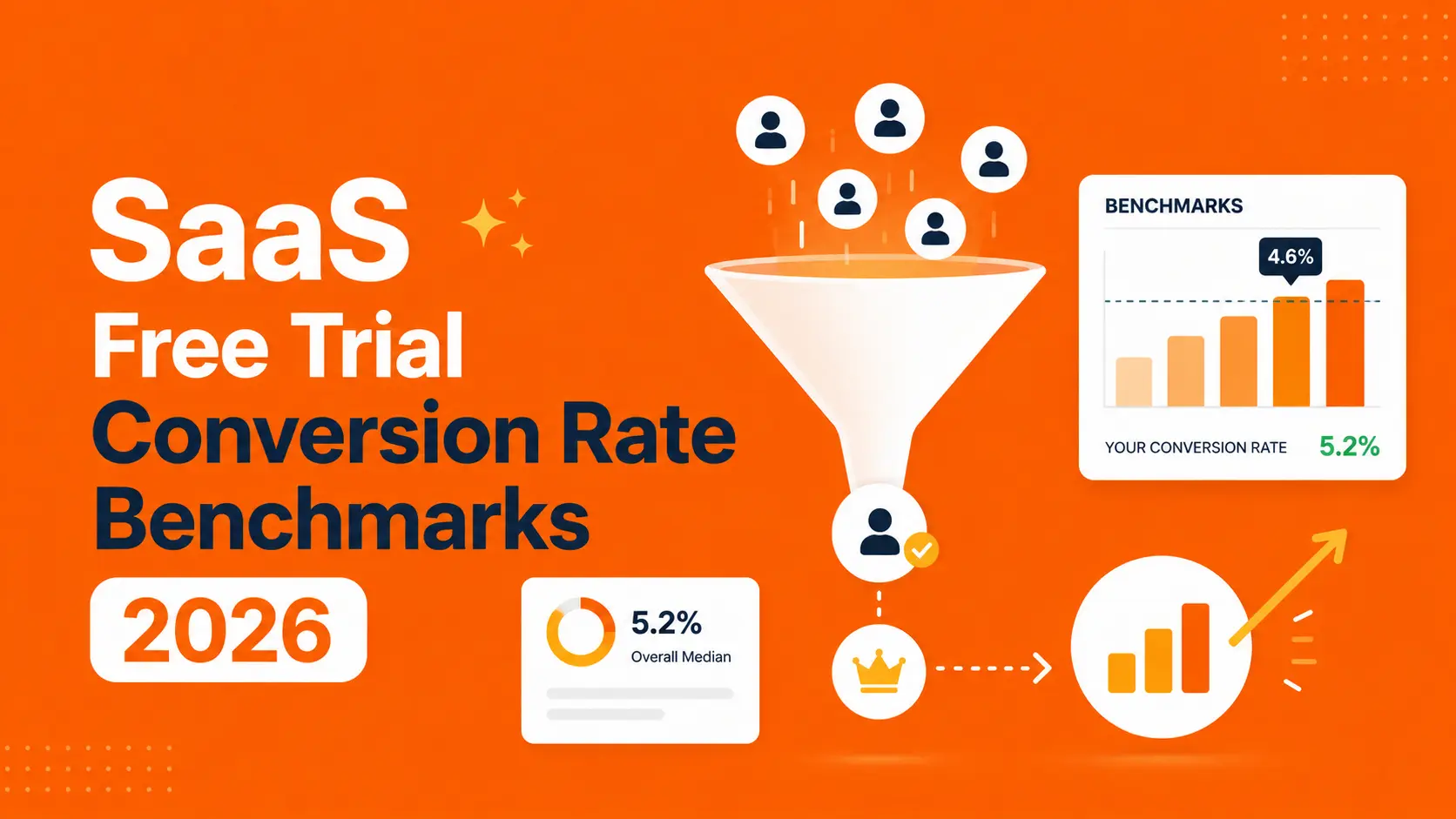
ChartMogul's SaaS Conversion Report, built with ProductLed from a January 2026 survey of 200 B2B software products, found a median free-to-paid conversion rate of 8% across all products.
Then a spread so wide that the median barely matters: 20% of free-trial products convert below 2.5%, while roughly a quarter convert above 25%.
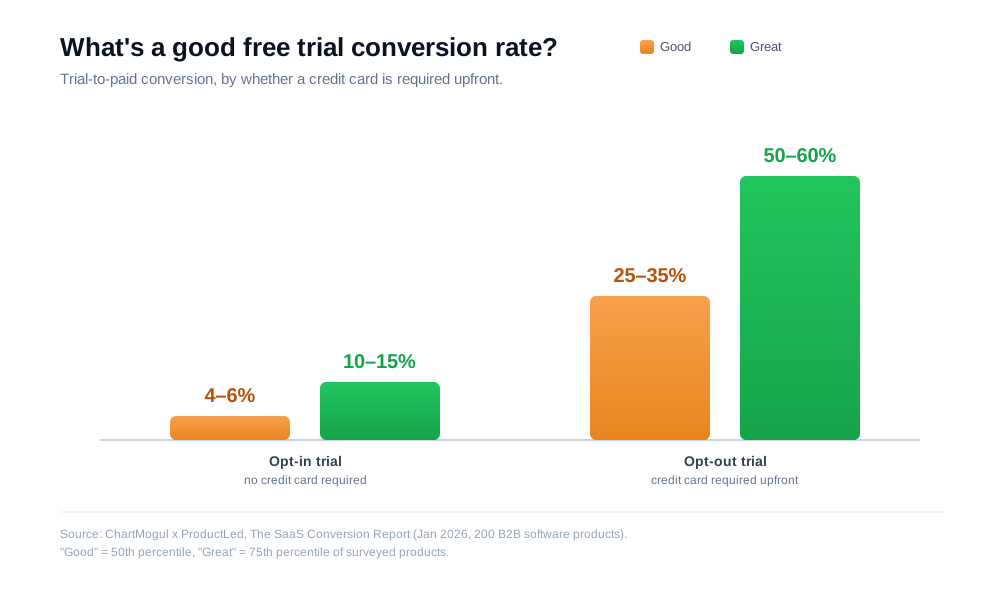
Split by trial type, the picture gets much clearer:
- Trials that don't require a credit card: 4 to 6% is a good conversion rate, 10 to 15% is a great one.
- Trials that do require a credit card upfront: good jumps to 25 to 35%, great climbs to 50 to 60%.
First Page Sage, an agency that tracks its own base of 86 SaaS clients (71% B2B, 29% B2C) going back to Q1 2022, found the same pattern independently: opt-in trials convert to paid at 18.2% on average, while opt-out (credit card required) trials convert at 48.8%, close to three times higher.
Two different datasets, collected two different ways, land on the same conclusion: the credit card requirement is the single biggest lever on your conversion number, bigger than industry, bigger than trial length, bigger than most of what a CRO checklist usually tells you to test first.
Why does requiring a credit card change the number so much?
It comes down to who's making the decision and when.
In an opt-in trial, a user has to take a deliberate, active step to become a paying customer once the trial ends: enter payment details, confirm a plan, commit. Plenty of people who got real value from the product still don't get around to it before the trial expires, or decide the friction of typing in a card isn't worth it for a tool they were only half-sure about.
In an opt-out trial, that decision already happened at signup. The user who enters a card at the start has pre-committed; unless they actively cancel, they convert by default. That's a fundamentally different psychological moment, and it shows up directly in the conversion math.
But the credit card requirement doesn't only change conversion. It also changes who signs up in the first place, and by how much matters more than most CRO advice accounts for.
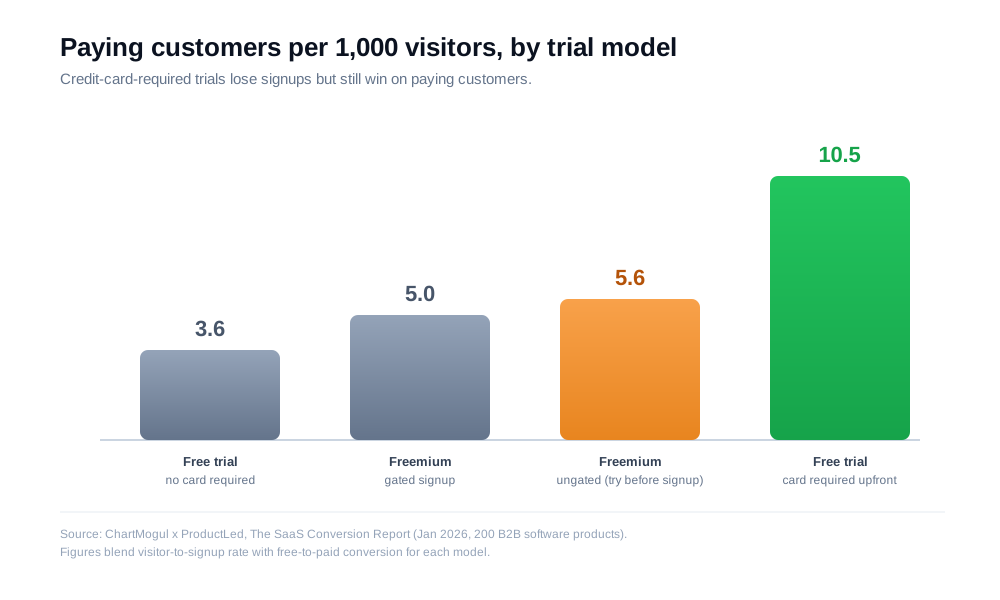
Per ChartMogul's data, for every 1,000 website visitors:
- A no-card free trial produces about 45 signups and 3.6 paying customers.
- A gated freemium product produces 90 signups and 5 paying customers.
- An ungated freemium experience, where people can use the product before creating an account, produces 70 signups and 5.6 paying customers.
- A card-required trial produces just 35 signups, the fewest of any model, but 10.5 paying customers, the most of any model.
That last number is the one worth sitting with. Requiring a credit card cuts your signups by more than half compared to a no-card trial, and you still end up with roughly three times the paying customers.
The tradeoff only makes sense if your product is ready for that friction: if the value is obvious enough, fast enough, that the people willing to hand over a card are the people who were always going to buy.
Bolt a card requirement onto a product that needs time to prove itself, and you'll mostly just kill your signup volume without the conversion lift to make up for it.
Why trials fail to convert even when people sign up
A trial user who never logs in again after day one was never going to convert, regardless of what your pricing page or email sequence does afterward.
Amplitude's 2025 Product Benchmark Report, based on data from more than 2,600 companies, found that even top-performing products (the 90th percentile) see activation drop from 21% on day 1 to 12% by day 7 and down to 9% by day 14.
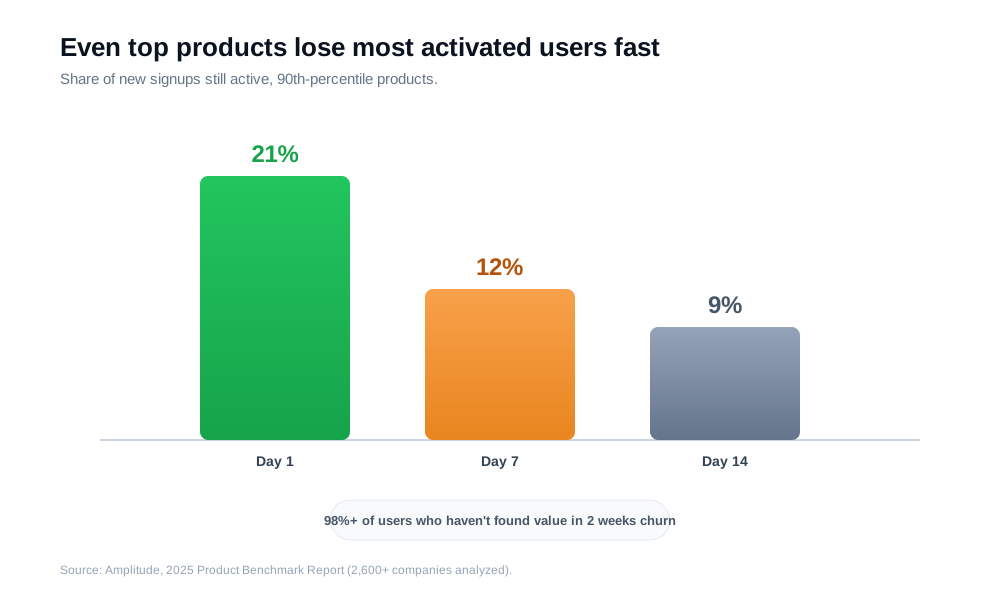
The report's more striking finding is what that early drop-off predicts: products with strong seven-day activation were also strong three-month retention performers 69% of the time.
Users who don't reach a real "aha" moment in the first few days rarely come back to find it later; more than 98% of users who haven't experienced value within two weeks are gone for good.
Trial conversion isn't decided on the day the trial ends. For most users, it's decided in the first 24 to 72 hours, long before pricing ever enters the picture.
This reframes what "improving trial conversion" actually means. A better pricing page or a sharper end-of-trial email can only convert the users who were already activated. The bigger lever is getting more people to activation in the first place, and fast.
How to actually improve your trial conversion rate
Shorten the distance to the first real "aha" moment. Look at what your best customers did in their first session before they became convinced. Then redesign onboarding to get every new trial user to that exact moment as directly as possible, cutting anything that isn't required to get there.
Sample data, pre-filled templates, and skippable setup steps all help; a long profile-completion flow before someone can touch the actual product works against you.
Match your trial model to how fast your product proves itself. If a new user can see clear value in their first session, a credit-card-required trial is worth testing since your product is fast enough to earn that friction.
If value only becomes obvious after real usage or setup, forcing a card upfront will mostly cost you signups you needed to nurture toward conversion the slower way.
Watch the first 3 days more closely than the last 3. Since un-activated trials in the first few days rarely activate later, that's where intervention has the most leverage.
A check-in email, an in-app nudge, or a real conversation triggered by specific behavior (someone who signed up and never completed setup, or who explored pricing but hasn't used a core feature) does more for conversion than anything you can add to the pricing page at the end.
Don't leave hesitation to a support ticket. A trial user who hits a wall, a permissions question, an integration that doesn't behave as expected, an "is this actually right for my team" doubt, either finds an answer immediately or quietly churns.
Most tools only offer a contact form or a help center article for this moment, and most people don't use either. We built Glimpze around exactly this gap: proactive triggers can start a live conversation with a trial user at the exact point they're stuck (on a specific page, after a specific amount of time, or after a specific action), instead of waiting for them to go looking for help on their own. See how this fits into a broader funnel strategy on our CRO use case page.
Track trial-to-paid separately from visitor-to-signup. As the funnel data above shows, a model that wins on signups can lose on paying customers, and vice versa.
Optimizing one number in isolation can make the other worse. Report both, and treat the combination, not either number alone, as the metric that matters.
Free trial conversion rate: FAQs
What is a good free trial conversion rate for SaaS?
It depends on your trial model. For trials that don't require a credit card, 4 to 6% is a good trial-to-paid conversion rate and 10 to 15% is great, per ChartMogul's 2026 survey of 200 B2B software products. For trials that require a credit card upfront, good is 25 to 35% and great is 50 to 60%.
Comparing your number to an industry average without accounting for which model you run will give you the wrong read on how you're actually doing.
Does requiring a credit card actually increase revenue, not just conversion rate?
Usually, but not automatically. Credit-card-required trials convert to paid at roughly 3 to 5 times the rate of no-card trials, but they also produce far fewer signups (research from ChartMogul found roughly 35 signups per 1,000 visitors for card-required trials versus around 45 to 90 for other models).
The net effect on paying customers was still positive in ChartMogul's data (10.5 per 1,000 visitors versus 3.6 to 5.6 for other models), but that only holds if your product proves its value fast enough to justify the extra friction at signup. Test it rather than assuming it.
How long should a free trial be?
There's no universal answer, and the data on trial length is less decisive than the data on credit card requirements. What matters more than the number of days is whether your onboarding gets users to real value inside whatever window you choose.
A 14-day trial (the most common length, used by 62% of products in ChartMogul's survey) that wastes its first week on setup performs worse than a 7-day trial that gets users to value on day one.
Is freemium or a free trial better for conversion?
Neither wins outright, and the honest answer is that it's the wrong first question to ask. ChartMogul's data shows free trials converting slightly higher than freemium overall (8% vs. roughly 5.5%), but freemium products generate far more signups, so the total number of paying customers ends up close either way for the standard versions of each model.
The bigger driver is a different fork entirely: whether you gate the experience behind a signup at all, and whether you ask for a credit card. Choose based on how fast your product proves value and how much friction your signup flow can absorb, not based on which model sounds more common.
How quickly do I need to show new trial users value?
As quickly as you possibly can. Amplitude's research found that even top-performing products lose more than half their activated users between day 1 and day 7, and products with strong activation in the first week were also strong three-month retention performers roughly 69% of the time.
If a trial user hasn't experienced real value within roughly two weeks, they're very unlikely to convert or stick around, regardless of what happens afterward.
Key takeaways
- Trial model matters more than industry. Whether your trial requires a credit card upfront predicts your conversion rate far more reliably than what industry you're in. No-card trials: 4-6% good, 10-15% great. Card-required trials: 25-35% good, 50-60% great.
- The credit card tradeoff is real, not free. Card-required trials get roughly half the signups of no-card trials, but still produce more total paying customers, so long as your product proves value fast enough to earn that friction at signup.
- Conversion is mostly decided in the first few days. Activation drops sharply between day 1 and day 14 even for top performers, and early activation strongly predicts long-term retention. The pricing page matters less than what happens in a user's first session.
- Freemium vs. free trial is the wrong first question. Both convert similarly once you account for signup volume. Whether you gate access at all, and whether you require payment info, matters more than which label you put on the model.
- The biggest wins happen before the trial ends, not at the end of it. A better cancellation-prevention email helps at the margins. Getting more users to a real "aha" moment in their first 3 days moves the number far more.
TAGS

Written by
Nilas MylerCo-founder & CTO, Glimpze
Nilas is the co-founder and CTO of Glimpze, an inbound sales tool that turns high-intent website visitors into live conversations. A former SEO consultant for some of the largest companies in Denmark, he writes about speed-to-lead, inbound sales, and conversion rate optimization — the technical and operational mechanics of turning traffic into pipeline.