
On this page
A customer signs a $60,000 annual contract, sits through a friendly kickoff call, then goes quiet. Renewal comes around eleven months later and they cancel. The account manager is genuinely surprised, because from the inside everything looked fine. The product worked. Tickets got answered. What nobody wrote down was the single outcome this customer bought the product to reach, so nobody noticed when the account drifted away from it.
That is the gap a customer success plan closes. It is a short, shared document that states what the customer is trying to achieve, how you will both know they got there, and who does what along the way. Done well, it turns "the account seems okay" into a set of specific claims you can check every week.
This guide covers what a customer success plan is, how it differs from an onboarding plan, what to put in one, how to align it to the customer's real goals, and how to track progress against it, with a worked example and the retention math that explains why the whole exercise pays for itself.
What is a customer success plan?
A customer success plan is a written roadmap that maps a customer's business goals to the specific milestones, metrics, and actions that will get them there, owned jointly by your team and theirs. It answers three questions in one place: what does this customer want, what does success look like in numbers, and what happens next. HubSpot describes it as a roadmap for how a customer will achieve their goals with your product, and the useful word there is roadmap, because a plan without a destination is just a task list.
The reason it matters is money, and the numbers are stark. Bain research popularized by Harvard Business Review found that increasing customer retention by 5 percent can raise profits by 25 to 95 percent, and that acquiring a new customer costs five to twenty-five times more than keeping one you already have. A customer success plan is one of the few tools that acts directly on that retention lever, because it makes the customer's outcome visible before the renewal date instead of after it.
There is an expansion side too. Gainsight's benchmarking puts strong net revenue retention (NRR) for top SaaS performers in the 115 to 120 percent range, which only happens when existing customers renew and buy more. Customers expand after they have already gotten value, and a success plan is how a team proves that value happened on purpose rather than by luck.
How is a customer success plan different from an onboarding plan?
The difference is scope and time: an onboarding plan gets a customer set up in the first weeks, while a customer success plan governs the entire relationship, from the sales handoff through adoption, renewal, and expansion. Onboarding is one chapter inside the success plan rather than a synonym for it.
There is also an audience difference worth naming. An onboarding plan, or onboarding playbook, is often an internal checklist your team runs to get someone live consistently. A customer success plan is external, shared with the customer, and written in the language of their goals rather than your tasks. Dock and other customer success teams frame the success plan as the document both sides align on, which is what makes it a planning tool rather than a status report.
Onboarding is high-stakes in its own right. Wyzowl found that 86 percent of people say they would stay more loyal to a business that invests in onboarding content that welcomes and educates them after they buy. But onboarding is still one phase. The practical test is simple: if the document goes stale the moment the customer is "live," it was an onboarding plan. If it still tells you something useful at month nine, when the question is whether they will renew and grow, it was a success plan.
What should a customer success plan include?
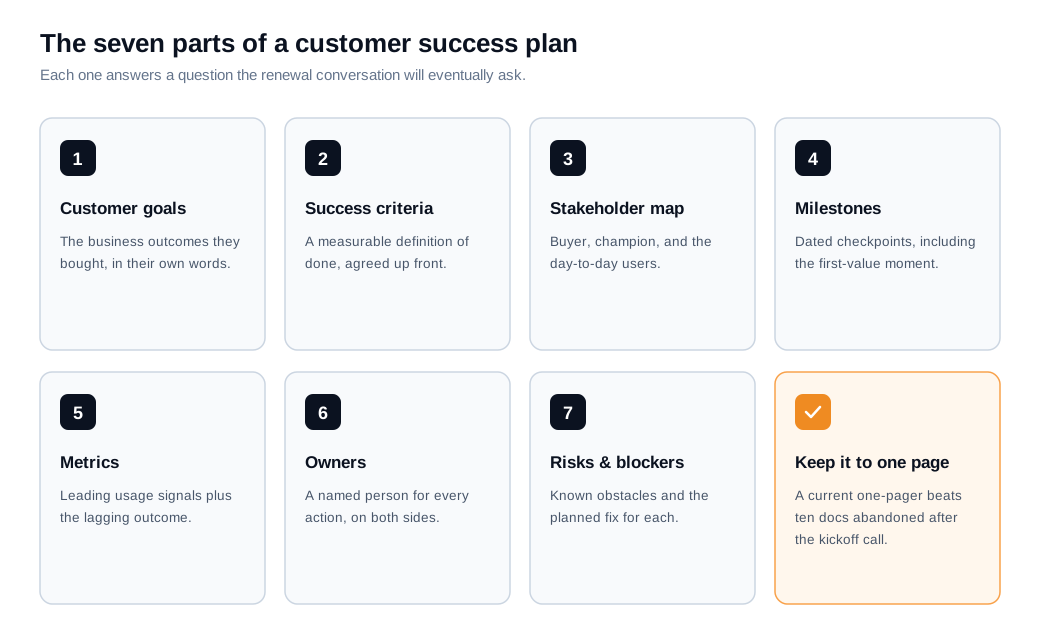
A customer success plan should include seven parts: the customer's goals, defined success criteria, a stakeholder map, a timeline of milestones, the metrics you will track, named owners on both sides, and a risk or blocker log. Each one answers a question the renewal conversation will eventually ask.
Walking through them:
- Customer goals. The business outcomes the customer is buying, in their words, such as "cut order-processing time by 20 percent" rather than "use the workflow module."
- Success criteria. The specific, measurable definition of "done" for each goal, so both sides agree in advance what winning looks like.
- Stakeholder map. Who the economic buyer, the champion, and the day-to-day users are, and how to reach each one. Champions leave, and a plan that names only one contact is fragile.
- Timeline and milestones. The dated checkpoints between kickoff and the target outcome, including the first-value milestone, the moment the customer first gets something useful.
- Metrics. The leading indicators (adoption, usage, engagement) and the lagging outcome (the business result) you will report against.
- Owners. A named person accountable for each action, on your side and theirs. Shared accountability is what separates a plan from a wish.
- Risks and blockers. The known obstacles, such as a data migration, a competing internal project, or a skeptical stakeholder, and what you are doing about each.
Keep it short. A plan nobody updates is worse than none, because it creates false confidence. One page that stays current beats ten that get abandoned after the kickoff call.
How do you align a customer success plan to customer goals?
You align the plan to the customer's goals by starting from their business objective, translating it into measurable success criteria, then working backward to the product usage and milestones that produce it. The order matters. Teams that start from product features and reverse into "goals" end up with adoption metrics the customer never cared about.
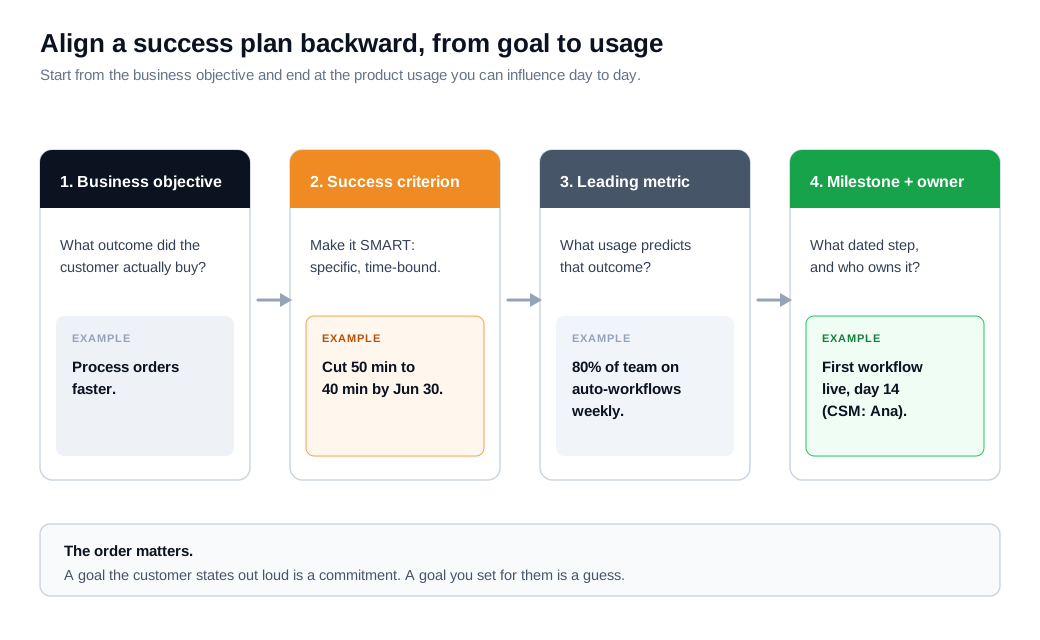
Step one is to ask, in discovery or at kickoff, what the customer needs to be true in six or twelve months for this purchase to have been worth it. Write it as a SMART goal (specific, measurable, achievable, relevant, and time-bound), because a vague goal cannot be tracked. "Improve efficiency" is not trackable. "Reduce average order-processing time from 50 minutes to 40 minutes by June 30" is.
Step two is to make the plan a joint document. Customer success practitioners recommend co-creating the plan with the customer, so both sides contribute goals, agree on the success criteria, and sign up for responsibilities. A goal you set for a customer is a guess. A goal the customer states out loud is a commitment.
Step three is to connect each goal to a product-usage path, because that is the part you can influence day to day. If the goal is faster order processing, the leading indicator might be "80 percent of the fulfillment team using automated workflows weekly." That usage is what a customer success manager can move through training, proactive outreach when adoption stalls, and removing blockers, long before the lagging outcome shows up in a report.
How do you track progress against a customer success plan?
You track progress by pairing a customer health score, a composite of usage, outcomes, sentiment, and relationship signals, with a regular review cadence, usually a quarterly business review, that checks each success criterion against its target. The health score is the early-warning system, and the review is where you act on it.
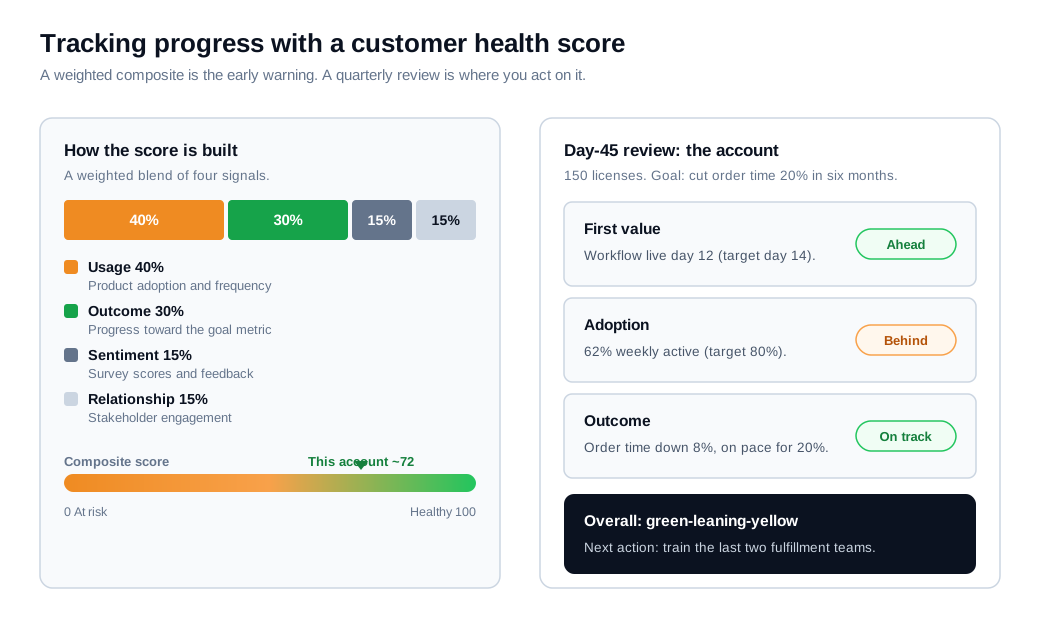
A health score rolls several signals into one number, often shown as red, yellow, or green, or on a 0 to 100 scale. Gainsight describes it as a composite of product usage, engagement, survey scores, and account growth, weighted to reflect what value looks like for that customer. The point is prediction. A green account is likely to renew, and a red one needs intervention now, not at the renewal meeting.
Set a review cadence that matches account value. Strategic accounts get a quarterly business review of 60 to 90 minutes where you walk the success plan line by line. Smaller accounts might get a lighter touch or a digital check-in. In every case, the plan is the agenda, so the review stays about the customer's outcomes rather than a demo of new features.
Here is a worked example. Take a 200-person logistics company paying $60,000 a year for your workflow software across 150 licenses. Their stated goal is to cut average order-processing time by 20 percent within six months. The success plan sets three checkpoints. First value: one automated workflow live by day 14. Adoption: 80 percent of the 150 licenses active weekly by day 90. Outcome: processing time down 20 percent by month six.
At the day-45 review, you score it. The first workflow went live on day 12, ahead of plan, so that milestone is green. Weekly active licenses sit at 62 percent, climbing toward the 80 percent target but not there yet, so adoption is yellow. Processing time is down 8 percent, roughly on pace for 20 percent by month six, so the outcome is on track. Weighting usage at 40 percent, outcome at 30 percent, sentiment at 15 percent, and relationship at 15 percent, the account lands green-leaning-yellow, with one clear action: get the last two fulfillment teams trained to lift adoption. Because the plan named the metric and the target up front, that action is obvious at day 45 instead of surfacing as a shock at month eleven.
Two operational details make tracking real. Progress data has to be visible without a fire drill, which means instrumenting usage rather than guessing from anecdotes. And customers need a fast way to raise a problem the moment they hit one, whether that is live chat when something breaks mid-task or an AI chat assistant that answers common questions instantly, so friction gets logged and cleared before it drags the health score down. A plan you review once a quarter still needs a channel that catches trouble in between.
Key takeaways
- A customer success plan is a shared roadmap, mapping a customer's business goals to the milestones, metrics, and owners that will reach them, so "the account seems fine" becomes a set of claims you can check.
- It is broader than onboarding, which is one early chapter; a real success plan still tells you something useful at month nine, when renewal and expansion are on the line.
- Seven parts make a complete plan: goals, success criteria, a stakeholder map, a milestone timeline, metrics, named owners, and a risk log, kept to a page that stays current.
- Align from the goal backward, turning the customer's business objective into a SMART success criterion and only then into the product usage a manager can influence day to day.
- Track with a health score plus a review cadence, using a composite of usage, outcomes, and sentiment as the early warning and a quarterly review to act on it.
- The payoff is retention and expansion, the lever Bain tied to a 25 to 95 percent profit lift from a 5 percent retention gain, and the reason strong SaaS teams keep net revenue retention above 100 percent.

Written by
Nilas MylerCo-founder & CTO, Glimpze
Nilas is the co-founder and CTO of Glimpze, an inbound sales tool that turns high-intent website visitors into live conversations. A former SEO consultant for some of the largest companies in Denmark, he writes about speed-to-lead, inbound sales, and conversion rate optimization — the technical and operational mechanics of turning traffic into pipeline.


