
On this page
- What is the difference between high-touch and low-touch customer success?
- What is high-touch customer success?
- What is low-touch customer success?
- What is tech-touch customer success?
- How do you segment accounts by touch?
- How do you scale each model?
- When should you use high-touch vs low-touch?
- Key takeaways
- Sources
A 15-person startup signs two customers in the same week. One is a 12-seat marketing team paying $4,800 a year on a standard plan. The other is a 400-seat enterprise paying $180,000 a year, with a custom integration, a security review, and three executive sponsors who each want a say in the rollout. Give both accounts the same welcome email and the same weekly check-in call, and you overserve one while starving the other.
That gap is what high-touch and low-touch customer success exist to close. One model spends scarce human hours on the accounts where a real relationship changes the outcome. The other uses automation and self-service to guide everyone else, so the math still works at a thousand customers instead of ten.
This guide covers what each model is, where tech-touch fits between them, how to sort accounts by touch, the staffing ratios each model runs, and how to scale high-touch and low-touch without breaking either.
What is the difference between high-touch and low-touch customer success?
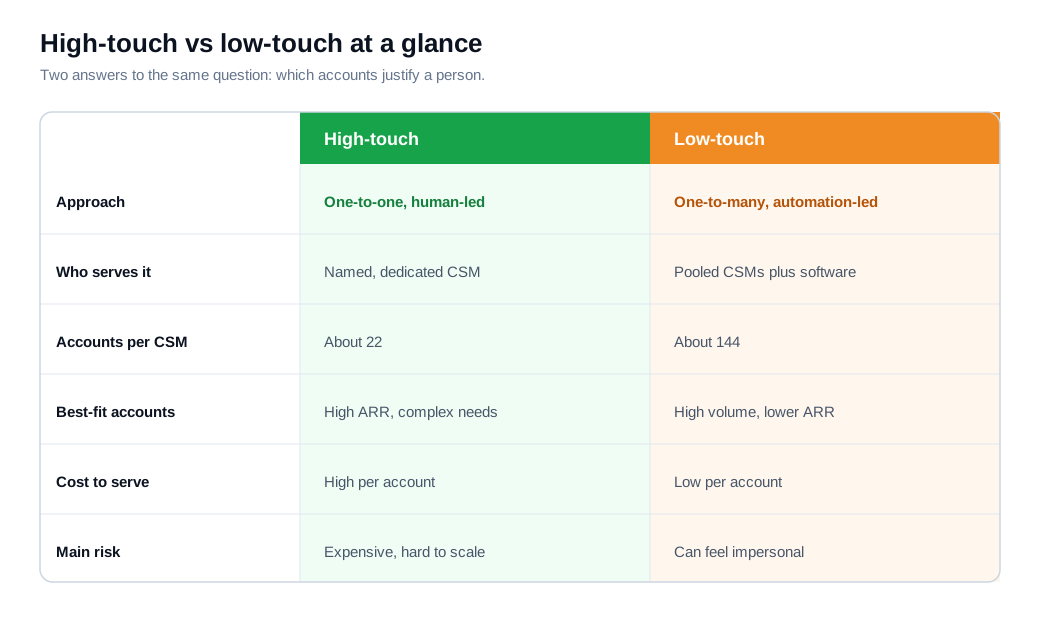
The difference is how much dedicated human attention an account gets. High-touch customer success assigns a named person to guide an account through onboarding, adoption, and renewal, while low-touch customer success leans on automation, in-product guidance, and self-service to serve many accounts at once with almost no one-to-one time.
Everything else follows from that split. High-touch is built around relationships and judgment, so it costs more per account and is harder to scale. Low-touch is built around software and repeatable workflows, so it costs less per account and scales cleanly, though it can feel impersonal when the automation is thin. HubSpot frames the trade the same way: high-touch suits high-value or high-complexity customers, and low-touch suits a large base of lower-value customers whose needs a good self-service system can meet.
Neither model is the better one in the abstract. They answer different questions about the same customer base: which accounts justify a person, and which accounts a product can carry on its own.
What is high-touch customer success?
High-touch customer success is a one-to-one model where a dedicated customer success manager owns a small book of high-value accounts and works them by hand. The CSM is a named contact the customer knows and can reach, and the relationship runs the length of the contract rather than the length of a ticket.
The work is proactive and scheduled. A high-touch CSM runs white-glove onboarding, builds a success plan tied to the customer's goals, holds regular business reviews where usage data gets connected back to outcomes, watches account health for early churn signals, and leads the renewal and expansion conversation before the contract comes up. Gainsight describes this as the model for a company's most strategic accounts, where higher contract values justify fewer accounts per CSM and deeper, personalized service.
The ratios reflect that depth. In Gainsight's benchmarking of enterprise customers, high-touch CSMs carried an average of 22 accounts each, far fewer than their mid-touch or low-touch peers, precisely because each account demands more hours. High-touch tends to fit accounts above a defined ARR threshold, complex implementations, and customers with strong expansion potential, where a person materially changes whether the account grows or leaves.
The cost is the catch. A high-touch CSM is a full salary spread across a couple dozen accounts, so the model only pays off when those accounts are worth enough that a saved renewal or an expansion deal covers the time many times over. Point it at small accounts and the economics collapse.
What is low-touch customer success?
Low-touch customer success is a one-to-many model that uses automation, self-service, and standardized workflows to guide a large number of customers with little dedicated human time. Instead of a named CSM per account, customers move through structured onboarding journeys, in-app prompts, lifecycle emails, and a knowledge base, with human help available when something genuinely needs it.
The point is efficiency at scale. A low-touch motion is designed to bring hundreds or thousands of customers to value without a one-to-one conversation for each one, which keeps the cost of serving smaller accounts in line with what those accounts actually pay. Zendesk describes low-touch as a way to let a small team support a large base by automating the universal, repeatable tasks and reserving people for the exceptions.
Low-touch is not the same as no-touch. Many low-touch models still keep a pool of CSMs who handle exceptions, respond to at-risk alerts, and jump on the occasional call, so a customer can reach a human when a moment matters. The risk to manage is thin automation. If the self-service path leaves customers stuck, a low-touch model quietly raises churn instead of lowering cost, which is the trade Totango flags when it weighs scale against the loss of personal contact.
What is tech-touch customer success?
Tech-touch customer success is the fully automated end of the low-touch spectrum, where behavior-triggered digital workflows do nearly all the engagement without real-time human input. Onboarding emails, in-product tooltips, usage-based nudges, automated review summaries, and NPS surveys fire based on what a customer does or fails to do, so the system scales to the long tail of small accounts that could never support a person.
Teams use "low-touch" and "tech-touch" loosely, and the line between them is soft. A useful way to hold it: low-touch still keeps a pooled human safety net, while tech-touch aims to run on software alone for the lowest-value segment. Gainsight advises defining a tech-touch segment deliberately, by asking which customers you can serve well digitally rather than defaulting everyone who is not enterprise into an automated bucket.
Tech-touch lives or dies on content and instrumentation. The knowledge base has to actually answer questions, the in-app guidance has to reach customers at the right step, and someone has to watch the usage signals that flag an account slipping. An AI chat assistant trained on your help content can deflect the routine questions this segment generates, and a well-built knowledge base turns "how do I" from a support ticket into a self-serve answer, both of which keep the model cheap without leaving customers stranded.
How do you segment accounts by touch?
You segment accounts by the value and complexity of each account, not by size alone. The inputs that matter are ARR or lifetime value, implementation complexity, expansion potential, and churn risk, and the goal is to spend your most expensive resource, human time, where it changes the outcome the most.
There is no universal ARR cutoff that assigns a named CSM, because complexity often matters more than contract size. A $20,000 account with a custom integration and three internal stakeholders can need more hands than a $200,000 account running a standard plan with one admin who already knows the product. Start from strategy: who the product is for, where growth is coming from, and which accounts carry the revenue and the risk.
Here is a worked example. Say a SaaS company has 600 customers and $12 million in ARR, spread very unevenly. Sorted by value and complexity, the book splits into three tiers.
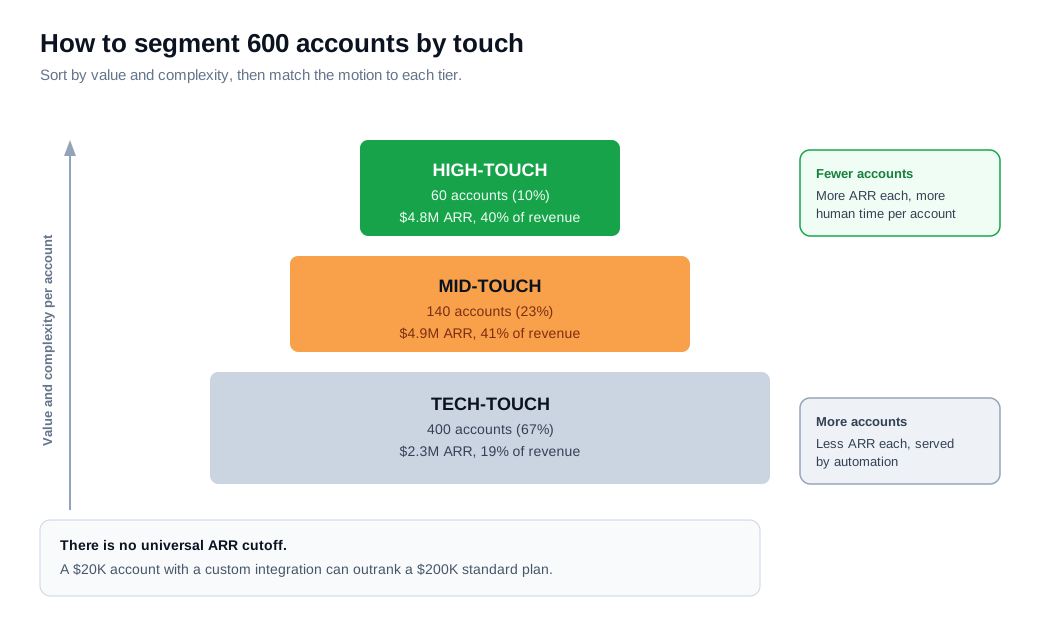
The top tier is 60 accounts, about 10 percent of the logos, averaging $80,000 in ARR and carrying $4.8 million, which is 40 percent of total revenue. These get high-touch. The middle tier is 140 accounts averaging $35,000, another $4.9 million, on a mid-touch motion that blends automation with scheduled human check-ins. The bottom tier is 400 accounts averaging under $6,000 each, $2.3 million combined, served tech-touch through onboarding flows, in-app guidance, and a knowledge base.
The split is not permanent. A tech-touch account that adds seats and starts expanding can graduate to mid-touch, and a high-touch account that goes quiet gets flagged for review. Watch usage, ARR shifts, and engagement signals, and move accounts between tiers as their value and risk change.
How do you scale each model?
You scale high-touch by adding headcount and protecting the ratio, and you scale low-touch by adding automation and pooling CSMs so software carries the repeatable work. The two models scale on different resources, which is the whole reason to run both.
High-touch scales linearly, and that is its constraint. If a CSM can hold roughly 22 strategic accounts well, doubling the strategic segment means roughly doubling the CSMs, and each hire is expensive. There is no shortcut that keeps the depth, so the discipline is guarding the ratio. Let it drift to 40 high-touch accounts per CSM and the model stops being high-touch in everything but name.
Low-touch scales on software, so the same team can cover far more customers. Gainsight's benchmarks put mid-touch CSMs at about 49 accounts each and low-touch CSMs at about 144, and pooled structures push that further by dropping the single-owner model. In a pooled team, any CSM can pick up any customer, backed by an early-warning system that surfaces at-risk accounts and expansion signals so the humans spend their hours where it counts. Forrester has argued that scaling customer success through digital motions can meaningfully raise the return on the function, and ChurnZero lays out the shift from one-to-one to one-to-many as automating universal tasks like check-ins, business reviews, and surveys while keeping people for the exceptions.
Return to the 600-customer example to see the staffing fall out. At 22 accounts per CSM, the 60 high-touch accounts need about 3 CSMs. At 49, the 140 mid-touch accounts need about 3. At 144, the 400 tech-touch accounts need about 3 pooled CSMs, but only because automation handles the onboarding, nudges, and routine questions that would otherwise swamp them. Nine CSMs cover the whole base.
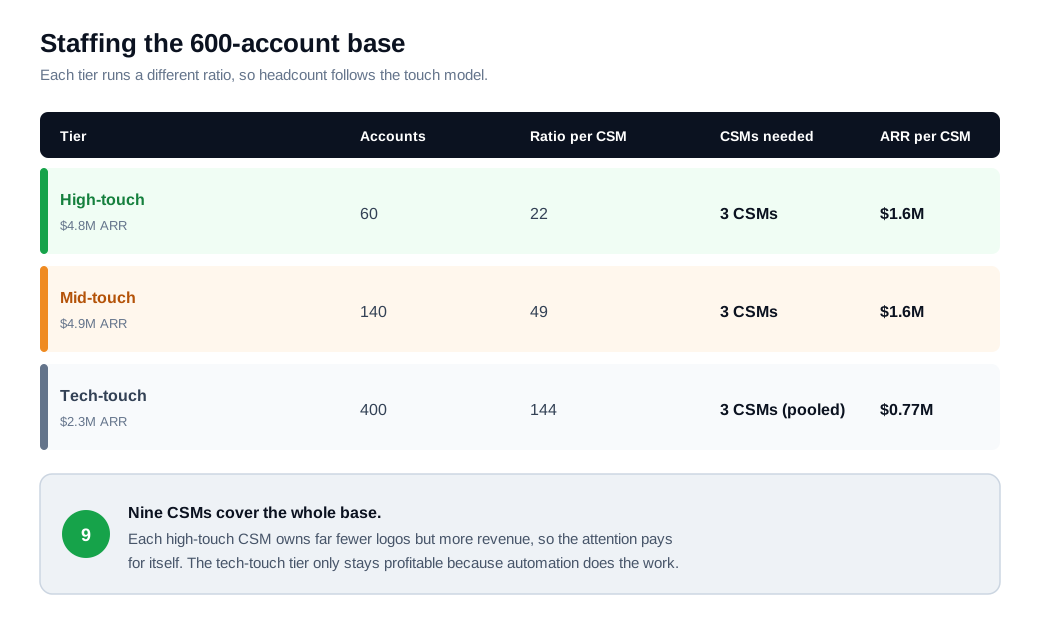
Notice what each head is responsible for. The three high-touch CSMs carry $4.8 million, about $1.6 million in ARR each, while the three tech-touch CSMs carry $2.3 million between them, under $800,000 each. The high-touch CSMs hold far fewer logos and far more revenue, which is exactly why the personal attention pays for itself, and why the tech-touch tier has to run lean on automation to stay profitable.
Live channels help both ends of the book. A fast live chat with the option to escalate to a live video call or screen share lets a pooled CSM resolve a stuck customer in one session instead of a multi-day email thread, and proactive in-app nudges reach at-risk accounts before a renewal is in doubt. The same conversations surface expansion signals early, since a customer asking how to do more is telling you they are ready to.
When should you use high-touch vs low-touch?
Use high-touch where a human relationship changes whether an account renews and expands, and use low-touch everywhere the product can carry the customer to value on its own. In practice most companies run both at once, matching the motion to the account rather than picking a single model for the whole base.
High-touch earns its cost on accounts with high ARR, complex needs, multiple stakeholders, or large expansion upside, where one saved renewal covers the CSM's time many times over. Low-touch and tech-touch fit high-volume, lower-ACV segments that adopt quickly and prefer to move on their own, where a named CSM would cost more than the account is worth and would not be especially welcome anyway.
The hybrid is the default for a reason. A single company often has a handful of strategic accounts that need white-glove attention, a broad mid-market that does well with a light human layer over automation, and a long tail that self-serves. The real work is setting the thresholds, instrumenting the signals that move accounts between tiers, and reviewing the split as the business grows, so the expensive human hours keep landing where they change the outcome.
Key takeaways
- The models differ on human attention. High-touch assigns a named CSM to a small book of high-value accounts, while low-touch uses automation and self-service to guide many accounts with little one-to-one time.
- Tech-touch is the automated far end. Behavior-triggered emails, in-app guidance, and a knowledge base run the long tail of small accounts, with pooled humans reserved for exceptions.
- Segment by value and complexity, not size alone. A small account with a custom integration can need more than a large account on a standard plan, and there is no universal ARR cutoff for a named CSM.
- Each model runs a different ratio. Gainsight's benchmarks put high-touch CSMs near 22 accounts, mid-touch near 49, and low-touch near 144, so staffing follows the touch model you assign.
- The two scale on different resources. High-touch scales by adding headcount and protecting the ratio, while low-touch scales by adding automation and pooling CSMs so software carries the repeatable work.
- Most companies run a hybrid. High-touch for strategic accounts, tech-touch for the long tail, and a mid layer in between, with accounts moving tiers as their value and risk change.

Written by
Nilas MylerCo-founder & CTO, Glimpze
Nilas is the co-founder and CTO of Glimpze, an inbound sales tool that turns high-intent website visitors into live conversations. A former SEO consultant for some of the largest companies in Denmark, he writes about speed-to-lead, inbound sales, and conversion rate optimization — the technical and operational mechanics of turning traffic into pipeline.


