On this page
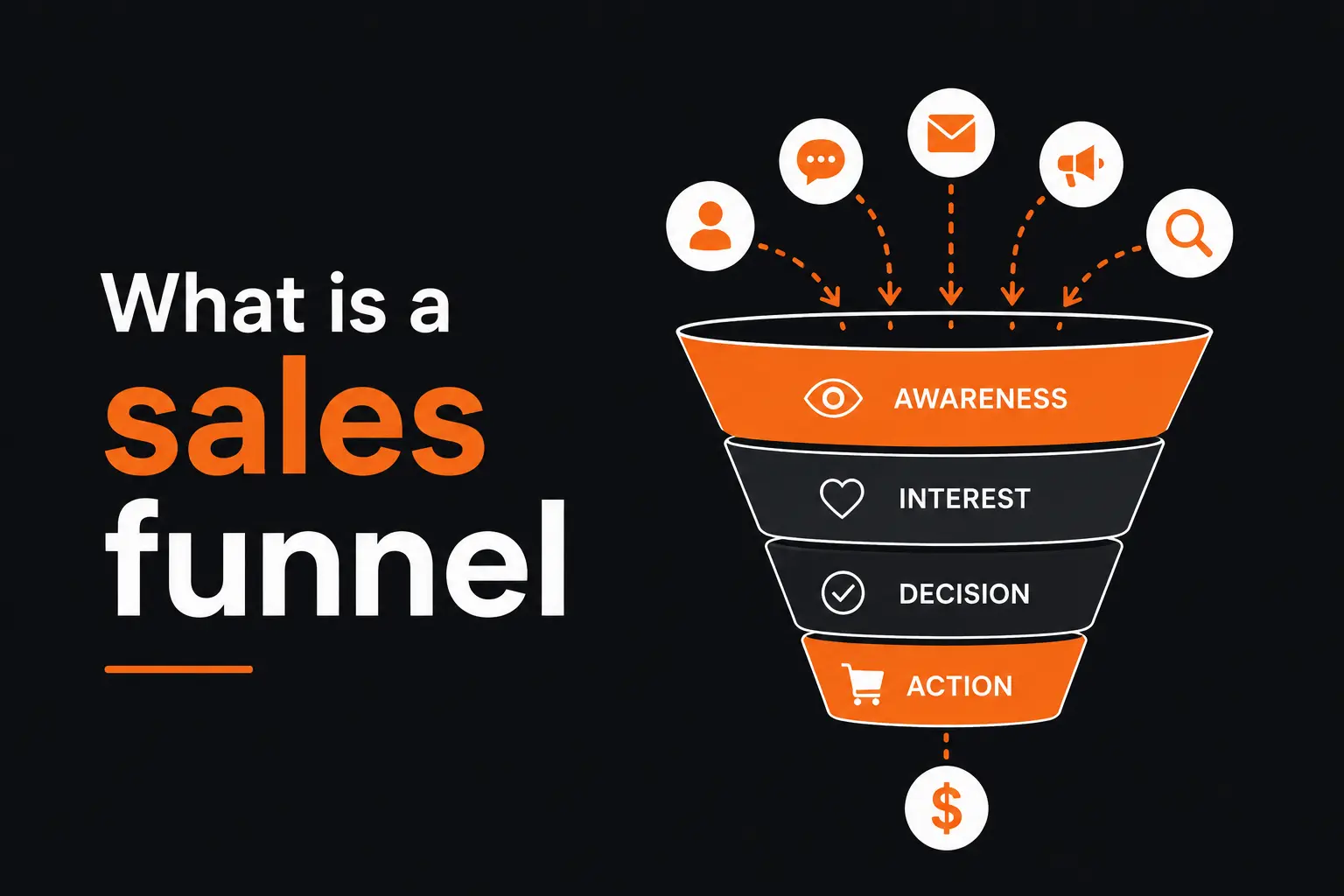
If you've worked in sales or marketing for more than a week, you've seen the shape: wide at the top, narrow at the bottom, an arrow pointing down through it. The sales funnel is one of the oldest models in business, and it's still the first thing most people reach for when they try to explain how strangers turn into customers.
It's also more misunderstood than its simplicity suggests. People use "sales funnel," "marketing funnel," and "pipeline" interchangeably, argue about how many stages it should have, and increasingly argue about whether the whole shape is even the right way to think about buying anymore. This post covers what a sales funnel actually is, how it works, the stages most teams use, a worked example with real numbers, how to build one, and a fair look at whether the model still holds up.
What is a sales funnel?
A sales funnel is a model of the path a prospect takes from first learning about a product to becoming a paying customer, organized into stages that get narrower as fewer people move forward at each step. It's called a funnel because that's literally what the shape represents: a large number of people enter at the top with some level of awareness or interest, and a much smaller number come out the bottom as customers.
The term is often used alongside "marketing funnel" and "purchase funnel," and in practice the boundaries blur. Marketing usually owns the top (getting people aware and interested), sales usually owns the middle and bottom (evaluation and closing), and most companies draw the line between the two differently. What matters more than the label is the underlying idea: buying is a process with distinct phases, and a prospect's needs, questions, and objections change depending on where they are in it.
The model has been around for a long time. In 1898, advertising executive Elias St. Elmo Lewis outlined a sequence for how a sale happens (get attention, hold interest, create desire, prompt action) while studying the U.S. life insurance market. That sequence became known as AIDA, and in 1924, sales trainer William W. Townsend was the one who described it using the funnel shape, writing in Bond Salesmanship that a salesperson should "visualize the whole problem of developing the sales steps as the forcing by compression of a broad and general concept of facts through a funnel." Over a century later, the metaphor is still standard vocabulary in sales and marketing, even as the specific stages have been redrawn many times over.
How does a sales funnel work?
A sales funnel works by matching what you say and offer to where the prospect actually is in their decision, instead of pitching everyone the same way regardless of how much they already know or want.
At the top, most people aren't ready to talk to a salesperson. They're still figuring out whether they even have the problem you solve. Content, ads, and search results do the work of building awareness and giving them a reason to keep looking. As they move down, the goal shifts from "get noticed" to "get evaluated favorably": comparison content, case studies, pricing pages, and demos help a prospect who already knows you exist decide whether you're the right fit. At the bottom, the job is to remove whatever is still stopping a decision, whether that's a lingering question, a budget concern, or a need for internal sign-off, and make it easy to say yes.
The mechanism underneath all of this is attrition by design. Not everyone who becomes aware of you should become a customer, and a good funnel is supposed to filter people out at each stage: the ones who aren't a fit, aren't ready, or were never going to buy. That's why the shape narrows. A funnel that doesn't lose anyone between stages usually isn't measuring anything useful.
What are the different stages of a sales funnel?
Most versions of the funnel collapse into three broad zones, sometimes abbreviated TOFU, MOFU, and BOFU (top, middle, bottom of funnel), with the classic four-stage AIDA sequence mapped underneath:
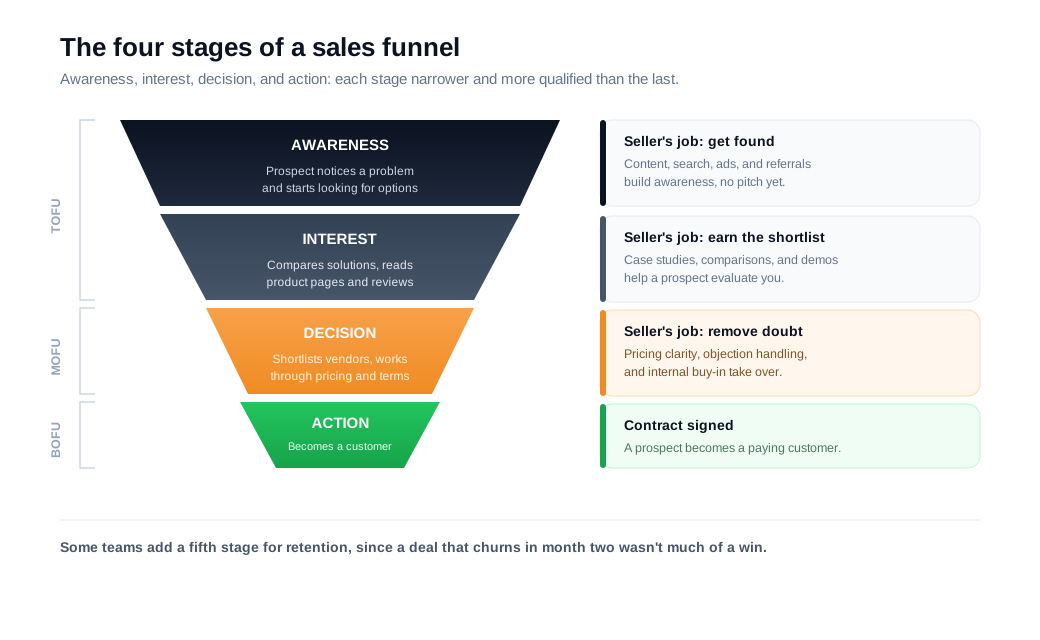
Awareness (top of funnel). A prospect realizes they have a problem or goal and starts looking for options. They find you through search, a referral, an ad, or social content. They are not ready for a sales pitch; they're ready for information.
Interest and consideration (middle of funnel). The prospect is actively comparing solutions. They read product pages, watch demos, download guides, and start narrowing their list. This is usually where marketing hands off to sales, or where the two start working the same account together.
Decision (bottom of funnel). The prospect has a shortlist, often of one to three vendors, and is working through pricing, contract terms, implementation questions, and internal approval. This is where sales does its most concentrated work: answering objections, running the demo, negotiating terms.
Action. The prospect signs, pays, or converts. Some versions of the funnel stop here; more complete ones add a fifth stage for retention and referral, since a signed deal that churns in month two wasn't much of a win.
The number of stages you use should match how your business actually sells. A $20 subscription bought on impulse doesn't need the same granularity as an enterprise deal with a six-person buying committee and a nine-month sales cycle. Adding stages you don't need just adds reporting overhead; using too few hides where deals are actually getting stuck.
What is an example of a sales funnel?
Numbers make the model concrete faster than definitions do. Here's a simplified example of what a B2B software funnel might look like over a month:
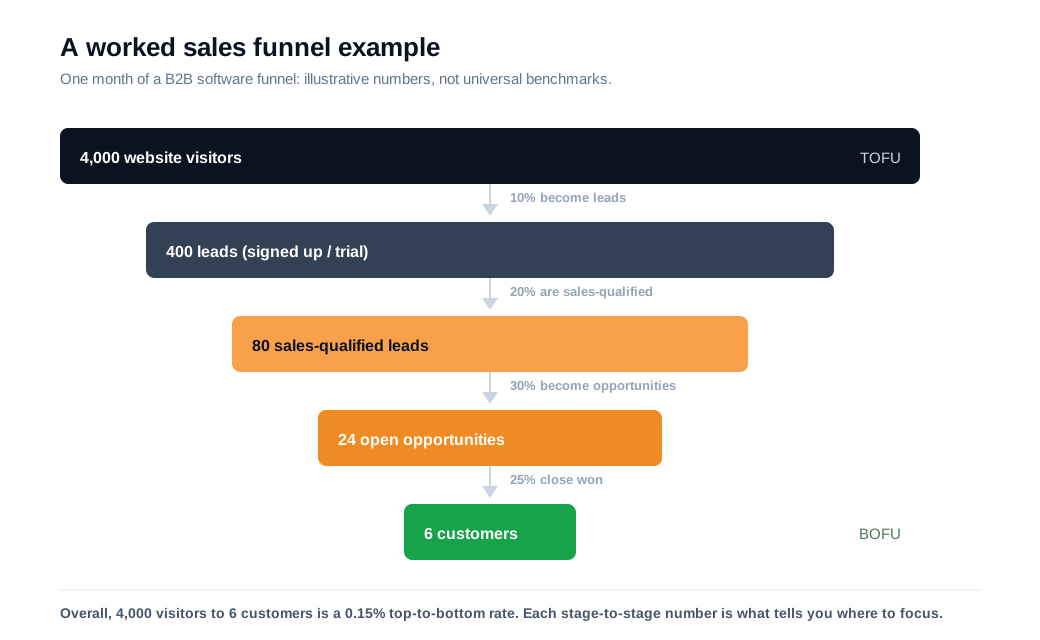
A blog post ranks for a relevant search term and brings in 4,000 visitors in a month. Of those, 400 (10%) sign up for a newsletter, download a guide, or start a free trial: they've become leads. A sales or marketing team reviews those leads against basic fit criteria (company size, role, use case) and finds that 80 of them (20%) look like a real match, so these become sales-qualified leads. A rep works those 80 leads through discovery calls and demos, and 24 of them (30%) turn into open opportunities with a defined timeline and budget. Of those 24, 6 (25%) sign a contract and become customers.
The percentages here are illustrative, not universal benchmarks. Actual conversion rates vary enormously by industry, deal size, and how leads are sourced. What the example is meant to show is the mechanic: each stage answers a narrower, more qualifying question than the one before it, and the multiplication of those percentages is what determines how much top-of-funnel traffic you actually need to hit a revenue number.
How do you build a sales funnel?
Building a funnel is less about picking a diagram and more about instrumenting a process you can actually measure and improve. A practical starting sequence:
1. Define your stages around real decision points, not arbitrary milestones. A stage should represent a meaningful shift in the prospect's thinking (aware → interested → evaluating → deciding), not just an activity you did to them (sent an email → sent another email).
2. Map content and actions to each stage. Top-of-funnel content should answer "do I have this problem," not "why should I pick you." Middle-of-funnel content should help someone evaluate you specifically. Bottom-of-funnel material should resolve the last objections: pricing clarity, implementation details, security and compliance documentation, references.
3. Set entry and exit criteria for every stage. A lead shouldn't move from "interested" to "sales-qualified" just because a rep feels good about the call. Use explicit criteria, such as budget confirmed, decision-maker identified, and timeline established, so your funnel data means the same thing across every rep and every deal.
4. Instrument the handoffs. The points where marketing hands off to sales, or where a prospect moves from self-serve to human-assisted, are where most funnels leak. Track conversion rate and elapsed time at every handoff, not just at the top and bottom.
5. Measure stage-to-stage conversion, not just the overall rate. An overall 1% visitor-to-customer rate tells you almost nothing about what to fix. Knowing that 10% of visitors become leads but only 8% of leads become qualified opportunities tells you exactly where to spend your next quarter of effort.
6. Review and adjust quarterly. Buyer behavior, channels, and competitive pressure all shift. A funnel definition that was accurate a year ago is worth re-checking against what's actually happening in your CRM today.
Live conversation tools tend to matter most at the handoff points rather than the endpoints. A prospect moving from self-serve research into an evaluation conversation, for instance, often converts better through something like live chat or a live video call than through a form that sits in a queue. That's a detail worth instrumenting specifically, since handoff friction is where a lot of funnel data quietly goes missing.
Do sales funnels actually work?
Yes, with an important caveat: the funnel is a useful simplification of a much messier reality, and it stops working the moment people treat it as a literal description of how buyers behave.
The case for the funnel is straightforward. It gives marketing and sales a shared vocabulary for where a deal stands, it forces you to measure conversion at each step instead of just looking at total revenue, and it's genuinely predictive: if you know your visitor-to-lead rate and your lead-to-customer rate, you can forecast pipeline with reasonable accuracy. That's not nothing. Most of what CRM software does under the hood is still, structurally, funnel accounting.
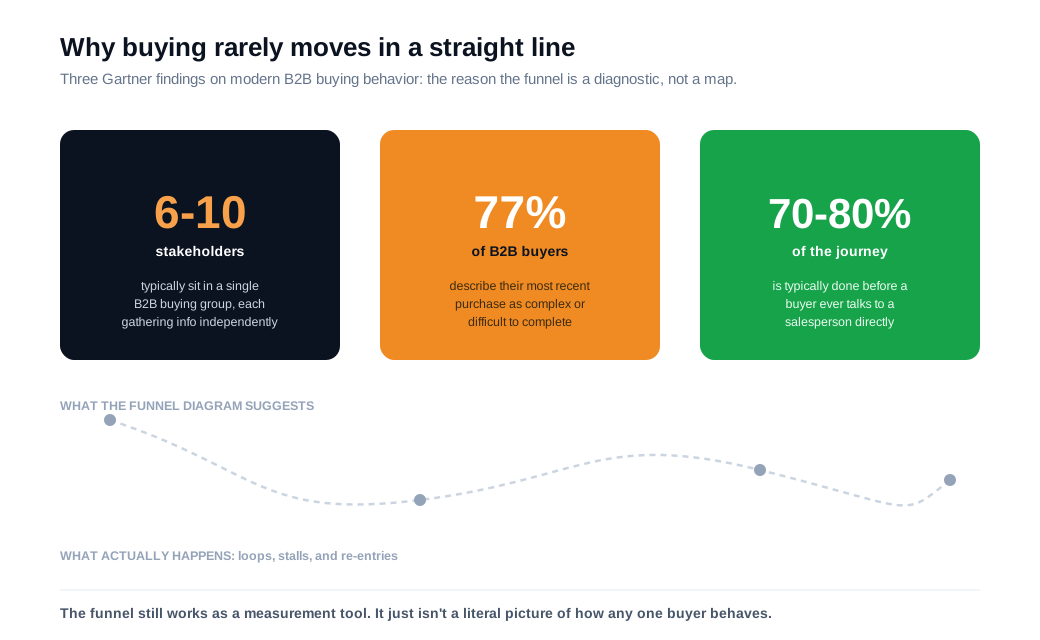
The case against it is also well documented. Gartner's research on B2B buying groups describes a process that "loops" through a set of buying jobs (problem identification, solution exploration, requirements building, supplier selection, validation, and consensus creation) rather than moving through them in order, with most buyers revisiting at least one job before a purchase is finalized. Gartner's sales research is also the source of a widely cited stat cluster: that a typical B2B buying group includes six to ten stakeholders, that 77% of B2B buyers describe their most recent purchase as complex or difficult, and that buyers complete somewhere between 70% and 80% of their research before ever engaging a salesperson.
None of that fits a clean, linear line from awareness to action. Real buyers loop back, involve new stakeholders mid-process, get stuck in internal debate, and disengage for weeks at a time.
Harvard Business Review made this case directly in 2014, arguing that funnels can no longer account for how consumers actually search, compare, and decide in a world of infinite information access. HubSpot's Brian Halligan made a related argument in HBR in 2018 for replacing the funnel with a "flywheel," a model built around momentum from existing customers rather than a one-way pour from strangers to buyers, on the reasoning that a funnel treats customers as an output rather than a source of future growth.
Both critiques are fair, and neither one means the funnel is useless. A funnel that tracks discrete stages, each with entry criteria and a conversion rate, still gives you the clearest diagnostic tool available for finding out where deals actually die. The mistake is assuming every prospect marches through it in order, or that a tidy diagram means your buyers behave tidily. Treat the funnel as an instrument panel, not a map of a straight road, and it holds up fine.
Key takeaways
- A sales funnel models the path from stranger to customer, organized into narrowing stages so you can see where deals are actually getting lost.
- The model dates back over a century. Elias St. Elmo Lewis outlined the AIDA sequence in 1898, and William Townsend gave it the funnel shape in 1924.
- Most funnels use three to five stages: awareness, interest, decision, and action, sometimes with a retention stage added at the end.
- A worked example matters more than a diagram. Track stage-to-stage conversion rates, not just the overall visitor-to-customer number, to find where to focus.
- Building one is mostly instrumentation: clear entry and exit criteria per stage, tracked handoffs, and quarterly review against what your CRM actually shows.
- The funnel works as a diagnostic, not a literal map. Real B2B buying is non-linear and involves 6-10 stakeholders on average, so use the funnel to measure, not to assume.
TAGS

Written by
Nilas MylerCo-founder & CTO, Glimpze
Nilas is the co-founder and CTO of Glimpze, an inbound sales tool that turns high-intent website visitors into live conversations. A former SEO consultant for some of the largest companies in Denmark, he writes about speed-to-lead, inbound sales, and conversion rate optimization — the technical and operational mechanics of turning traffic into pipeline.


