
On this page
Ask five people on the same sales team to define a "lead" and you will get five answers. To a marketer, a lead is an email address on a form. To a rep, it is someone worth picking up the phone for. To a founder, it is anything that might one day turn into revenue.
That gap costs money. Reps chase names that were never going to buy, marketing gets blamed for "bad leads," and genuine buyers slip away because nobody agreed on who counts. Pinning down what a sales lead actually is, and where the good ones come from, is the groundwork every other part of inbound sales rests on.
This guide defines a sales lead, separates it from a prospect, maps the channels leads arrive from, breaks down how lead types differ, and walks through how a lead moves into the pipeline, with a worked example at the end.
What is a sales lead?
A sales lead is a person or company that has shown some interest in what you sell and given you a way to reach them, which makes them worth a sales conversation. Salesforce defines it as a potential customer who has indicated interest in a product or service but has not yet been qualified as ready to buy, per Salesforce's guide to sales leads.
Every lead has the same two parts. A contact detail, so you can reach the person, and an intent signal, however faint, so you have a reason to. An email typed into a newsletter box, a phone number on a demo request, or a company name your software recognized from an anonymous visit all qualify. Miss either half and you do not have a lead. A name with no way to reach it is a dead end, and a contact who has shown zero interest is a stranger in a database.
The bar for interest is deliberately low. Downloading a checklist, clicking an ad, or opening a chat window on your pricing page each counts, even though none of those actions means the person is ready to buy. That low bar is why raw lead counts flatter a dashboard and mislead a forecast. The work of turning interest into revenue happens after the lead exists, in how you qualify, route, and follow up.
What is the difference between a sales lead and a prospect?
A lead becomes a prospect once you have qualified it against your ideal customer profile and confirmed it could realistically buy. A lead is raw interest. A prospect is interest that has passed a first check for fit.
Picture the order. Someone downloads your ebook, so they are a lead. You look them up, see they run sales at a 200-person software company that matches your best customers, and confirm they have a problem you solve. Now they are a prospect worth a rep's time. The same ebook download from a student writing a term paper stays a lead and never becomes a prospect, because the fit is absent.
Some teams add a "suspect" at the front of that line for a contact who might fit but has shown no interest at all, and an "opportunity" at the back for a prospect who has entered an active deal. The labels vary by company. The idea underneath them holds everywhere: each step should raise the bar before a contact moves forward and earns more of your attention.
What are the main lead sources?
The main lead sources split into inbound channels where buyers find you (organic search, content, your website, referrals, social) and outbound channels where you find them (cold email, cold calls, paid ads, purchased lists, events). A lead source is the first channel where a buyer and your company crossed paths.
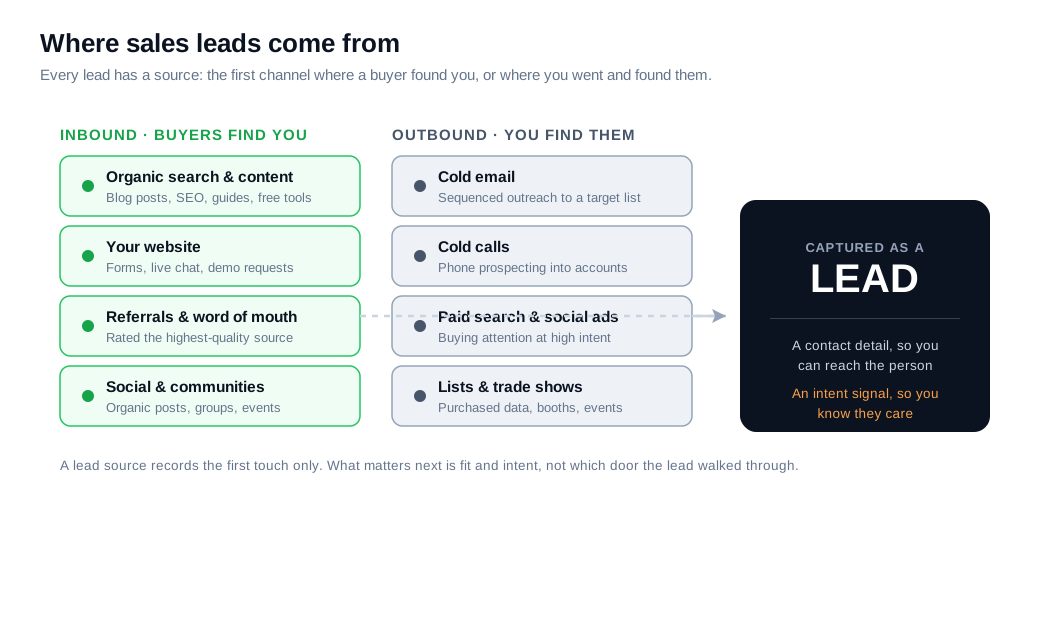
A lead source records the first point of contact, not every touch that follows, as monday.com's guide to lead sources explains. If a buyer reads three blog posts, clicks a retargeting ad, and then books a demo, the source is the blog, the thing that first pulled them in. Getting this right matters because it tells you which channels actually start relationships, rather than which ones happen to be last in line when a deal closes.
Inbound sources tend to produce fewer leads that convert at a higher rate, because those buyers arrived under their own steam with a problem already in mind. Your website is the hub for most of them, which is why giving high-intent visitors a way to start a live chat on a pricing or demo page catches interest that a static form would let cool.
Outbound sources give you reach and control. You pick the accounts, build the list, and start the conversation, which is the only way to land some of your best-fit companies, the large ones that never fill out a form. The tradeoff is that these leads arrive cold and take longer to warm up.
Referrals sit in a category of their own. Across surveys of B2B sellers, referred leads are consistently rated the highest-quality source, because a trusted introduction skips most of the trust-building that every other channel has to earn, per Martal's 2026 conversion benchmarks. The catch is that referrals are hard to manufacture on demand, so most teams treat them as a bonus on top of a plan rather than the plan itself.
How do lead types differ?
Lead types differ along two axes: how ready the lead is to buy (cold, warm, or hot) and how far it has been qualified (MQL, SQL, or PQL). The first axis describes the buyer's state of mind. The second describes where the lead sits in your process.
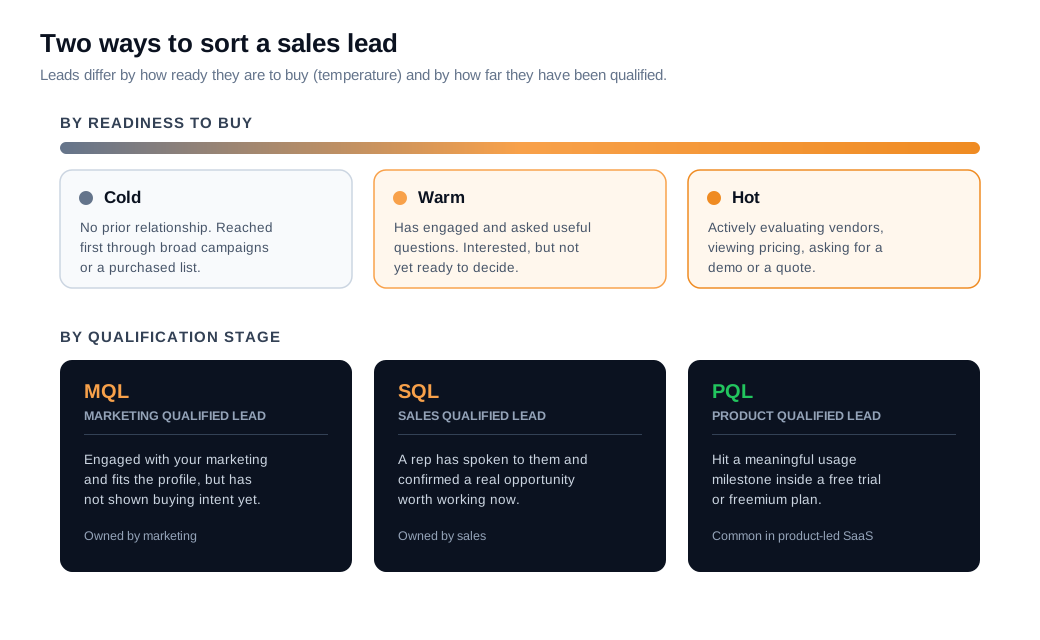
Temperature is the simpler axis. A cold lead has no prior relationship with you and was reached first through a broad campaign or a bought list. A warm lead has engaged, asked a question or two, and shown early interest without being ready to decide. A hot lead is actively evaluating, looking at pricing, and asking for a demo or a quote. The practical reason to sort by temperature is conversion: warm and inbound leads close at a far higher rate than cold ones, with one widely cited benchmark putting warm close rates near 14.6 percent against roughly 1.7 percent for cold, per Revnew's breakdown of lead classification.
Qualification is the second axis, and it usually runs through three labels. A marketing qualified lead (MQL) has engaged with your marketing and fits your target profile, but has not shown clear purchase intent yet, as HubSpot describes it. A sales qualified lead (SQL) is one a rep has spoken to and confirmed as a real opportunity worth working now. A product qualified lead (PQL) is specific to product-led companies: someone who hit a meaningful usage milestone inside a free trial or freemium plan, like connecting a data source or inviting a teammate, per Salesforce's comparison of the two.
The two axes are related, though they measure different things. A lead can be hot yet unqualified, a stranger who lands on your pricing page ready to buy but whom you know nothing about, or an MQL who has gone cold after months of silence. Reading both together tells you who to call first.
How do leads move into the pipeline?
Leads move into the pipeline through a series of qualification handoffs: a captured lead becomes an MQL, then a sales qualified lead, then an open opportunity a rep works toward a close. Each stage has an owner and a done-when test, and a lead only advances once it clears the bar before it.
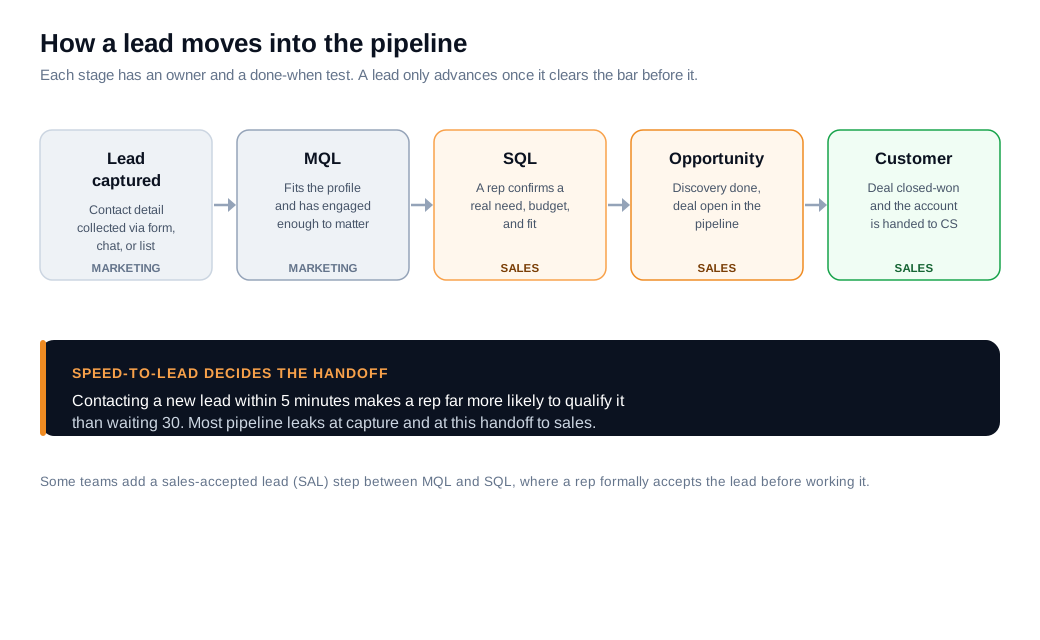
It starts with capture. Marketing owns this stage, and it is done when a contact detail lands in your system, whether from a form, a chat, or an outbound list. The lead then becomes an MQL once it both fits your profile and has engaged enough to be worth attention. Some teams add a sales-accepted lead (SAL) step here, where a rep formally accepts the MQL, confirms it is reachable and in-territory, and agrees to work it before it counts as qualified.
From there sales takes over. A rep contacts the lead, runs a quick discovery, and if there is a real need, budget, and fit, promotes it to an SQL. Once discovery is complete and a genuine deal is on the table, the SQL becomes an opportunity: an active line in the pipeline with a value and a close date. The rep then works the opportunity toward closed-won, at which point the lead has finished its journey and become a customer.
Speed decides how many leads survive the trip. The MIT and InsideSales Lead Response Management study found that contacting a web lead within five minutes made a rep far more likely to qualify it than waiting even 30 minutes, per the Lead Response Management research. Intent decays by the hour, so the handoff from a captured lead to a live conversation is where the most pipeline quietly dies. Wiring up instant routing and notifications that alert the right rep the moment a qualified lead appears is what keeps a hot lead hot.
What makes a sales lead worth pursuing?
A sales lead is worth pursuing when it has both fit and intent: fit means it matches the kind of company you can serve, and intent means it has done something that signals a real need. A lead strong on one and weak on the other is a maybe. A lead strong on both is where your reps should spend their day.
Fit is about the account. Industry, company size, role, region, and budget all feed a simple test: is this the sort of customer we win and keep? Intent is about behavior. Visiting the pricing page twice, opening a chat, requesting a demo, or hitting a usage milestone in a trial all say the timing might be right. Qualification frameworks like BANT (budget, authority, need, timeline) exist to make that judgment consistent across a team instead of leaving it to gut feel.
This also explains why buyers give you so little room to work with. Gartner's research on the B2B buying journey found that buyers spend only about 17 percent of their total time meeting with any potential supplier, and far less with any single one, per Gartner's analysis. The few minutes you get with a good-fit, high-intent lead have to count, which is the whole argument for qualifying fast and responding faster.
What does a lead's journey look like in numbers?
Here is a worked example that ties the pieces together. Say a B2B software company generates 1,000 new leads in a month, spread across the sources above, and wants to know what that pool is worth.
Suppose the mix breaks down like this: 400 leads from organic search and content, 250 from paid ads, 200 from cold outbound, 100 from website chat and demo requests, and 50 from referrals. The leads are not equal. The 100 chat and demo leads and the 50 referrals arrive warm, so a large share clear the marketing bar. The 200 cold outbound leads arrive, as the name says, cold, so far fewer do.
Run the pool through the pipeline. If 30 percent of the 1,000 leads become MQLs, that is 300 MQLs. Sales works them, and 20 percent become SQLs, giving 60 real opportunities. At a 25 percent win rate, that funnel produces 15 new customers for the month.
Now change one thing. The company routes every high-intent website chat to a rep in under a minute instead of dropping it into a next-day queue. Those warm leads convert to MQLs at closer to 60 percent rather than 30, and because a live conversation also filters out the browsers, their SQL and win rates climb too. Even if only the website and referral leads improve, lifting their combined conversion can add three or four customers a month on the same 1,000 leads. The lesson is the one every part of this guide points to. The leads you already have are usually worth more than the next batch, when you answer the good ones fast.
Key takeaways
- A sales lead needs two things: a contact detail and an intent signal. A name you cannot reach or a contact who has shown no interest does not qualify.
- A lead becomes a prospect once it passes a fit check. Leads are raw interest; prospects are interest confirmed against your ideal customer profile.
- Lead sources split into inbound and outbound, and a source records only the first touch. Referrals are consistently rated the highest-quality source.
- Lead types run on two axes. Temperature (cold, warm, hot) describes readiness to buy; qualification (MQL, SQL, PQL) describes how far the lead has moved through your process.
- Leads enter the pipeline through handoffs, each with an owner and a done-when test, and most pipeline leaks at capture and at the handoff to sales.
- Speed and fit decide the outcome. A good-fit lead answered within minutes converts far better than the same lead left to cool, which is the cheapest lever most teams ignore.
TAGS

Written by
Daniel SemeckyCo-founder & CEO
Daniel is the co-founder and CEO of Glimpze. He spends his days talking to revenue teams about how to catch high-intent visitors before they bounce, and writes about inbound sales, lead conversion, and building a motion where marketing and sales actually share a number.


