
On this page
- What is buyer enablement?
- Why does buyer enablement matter now?
- What are the six B2B buying jobs?
- How does buyer enablement differ from sales enablement?
- What content helps buyers self-educate?
- What does buyer enablement look like in practice?
- How do you measure buyer enablement impact?
- Key takeaways
- Sources
By the time a B2B buying team reaches out to your reps, most of the decision is already behind them. A typical group of five or six people has read your docs, pulled three competitors into a spreadsheet, argued about requirements in a Slack thread you will never see, and formed opinions you now have to work around.
Buyer enablement is the discipline of making that hidden work easier. It starts from a plain question: what does the buyer actually need to get this purchase done, and how do we hand it to them? Answer that well, and buyers reward you with bigger, faster, and less regretful deals.
This guide covers what buyer enablement is, why it matters now, the six jobs every buying team has to finish, how it differs from sales enablement, the content that helps buyers self-educate, a worked example, and how to measure whether any of it is working.
What is buyer enablement?
Buyer enablement is the practice of giving B2B buyers the information and tools they need to complete the jobs of buying, rather than the assets your reps need to sell. Gartner, which coined the term, defines it as the provisioning of information that supports the completion of critical buying jobs, delivered in a form buyers can act on without hand-holding.
Gartner splits that provisioning into two parts. The first is prescriptive advice: clear "do this" and "avoid that" guidance that steers buyers through decisions they have never made before. The second is practical support, the job-completion tools buyers use to follow the advice, such as ROI calculators, requirements checklists, and vendor-comparison templates.
The framing matters because it moves your attention off your own funnel. A buyer does not care about your pipeline stages. They care about building a defensible business case, getting five colleagues to agree, and not looking foolish in six months. Buyer enablement asks what would make each of those tasks easier, then supplies it.
Why does buyer enablement matter now?
Buyer enablement matters now because buyers spend most of a purchase away from your reps, and the part they do alone has become genuinely hard. Gartner's research on the B2B buying journey found that buyers spend only 17% of their total purchase time meeting with potential suppliers, and when several vendors are in the running, any single rep gets closer to 5% of the buyer's attention.
The self-guided stretch is where deals stall. Gartner reports that 77% of B2B buyers describe their most recent purchase as very complex or difficult, and 44% run into conflicting information from suppliers that they then have to reconcile before the group can move. When buying feels confusing, the safest choice for a committee is often to do nothing, which is why "no decision" quietly beats your named competitors in so many pipelines.
Making the work easier pays in hard terms. Gartner found that customers who see supplier information as genuinely helpful in moving them forward are 2.8 times more likely to report a high degree of purchase ease, and three times more likely to close a larger deal with little regret. Purchase ease drives deal size, win rate, and the odds the customer sticks around.
Timing reinforces all of it. In Gartner's 2026 survey, 67% of B2B buyers said they prefer a rep-free experience for at least part of the journey. When buyers want to self-serve, the vendor whose self-serve materials are clearest takes the early lead, well before a rep joins a call.
What are the six B2B buying jobs?
The six B2B buying jobs are problem identification, solution exploration, requirements building, supplier selection, validation, and consensus creation. Gartner identified these as the tasks every buying group has to complete, in some order, before money changes hands, and buyer enablement works by attaching the right help to each one.
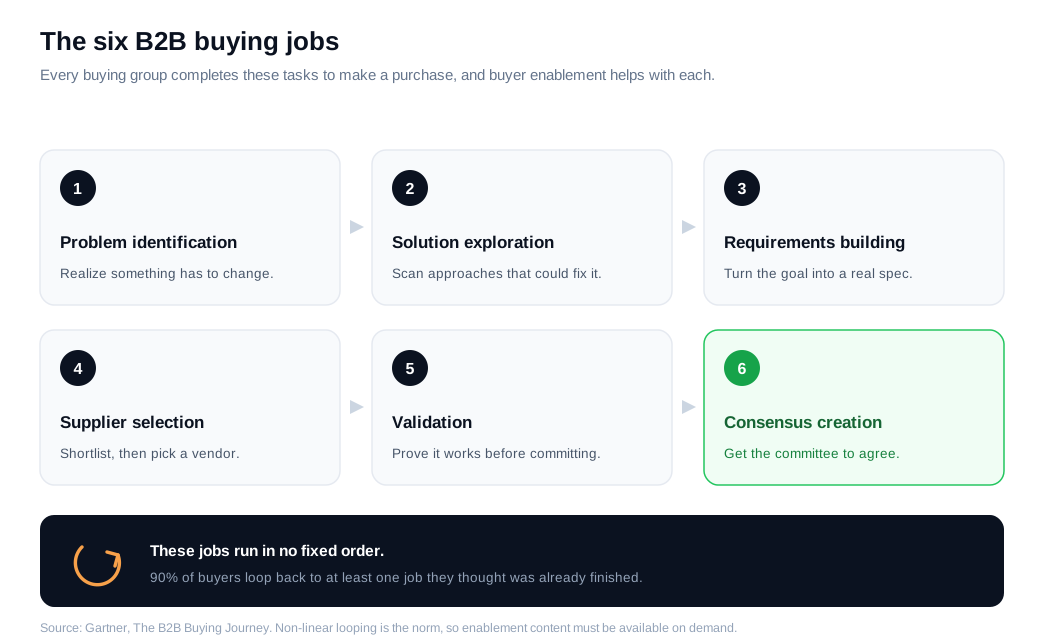
Problem identification is where a buyer decides something needs to change. Solution exploration is the search for approaches that might fix it. Requirements building turns a vague goal into a concrete spec. Supplier selection narrows the field to a shortlist and then a choice. Validation is the buyer double-checking they are right, through references, trials, and proof. Consensus creation is the quiet, grinding work of getting everyone on the committee to agree.
The important detail is that these jobs run in no fixed order. Gartner found that 90% of buyers loop back to at least one job they thought they had finished, so a committee can be validating a shortlist one week and reopening its requirements the next. That non-linear reality is why a rigid sales sequence so often feels out of step with the buyer, and why enablement content has to be available on demand rather than drip-fed in a set order.
How does buyer enablement differ from sales enablement?
Buyer enablement differs from sales enablement in who the material is built for: buyer enablement equips the customer to buy, while sales enablement equips your reps to sell. Sales enablement produces internal assets like battle cards, call scripts, objection-handling guides, and rep training. Gartner describes sales enablement as the activities and tools that improve seller performance, all of it pointed inward at your team.
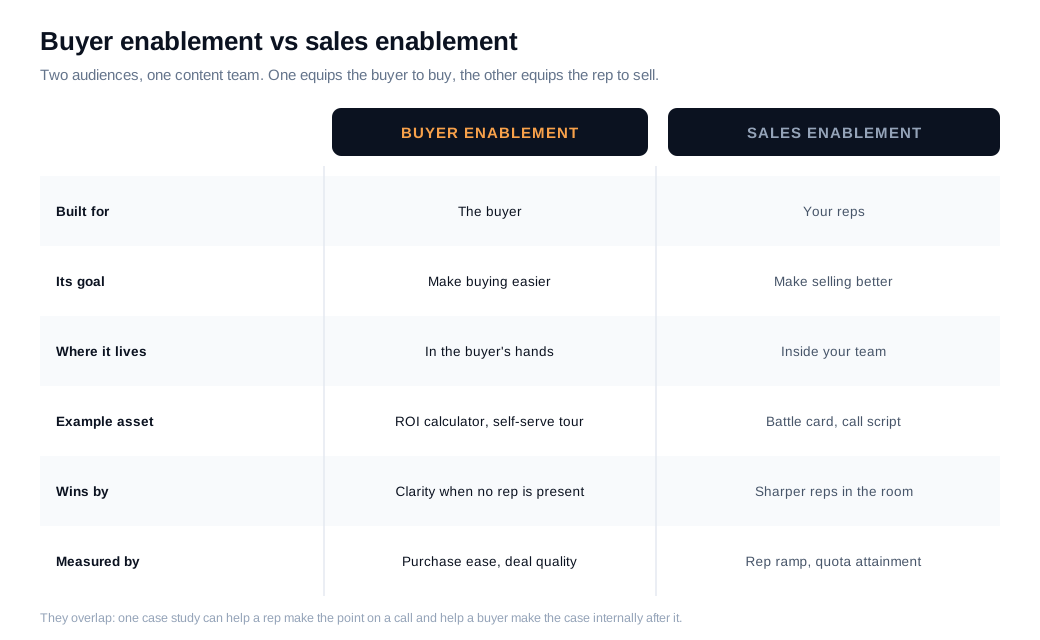
Buyer enablement points outward. Its outputs are things a buyer holds and uses alone: a self-serve product tour, a pricing page that answers real questions, an ROI model the champion can run, a template the champion can forward to a skeptical CFO. The test is simple. If the asset only makes sense with a rep in the room, it is sales enablement. If a buyer can pick it up on their own and get further, it is buyer enablement.
The two overlap more than they compete. A strong case study helps a rep make a point on a call and helps a buyer justify the decision internally after the call ends. The smartest teams build once and design for both audiences, so the same proof travels from a rep's screen share into the buyer's internal deck without a rewrite. Sales enablement makes your people better at selling; buyer enablement makes your absence survivable, which, given that reps touch less than a fifth of the journey, is where plenty of deals are actually won.
What content helps buyers self-educate?
The content that helps buyers self-educate is material mapped to each buying job, pairing prescriptive advice with a practical tool the buyer can use without you. A plain explainer serves problem identification. A comparison guide serves solution exploration. A requirements checklist serves requirements building. Reference stories and a free trial serve validation. A ready-made internal business case serves consensus creation.
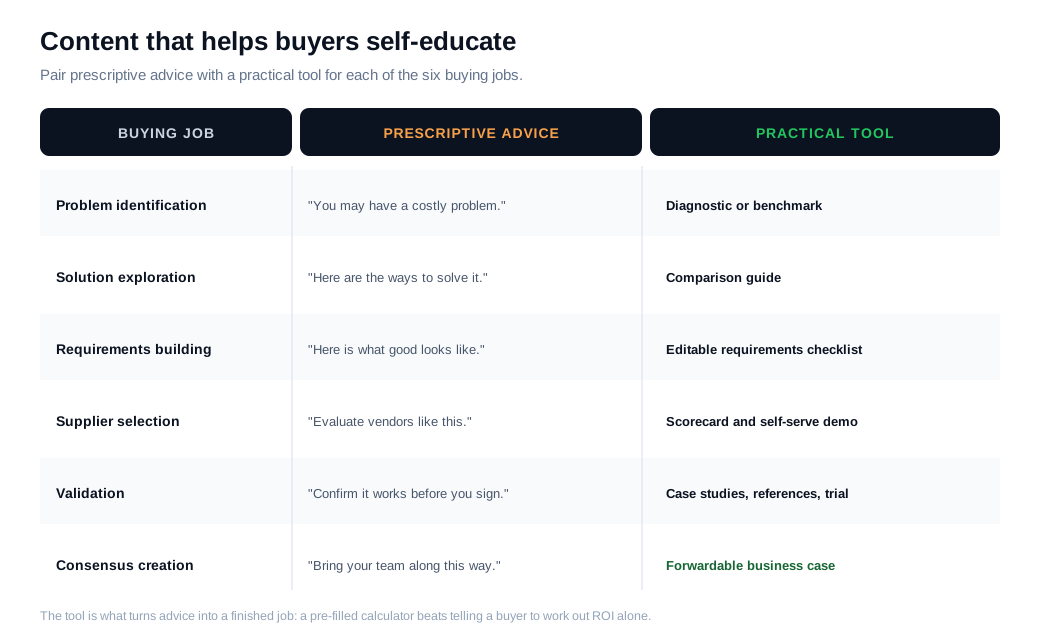
Gartner's two-part model is the useful lens. For each job, pair the "what to do" with the "thing to do it with." Telling a buyer to calculate ROI is advice. Handing them a calculator with your assumptions pre-filled is enablement. Telling a committee to align on requirements is advice. Handing them a checklist they can edit together is enablement. The tool is what turns good intentions into a finished job.
A few formats do the heavy lifting. Interactive product tours and self-serve demos let buyers explore without booking a call. An AI chat assistant can answer the specific, in-the-weeds questions a static page cannot, at the hour the buyer is actually researching. A clear, searchable knowledge base and honest comparison pages give buyers something to cite when they argue your case internally. The common thread is that each asset assumes the buyer is smart, busy, and on their own.
One caution. More content is not the goal, and volume can backfire. Since 44% of buyers already struggle with conflicting information, adding twenty assets that contradict each other makes buying harder. The job is to make the path clearer, and every asset that fails to do that is just clutter in the way.
What does buyer enablement look like in practice?
In practice, buyer enablement looks like auditing where deals stall, then building a specific tool for the exact job that is stuck. A worked example makes it concrete.
Suppose a B2B software vendor sells a $30,000-a-year platform to a buying committee of six, with a sales cycle that averages 90 days. Reviewing lost and slow deals, the team spots two patterns: buyers stall while building requirements, and champions go quiet during consensus creation, when they have to sell the decision to a CFO the rep never meets.
So the team builds three things. First, an editable requirements checklist for the buyer's category, so a committee can align on must-haves in an afternoon instead of three meetings. Second, an ROI calculator pre-filled with realistic assumptions, so the champion can produce a number they can defend. Third, a one-page business case template the champion can forward without rewriting it. They also add a self-serve tour and a live chat path on the pricing page, so a buyer researching at 9 p.m. gets an answer instead of a form.
The results below are illustrative, not a guarantee, though the mechanism is real. Deals that use the ROI calculator carry a stronger internal case, so more of them clear procurement. The requirements checklist compresses the early back-and-forth, trimming the average cycle from 90 days toward roughly 75. And because champions now carry a ready-made case, fewer deals die in the silent stretch between the last demo and the final sign-off. None of this took a bigger sales team. It took removing friction from jobs the buyer was already trying to do, which is the heart of an inbound sales motion.
How do you measure buyer enablement impact?
You measure buyer enablement impact by tracking purchase ease and deal quality, not how many times an asset was opened. Content views tell you something got clicked. They do not tell you a buyer got unstuck, so the metrics that matter tie enablement to the outcomes buyers and finance actually care about.
Start with four. Purchase ease, gathered from a short post-decision survey that asks buyers how easy the process felt, is the leading indicator Gartner ties to bigger, lower-regret deals. Win rate on deals where buyers engaged with enablement content shows whether the tools move outcomes, especially next to deals that skipped them. Sales-cycle length reveals whether the tools remove friction or just add clicks. And deal size plus early churn tells you whether easier buying is producing the higher-quality, lower-regret purchases the research predicts.
Two habits keep the numbers honest. Attach specific assets to specific deals in your CRM, so you can compare opportunities that used the ROI calculator against those that did not, rather than guessing. And watch for loop-backs: if buyers keep reopening the same job, the content for that job is failing, and that is where to fix next. Measured this way, buyer enablement stops being a content-production exercise and becomes a lever you can steer with evidence.
Key takeaways
- Buyer enablement equips the buyer, not the rep. It supplies the information and tools a buying group needs to finish the purchase, framed by Gartner as prescriptive advice plus practical job-completion tools.
- It matters because buyers are mostly on their own. Reps touch only about 17% of the journey, 77% of buyers call the process complex, and easier buying drives measurably bigger, lower-regret deals.
- Every deal runs through six buying jobs. Problem identification, solution exploration, requirements building, supplier selection, validation, and consensus creation, looped through in no fixed order.
- Sales enablement and buyer enablement are complements. One makes reps sharper in the room; the other makes your materials work when no rep is there at all.
- The best content pairs advice with a tool. A calculator, a checklist, or a forwardable business case beats another explainer, and piling on content can backfire when it conflicts.
- Measure ease and deal quality, not views. Tie specific assets to specific deals and track purchase ease, win rate, cycle time, and regret to steer the program.
TAGS

Written by
Daniel SemeckyCo-founder & CEO
Daniel is the co-founder and CEO of Glimpze. He spends his days talking to revenue teams about how to catch high-intent visitors before they bounce, and writes about inbound sales, lead conversion, and building a motion where marketing and sales actually share a number.


