
On this page
A deal marked "commit" for March closes in June. Nobody lost it. The buyer still signs, the logo still lands, and the rep still gets paid. The quarter it was promised to missed by exactly that amount, and the forecast that counted on it looked healthy until the final week.
That gap between when a deal was supposed to close and when it actually does has a name. It is called deal slippage, and it rarely arrives as a dramatic loss, which is why it hides in plain sight. Three committed deals each move out "just one quarter," the cash lands late, and the number you told the board evaporates. This post covers what slippage is, how to measure it, why deals slip, how to catch the ones sliding before the date moves, and how to keep the rest on track.
What is deal slippage?
Deal slippage is when an opportunity forecast to close in one period fails to close on time and rolls into a later period instead. The deal is still alive. It moved. An opportunity committed for Q3 that signs in Q4, or one that slides from March to April, has slipped, and the period it was promised to absorbs the shortfall (Revenue.io).
Slippage delays revenue rather than erasing it, which is what makes it easy to wave off. The business may still book the deal, so the loss looks temporary. The damage is real anyway. Late cash starves the quarter it was planned for, hiring and resource decisions built on that revenue get made on bad information, and committed targets miss even though the work was solid. Slipped deals also refuse to disappear from the pipeline. They keep rolling forward, older and colder each period, until the pipeline is padded with stale opportunities that read as active but may never convert.
The problem has grown. Analysis from the revenue-forecasting platform Kluster found that slippage roughly doubled, climbing from about 12 percent to 22 percent of pipeline, as more stakeholders such as CFOs and procurement officers entered deals in their later stages (Kluster). Every extra approver is another gate a deal has to clear before the date it was assigned, and each gate is a place it can stall.
How do you calculate a deal slippage rate?
You calculate a deal slippage rate by dividing the deals that pushed out of a period by the total committed to close in it, then multiplying by 100. You can run it on deal count or on dollar value, and most teams track both (KPI Examples).
Work an example. A team commits 40 deals to close in Q3. When the quarter ends, 28 have closed and 12 have pushed into Q4. The slippage rate is 12 divided by 40, or 30 percent. Run the same math in dollars: if $2.0 million was committed and $600,000 slid into the next quarter, that is also a 30 percent slippage rate. The count and the dollar figure can diverge when the deals that slip are unusually large or small, which is why watching both catches problems a single number would hide.
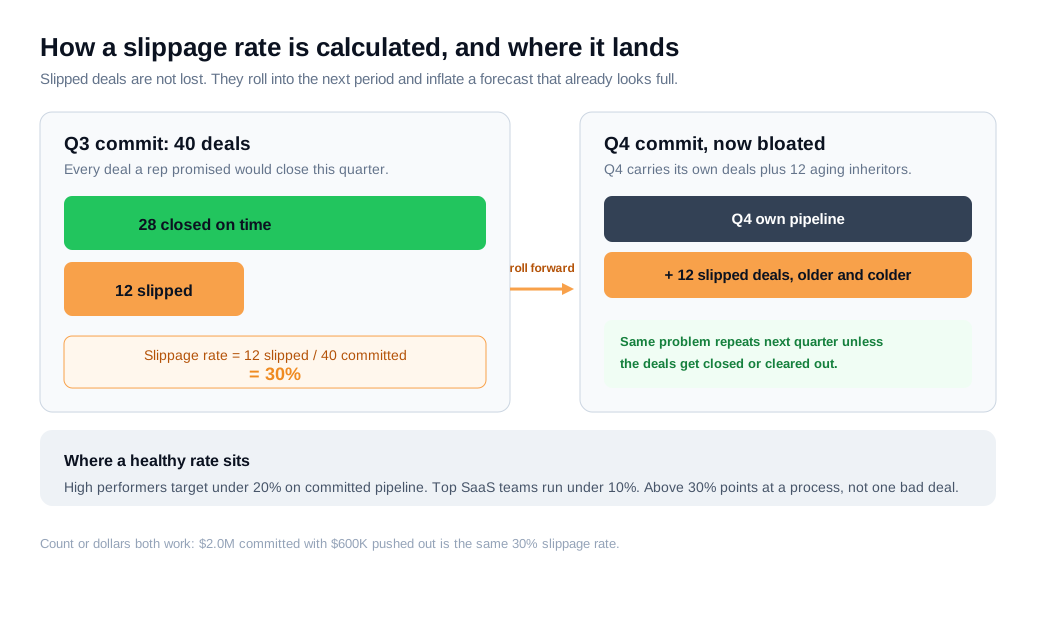
The number only means something against a benchmark. High-performing sales organizations tend to target a slippage rate under 20 percent on committed pipeline, top SaaS teams often run under 10 percent, and the broad industry range sits somewhere around 15 to 25 percent (Census, Monetizely). A rate that sits above 30 percent quarter after quarter is usually a signal about your process, your qualification, or your forecast discipline rather than a run of unlucky deals.
Slippage and forecast accuracy move together. Top-performing SaaS teams keep forecast accuracy at 85 percent or higher, average performers land closer to 70 to 75 percent, and only a minority of organizations forecast within 5 percent of what they actually book (Forecastio). Every slipped deal is a forecast that was wrong about timing, so cutting slippage is one of the most direct ways to make the number you commit worth committing to.
Why do deals slip?
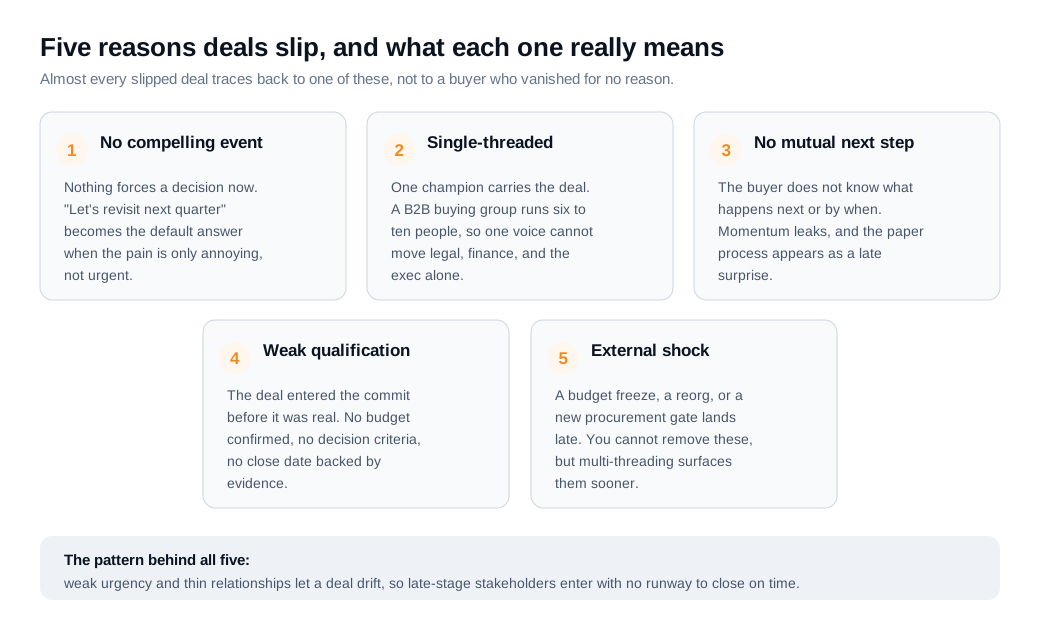
Deals slip for a short list of recurring reasons, and almost none of them are "the buyer went dark for no reason." The five below cover the large majority.
The first is the absence of a compelling event. When nothing forces a decision by a specific date, "let's revisit next quarter" becomes the buyer's default, and next quarter the same thing happens again. Research popularized in Matthew Dixon's book The JOLT Effect found that 40 to 60 percent of the average rep's pipeline is lost to "no decision" rather than to a competitor, and deals attached to a real deadline with real consequences close at roughly 3.4 times the rate of deals without one (Inversion Selling). A deal with no compelling event is a deal built to slip.
The second is single-threading. Gartner research puts a typical B2B buying group at six to ten decision makers, so a deal that lives inside one relationship depends on a single champion to carry legal, finance, and an executive sponsor over the line (Growth Method). When that champion runs out of internal influence, or leaves the company, the deal stalls in place (Ziel Lab).
The third is the missing mutual next step. When a buyer does not know what happens next, what is required of them, or what the timeline looks like, momentum leaks and the paper process (procurement, security review, legal redlines) shows up as a late surprise that pushes the date (Outreach).
The fourth is weak qualification. A deal that entered the commit before budget was confirmed, decision criteria were known, or a close date was backed by evidence was never really a commit-stage deal. It was optimism with a date attached, and optimism slips.
The fifth is the external shock you cannot control: a budget freeze, a reorganization, a new approval gate. You cannot prevent these, but multi-threaded deals surface them weeks earlier, which is often the difference between a managed push and a blind miss.
How do you spot slipping deals early?
You spot slipping deals early by tracking buyer behavior instead of rep optimism, because at-risk deals send warning signs two to four weeks before the close date actually moves (Sybill). The signals are quiet, consistent, and easy to miss if nobody is watching for them.
Watch the response pattern first. A buyer who used to reply within a few hours now takes days, and the replies get shorter and vaguer with each exchange. Watch the room next: fewer stakeholders show up to calls, and the champion who used to drive the thread goes quiet. Watch for objections you thought were handled resurfacing, for late-stage emails that are all scheduling and check-ins rather than substantive next steps, and for a close date that moves once and then moves again (Outreach).
Activity gaps in the CRM are the bluntest signal of all. A committed deal with no logged call, email, or meeting for 14 days is effectively stalled, whatever stage the record still shows, and deal age compounds the risk: opportunities that close within about 50 days win at roughly 47 percent, while those that drag well past that window fall toward 20 percent or lower (Prospeo). Time is not neutral. The longer a deal sits, the less likely it is to close at all.
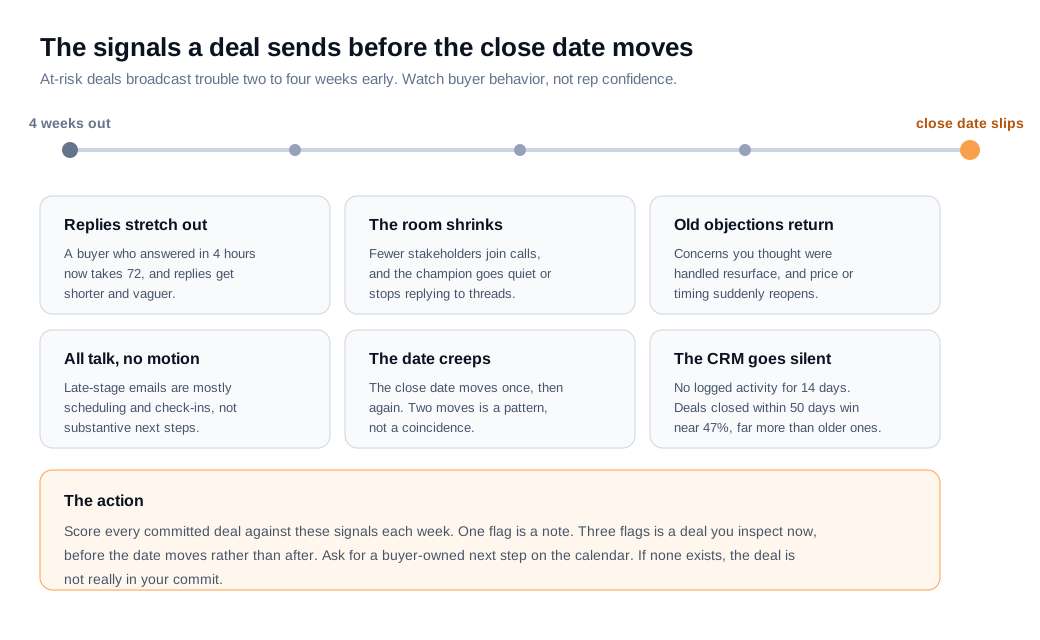
The practical move is to score every committed deal against these signals each week. One flag is a note to keep an eye on. Three flags is a deal you inspect now, while there is still time to intervene, rather than in the quarter-end review when the date has already slipped.
How do you keep deals on track?
You keep deals on track with three disciplines: a mutual action plan the buyer co-owns, multi-threading beyond a single champion, and a forecast that only counts deals backed by evidence. Each one attacks a root cause directly.
A mutual action plan is a shared, dated map from where the deal is now to a signed contract, with each milestone owned by a named person on the buyer's side. It replaces "they seemed positive" with observable actions: the security review is booked for the 12th, legal has the redlines, the business case goes to the CFO on the 20th. The effect is measurable. Outreach found that deals worked with a mutual action plan won at a 26 percent higher rate than those without (Outreach), and separate analysis put deals with a plan at a 60 percent win rate against a 29 percent baseline, with success climbing as more milestones get checked off (GetAccept). A plan the buyer helped build is a plan the buyer feels accountable to.
Multi-threading is the fix for single-threaded risk. Build real relationships with at least three people in the buying group, map the paper process early so procurement and legal are not a fourth-quarter ambush, and make sure at least one of those relationships reaches high enough to unblock a stalled approval. When your champion goes quiet, a multi-threaded deal has somewhere else to go.
Forecast discipline ties it together. Qualification frameworks such as MEDDIC exist to make a deal prove it is real before it enters the commit, and the gaps in the scorecard double as the deal's next steps: no confirmed economic buyer means the next task is to find one (Salesmotion). Require evidence before a deal counts in the forecast, and slippage drops, because the commit stops filling up with deals that were never going to close on time.
Speed at the top of the pipeline quietly protects everything downstream. A deal that starts with a fast, real conversation while buyer intent is still high tends to build a stronger champion and a clearer next step than one that began with a form and a 24-hour wait, and that early momentum is exactly what resists slippage later. Reaching high-intent visitors in the moment through live chat on the page, then routing them straight to an available rep so the inbound sales conversation starts on day zero, gets deals into the pipeline with the urgency and engagement that keep them moving. Faster handoffs early mean fewer stalled commits three months on, and instant routing and notifications keep the first response from becoming the first place a deal slips.
Deal slippage FAQs
What is a good deal slippage rate?
Aim to keep deal slippage under 20 percent of committed pipeline, and treat under 10 percent as a strong benchmark for a disciplined SaaS team. There is no single universal number, because the right target depends on your sales cycle length and deal complexity, but a rate that sits above 30 percent for more than a quarter is a reliable sign of a process problem rather than a run of bad luck. Back into your own target by tracking slippage for a few quarters and setting a ceiling slightly below your recent average.
Is deal slippage the same as a lost deal?
No, slippage and a lost deal are different outcomes. A lost deal is gone, closed lost, and removed from the forecast, while a slipped deal is still live and simply closes later than promised. The distinction changes how you respond. A lost deal feeds your loss analysis, while a slipped deal stays in the pipeline and needs a new, evidence-backed close date, or, if it keeps sliding with no compelling event, an honest decision to close it out rather than let it age.
How often should you review deals for slippage risk?
Review committed deals for slippage risk weekly, alongside the standard pipeline review, rather than saving the check for quarter-end. A weekly scan of the warning signals (response times stretching, close dates creeping, activity going quiet) catches a deal while there is still time to act. By the time slippage shows up in the quarter-end forecast, the date has already moved and your options have narrowed to explaining the miss.
Key takeaways
- Deal slippage delays revenue rather than erasing it, which is why a forecast can look healthy right up to the week a committed deal moves out a quarter.
- A slippage rate is slipped deals divided by committed deals, and high performers keep it under 20 percent, with the best SaaS teams under 10 percent.
- Most slippage traces to five causes, led by no compelling event and single-threading, so the fixes are real urgency and more relationships inside the buying group.
- At-risk deals warn you two to four weeks early, through stretched reply times, a quiet champion, resurfacing objections, and a close date that creeps.
- A buyer-owned mutual action plan is the strongest single fix, lifting win rates by roughly a quarter and replacing rep optimism with dated, observable milestones.
- Speed and engagement at the top of the pipeline compound, because deals that begin with a fast, real conversation build the momentum that resists slippage later.
TAGS

Written by
Daniel SemeckyCo-founder & CEO
Daniel is the co-founder and CEO of Glimpze. He spends his days talking to revenue teams about how to catch high-intent visitors before they bounce, and writes about inbound sales, lead conversion, and building a motion where marketing and sales actually share a number.


