
On this page
A VP of sales opens the quarterly review with one line: the team hit 92 percent of its number. The board relaxes. Two weeks later, three of the eight reps hand in notice, all of them people who finished the quarter well under half of their individual quota.
Both facts came out of the same spreadsheet. Quota attainment is the metric sitting underneath them, and it is the number most likely to be quoted with confidence and understood loosely. This post pins down what it means, how to calculate it for a rep and a team, what a healthy figure actually looks like, and the levers that move it.
What is quota attainment?
Quota attainment is the percentage of an assigned sales target that a rep or team actually reaches in a given period, so it answers one blunt question: of the number you were asked to hit, how much did you hit? If a rep carried a $250,000 quarterly quota and closed $200,000, their quota attainment is 80 percent.
The target can be revenue, bookings, new ARR, units sold, or gross margin, depending on how the comp plan is written, but the shape of the metric stays the same, actual result over assigned goal. Salesforce and DealHub both define it as a core sales KPI, because it folds performance, quota design, and compensation into a single figure a manager can read at a glance.
That figure carries more weight than most numbers on the dashboard. It drives commission and accelerators, it feeds the revenue forecast, and it decides who gets coached and who gets a performance plan. Because attainment depends on both the result a rep produced and the quota someone else set, a low reading can mean the rep underperformed or the quota was wrong from the start, and telling those two apart is most of the work.
How do you calculate quota attainment?
The quota attainment formula is actual sales divided by the quota target, multiplied by 100: (actual sales ÷ quota) × 100 = attainment percent. The result reads as a percentage, where 100 percent means the rep landed exactly on quota and anything above means they beat it.
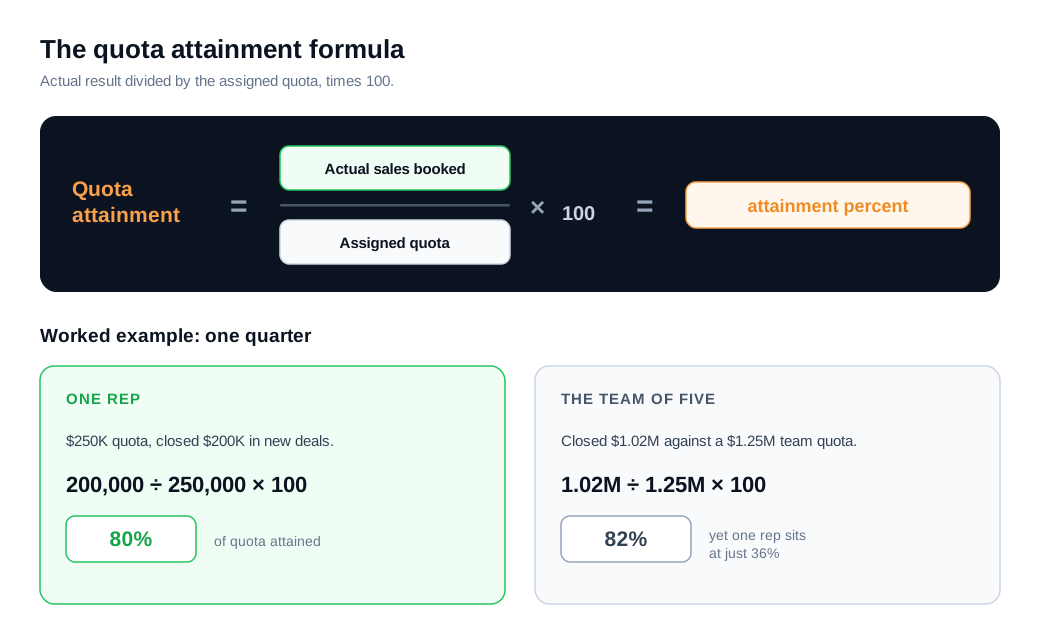
Here is a worked example for a single rep. Say an account executive carried a $250,000 quota for the quarter and closed $200,000 in new business. Divide 200,000 by 250,000 to get 0.80, multiply by 100, and their quota attainment was 80 percent for the quarter.
Team attainment uses the same formula one level up, and the roll-up can hide as much as it shows. Take a five-person team, each rep carrying that same $250,000 quarterly quota, for a $1.25 million team number. Suppose they close $200,000, $300,000, $180,000, $250,000, and $90,000. Add those to $1.02 million, divide by the $1.25 million team quota, and team attainment comes to about 82 percent. Healthy on the surface. Look at the individuals and the range runs from 120 percent down to 36 percent, and the rep at 36 percent is the one most likely to walk. Team attainment tells you whether the group made its number. The distribution underneath tells you whether the group is actually healthy.
One choice decides whether the number means anything, and that is the quota in the denominator. When quotas are set by gut rather than by capacity and territory history, attainment measures the guess as much as the selling, the same way a win rate only means what its denominator lets it mean.
What is a healthy quota attainment rate?
There is no single healthy attainment rate, but most sales orgs design the plan so that roughly 60 to 70 percent of reps reach 100 percent of quota, while average attainment across a full team has historically sat closer to 45 to 55 percent. Both numbers can describe a well-run team, because they answer different questions.
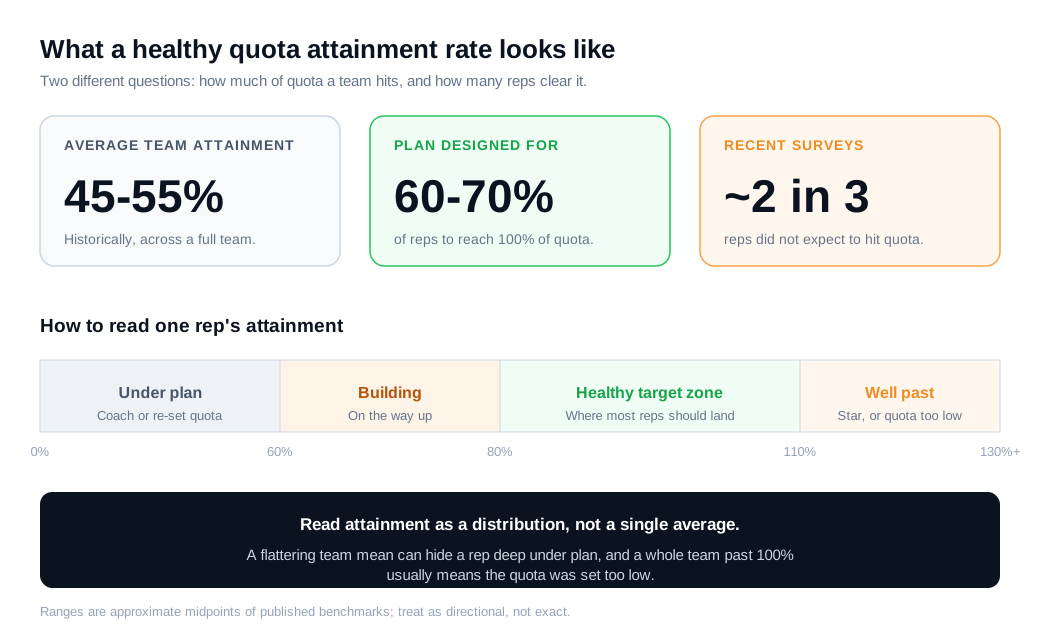
The gap between "designed for" and "actually happening" has widened lately. Salesforce's State of Sales research, summarized by Prospeo, found that a majority of reps did not expect to hit quota in the year surveyed, and an even larger share had missed it the year before. Analysts at QuotaPath put a genuinely good individual attainment in the 60 to 80 percent band over time, and flag consistent triple-digit finishes as a sign the quota may be too low rather than a reason to celebrate.
That last point matters. A rep who clears 130 percent every quarter is either exceptional or under-quota, and a team where everyone beats plan usually means the plan was sandbagged, which quietly caps the revenue you could have booked. Read attainment as a distribution, not a single average. You want most of the team in a realistic band near 100 percent, a top slice pushing well past it, and a short tail below, rather than a flattering mean propped up by a couple of outliers.
What is the difference between quota attainment and win rate?
Quota attainment measures whether you hit your target, while win rate measures how efficiently you convert the deals you work, so one is the outcome and the other is a driver that produces it. You can post a strong win rate and still miss quota when your pipeline was too thin, and you can hit quota on a mediocre win rate when you had enough volume to absorb the losses.
The two sit at different points in the same chain. Win rate is the share of closed opportunities you won. Pipeline coverage is how much qualified pipeline you carry against the target. Attainment is the result those two produce together. Analysts at Varicent describe attainment as the outcome metric and win rate as one of the conversion metrics you read next to it, precisely so a miss can be diagnosed. When attainment comes in low, the coverage and win-rate figures tell you whether the cause was too little pipeline, too weak a conversion, deals that were too small, or a quota that was never reachable in the first place.
Why do so many sales reps miss quota?
Reps miss quota for three reasons far more often than for a lack of effort: the quota was set too high for the territory, the pipeline was never deep enough to support it, or high-intent buyers went cold before anyone reached them. Each one is a systems problem a manager can fix, and none of them shows up if you only stare at the final attainment number.
Start with the denominator again. When quotas are handed down as a top-line revenue goal split evenly across heads, rather than built from each territory's history and capacity, a chunk of the team is underwater on day one. Attainment then measures the planning error as much as the selling.
Pipeline depth is the next culprit, and it is the most measurable of the three. The old rule of thumb was 3x coverage, three dollars of qualified pipeline for every dollar of quota, but that number was calibrated for 1990s enterprise deals and fits few teams today. The cleaner version, laid out by Fullcast and Clari, is that required coverage equals one divided by your win rate. A team that wins 25 percent of its deals needs about 4x coverage; a team at 20 percent needs 5x. Carry less than that and the math caps attainment before the quarter even starts.
The third reason is speed. A large share of inbound pipeline is lost in the first hour rather than in the demo, because nobody answered in time. The classic Harvard Business Review study "The Short Life of Online Sales Leads," summarized by Revenue.io, found that firms contacting a new lead within an hour were nearly seven times more likely to qualify it than firms that waited even an hour longer, and roughly sixty times more likely than firms that waited a full day. High-intent visitors on your site are the easiest deals you will ever add to the pipeline, and a form-and-wait response hands them to whoever replies first. This is where a fast inbound sales motion quietly protects attainment.
How do you improve quota attainment?
You improve quota attainment by working both sides of the fraction: set a quota the territory can carry, then feed it enough qualified pipeline and convert enough of it to clear the number. Because attainment is a ratio, a gap can be closed from either direction, and the fastest fix is usually the one your current metrics are already pointing at.
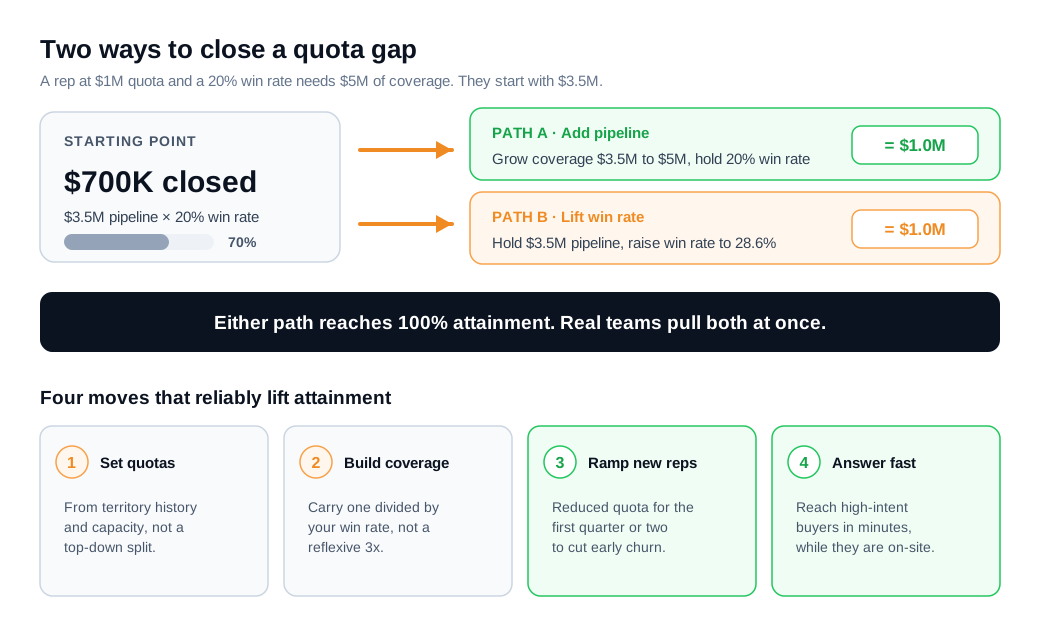
Here is the math behind it. Take a rep with a $1 million annual quota who wins 20 percent of their deals. At that win rate they need five dollars of qualified pipeline for every dollar of quota, so $5 million in coverage to reach the number. Suppose they start the year with $3.5 million. Expected closed revenue is $3.5 million times 20 percent, or $700,000, which lands them at 70 percent attainment before the year even runs. The gap traces to one thing: $1.5 million of missing pipeline.
There are two honest ways to close it. Add the pipeline, taking coverage from $3.5 million to $5 million, and the same 20 percent win rate produces the full $1 million. Or lift the conversion, holding pipeline at $3.5 million and raising the win rate from 20 to about 28.6 percent, which reaches $1 million from what you already have. Real teams pull both levers at once, which is why a modest gain in each can swing attainment by double digits, a pattern that Outdoo and others put at roughly 10 to 15 points of attainment for every five points of win rate.
Four moves reliably move the number:
- Set quotas from history and capacity, not a top-down split. Build each rep's target from their territory's past attainment, ramp stage, and realistic pipeline, then pressure-test it against coverage. A quota nobody can model a path to is a resignation waiting to happen.
- Carry coverage equal to one divided by your win rate. Stop defaulting to 3x. Measure your real win rate by segment and hold enough qualified pipeline behind each quota, refreshing it early in the period while there is still time to build.
- Ramp new reps on a reduced quota. New hires who get seeded pipeline and a stepped-down target for their first quarter or two reach full productivity faster and churn less, which lifts blended attainment more than holding them to full quota on day one.
- Answer high-intent buyers while they are still on the page. Speed-to-lead is the rare lever that adds pipeline and lifts win rate at the same time, and it costs nothing but a faster path from raised hand to live rep.
That last move earns its own paragraph because it is so often left on the table. High-intent visitors reach your site with active intent, and every minute of delay drains it. Routing those visitors to an available rep the moment they act, through lead routing and instant notifications rather than a shared inbox nobody watches, is the difference between a day-zero conversation and a cold callback two days later. Letting them start talking on the page itself through live chat that can escalate to a live video call or screen share keeps the deal warm at the exact moment attainment is cheapest to protect, before a form-fill drops into a three-day email sequence.
Quota attainment FAQs
What is a good quota attainment for a new rep?
A ramping rep should be measured against a reduced quota, not the full number, for their first one or two quarters, so 100 percent of a stepped-down target is the fair bar rather than a small fraction of a fully loaded one. Time to first full quota varies by role, from a few months for an SDR to the better part of a year for an enterprise AE, and holding new hires to a veteran's quota on day one mostly manufactures early attrition.
Should you measure quota attainment monthly or quarterly?
Measure attainment on the same cadence you pay and forecast on, which for most teams means quarterly with a monthly pacing view to catch problems early. A single large deal slipping from March into April can wreck a monthly reading without saying anything real about the trend, so the quarter is usually the more honest unit, while monthly pacing tells you whether a rep is on track to get there.
Is 100 percent quota attainment the goal for everyone?
Full attainment at 100 percent is a goal for the plan as a whole, while individual reps are expected to spread around it, since a well-designed quota is set so that a healthy majority clears it, some exceed it, and a few fall short. If every rep lands on exactly 100 percent, the quota is almost certainly too easy, and the revenue your best performers could have added is being left uncounted.
Key takeaways
- Quota attainment is actual result divided by quota, times 100, so it measures how much of an assigned target a rep or team reached and folds performance, quota design, and pay into one figure.
- The quota in the denominator decides what the number means, because a target set by gut rather than by territory history and capacity turns attainment into a measure of the planning error as much as the selling.
- Read attainment as a distribution, not an average, since a team can post a healthy 82 percent while one rep sits at 36 percent, and the tail is where the risk and the turnover live.
- Most plans are designed for 60 to 70 percent of reps to clear quota, while actual average attainment has run closer to half, and consistent triple-digit finishes usually signal a quota set too low.
- Pipeline coverage should equal one divided by your win rate, not a reflexive 3x, and carrying less than that caps attainment before the period begins.
- Speed-to-lead protects attainment for free, because reaching high-intent buyers in minutes rather than hours adds pipeline and lifts win rate at the same time.
TAGS

Written by
Daniel SemeckyCo-founder & CEO
Daniel is the co-founder and CEO of Glimpze. He spends his days talking to revenue teams about how to catch high-intent visitors before they bounce, and writes about inbound sales, lead conversion, and building a motion where marketing and sales actually share a number.


