
On this page
A rep closes a $90,000 deal and earns the same commission rate the plan pays on a $9,000 renewal. Down the hall, another rep quietly pushes two deals into next quarter, because the plan zeroes out their commission rate every January and starting fresh in a lower tier is not worth it in December. Neither rep is doing anything wrong. They are reading the plan and following the money.
That is the core fact of sales pay: reps do what the plan rewards, whether or not it matches what the company needs. By one Harvard Business School estimate, U.S. businesses spend more than $800 billion a year on their sales forces, with roughly $200 billion of that going to compensation, yet fewer than one in ten companies believe their plan reliably drives the selling behavior they want. Designing that plan well is one of the highest-impact jobs in revenue operations.
This post covers what sales compensation planning is, what a plan includes, the common plan structures and when to use each, how to align a plan to company goals with a worked example, and the pitfalls that quietly damage both morale and revenue.
What is sales compensation planning?
Sales compensation planning is the process of designing, launching, and adjusting how a company pays its sales team so that pay pushes reps toward the outcomes the business wants. It runs as a cycle, not a one-time task. You set the pay structure, define quotas and the metrics that trigger payouts, model the cost, communicate the plan to the field, then monitor results and tune the plan as territories, products, and targets change through the year.
Compensation is usually the single largest line in a go-to-market budget, so small design choices scale into large costs and large behavioral effects. A commission rate set half a point too high across fifty reps is real money. A quota set without looking at territory potential can flatten the morale of an entire region.
Planning is cross-functional by nature. Finance cares about cost and margin, sales leadership cares about motivation and fairness, and revenue operations owns the CRM, quota, and performance data the plan runs on. That is why comp planning increasingly sits inside RevOps, the team already holding the numbers every payout depends on.
What does a sales compensation plan include?
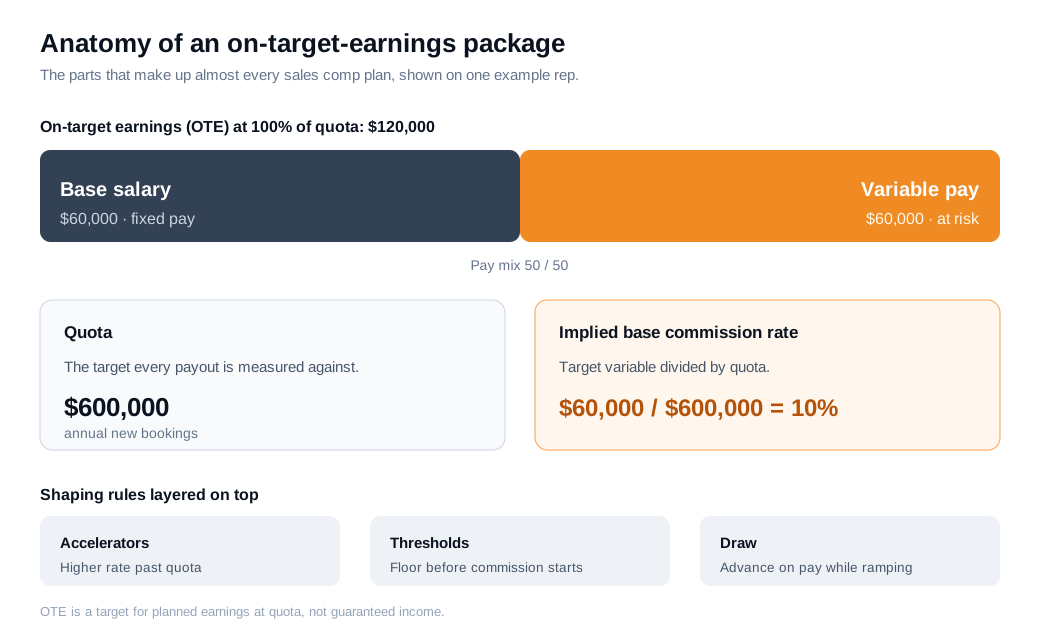
A sales compensation plan is built from a handful of standard parts: base salary, variable pay, on-target earnings, pay mix, a quota, and the rules that connect performance to payout. Learn these five terms and most plans become easy to read.
- Base salary is the fixed pay a rep earns regardless of results. It buys stability and covers the non-selling work like CRM hygiene, forecasting, and training.
- Variable pay is the at-risk portion tied to performance, usually commission (a percentage of what a rep sells) or a bonus (a set sum for hitting a defined target).
- On-target earnings, or OTE, is the total a rep earns at 100% of quota, base plus variable combined. As Everstage explains, OTE is a target for planned earnings, not a guaranteed paycheck.
- Pay mix is the split between base and variable inside OTE, written base/variable. Xactly defines a 60/40 mix as 60% fixed base and 40% target variable.
- Quota is the sales target a rep is measured against, the denominator for everything the plan pays.
On top of those sit the shaping rules: accelerators that raise the rate past quota, thresholds that must be cleared before commission starts, and a draw that advances pay to new reps while they ramp.
Here is a quick worked example. An account executive with a $120,000 OTE on a 50/50 pay mix earns $60,000 in base salary and can earn another $60,000 in variable pay at full quota. If that variable is tied to a $600,000 annual bookings quota, the plan implies a base commission rate of 10% ($60,000 divided by $600,000).
Pay mix usually tracks how much control a role has over the sale. Xactly notes that closing roles such as account executives often sit near 50/50, while roles with a longer or less direct line to revenue, like sales engineers, managers, and customer success, lean toward 60/40 or 70/30, with more base and less at risk.
What are the common sales compensation plan structures?
The common structures are salary only, commission only, base plus commission, base plus bonus, and tiered plans with accelerators, and each one steers reps toward a different behavior. Choosing among them is really a choice about what you want the team to optimize.
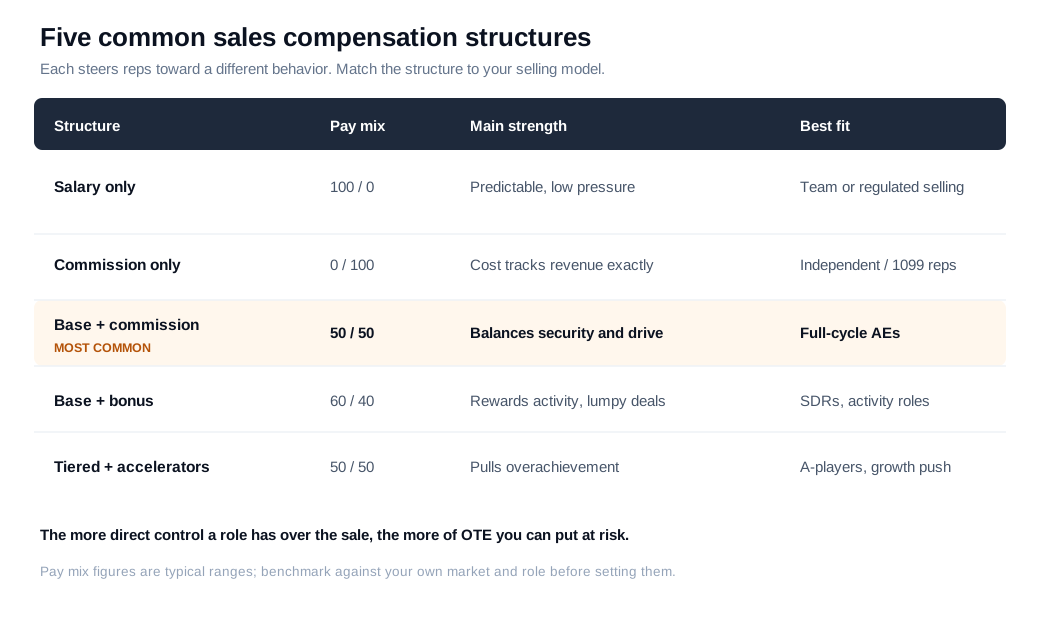
Salary only pays a flat wage with no variable component. It is predictable and low-pressure, which suits team-based selling, heavily regulated products, or roles where collaboration matters more than individual heroics. The trade-off is weak pull to chase the next deal.
Commission only pays entirely on results with no base. The upside is high and the cost tracks revenue almost perfectly, but it punishes ramp time and pipeline building, and it screens out many strong candidates who cannot gamble on an empty first month. It shows up most in independent or 1099 roles.
Base plus commission is the default for most B2B closing roles. A stable base covers the basics and a commission on closed business supplies the drive. It balances security and motivation, which is why it fits full-cycle account executives so well.
Base plus bonus pays a base plus a fixed sum for hitting milestones or management-by-objective targets. It works when deals are lumpy or hard to attribute to one rep, or when the behavior you want is activity rather than raw revenue, which is why sales development reps are often paid a bonus on meetings booked.
Tiered plans with accelerators raise the commission rate once a rep clears quota. They reward overachievement and keep A-players pushing late in the year. Research summarized by CaptivateIQ, drawing on academic work from Harvard, Darden, and Yale, found that overachievement pay drove more than 13% higher revenue and about 2% higher profit than flat-rate plans.
How do you align a sales compensation plan to company goals?
You align a comp plan to company goals by translating this year's strategy into the one or two metrics the plan pays on, then setting the quota, rate, and accelerators so that hitting the goal is the most profitable thing a rep can do. Reps optimize for whatever the plan measures, so the metric choice is the alignment.
Start with the strategy and pick the metric. If the goal is new-logo growth, pay on new bookings. If it is retention and expansion, pay on renewals or net revenue retention. If margin is under pressure, fold a discounting guardrail into the payout. Keep it to one or two metrics, because a plan that pays on five things pays attention to none.
Set the quota from data, not from the top down. Use historical attainment, territory potential, and current pipeline to size each quota. Quotas dropped in from a board number, with no territory analysis underneath, tend to overpay weak territories and underpay strong ones, the reverse of what you want.
Then set the pay mix and commission rate to match the role's control over the outcome, and add an accelerator to pull the top end.
Here is a full worked example. Take that account executive again: $120,000 OTE, 50/50 mix, so $60,000 base and $60,000 target variable, against a $600,000 bookings quota. The base commission rate is 10%. Now add an accelerator that pays 15% on every dollar above 100% of quota.
- A rep who lands exactly at quota sells $600,000, earns $60,000 in variable, and takes home $120,000, the OTE by design.
- A rep at 120% sells $720,000. The first $600,000 pays 10% ($60,000), and the next $120,000 pays the accelerated 15% ($18,000). Variable pay is $78,000 and total comp is $138,000.
- A rep at 70% sells $420,000 and earns $42,000 in variable, for $102,000 total.
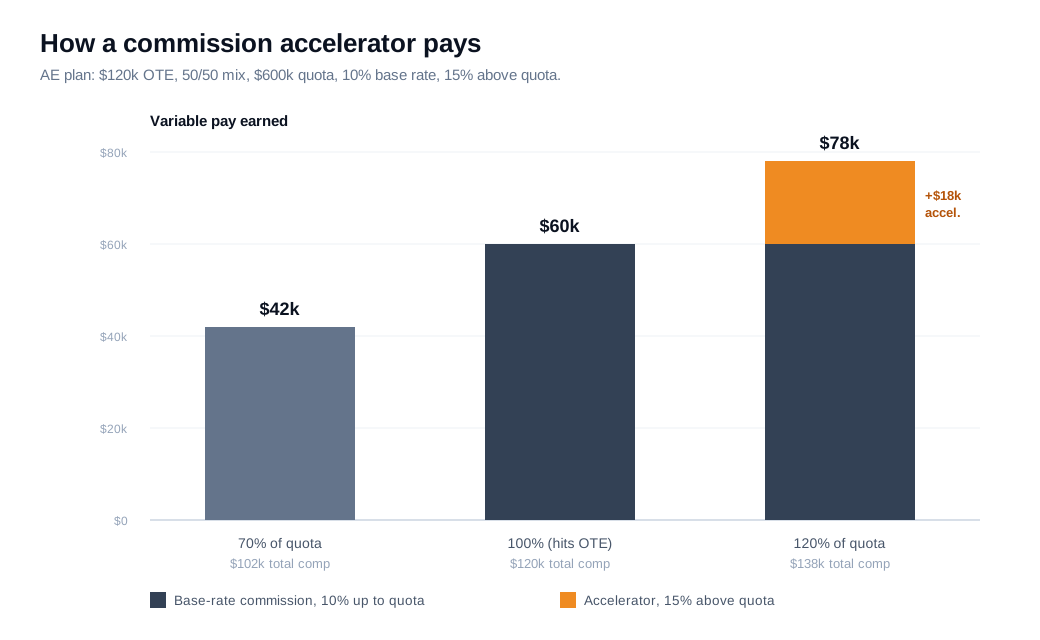
The accelerator is the point. That extra $120,000 of revenue cost the company $18,000 in commission, a marginal rate finance can model and fund in advance, and the rep clears their OTE by $18,000 for beating the number. Both sides gain from the same behavior.
Alignment also means paying for the operational behaviors that create revenue, not only the closed deal at the end. If speed on inbound demand is a company priority, the plan can reward fast follow-up as part of an inbound sales motion. That incentive only pays off if the operational side keeps up, so pair it with lead routing and notifications that put a hot lead in front of the right rep in seconds. Compensation can reward the rep who beats a slow handoff, but it cannot fix the handoff itself.
How do you avoid common sales compensation plan pitfalls?
Avoid the usual pitfalls by keeping the plan simple, grounding quotas in territory data, capping the right things instead of the wrong ones, and reviewing the plan on a schedule rather than leaving it frozen for years. Most comp failures trace back to one of these four habits.
Over-complexity is the quiet killer. Layering four metrics, several modifiers, and a decelerator produces a plan no rep can calculate. Xactly's guidance is blunt on this: the simpler the plan, the easier it is to communicate and the more it motivates, because reps can see a clear path to their earnings. If a rep cannot estimate their own commission on the back of a napkin, the plan has stopped steering behavior.
Capping commission is the fastest way to lose a top performer. A hard ceiling tells your best rep to stop selling the moment they reach it, and to park the rest of their pipeline for next year. When windfall deals genuinely worry finance, use a per-deal review or a windfall clause on unusually large orders and leave the standard curve uncapped.
Quotas divorced from reality break trust before the year even starts. In recent Salesforce State of Sales reporting, fewer than a third of reps hit their annual quota, and quota-setting that ignores territory potential is a big reason why. A quota nobody in a territory can realistically reach pushes good reps to update their resumes instead of their pipelines.
Rewarding the wrong behavior is subtler. Forrester's review of comp design lists paying only on closed revenue, while ignoring pipeline, retention, and discipline on discounting, as a core pitfall, because it invites reps to slash price and walk away from accounts that later churn. Match the metric to the behavior you actually want repeated.
Finally, plans go stale. A comp plan built for last year's strategy keeps paying for behavior the business has moved past, yet changing the plan every quarter destroys the stability reps need to trust it. Review at least once a year, model the cost of any change before rollout, and communicate it to the field early so nobody is surprised by their first paycheck under the new rules. A structured guide like Salesforce's overview of sales compensation plans is a useful checklist when you sit down to revise.
Key takeaways
- Reps do what the plan pays them to do. Sales compensation planning is the discipline of making that rewarded behavior line up with company strategy, which is why fewer than one in ten firms feel their plan drives the selling they want.
- Know the building blocks. Base salary, variable pay, OTE, pay mix, and quota are the levers, and moving any one of them changes how reps behave.
- Match the structure to the motion. Salary only, commission only, base plus commission, base plus bonus, and accelerator plans each reward a different thing, so pick the one that fits your selling model.
- Align on one or two metrics. Pay on the outcome the strategy needs, set quota from territory data, and use accelerators to reward overachievement, which research links to double-digit revenue gains.
- Keep it simple and reward the top. A plan a rep cannot calculate stops motivating, and a commission cap tells your best seller to stop early.
- Review on a cadence. Model the cost, communicate changes ahead of time, and revisit the plan at least yearly so it never pays for last year's goals.

Written by
Daniel SemeckyCo-founder & CEO
Daniel is the co-founder and CEO of Glimpze. He spends his days talking to revenue teams about how to catch high-intent visitors before they bounce, and writes about inbound sales, lead conversion, and building a motion where marketing and sales actually share a number.


