On this page
A four-person sales team splits its market alphabetically. The rep who lands accounts A through F picks up three of the region's five biggest buyers and more pipeline than one person can work. The rep assigned S through Z runs dry by spring and spends the rest of the year dialing companies that were never going to buy. Same headcount, same product, same comp plan, and a three-to-one gap in results.
That gap is a territory design problem, and it is far more common than most sales leaders assume. Harvard Business Review research from Andris Zoltners and colleagues found that 55% of sales territories are the wrong size at any given moment, too big to cover or too small to hit quota. Fixing the split, with no new reps and no new budget, is one of the quieter levers that moves revenue.
This post covers what territory management is, the main types of territories, why the design matters, how to build fair territories, how they shape quota and coverage, and how to keep them balanced as the market shifts.
What is territory management in sales?
Territory management in sales is the practice of dividing a market into defined segments and giving clear ownership of each one to a rep or team, then keeping those segments covered, balanced, and fairly matched to the people who work them. A territory can be a geography, an industry, a band of company sizes, or a named list of accounts. Management is the ongoing part: assigning new leads, settling ownership disputes, and adjusting boundaries as the data changes.
The word management does a lot of work in that definition. monday.com describes territory management as the continuous handling of lead assignment, ownership questions, and boundary changes based on real performance, rather than a slide you build once a year and forget. A territory plan is a snapshot. Territory management is the operating discipline that keeps the snapshot honest as reps ramp, accounts move, and demand shifts between segments.
The goal is simple to state and hard to hold: every account that matters has exactly one owner, no rep is buried or starved, and the people closest to a buyer are the ones responsible for winning them. Get that right and the pipeline becomes more predictable, because coverage is even and no one is quietly sitting on more opportunity than they can touch.
What are the types of sales territories?
Sales territories are usually built on one of four dimensions: geography, industry vertical, account size, or named accounts, and plenty of teams stack two of them together. The right choice depends on how buyers cluster and where your reps create the most value.
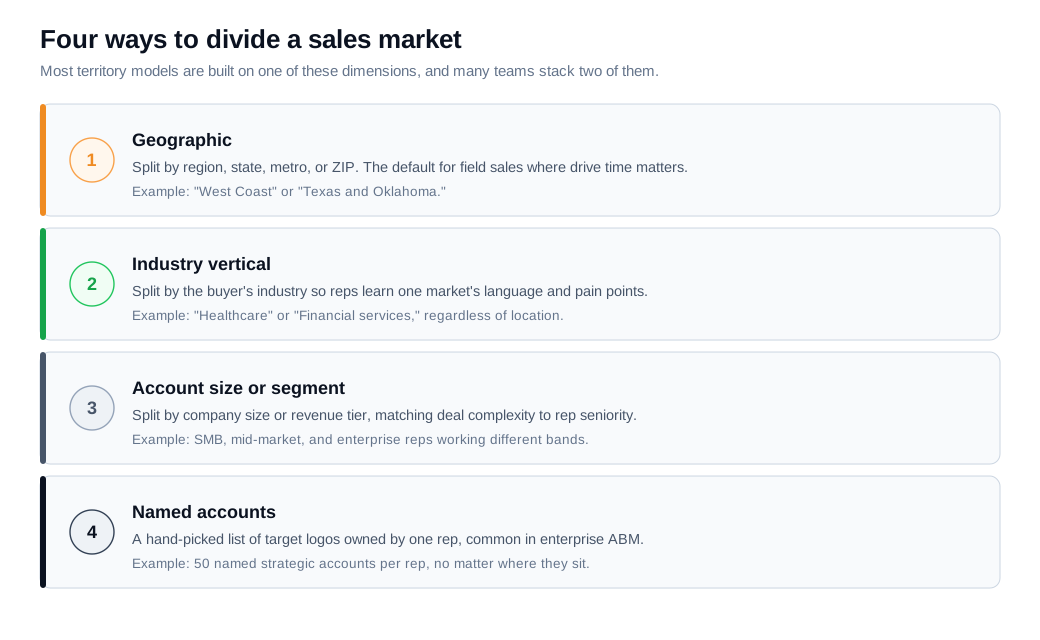
Geographic territories split the market by region, state, metro, or ZIP code, and they remain the default for any team that sells in person. When drive time is a real cost, a rep who owns a compact, dense area spends more hours in front of buyers and fewer on the highway, so density and travel logic help decide where the lines fall.
Industry vertical territories split by the buyer's industry, so one rep owns healthcare and another owns financial services regardless of geography. The rep learns a single market's language, budget cycles, and regulatory pain points instead of switching context between a hospital and a hedge fund, which shortens ramp and sharpens the pitch.
Account size territories split by company size or revenue tier and match deal complexity to rep experience. SMB reps work high volumes of fast, transactional deals while enterprise reps carry a handful of long, consultative ones, and paying both on the same plan without acknowledging that difference is a common way to lose good people.
Named account territories hand each rep a curated list of target logos, a model common in enterprise and account-based selling. The rep owns those specific companies wherever they sit and whatever they do, which concentrates effort on the accounts most worth winning and works well when a few strategic buyers drive most of the revenue.
Most modern go-to-market models blend these. The GTM Advisor's comparison notes that many teams layer a segment cut on top of geography, so you might have an enterprise rep for the Northeast and an SMB rep for the same map. The layering is where routing rules get complicated, which is one reason management matters as much as the original design.
Why does territory management matter?
Territory management matters because the same reps selling the same product produce very different numbers depending on how the market is split. The design decides who gets a fair shot at quota, which accounts get worked and which get ignored, and how much of your total addressable market actually gets covered.
The revenue at stake is larger than it looks. Harvard Business Review reports that optimizing sales territory design can raise revenue by 2% to 7% with no change to headcount, strategy, or budget. The mechanism is straightforward: rebalancing for potential stops reps from spending expensive hours on low-yield ground and redirects that time to accounts that can close. Xactly's planning guide cites Alexander Group work putting the productivity gain from well-structured territories at 10% to 20%.
Run the HBR number on the team from the intro. If those four reps sit on a $24 million market, a 2% to 7% lift from a cleaner split is worth $480,000 to $1.68 million a year, found without a single new hire or campaign. That is the math that makes territory design one of the highest-return projects a revenue operations team can run.
There is a fairness cost too. When one rep sits on triple another's potential, the comp plan turns into a lottery, strong performers in weak patches leave, and quota attainment splits into a bimodal mess where a few reps blow past goal while many miss badly. Alexander Group analysis of quota distributions describes exactly that pattern and argues healthy teams should get at least 60% of reps to goal. Balanced territories are what make that possible.
How do you design fair territories?
You design fair territories by balancing three things across every rep: workload, opportunity, and geographic or logistical feasibility, using real data instead of gut feel. Xactly frames those as the three dimensions to equalize: the number of accounts and activity a patch demands, the revenue it can produce, and how reachable it is.
The build runs in a few steps:
- Pick the unit. Decide the smallest block you assign, usually an account, a ZIP code, or a customer segment, so territories are made of countable pieces.
- Score each unit. Pull weighted potential, historical win rate, average deal size, and current pipeline from the CRM, so every block carries a number.
- Set balance targets. Decide the fair range for accounts and potential per rep, factoring ramp time for new hires who cannot carry a full load yet.
- Assign to the targets. Group blocks into territories that land inside the range on all three dimensions, not one alone.
- Check the balance. Confirm no rep is carrying double another's potential before you publish.
Here is the worked version. Take a mid-market software team with four AEs and 1,200 target accounts carrying $24 million in weighted potential. Split the accounts alphabetically and the potential lands lopsided, because the biggest buyers cluster: one rep holds $9 million, the next $7 million, then $5 million, then $3 million. The $9 million rep physically cannot touch every account, so real opportunity goes uncovered, while the $3 million rep exhausts the list by the second quarter.
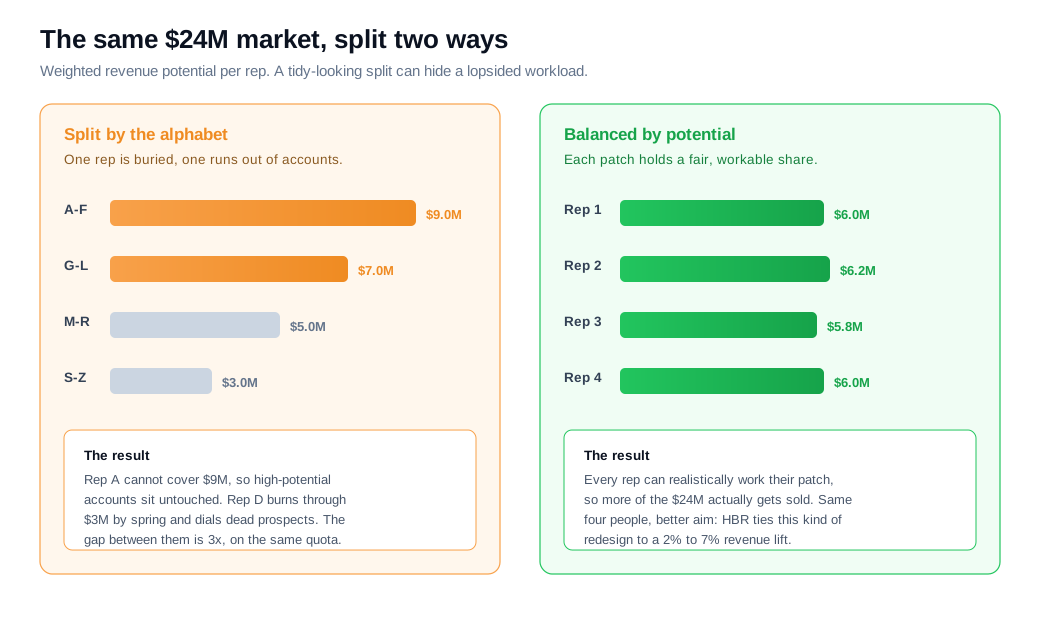
Rebuild it around potential and workload and each rep carries close to $6 million in reachable opportunity and a similar account count. Now every dollar of that $24 million has an owner who can actually work it, which is the exact condition HBR's 2% to 7% lift comes from. The redesign added no reps and no leads. It just pointed the four you have at the right accounts.
Assignment is where management meets tooling. Once the map is set, new inbound leads have to reach the territory owner automatically, or the balance you designed erodes within a month. Reliable routing and notifications send each lead to the rep who owns that account or segment the moment it arrives, which keeps the design intact and the response fast. Speed matters most for the high-intent buyer already on your site, where letting them start a conversation through live chat with the right owner beats a form and a next-day callback.
How does territory management affect quota and coverage?
Territory management sets the ceiling on both quota and coverage: quota should track each territory's real potential, and coverage means every account worth pursuing has one clear owner with no gaps and no overlaps. Get the territories wrong and both numbers inherit the mistake.
On quota, the fair method reconciles two views. Sales planning guides describe a top-down number, the company revenue goal divided across the team to stay aligned to the plan, and a bottom-up number, what each territory's accounts, white space, and pipeline suggest it can actually produce. When the two agree, the quota is credible. When they diverge, fix the territory before you question the salesperson.
A quick example shows why potential has to drive the split. Say the company goal is $10 million across those same four reps. Divide it top-down and everyone carries $2.5 million. But if the four territories hold $6 million, $3 million, $2 million, and $1 million in potential, the last rep is being asked for 250% of what the patch can yield while the first is handed a target below coasting speed. Allocate the $10 million in proportion to potential instead, roughly $5 million, $2.5 million, $1.7 million, and $0.8 million, and each quota becomes a stretch rather than a fantasy or a gift.
On coverage, the two failure modes are gaps and overlaps. A gap is white space, an account or region no one owns, so inbound interest lands in a queue and dies. An overlap is two reps chasing the same logo, which wastes effort and confuses the buyer. Xactly notes that the core aim of territory management is exactly this, good coverage with no neglected or double-covered ground. Clean territories are why a lead is only worth generating if it reaches an owner expected to work it, which is the whole point of a disciplined inbound sales motion.
How do you balance territories over time?
You balance territories over time by monitoring coverage and attainment continuously, making small adjustments each quarter, and saving big structural redesigns for the annual planning cycle. Markets move, reps ramp and leave, and a plan that was balanced in January drifts by summer, so management has to run on a cadence.
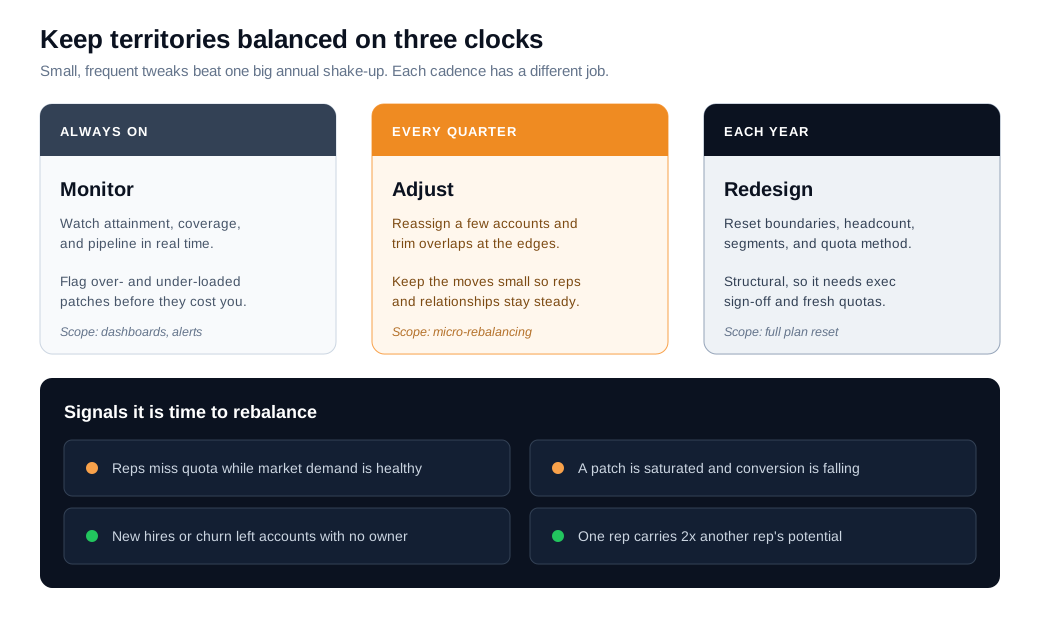
Continuous monitoring is the always-on layer. Dashboards for attainment, coverage, and pipeline flag an over- or under-loaded patch early, while the fix is still a nudge. Quarterly reviews are where you act on those flags with small moves, reassigning a handful of accounts or trimming an overlap, because research on review cadence finds small frequent adjustments are far less disruptive than large infrequent ones. The annual redesign is the structural reset, when boundaries, headcount, segments, and quota methodology all get revisited with executive sign-off.
Watch for the signals that a patch has drifted. Reps missing quota while overall demand stays healthy usually points to uneven distribution rather than weak selling. A saturated territory, where a rep has worked every viable account and conversion is sliding, needs fresh ground. New hires and churn leave accounts with no owner. And any time one rep's potential runs to double another's, the split is overdue for a rebalance. Catching these in a quarterly review instead of at the next painful annual overhaul is the same continuous-ownership habit that defines good revenue operations.
Key takeaways
- Territory management is ongoing, not annual. It is the continuous work of dividing the market, assigning ownership, and keeping every patch covered and fair.
- Four models cover most teams. Geography, industry vertical, account size, and named accounts, often layered, each fit a different way buyers cluster.
- The design moves real money. HBR ties an optimized split to a 2% to 7% revenue lift with no new headcount, and Alexander Group work puts the productivity gain at 10% to 20%.
- Fair territories balance three things. Workload, opportunity, and feasibility should be roughly even across reps, verified with CRM data rather than gut feel.
- Quota and coverage inherit the design. Set quota to each territory's potential, and make sure every worthwhile account has exactly one owner with no gaps or overlaps.
- Rebalance on a cadence. Monitor continuously, make small quarterly adjustments, and reserve structural redesigns for annual planning.

Written by
Daniel SemeckyCo-founder & CEO
Daniel is the co-founder and CEO of Glimpze. He spends his days talking to revenue teams about how to catch high-intent visitors before they bounce, and writes about inbound sales, lead conversion, and building a motion where marketing and sales actually share a number.