
On this page
- What is the Rule of 40?
- How do you calculate the Rule of 40?
- Which profitability metric should you use, EBITDA or free cash flow?
- Why do investors care about the Rule of 40?
- What counts as a good Rule of 40 score, and how many companies actually hit it?
- How do you balance growth and profitability?
- What are the limitations of the Rule of 40?
- Key takeaways
- Sources
A SaaS founder can post 80% revenue growth and still make an investor nervous. Another can grow 15% a year and command a premium valuation. The Rule of 40 is the shorthand that explains the gap.
It squeezes two numbers that usually pull against each other, growth and profitability, into a single score. When they add up to 40 or more, the business looks healthy. When they fall short, the trade between growth and burn is out of line.
This guide covers what the Rule of 40 is, how to calculate it, which profit figure to plug in, why investors lean on it, what a good score looks like today, how to balance the two levers, and where the rule stops being useful.
What is the Rule of 40?
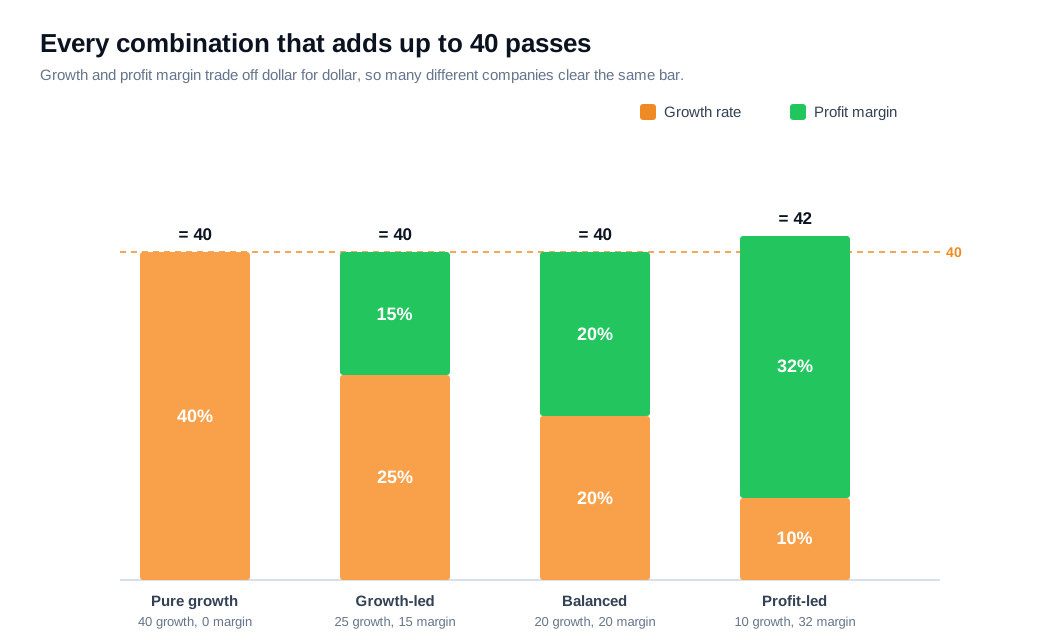
The Rule of 40 is a benchmark that says a healthy SaaS company's revenue growth rate plus its profit margin should equal at least 40%. Growth of 30% paired with a 10% margin gets you there. So does 10% growth paired with a 30% margin.
The rule reached a wide audience in early 2015, when venture capitalist Brad Feld wrote a blog post titled "The 40% rule for a healthy SaaS company." Feld did not invent it. He credited a late-stage investor who used it to size up a healthcare software company, and the original framing applied to businesses with at least $50 million in revenue. The appeal was simple: boards and investors could skip a stack of financial statements and read one number.
The two inputs get equal weight, which is the whole point. A dollar of margin is treated as worth the same as a dollar of growth, so a company can lean hard on either lever as long as the sum clears the bar.
Why 40 and not 30 or 50? The threshold was calibrated for growth-stage software companies with real revenue behind them, where the market had shown that this mix of expansion and efficiency tended to separate durable businesses from cash-hungry ones. It reads as a round rule of thumb rather than a law, which is why plenty of strong companies sit in the mid-30s and plenty of weak ones briefly spike above 40.
How do you calculate the Rule of 40?
You calculate the Rule of 40 by adding your revenue growth rate to your profit margin for the same period, both expressed as percentages. Growth for a subscription business usually means the year-over-year change in Annual Recurring Revenue (ARR) or Monthly Recurring Revenue (MRR). Profit usually means an operating margin such as EBITDA margin.
Work through a concrete case. Say a company grew ARR from $8 million to $10 million over the year, a 25% increase. In that same year it produced $1.8 million of EBITDA on $10 million of revenue, an 18% margin. Add the two figures, 25 plus 18, and the score is 43. The business clears the Rule of 40.

Two habits keep the math honest. Measure both inputs over the same window so you are not blending last year's growth with this quarter's margin. And use the same revenue base for both, whether that is total revenue or subscription revenue, so the two percentages describe the same company.
Which profitability metric should you use, EBITDA or free cash flow?
There is no single agreed profit figure, so the two most common choices are EBITDA margin and free cash flow (FCF) margin. EBITDA margin is popular because it strips out interest, taxes, depreciation, and amortization, which makes it easier to compare businesses with different capital structures. Many growth investors prefer FCF margin instead, since it captures the cash the business actually generates after capital spending.
Each figure has a soft spot. EBITDA can be flattered when a company capitalizes development costs aggressively, which pushes expenses into depreciation that EBITDA adds back. FCF margin can be inflated with heavy stock-based compensation or by pushing out capital expenditures. Some analysts sidestep both and use operating income.
Here is how much the choice can move the score. Suppose that same $10 million company reports $1.8 million of EBITDA, an 18% margin, but only $700,000 of free cash flow after it capitalizes engineering costs and buys new servers. On EBITDA it scores 25 plus 18, or 43, and passes. On free cash flow it scores 25 plus 7, or 32, and misses. Same company, same year, two different verdicts.
The number you pick matters less than using it consistently. Reporting a 43 on EBITDA one quarter and a 43 on free cash flow the next tells an investor very little, because you have changed the ruler. Choose one definition, state it plainly, and hold it steady across periods and against the peers you compare yourself to.
Why do investors care about the Rule of 40?
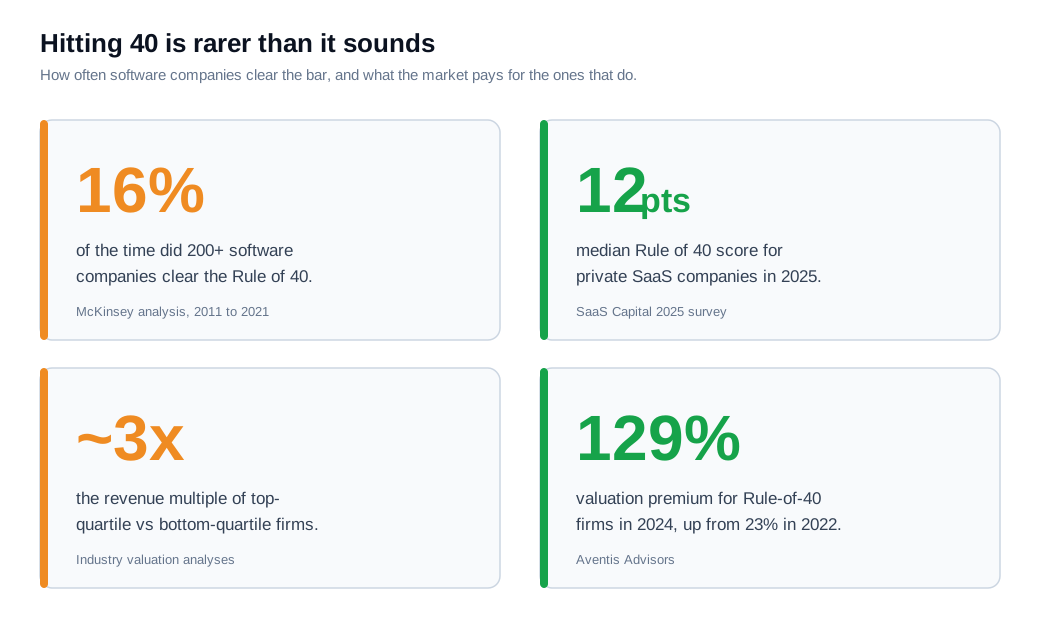
Investors care because the Rule of 40 tracks valuation: companies at or above 40 consistently earn higher revenue multiples than companies below it. McKinsey, which analyzed more than 200 software companies, found that the market rewards firms clearing the rule with meaningfully higher enterprise-value-to-revenue multiples. In several valuation studies, top-quartile performers trade at close to three times the multiple of bottom-quartile firms.
The reward has grown sharper. According to research summarized by Aventis Advisors, the valuation premium attached to Rule-of-40 companies jumped from about 23% in 2022 to roughly 129% in 2024, as public markets shifted their attention from growth at any cost toward efficient growth. The logic behind the premium is that a company clearing the bar is largely funding its own growth, so it leans less on raising fresh capital in markets that may not cooperate.
The rule works as a screen. It answers one question fast: is this company converting its growth into a durable business, or buying revenue it cannot sustain? A company growing 60% while burning 40 points of margin scores 20 and fails, which flags the burn even though the top line looks exciting.
What counts as a good Rule of 40 score, and how many companies actually hit it?
A score of 40 or higher is the target, the low-to-mid 30s is respectable for many companies, and clearing 40 consistently is much rarer than founders assume. The bar sounds reachable until you look at how often real companies clear it.
McKinsey's study of 200-plus software firms found they exceeded Rule of 40 performance only about 16% of the time across 2011 to 2021. Sustained excellence was rarer still: only 1.6% of those companies kept revenue growth of 30% or more going for the full decade. Hitting 40 in a single good year is one thing. Holding it is the hard part.
Private companies sit lower than the headline number suggests. The SaaS Capital 2025 survey put the median private SaaS Rule of 40 score at 12, built from roughly 10% median growth and a 6% EBITDA margin. Scores have slipped over the past two years as growth rates cooled. Public medians have also come under pressure recently as heavy AI infrastructure spending compresses margins, so a company that scored 45 in 2024 might print a lower number in 2026 even while growing faster.
How do you balance growth and profitability?
You balance them by treating 40 as a budget where every point of margin you give up has to buy at least a point of growth, and every point of growth you sacrifice has to return as margin. If you grow 40%, you can run at breakeven and still pass. If growth is flat, you need a 40% margin. At 20% growth you need a 20% margin.
Stage decides which lever to pull. Early companies, often those under $5 million in ARR, are expected to prioritize growth and run at a loss while they chase product-market fit and land share. A company growing 30% with a negative 10% margin scores 20, below the line, and that can still be reasonable if the trajectory is right. As a business matures and growth naturally slows, profitability has to carry more of the load. A 15% grower with a 25% margin lands at 40 and reads as a stable, self-funding business.
The growth side of the equation is not only a product-and-market question. Faster growth often comes from converting more of the demand you already pay to attract, which is where speed of response matters. Answering high-intent visitors in the moment with live chat instead of a form-and-wait flow, and building an inbound sales motion around fast follow-up, can lift the growth input without adding the sales headcount that would drag the margin input down. Efficiency on the revenue side is what lets both numbers rise together.
Protecting the margin input follows the same logic. Retaining an existing customer costs far less than winning a new one, so lifting net revenue retention lets recurring revenue compound without a matching jump in sales and marketing spend. Expansion inside the accounts you already have supports both halves of the score at once, which is why retention tends to be the quiet engine behind companies that hold a high number for years.
What are the limitations of the Rule of 40?
The Rule of 40 is a heuristic, so it hides as much as it shows and should never be your only metric. Its equal weighting is the most common complaint, because for a company near breakeven a point of growth and a point of margin are arguably worth different amounts. That criticism produced the "Rule of X," an alternative that weights growth more heavily than profit.
The definitional wobble is a second issue. Two analysts can score the same company differently depending on whether they use total or subscription revenue, ARR or MRR, and EBITDA, FCF, or operating income for the profit term. That variance makes cross-company comparisons shakier than a single tidy number implies, and stock-based compensation can quietly prop up the margin side.
Finally, the rule says nothing about scale or durability. A 40 built on 40% growth and a 0% margin is a very different business from a 40 built on flat growth and a 40% margin, even though the score is identical. It also ignores net revenue retention, unit economics, and how much capital the company burned to get there. Use it as a quick read, then look under the hood with retention, cash efficiency, and gross margin before you draw conclusions.
Key takeaways
- The Rule of 40 is one number: add your revenue growth rate to your profit margin, and a healthy SaaS business should reach at least 40%.
- The two inputs trade dollar for dollar: 40% growth with a 0% margin and 10% growth with a 30% margin both clear the bar, so stage and strategy decide which lever you lean on.
- Pick one profit definition and hold it: EBITDA margin and free cash flow margin are both common, but switching between them across periods makes the score meaningless.
- Investors use it as a valuation screen: companies at or above 40 earn higher revenue multiples, and that premium has widened sharply in recent years.
- Clearing 40 is rarer than it looks: software firms exceeded the rule only about 16% of the time in one McKinsey study, and the private SaaS median sits near 12.
- Treat it as a starting point: the rule ignores scale, retention, and capital efficiency, so pair it with unit economics before you judge a business.
TAGS

Written by
Daniel SemeckyCo-founder & CEO
Daniel is the co-founder and CEO of Glimpze. He spends his days talking to revenue teams about how to catch high-intent visitors before they bounce, and writes about inbound sales, lead conversion, and building a motion where marketing and sales actually share a number.


